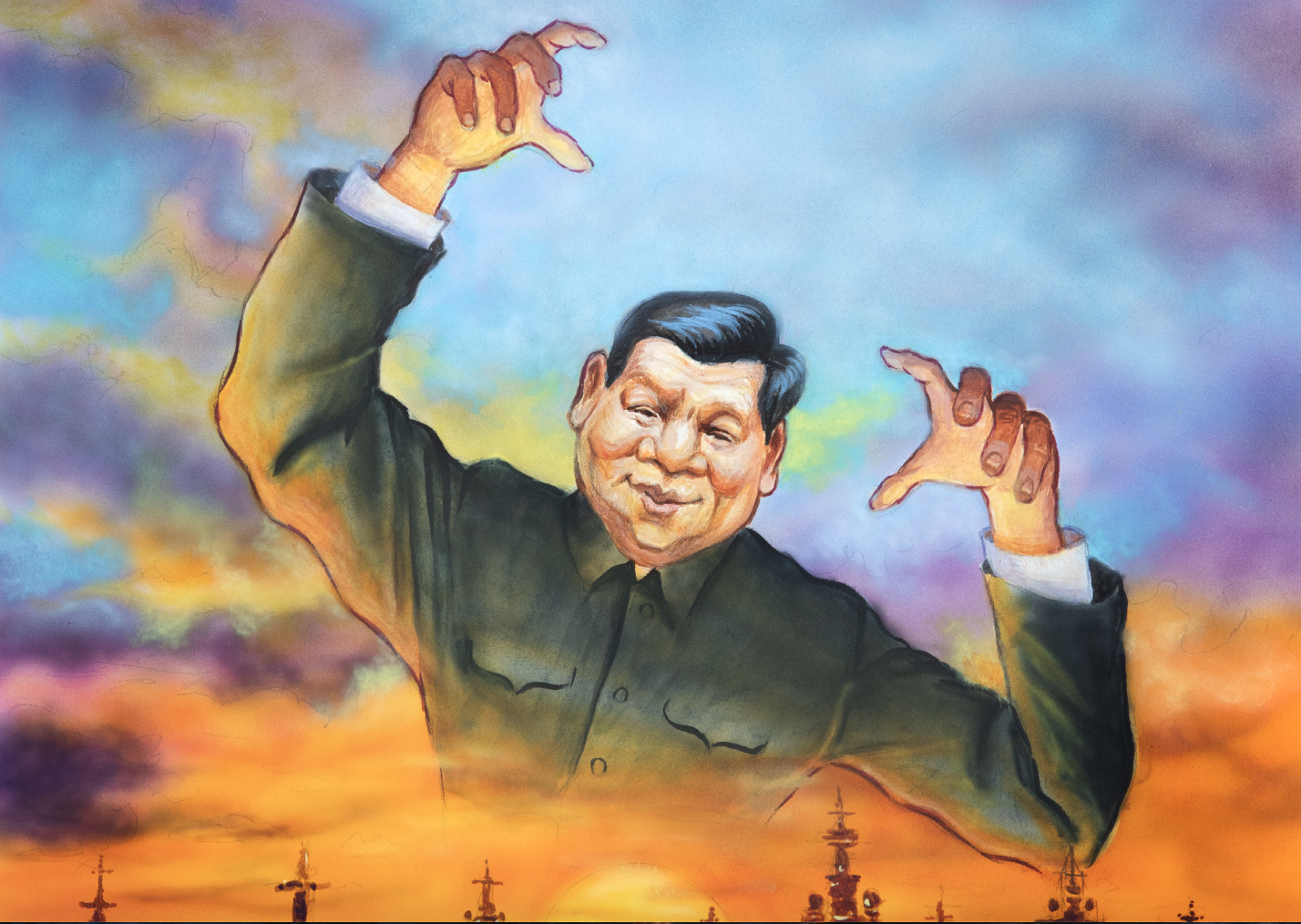
During the Cold War against the Soviet Union, some of the most perceptive strategic thinkers wrote books about that conflict with titles like The Struggle for the World, This War Called Peace, and The Real War. Those titles reflected the geopolitical realities of the second half of the twentieth century. The Cold War had both geopolitical and ideological aspects because our principal enemy — the Soviet Union — was both a great power and was led by a totalitarian Marxist–Leninist Communist Party. President John F. Kennedy once called the U.S.–Soviet rivalry the “long twilight struggle.” It is a phrase that accurately describes the current U.S.–China rivalry, too.
Read more With Republicans Like These, Who Needs Democrats?
This article is from The American Spectator’s summer 2026 print magazine. Subscribe to The American Spectator to receive the magazine.
At the beginning of the Cold War, the director of the State Department’s Policy Planning Staff, George F. Kennan, explained in his famous “X” article in Foreign Affairs that Soviet foreign and defense policies derived from Marxist–Leninist ideology and Russian history. Kennan also noted that Soviet policy was conditioned by geographical circumstances — ones that the great British geopolitical thinker Sir Halford Mackinder analyzed in his 1904 paper “The Geographical Pivot of History.” Russia, Mackinder wrote, like the Mongol Empire of the thirteenth and fourteenth centuries, was geographically situated in the “heartland” of Eurasia, enabling expansion into Western Europe, the Middle East, and East Asia. And Mackinder believed that a great power or alliance of powers that controlled the resources of Eurasia could forge a world empire.
Mackinder remarkably foresaw in an essay in Foreign Affairs in 1943 the creation of an alliance of sea powers and coastal Eurasian powers that could counterbalance the threat from Soviet Russia. The Cold War played out as Mackinder thought it would in that 1943 essay, titled “The Round World and the Winning of the Peace.” He predicted that the rise of what he called the “Monsoon countries” of China and India, combined with North Atlantic sea powers, would produce a balanced globe.
Subscribe to The American Spectator to receive our summer 2026 print magazine.
Interestingly, Mackinder in his 1904 paper suggested that China, too, was geographically situated on Eurasia to bid for global hegemony if it could politically consolidate the most populous country in the world. Indeed, unlike Russia, China had a long, warm-water coastal area that provided it with greater access to the sea than Russia if the Chinese invested sufficiently in naval power and weren’t blocked by opponents on nearby island chains in the Western Pacific Ocean in a maritime region that Nicholas Spykman later called the “Asiatic Mediterranean.”
Like the Soviet Union in the twentieth century, China’s foreign policy today reflects Marxist–Leninist–Maoist ideology, Chinese history, and China’s geographical circumstances.
Chinese Communist Party (CCP) leaders are committed Marxist–Leninist–Maoists. The French writer Charles Baudelaire once noted that “The Devil’s cleverest wile is to make men believe that he does not exist.” Beginning in the 1980s and continuing to the present, the CCP’s “cleverest wile” was and is to make Americans believe that the leaders of the CCP are no longer communists. That “wile” helped the CCP grow its economy and its military power — with U.S. and Western financial assistance. Many U.S. businessmen and political leaders were persuaded by this wile that CCP leaders were really capitalists who just wanted to make money and make their country wealthy. Retired Navy Captain James Fanell and Bradley Thayer examine the success of this CCP wile in their book Embracing Communist China: America’s Greatest Strategic Failure (2024).
The CCP effectively conducted a massive disinformation campaign that was reminiscent in some respects of the Soviet disinformation operation in the early-to-mid 1920s known as the “Trust.” The Trust involved Bolshevik operatives who persuaded U.S. and Western intelligence services that communism in Russia was over; that the Bolsheviks had abandoned their revolutionary ideology and political program to spread communism throughout the world. As Edward Jay Epstein noted in his book Deception, the Bolshevik disinformation campaign “was carefully calculated to dupe the West into believing the Communist revolution was moribund — and therefore no threat.” Western nations extended trade credits, technology transfers, and subsequently diplomatic recognition to “what they assumed would quickly evolve into a non-Communist Soviet Union.”
In his book Red-Handed: How American Elites Get Rich Helping China Win, Peter Schweizer attributed the success of the CCP’s wile to Western economic greed, corruption, and political naivete. Whatever the cause or causes, it is clear that the CCP-led China convinced most of the world — but not their own people — that while they sometimes paid lip service to communism, they were really Asian capitalists. Former national security official Matt Pottinger told Congress in 2023 that “the success the CCP has enjoyed presenting itself as constructive, cooperative, responsible, normal, is one of the great magic tricks of the modern era.”
With the ascension of Xi Jinping to power in 2012, however, the mask of capitalism came off, revealing to anyone who cared to look that the CCP remained a totalitarian communist regime. All one had to do was to read Xi’s speeches and observe his accumulation of power that rivaled that of Mao Zedong. In a speech to the CCP’s Central Committee in 2013, Xi stated his belief that “capitalism will inevitably perish and socialism will inevitably triumph.” In 2018, Xi told his audience that “Marx was the greatest thinker in human history” and that the CCP “must struggle for communism our entire lives.” Xi has explained that China’s ideology and social system “are fundamentally incompatible with the West” and that China’s struggle with the West is “irreconcilable so it will inevitably be strong, complicated and sometimes even very sharp.” Xi has also promised that China will “never allow any foreign force to bully, oppress or subjugate us” and “anyone who attempts to do so will bash their heads bloody on a great wall of steel forged with the flesh and blood of over 1.4 billion Chinese people.”
Read more Like It Or Not, Data Centers Are Part of the Midterms Now
The CCP’s commitment to Leninism and Maoism has created what Norwegian political scientist Stein Ringen calls “the perfect dictatorship.” China’s regime is “single-mindedly committed to its own preservation.” The CCP is omnipresent and hosts “an ideology that is ultra-dangerous.” It is a massive surveillance state led by a regime that will do whatever it takes to maintain and expand its power, including committing genocide, as has been documented in Xinjiang province.
Chinese history and tradition reinforce the CCP’s ideology that China will triumph in its struggle with the West. China’s rulers historically have viewed it as the center of the world destined to bring “All Under Heaven (tianxia) under its sway.” As Olivia Cheung has pointed out, “Tianxia is a hierarchical world order, where China, the top ‘civilizational power,’ is above other countries.” Xi Jinping’s version of tianxia is “unrivaled Chinese power,” similar to China during the Ming Dynasty (1368–1644), where its rulers viewed their country as the center of the world, with all other states being peripheral powers that must pay tribute to the Middle Kingdom. During that time period, China also ventured out into the world’s oceans and built a navy led by Admiral Zheng He that dominated the South China Sea and the Indian Ocean.
When the CCP achieved victory in China’s civil war in October 1949, Mao Zedong added another historical narrative: The CCP’s victory, he said, was the end of a “century of humiliation” when China was economically and politically exploited by the world’s other great powers. As Mark Metcalf has noted, the century of humiliation is used by the CCP as a motive for China “to reclaim its past glory and its rightful place in the world.” It is part of the justification for Xi Jinping’s program for the “great rejuvenation of the Chinese people.”
An essential part of Xi’s program is to build a “world-class military,” which China is in the process of doing. The Department of War’s 2025 “Annual Report to Congress: Military and Security Developments Involving the People’s Republic of China” notes that the People’s Liberation Army “has continued its massive nuclear expansion,” with a stockpile of over 600 nuclear warheads that will likely reach more than a thousand warheads by 2030. China’s immediate goal, according to the report, is “to use nuclear deterrence to more broadly deter and limit adversary military involvement in a conventional conflict,” such as war in the South China Sea over Taiwan.
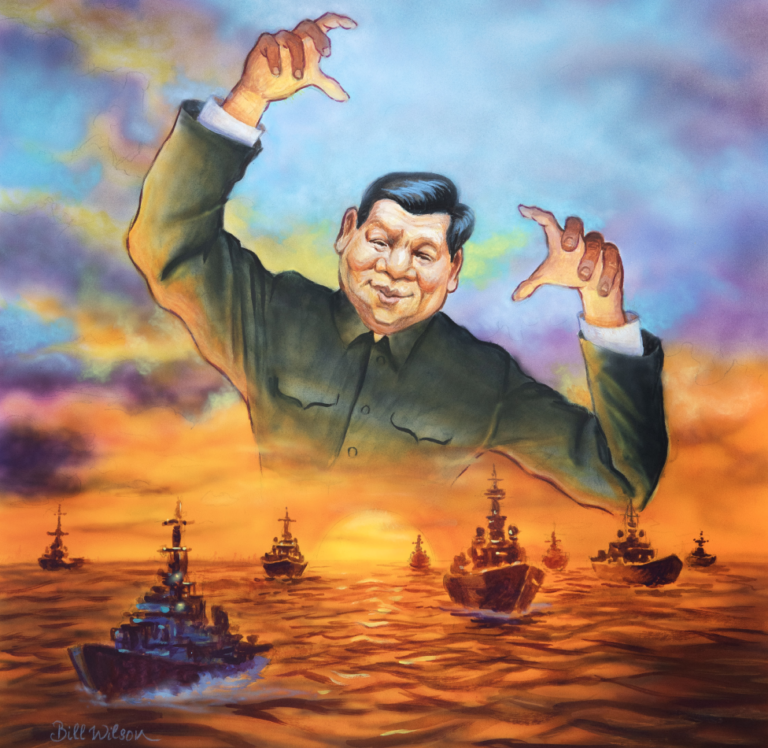
Art by Bill Wilson for The American Spectator
China’s navy is the world’s largest, and while experts say the United States still has a qualitative advantage in sea power, that advantage is eroding. China’s shipbuilding capacity is more than 200 times that of the United States, which does not bode well for the United States in a future Western Pacific war. Importantly, in nuclear weapons and naval warships, the trends are moving in China’s direction. One naval expert worries that China is aiming at a “globe-spanning” navy “that can threaten the U.S. Navy’s command of the world ocean.” A recent biography of Admiral Liu Huaqing, who was most responsible for the rise of China’s navy, calls him “China’s Mahan,” after Alfred Thayer Mahan, who was the foremost exponent of American sea power in the late nineteenth to early twentieth centuries. Xi Jinping said Admiral Liu’s work and vision “would inspire the whole [Communist] party, whole country, and all the Chinese people … to realize the great goals of … the great rejuvenation of the Chinese nation.”
China’s ideology and global ambitions mean that the United States is once again in a “long twilight struggle” that is similar to, but even more dangerous than, the Cold War with the Soviet Union. George Kennan, in his “long telegram” from Moscow in February 1946, described the Soviet Union’s leadership as “a political force committed fanatically to the belief that with the U.S. there can be no permanent modus vivendi.” The same is true of the CCP today. China, unlike the USSR during the Cold War, presents a multidimensional challenge across all domains of power. China’s economy and political structure are less vulnerable to U.S. pressure than were the economy and political structure of the Soviet Union. And, importantly, there appears to be no Chinese Gorbachev on the CCP’s political horizon.
That doesn’t mean that this geopolitical rivalry will end in war. Chinese strategic thought reaches back to Sun Tzu, who in the fifth century B.C. counseled: “To subdue the enemy without fighting is the acme of skill.” The United States, meanwhile, won the first long twilight struggle against the Soviet Union by combining George Kennan’s preferred “patient, firm and vigilant” containment with the political, economic, and subversive warfare of the Reagan administration.
In 1919, the tired and war-weary Western democracies failed to strangle Bolshevism in its cradle, as Winston Churchill and Halford Mackinder urged them to do. The democracies provided insufficient support to the “White” forces in Russia’s civil war, and the Bolsheviks emerged victorious. The long twilight struggle against the Soviet Union lasted until 1991. In 1945–46, the tired and war-weary Western democracies failed to sufficiently support the Nationalist forces in China, as General Douglas MacArthur, William Bullitt, and others urged them to do so. With Soviet support, the CCP emerged victorious in China’s civil war three years later, setting the stage for another “long twilight struggle,” the outcome of which will likely determine the political structure of the world order for the rest of the twenty-first century.
Read more The Spectacle Ep. 461: Post-COVID Malone: Robert and Jill Malone Find Health in Homesteading
Subscribe to The American Spectator to receive our summer 2026 print magazine.
About the Author