They’re big. Like really big.
So big, in fact, that as you drive by them on the highway, your brain plays tricks on you. You know this because the nearby trees look like wooden toy trees from a child’s train set.
Read more The Spectacle Ep. 461: Post-COVID Malone: Robert and Jill Malone Find Health in Homesteading
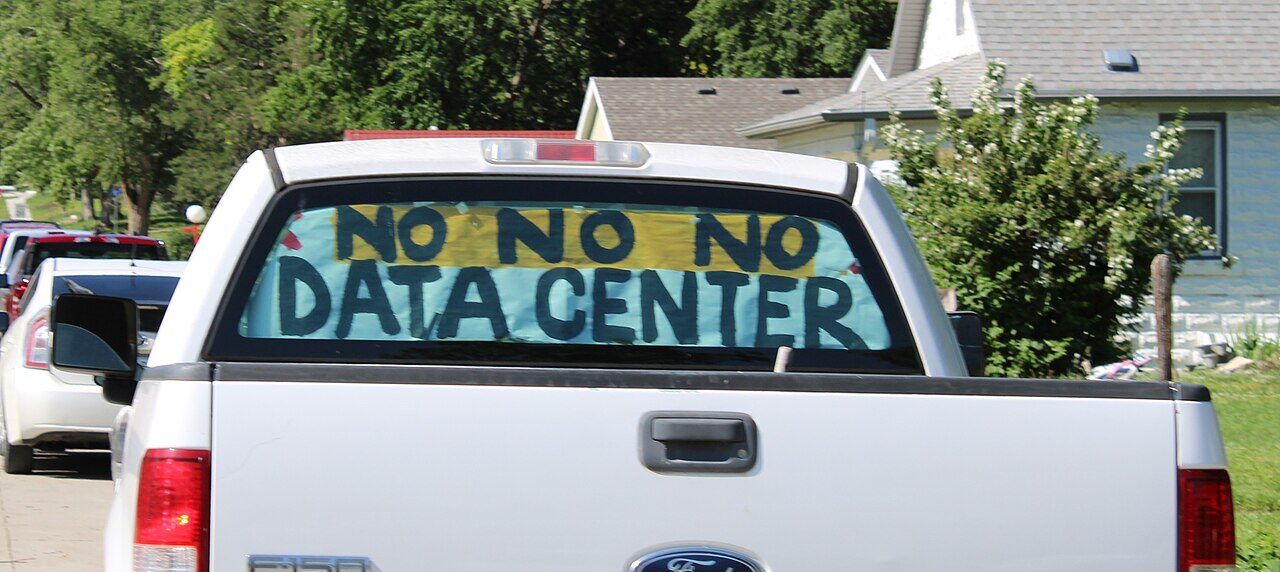
Colossal buildings assigned colossal tasks necessarily take up colossal resources and put a colossal strain on local communities — or so the logic goes among residents who are worried about practical things like the cost of electricity and water wherever data centers are being built. You can argue until you’re blue in the face about whether data centers are really all that bad, but the fact is, they’re wildly unpopular. (RELATED: Why Aren’t Our Modern-Day Robber Barons Giving Us Robber-Baron Benefits?)
Gallup polling from a few months ago found that seven in 10 Americans are either strongly opposed or somewhat opposed to data centers being built in their local area. For comparison, just 53 percent of Americans said the same about nuclear power plants when asked in the same poll. (RELATED: The Backyard Problem of Data Centers)
It’s not split down party lines either. The 56 percent of Democrats who are strongly opposed to data centers in their communities are joined by 39 percent of Republicans and 48 percent of independents. As a general rule, the Midwest and South are slightly more anti-data-center than everyone else.
What, you ask, is the problem with data centers? Well, the responses vary. Some opponents are concerned about noise and pollution. Others are worried that the potential demand on the electric grid could drive up electricity costs while the massive amount of water needed to cool down computers could deplete an area’s water resources. To be sure, there are responses to most of these concerns, but what matters here isn’t the content of the debate, but its context. (RELATED: Electricity Affordability — Trump’s Achilles’ Heel?)
Data centers, it turns out, seem to be turning into a crucial issue for November
Take the Senate race in Ohio, which is going to be an important piece of the puzzle if Republicans are going to maintain their control of the Senate. The race is between former Sen. Sherrod Brown and incumbent Sen. Jon Husted (who replaced J.D. Vance after he became vice president). A rather substantial portion of Brown’s campaign focuses on pinning 226 of Ohio’s data centers on Husted.
“If he loses and data centers get the blame, politicians across the country will take notice — and they will not go near the next one”
One political ad called Husted “the face of data centers in Ohio,” while another featured Brown claiming that Husted was responsible for “$2.5 billion in out of control tax breaks to big out-of-state corporations.” That’s a line of attack he’s also used in stump speeches.
To be sure, the attack is a bit unfair. In recent years, Husted has walked back some of his support. Recently, he proposed legislation in the Senate to try to alleviate the strain data centers allegedly place on the communities they’re being built in by requiring them to ensure that increased electricity costs don’t get passed down to average consumers. (RELATED: From ‘All In’ to Tap the Brakes: Josh Shapiro Redefines Pennsylvania’s Tech Boom)
Read more Scott McKay’s The Necessary Men — Episode 7: The Flip
But a political attack need not be completely true to be successful.
The whole thing has become so concerning that a leaked memo from the National Republican Senatorial Committee noted that the data center issue has become the “centerpiece” of Brown’s campaign against Husted. “More than any other thing in this race, data centers are the anchor hanging around Husted’s neck. If he loses and data centers get the blame, politicians across the country will take notice — and they will not go near the next one,” the memo reads.
President Donald Trump, it seems, did not read that memo.
“The only reason that communities throughout the U.S.A. should not want Data Centers is if they want to end up being backwards and poor,” Trump wrote on Truth Social earlier this week. “China could not be happier with this anti Data Center movement.”
Predictably, he got plenty of backlash for that comment. Most of it was from Democrats who are reading the polls and think the situation calls for wisecracks about putting a data center in Mar-a-Lago. (Apparently, Rep. Alexandria Ocasio-Cortez didn’t check to make sure there wasn’t one across the lagoon from Trump’s golf course.)
Look, Trump knows what he’s doing. He’s had his finger on the pulse of the American people for decades. He knows that sometimes political opinion runs in fads and that those fads pass away. Likely, he thinks the data center issue is a fad. Given America’s history of constantly improving technology, he’s probably right. Unfortunately, that doesn’t mean the fad won’t matter in November. (RELATED: Five Quick Things: Citizens Against Virtually Everything)
Then there was JD Vance, whose defense of the president’s remarks could serve as a blueprint in promoting economic growth while remaining sensitive to voter concerns. In comments to reporters, Vance suggested that the focus should be on making sure that data centers benefit the communities they’re in by lowering the utility bills we all pay every month.
“If you build the data center you should be putting power back into the grid, not taking it out,” he said. “And if that is happening, I don’t think the data centers are that controversial.”
Or perhaps we could all just get on board with Elon Musk’s plan to send the data centers into outer space.
Read more America’s Broken Health Establishment
READ MORE from Aubrey Harris:
Just When You Thought Girl Scouts Couldn’t Get Worse, the Muslims Take Over
Euthanasia and Organ Donation: When Death Becomes a Medical Resource
Nara Smith Shows Why the Tradwife Trend Is Changing
Image licensed under Creative Commons Attribution 4.0 International.
About the Author