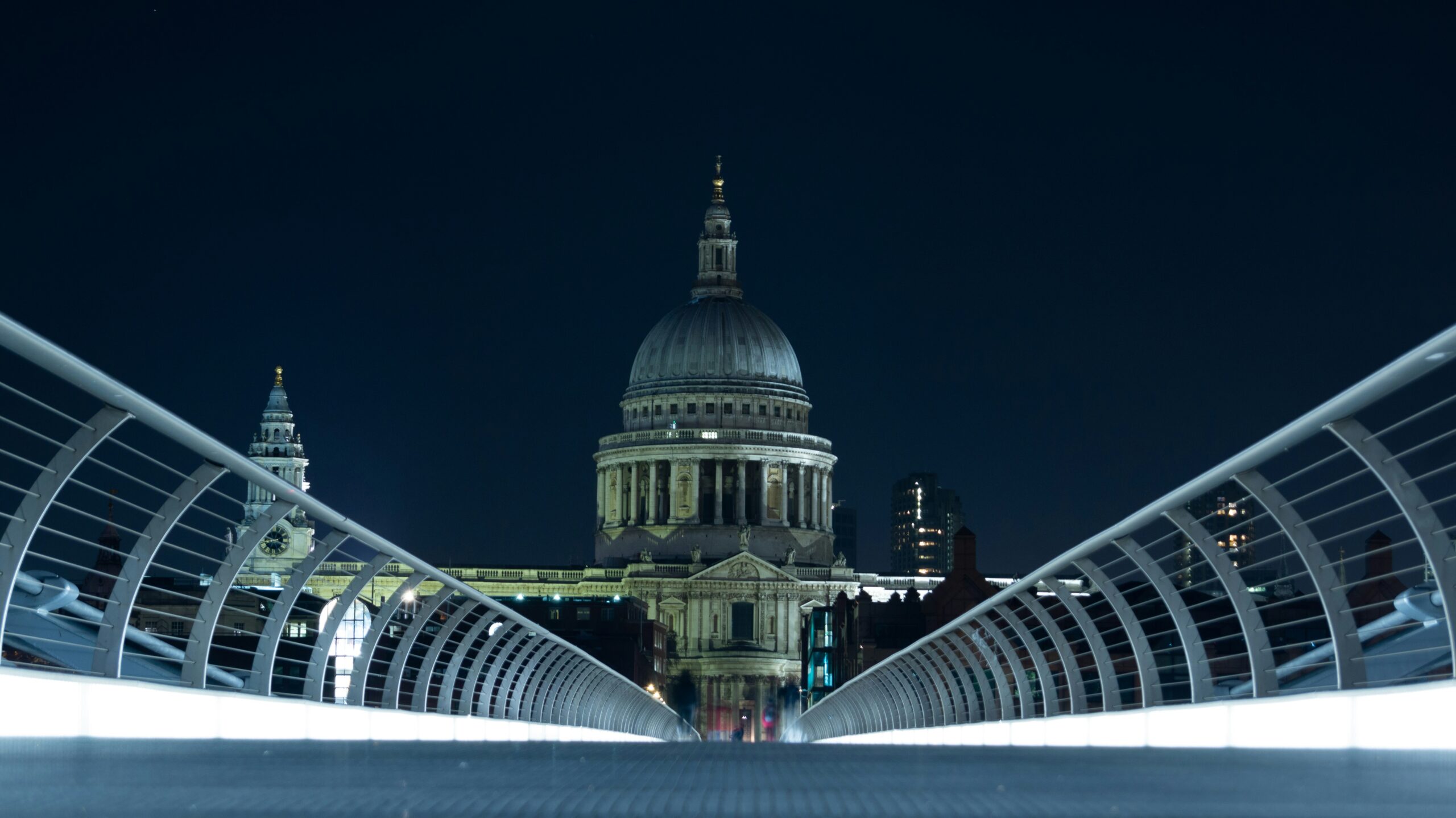
It was a man with a pen who noticed that the cross stood atop a ball at the apex of St. Paul’s Cathedral in London. Most of England, going about its business on and around Ludgate Hill, hadn’t thought much about it. But an author’s job is to notice. And then to write. So the man, as writers sometimes do, immediately put a professor named Lucifer in a spaceship alongside an old Bulgarian monk named Michael and had them circle the dome’s 112-foot diameter to have a conversation on rationalism and the sacred.
Read more The Spectacle Ep. 463: TikTok Is Toxic To Your Marriage
“After all it is easy enough to see what is really wrong with Wren’s architectural arrangement.”
“And what is that, pray?” inquired Michael, meekly.
“The cross is on top of the ball,” said Professor Lucifer, simply. “That is surely wrong. The ball should be on top of the cross. The cross is a mere barbaric prop; the ball is perfection.”
G.K. Chesterton was a wise man with uncanny foresight — perhaps even something of a prophet. The modern Englishman is an heir of the kind of rationalism Professor Lucifer espouses in Chesterton’s great novel, The Ball and the Cross. The result is that he enjoys smashing golf balls around the columns of Rochester Cathedral (as he did in 2019) and that even the Church of England feels compelled to host raves to try and get visitors through the doors of St. Paul’s.
Earlier this week, St. Paul’s Cathedral announced that it had signed a four-year agreement with Fabric, a popular nightclub company, to host concerts in the church’s nave. Predictably, the wrong people were instantly celebrating.
Apparently, the Church of England has decided that a secular concert is the only way to get people through church doors.
“Fabric. St. Paul’s Cathedral. Name a more iconic duo,” Sadiq Khan, the Muslim mayor of London, gushed on X. “Bringing together these two institutions will create a one-of-a-kind experience, pairing world-class music with one of our most special landmarks.”
The cathedral, of course, is iconic. The massive Baroque-style edifice, designed by Christopher Wren in the aftermath of the Great Fire of London, stands in place of the little chapel St. Augustine’s successor established back when tribal lords ruled the Saxon hills and the flame of faith in England was small and fragile, but growing.
Wren’s dome, rising above the city (it was the tallest structure in London until the 1960s), has served as a symbol of British resilience for decades. Possibly the most famous photo of London taken during World War II features its ball and the cross rising above the smoke of German bombs, unscathed.
Read more Gloria Steinem, CIA Operative
Symbols are all well and good — even vital for national solidarity — but the cathedral was and is more than a symbol. It is the seat of the Bishop of London (a seat that is currently vacant as its former occupant, Sarah Mullally, is now the Archbishop of Canterbury). It is supposed to be the center of faith and piety for the people of London. Instead, it is to be turned into a den of intoxicated partygoers.
“Iconic,” unfortunately, is not a term that applies to the nightclub in question. A decade ago, Fabric lost its license because two teenagers died of drug overdoses in separate incidents. It quickly reacquired it the following year. Perhaps “notorious” would be a better descriptor.
How, you ask, has the Church of England justified the desecration of one of its most iconic and sacred spaces? Well, Sandra Lynes Timbrell, the cathedral’s director of visitor engagement, told the BBC that the goal was for visitors “to discover and engage with this historic building in new and exciting ways.” Apparently, the Church of England has decided that a secular concert is the only way to get people through church doors.
After all the blowback, the cathedral’s staff assured the international community that the events wouldn’t be like the silent discos held at the Canterbury Cathedral in 2024. These will be seated events featuring bands from diverse “musical backgrounds and disciplines whose work responds to the Cathedral’s distinctive atmosphere, acoustics, and cultural heritage.”
The problem is that this isn’t the first time Fabric has been invited to host concerts at St. Paul’s. In the last two years, the nightclub has had RY X and Patti Smith at the cathedral to perform ambient and moody punk pop music. Both performances sold out almost instantly. It doesn’t seem likely that Fabric will just stick to The King’s Singers and the Tallis Scholars performing sacred polyphony from centuries past.
The problem was never the disco lights and druggies jumping up and down in poor imitation of dancing. Those elements merely made the problem starker for a generation so used to sacrilege that it takes an extreme version of it to arouse any emotion whatsoever. Rather, it was the inappropriate introduction of the secular into a space intended to be set apart from it.
As Bishop Robert Barron observed on X, “the contemporary West is, quite literally, the first culture in human history that is in danger of collapsing the sacred into the secular, or better, losing any sense of difference between the two. This is doing enormous damage, especially to young people, whose lives have been flattened into a preoccupation with money, worldly success, and material things.”
England’s faith and culture are mere shadows of their former selves. The country long ago put the cross atop the ball, only to discover that the ball, in all its round perfection, is not only unstable but curiously hollow. And a vacuum is always filled by something.
Read more Scott McKay’s The Necessary Men — Episode 9: Resuscitation
READ MORE from Aubrey Harris:
Like It Or Not, Data Centers Are Part of the Midterms Now
Just When You Thought Girl Scouts Couldn’t Get Worse, the Muslims Take Over
Euthanasia and Organ Donation: When Death Becomes a Medical Resource
About the Author