Welcome back to the world of Mike Holman.
If this is your first stop, here’s what you need to know: Mike Holman is the independent journalist, podcaster, and inveterate maker-of-enemies at the center of Scott McKay’s bitingly satirical thriller series — four novels (so far) chronicling one man’s habit of ending up in the middle of the very stories the rest of the media is too scared, too compromised, or too incurious to tell. Catch up on the whole series, read past episodes, and find links to every book at “The Mike Holman Novels at The American Spectator,” and soon, see the video-novel version of this and the previous books at MikeHolman.com.
Read more 9/11: Remembering the CIA’s Failure to Protect America
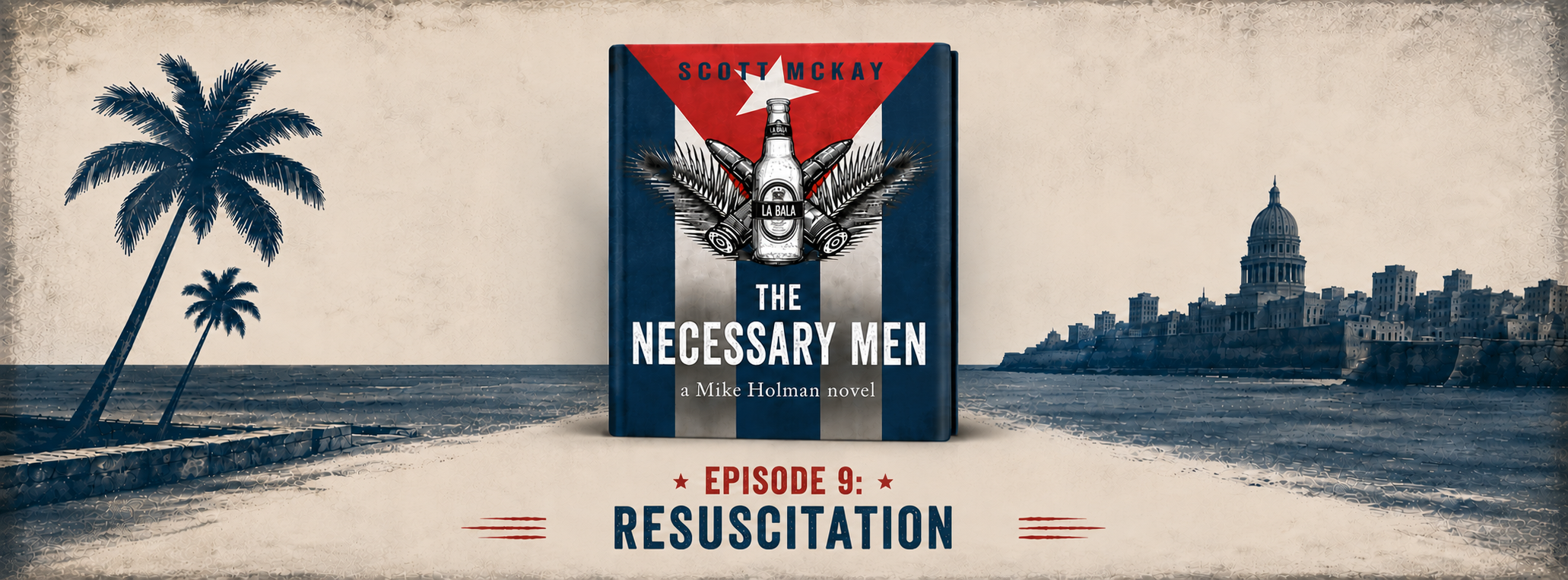
We’re now serializing the fourth Mike Holman novel, The Necessary Men, right here at The American Spectator — new episodes dropping every Wednesday and Saturday. The full book goes on sale September 26th at Amazon and the new MikeHolman.com site, and you can pre-order a signed copy right now.
Where we left off: A major obstacle to TODO’s rise has been removed, Diego’s tour through Eastern Cuba has gone big-time, and power is shifting more and more quickly.
Here are Chapters Seventeen and Eighteen of The Necessary Men.
Chapter Seventeen
Lyford Cay, Bahamas — October 24, 2026
I’d managed to make my last trip to Gibara as part of the PGFI/TODO project the second week of October. It was for the opening of Trent’s cigar factory.
There was a certain significance to that, because it was the first American capital investment in Cuba since Fidel seized power in 1959. There had only been one previous attempt at that, which was a tractor company out of Alabama that had looked into building a factory in Mariel during Omobba’s last year in office – the Cubans ultimately rejected them.
Nobody was rejecting Trent and Mariano. Even without Cesar and his connections, the people nominally in charge in Cuba were anxious to make sure they had friends outside of the regime. And on the eastern side of the country? I wouldn’t call it the Wild West, because the interesting part was that it was pretty peaceful as far as chaos went.
Things were happening at an accelerating pace. While we’d been grinding out the template for TODO takeovers in the 25 sites of the todosphere, which we ultimately were going to turn to Diego to be the frontman for, Diego had been building out his own management team with Pierce’s help.
And in Gibara on that windy, overcast day in early October, I got a first-hand look at what that was like.
Here, I’ll back up a bit and introduce somebody I’d known for a while. Eddie Scarpetta was from Alabama, and he’d been the chair of the Public Service Commission there. Eddie was a big proponent of nuclear energy, which came from the fact that he’d been an engineer in the Navy and had crewed on nuclear submarines for 20 years before he got out and made his money. After he did his stint on the PSC in Alabama, Eddie had gone to work in Trumbull’s first administration, spending the last year as the Secretary of Energy.
Eddie had done some lobbying work since for Westinghouse and NuScale, trying to get DOE to move on approving modular nuclear reactors. But then he signed on to work for Pierce as the Vice President for Strategic Development at Sentinel Energy, which was Pierce’s newest company.
And Sentinel Energy had built a manufacturing plant along the Essequibo River in Guyana, which built modular nuclear reactors. This was Eddie’s thing – he knew those reactors from his time in the Navy, and he knew they were big winners as something you could drop into a small town in the middle of nowhere that wasn’t plugged into a national power grid, and you’d immediately have enough juice to make it so living in that little town didn’t mean primitive poverty.
Sentinel Energy bought a couple of Japanese and Israeli modular reactor designs and improved them, and right around the time we started the Cuba project, they’d quietly deployed a few of their products in some of the small out-of-the-way towns in Guyana. The results had been good. A couple of the larger reactors the plant had built were online at Liberty Point already. And Pierce was in negotiations with the government of Guyana to build a power station off a cluster of the reactors just outside Georgetown, the capital.
You’re probably starting to understand what was underlying some of the PGFI project in Cuba. Let me flesh it out some more.
Eddie Scarpetta was on the flight with Trent, Mariano, and me into DMIA in Gibara. Because before Trent got to turn the ignition on the cigar factory in the building Che Guevara built and named for that Japanese communist who got turned into sushi, Eddie had a show to put on.
I hadn’t noticed it on my previous trip to Gibara, but right where the NR 221 became the Ronda de la Marina on the south edge of town, almost right where the airport access road was, they’d built a small nondescript little power station with a switchyard. But what I could see as the King Air 350 flew over the Bahia de Gibara on its way to landing at the airport was that there was a big barge docked in the bay not far from the switchyard.
“That’s mine,” said Scarpetta.
And when Victor, my security guy who met us at the airport and served as our driver, picked us up at the airport and deposited us first at the switchyard, Scarpetta got to throw the switch and turn on the juice that two modular nukes on that barge were making.
Which was several times the electricity those six Caterpillar diesel generators at the power station had provided to Gibara.
There was now enough electric power generation in that town to sustain 15,000 people running central air conditioning nonstop, surfing the web all day on desktop computers, watching big-screen TV’s 24/7 and running automated factories on every street corner. Gibara was at that moment the most power-rich city in all of Cuba.
And when Trent got to turn the lights on and welcome the workers to the new Colon Cigar Company, Scarpetta looked down the hill at the little wind farm on the coast north of Gibara.
“You see that?” he said. “That’s a press release. That’s not a power system. These poor people finally have a power system.”
Trent’s factory was actually two factories. He and Mariano had a compromise they’d made with each other, and it was inspired by the compromise Stan and Sam Uribe had made.
Trent’s idea was to go capital-intensive. He said he was going to bring in state-of-the-art machinery and mass-produce the greatest cigars in the world. Mariano told him that’s not how cigar-making works, that if you want the real thing, you have to hand-roll them with expert rollers – torcedores, they called them – and make them out of whole tobacco leaves. There was no way to automate that.
Trent had gone everywhere trying to prove Mariano wrong, and then he finally listened to him when Mariano said it wasn’t an either-or proposition.
So they’d taken half the factory floor and installed the machinery to make the mid-tier, reasonably-priced Cuban cigars – Colon Primas – they could flood the market with, and the other half they’d used to build a suite of rolling rooms where the torcedores they’d hired from all over Cuba – I didn’t know there were elite craftsman cigar-rollers, but apparently there were – were sitting in super-comfortable chairs listening to classical music and history podcasts as they were rolling the Colon Conquistadores Trent and Mariano were going to sell at $30 a stick.
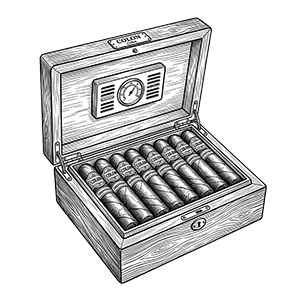
Scarpetta was a cigar guy, so we hung around the factory long enough that Trent gave him the first box that came off the Conquistadores line.
What was less than awesome was the encounter I had at the factory with an old LCTC employee.
I recognized him as the skinny thug who’d been with Cabrillo when he’d come up to me at the job fair. He said, in not the best English, that his name was Lido Garcia de Jesus and that I owed him a job.
“My boss no here,” he said. “They say he die in Panama.”
“Panama can be dangerous,” I told him. “What I would suggest is that you get together with Diego Maceo’s folks. I can introduce you to the mayor here; he can get you started.”
“I no live in Gibara,” he said dismissively.
I just shrugged. “I don’t have any jobs open right now,” I said. “I’m back home in Florida now. Mr. Maceo is running TODO in Cuba, and he’s got an organization. I know they need people.”
“You no just send me away,” said Lido, getting into my personal space.
“Hey, hey,” said Victor, stepping into Lido’s grill. “You’re gonna want to back off, pal.”
Lido did. But he wasn’t done grousing.
“Manuel Cabrillo!” he said loudly. “¡Fue asesinado!”
That elicited a bunch of looks from the folks on the factory floor, who quickly turned back to their jobs.
“I have nothing to do with that,” I said. “But I’m pretty sure your boss had my friend Jack Gray killed, so don’t ask me to cry for your guy Cabrillo. And your job interview skills absolutely suck, Lido.”
At that, he spat on the floor in front of me.
Cesar, who was watching, hustled up to the confrontation with a pair of security guards. They rather rudely gave Lido the bum’s rush.
Then Eddie got his humidor and we were off to Vita, and the drive didn’t take us long at all because Belcher had finished his 12-week road project in nine weeks. I ran into him at the port after a 15-minute drive that used to take more than an hour on the awful roads that previously connected Gibara and Vita.
“Pretty freakin’ awesome, huh?” he said when we saw him. A large container ship was making its way to the dock, and Scarpetta was beaming as he watched it come.
“How’d you get this done so fast?” I asked him.
“You won’t believe this, but we got a lot of help from our new friends at the Ejército Oriental.”
“The Army? I thought they were into blocking roads, not building them.”
“Well, it depends on who’s running the thing, as it turns out.”
“You made friends with that guy Mendoza?”
“Nope. I made friends with Colonel Rincon, who is Mendoza’s adjutant. Rincon is the new Mendoza.”
“I don’t know what that means, Jason.”
“It seems that if you want to talk to Mendoza, who is nominally still in charge of the Eastern Army, you have to go and see him in the stockade.”
“They mutinied?”
“Yes, they did. And it turns out that the Army has some road-paving equipment and a whole lot of dudes with nothing to do, so Rincon said that if we’d rent their equipment and pay a decent wage to their dudes, they’d be happy to expedite our project. The Army, in a joint venture with us, is now bringing the Autopista Aroldis Chapman into Holguin from where we’d ended it in Gibara.”
“Holy shit,” I said. “That’s some development. But when the Army is essentially a massive corporation in its own right, I guess it’s not a surprise.”
GAESA was the military’s holding company. You’d think that would mean it was a defense contractor, and you’d be 100 percent wrong. GAESA didn’t run the Army; it ran the money, tourism, the ports, the hard currency. That meant that once Rincon and the officers below him realized which way the wind was blowing, protecting the regime was a losing proposition for them. They had a business to sell, and they were selling it very reasonably – in return for a guarantee that they’d be fine when the music stopped.
“Yeah, well… the phone is ringing,” Belcher was saying. “I know you know the regime guys who run stuff – GAESA, ETECSA – are all calling. They’re looking for jobs with TODO, and they’re bringing real things with them.”
“We’re actually going to have a big meeting in the Bahamas in two weeks about that,” I said. “Diego, Stan and Trent, Pierce, a bunch of the Cuban exiles, and some American corporate folks.”
“About the repatriation problem, huh?”
“Yeah,” I said. “Stan and Trent have a plan on paper. It seems pretty sound economics-wise. Politically, I don’t know how well it plays.”
“The one thing I keep hearing from the locals,” said Belcher, “is that they worry they’ll have escaped from communism only to go right back under the thumb of the aristocrats who ran off to Miami. They hate the idea of that.”
“The problem with every post-communist country I’ve been to,” Scarpetta offered, as he watched the ship dock, “is that the commies fall, at least politically, but they end up with their hands on the means of production anyway. So you go from communism to oligarchy and everybody is still broke.”
“The good part is that there is a plan to do this differently,” I said. “And what comes off that boat of yours, Eddie, will pretty much change everything.”
Scarpetta nodded and smiled.
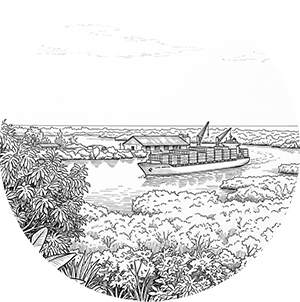
They’d been offloading trucks from ships at Vita for two weeks, and the receiving yard at the port looked like a very busy truck stop. But that day, they were offloading flatbed trailers with Eagle Model 1 reactors on them. Easily two dozen came off the ship, were hooked up to those semi-trucks, and took off for various nodes in the surrounding area.
Scarpetta explained that an Eagle Model 1 was capable of generating seven megawatts of electricity, and it didn’t need water coolant or anything like that. You set it down, hooked it up to the grid, and it was good for eight years’ worth of enough power to cover the needs of 5,000 American homes.
And 25,000 Cuban homes at their current usage rates.
“We’ll make more as we need to,” Scarpetta said. “But later this week, we’re offloading an Eagle Model 5, and that’s the one going to Holguin.”
He noted that the Eagle Model 5 was capable of generating 1,200 megawatts of electricity. And there were five of them going into Cuba – in Holguín, in Moa in the far east, in Sancti Spíritus in the middle of the country, and in La Coloma in the southwest and Bahía Honda just west of Havana. All were TODO towns. They’d be the backbone of a whole new electric generation system in Cuba. When those went online, there would be enough electric power generation to put Cuba in the same neighborhood as Spain in per-household electricity usage.
“What about UNE?” Belcher asked him.
UNE, Unión Eléctrica de Cuba, was the Cuban electric utility. It ran a bunch of old fuel-oil power plants which were in horrendous shape; the whole country was generating less than 2,000 megawatts of power. For Cuba’s nine and a half million people to have a standard of living in the neighborhood of what Americans had, they’d need something on the order of 11,000 megawatts.
“What about them?” Scarpetta said.
“I mean, it’s not like GAESA, which the military owns. For example, this port is owned by GAESA, and they’re basically willing to sell it to us. It’s pretty much a game of musical chairs for these guys – if you don’t sell what you control in exchange for a job or a piece of the action or something, you get left with nothing. But UNE is run by the Ministry of Energy and Mines. That’s direct to Candela. They can’t sell it. So, like…”
“Fuck those guys,” said Scarpetta. “If I get a chance, I’m going to junk all of their shit and start over. Switchyards, substations, transmission lines… I’ll appropriate that where I have to, but generation? Forget it. It’s trash. We’ll build a whole new system they can subscribe to with their TODO cards, and they’ll have the cheapest electric rates in Latin America.”
He wasn’t kidding. Pierce had circulated an email a few days before noting that at the generation cost, once the buildout of Cuba’s power system was completed, he’d be making a 31 percent profit margin with Sentinel Energy in the country charging three cents per kilowatt-hour. That was more than what Cuba’s shitty electric utility was charging; something like 90 percent of the power users were paying almost nothing for electricity that was more theoretical than real. But among the countries in the Western Hemisphere that had an actual functioning power grid, Paraguay, which ran on hydroelectric power, was the cheapest at 4.8 cents.
Pierce expected that once the word got out about what Sentinel Energy was going to do for the Cuban power grid, every manufacturer in the world would come calling in order to take advantage of the dirt-cheap electricity and the labor rates that would undercut China for a good while. Even marking up the juice for the large energy users to recoup the initial outlay and buildout costs, he’d still come in as the cheapest power supply around.
Which meant Cuba was in a position to absolutely clean China’s clock as a low-cost manufacturer and supplier to the U.S. market. At least, once the political risk scaring capital away was neutralized.
And Belcher noted that his contact from GAESA who’d leased him the dock space at the port of Vita had told him he and his bosses really wanted to sit down with the folks from Sentinel Ports Management about putting together a deal. And not just for Vita.
“You realize what he’s doing,” Belcher said.
“Yes, I do,” I said. “Pierce does good things. He does humanitarian things. But the things he does always make him stupid amounts of money.”
When Diego was pitching in the Cuban Serie Nacional, the Santiago de Cuba Avispas – the Wasps – were his Holguín team’s biggest rivals. And that no-hitter he threw against Santiago was a heartbreaking moment for the folks there.
That said, the year before, in 2001, Diego was pitching for the Cuban national team in the World Cup, in Santiago, against the Dominican Republic – which was as bitter a rivalry as there was in all of the sport.
And he no-hit the Dominicans, who had a team full of current and future major leaguers. That was what really put Diego on the radar for the major league teams and set in motion the process that led to his defection and signing with the Red Sox and… well, history.
So Diego was very much a prominent figure in Santiago. And the day after Trent’s cigar factory opened, a bunch of us – Trent, Stan, Hal, Melissa, who’d flown in for it, Marisol, Sam Uribe and the whole Uribe clan, and several others – hopped on a helicopter and flew in for his tour stop.
From the standpoint of risk, this was a little like Holguín. It was known that the people of Santiago were with Diego. We’d seen pictures and videos galore of people writing TODO de Cuba in graffiti, along with other things, like Diego Salvador and BUENO, LA BALA, on walls, on streets and pavements and so forth. And the fact that the Army was on board meant there was a blanket of protection which said Diego’s thing wasn’t an outlaw cavalcade like how it had begun.
Diego had been to a couple of the other larger cities in the East and had gotten a hero’s welcome. For example, Moa, from the videos I’d seen of his appearance there, was a rather garish display of palm fronds. I was starting to wonder whether Cuba’s royal palm trees would survive this tour, but was told that the supply of fronds was all but endless.
“Don’t be dumb, Mike,” said Marisol.
Even so, this was the second largest city in Cuba, and Diego had already given something akin to a religious experience to the fourth-largest. It was sort of now-or-never for the regime to do something about his tour. He’d done nothing overt to indicate a political role in Cuba, though, so the physics of attacking him were… problematic.
In other words, it was… mostly safe to go with Diego to Santiago de Cuba.
So we choppered into Santiago, and Diego told me to stand close after he finished his speech.
“If you’re gonna write the book about all this,” he said, “you should get a good look at what happens.”
He gave basically the same talk he’d been giving – about family, the memories of Cuba, his longing for home, the wonderful life he’d been able to live, and his desire to give back and to produce good things for his people.
They ate it up. They loved him. And they all knew what lay under his words – it was a direct indictment of the regime for chasing off the people who wanted to do more than simply survive, a cry for freedom and prosperity for the Cuban people and a rejection of Communism for the stifling of faith, of love, of ideas that make life worth living.
“No sólo de pan vivirá el hombre,” he said, and that blew up the crowd. “No man can live by bread alone.” The way Diego worked that in was by talking about how happiness comes from being able to follow your dreams, and that isn’t just about money. He said that he’d gotten into his various businesses not so much because he wanted to make money but because he liked creating things and watching them thrive the way a gardener does.
And of course, he expounded on how much he loved making La Bala Cerveza, which, not surprisingly, really got the crowd going. Diego had brought 1,000 kegs of La Bala to Santiago, and all of it was gone before it was over at that stadium.
He didn’t make a single explicit attack on communism, or the virulent brand of Marxism the Cuban Communist Party espoused. But the contempt for it was just underneath Diego’s sentimentality. Everybody got that. It was exquisitely crafted. And I was told he wrote it himself, but I have no doubt Essie helped.
And when Diego was done speaking from the stage in center field in that stadium, they set up a receiving line for him. A few thousand people, out of the fifty or sixty thousand who were in the stadium – it seated 35,000; almost that many were packed in like sardines standing on the field, and there were a whole lot more who stood outside the stadium and watched on the big TV’s they’d set up outside – lined up and Diego greeted every one of them.
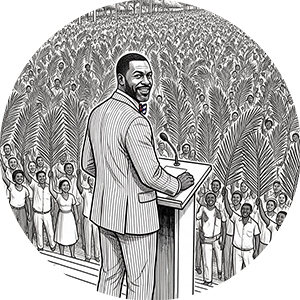
I’ve never seen so many palm fronds in my life. And as we looked around, I asked Marisol if she was sure the trees weren’t stripped bare.
“Psh,” was her response.
Most of the Santiagans coming to Diego in that receiving line had baseballs – or other things – for him to sign. A few offered words of appreciation. One old man who struggled to walk up to Diego held his hand tightly and said – and I managed to pick this up without Marisol translating it – “You can’t deliver us from communism only to bring back los gusanos. It would break our hearts.”
Los gusanos literally translates as “the worms.” It was a slur that Castro used to trash the landed gentry in Cuba the revolution chased off to Miami. I didn’t get the impression the old man was a communist. I don’t think he even realized how his characterization of the exiles sounded.
I could sense Sam Uribe tensing up at that word.
But how it registered to me was that this old guy had swallowed 67 years of regime propaganda and it just came out of him like sweat.
Diego’s reaction was interesting. He looked at the man intently and said, “I understand what you’re saying.”
And then he gave a self-deprecating smile. “Los gusanos are all my friends in Miami,” he said with a chuckle, and the old man responded with a chuckle of his own. But then he grew serious again and said, “But I understand what you’re saying. Many of them want to come home, and they have the right to. And Cuba needs them. But not at the expense of the people. We have to find a way.”
“God bless you,” said the old man, who kissed Diego on the cheek.
The party secretary in Santiago was in the receiving line. He didn’t ask for a private meeting. He stood in line with the regular folks. And when he got to Diego, he introduced and identified himself, and he said, “Señor Maceo, I apologize for what this government made you do. It was a terrible mistake, and it made miserable an entire people. I will bear that shame for life.”
“Your life is not over,” said Diego. “Maybe we’ll have a new chapter together and this baggage can be left by the side of the road.”
“I’m at your disposal,” said the party boss of Cuba’s second largest city.
After a few days home with PJ, who was almost at the point of bed rest with the pregnancy and very much enjoying having a husband with a guilty conscience to make a waiter out of, I was on a plane again.
At the James Bond villa in Lyford Cay, there was a giant confab planned with representatives of the top 10 American corporate claimants against the Cuban regime, along with some of the biggest Cuban exile claimants who were mostly in Miami. It had been estimated that, all told, the Castros had stolen some $9 billion worth of private property from people and companies both foreign and domestic when they overthrew the Batista government and turned the place into a workers’ paradise; absolutely everyone recognized that the regime couldn’t possibly pay that back. Not when the present value of the theft, counting 67 years of accrued interest, was over $320 billion, which was more than 30 times the country’s GDP.
And per U.S. law, they’d have to in order to have the American embargo lifted against Cuba.
The meeting at Lyford Cay was to talk about how the repatriation issue was going to get resolved, because without that, none of the plans to turn Cuba around would ever get off the ground. And in back-channel conversations with Burro, Pierce told me that getting a waiver of the embargo was politically a Catch-22.
“He said that if there’s a waiver before the regime is turned over, the Cubans in Miami and most of the Republicans will go ballistic,” Pierce said, “and Corporate America will lose their shit over any waiver that isn’t predicated on their being paid back for what was stolen from them.”
“I don’t blame them,” I said.
“Yeah, but here’s the part where it gets stupid: he thinks the Democrats will filibuster any legislation lifting the embargo when the regime does turn over if there are any conditions of the embargo lifting which haven’t been met.”
“That’s how many figs they give about the Cuban people,” I said.
“See, they’re couching this in process. What this is about is all of a sudden they’re the ones who want to make sure a new Cuban regime isn’t screwing over any Americans. But the same Cuban regime that’s there now, they can go on screwing the same people they’ve been screwing for 67 years.”
“I trust the world can see how idiotic that position is,” I said. “Then again…”
“Yeah, exactly. Gas is still at four bucks because they can’t put an end to that fight in Iran, and the Dems are at plus-6 on the generic ballot, and there’s a good chance they’ll take the House, so we literally have to zero out the repatriation claims in order to get this ironclad and lift the embargo.”
“Without which you won’t get the capital investment in Cuba that pays the freight for recouping PGFI’s investment.”
“Precisely. Lyford Cay has got to be a grand slam, and then we’re going to have to fan out and make satisfied customers out of every one of the victims of Fidel’s crime spree.”
“Hey, no pressure,” I said.
“It’s not so much that it’s pressure; it’s that this shit is going to be highly expensive.”
“Well, you knew that going in.”
“Yeah, I guess I did. Still. Fucking commies destroy so much freakin’ wealth it’s just amazing.”
Trent, Stan, and Pierce, and a few experts they’d brought in to consult on the repatriation plan, had gone to the James Bond villa several days early to nail down the main draft of the plan. After his Santiago trip, Diego and I flew there to sit down with the core group of planners. The audience – the Cuban exiles and the corporate suits – were due a few days later than that.
“Guys,” said Diego, “I understand the thinking behind this plan. I do. But you can’t sell this to the people of Cuba.”
“Diego, this is the plan that lifts the embargo,” said Trent. “There is nobody in Cuba who won’t be greatly better off if we do it like it’s drawn up.”
“Except for a bunch of Candela’s commissars who get left sucking hind tit,” Pierce offered.
“What’s the specific problem you see, Diego?” I asked.
“Under the terms of this, you’re doing reparations almost 100 percent by giving real estate and property assets to foreigners and people who were the aristocracy before the revolution,” said Diego. “And I get it. Doing that makes them whole in the easiest and cheapest way. But what it signals to the people, and bear in mind that I’ve spent basically three weeks touring the eastern side of the country and I get hit with this over and over, is that their biggest fear is going back to Batista, when the country was ruled almost in a feudal-type system. And they won’t stand for that.”
“OK,” said Stan, “but can we agree that getting the embargo lifted is the single most important accomplishment that TODO can produce for Cuba?”
“No question,” said Pierce. “Getting the embargo lifted is everything. And you have to satisfy the claims in order to get the embargo lifted. So regardless of who’s happy and who’s not, this is the most crucial item on the table.”
“I understand,” Diego said, “and I guess I’m not making myself clear here. What we’re trying to do on the ground in Cuba is present something nobody in the country can say no to. Which is a fair settlement of the claims, on terms which satisfy the local stakeholders as well as Miami and New York or wherever else, and the kind of economic future where every Cuban willing to put in the effort can have the kind of life he wants. We’re bringing that not as a political solution; we’re bringing it as the terms on which TODO puts down roots everywhere in the country.”
“Right,” said Trent. “Essentially the first privately-owned nation on earth.”
“Let’s not get cute about that,” said Pierce. “We’re talking about a transition period where we do with Cuba what we did with the media business – we swallow everything, and then we start spitting it back out in small pieces, all fixed up and nicer than they were before, and in the process create a strong entrepreneurial and corporate class which is wide and deep enough that the bulk of the country is invested not in communist revolution but in creating wealth and serving the needs of the market.”
“Which we’re already doing,” I said. “Pretty much everybody in Santiago who’s got a car is set up as a Lyft driver through the TODO app now, and the place only just went over to TODO the day after Diego spoke.”
“That party secretary guy?” Diego said to me, “Lopez? He’s driving Lyft to make extra money, his little assistant fella told me.”
“That guy’s the worst communist I ever saw,” I said. There were laughs around the room.
“The point is,” said Diego, “we’re not presenting this as a political takeover. We’re saying that TODO is a transitional authority which ultimately might remain as a backbone for things like banking, utilities, telecom, and other common-carrier type stuff. But it’s also the incubator for a real economy in Cuba. And yeah, it’ll operate as an interim government while the real functions of government get rebuilt starting at the local level.
“But this is so new that you have to consider the politics. And if there is no way to make everyone happy, I will happily piss off the two million rich exiles who don’t live in Cuba rather than the nine million poor people who do. So, as one of los gusanos, we can’t just turn Cuba over to los gusanos.”
“If you have to run for office, Diego,” Stan said, “I think you’ll do fine.”
“The point is to go in there and just run the country so it works,” said Diego. “I don’t want political accountability; I’m not a politician. I want people to look at the numbers after I’ve put my time in, and hopefully they’ll say ‘yeah, this was good work.’”
“You’ll definitely sell more beer if they think so,” I said.
“Damn right I will,” he said. “But more important than that, the people who come later will have a template that isn’t from Fidel or Raul or Che.”
“So what’s your idea of how to fix the plan?” asked Trent.
“It’s not all that complicated,” said Diego, “but there are some people who won’t like it, and they’ll have to be smoothed over.”
As he described his proposed changes, I watched Pierce. He looked at me and grimaced.
“Like I said,” he mouthed. “EXPENSIVE.”
And then the audience came in. There were some very heavy hitters sitting at that huge dining table in the James Bond villa, and some pretty heavy hitters sitting in the chairs along the walls.
Pierce, Diego, and I actually sat in the middle of the table on one side, so we’d command the center of the room, more or less, and Stan and Trent took seats behind us – even though Trent was going to be the guy doing most of the talking as he took the folks through the PowerPoint presentation.
As corporate confabs went, this was almost like a legit-business ‘Appalachin.’ There were bigwigs representing…
- Binders, the office-supplies company, which, through an interesting twist of corporate history, was sitting on a quarter of a billion dollars in initial claims against the regime as a successor to the American company which was the power company in Cuba under Batista; that initial quarter of a billion bucks was now worth around $8 billion in present value;
- Diabent Americas, American Flavor Corp., Uribe Sugar, and Sweetworks; the four sugar companies had a combined $380 million worth of initial claims;
- B. Holl Corp., a giant mining concern that had held the mineral rights to the significant nickel and cobalt resources at four major facilities throughout Cuba; that was $110 million worth in initial claims;
- G. Bell Telecommunications, which was out $90 million in 1961 dollars and was pretty desperate for the cash infusion a payoff would give them;
- My friends from ExOil, who’d largely written off the $86 million they were owed, worth more than $2 billion today, but did have some interest in offshore oil leases off the far west of Cuba;
- The International Vacation Corporation, which had acquired the claims to seven Havana hotel properties which had been in the hands of various individuals before Castro took over; their claims were worth at least $82 million, worth around $2 billion now, and perhaps a lot more if the tax implications of those properties were to be worked out successfully; and
- The Pan-American Produce Corporation, which was the company that actually owned the James Bond villa.
The Uribes were there in their own capacity as Cuban exiles but also as a corporate claimant, and Reynaldo Uribe opened the meeting by expressing his satisfaction at the spirit of cooperation and goodwill that he’d seen with PGFI’s operation in Cuba. I turned and smiled at Stan, who gave me the “makin’ that money” hand signal for my trouble.
And then, after a few other remarks, we turned the thing over to Diego, and he presented the plan.
Which was Stan and Trent’s plan where if you had real estate or a hotel or a factory or whatever, and the Cuban government had stolen it under the Castros, you could reclaim it – or, you could cash out based on a “present-value-plus” formula an algorithm Stan and Trent had built had generated. And within that, it was a little like the Powerball people do it – you could take a full payout over 20 years, or you could get a lump sum payment immediately that was worth less.
But reclaiming the property had an encumbrance on it. You had to put up a performance bond for creating jobs with that property.
You couldn’t just reclaim land that was going to lie fallow. You had to improve the land and hire Cubans to do it, or you had to put a business on it, or something.
So if you wanted to regain the family villa in the hills above Santa Clara, you had to put up a performance bond that you’d be hiring a full-time housekeeper, butler, cook, landscape guy, and so on, at decent wages. If not, well, TODO would cut you a check, or periodic checks, based on what the algorithm said.
I was cringing, waiting for the room to erupt in screaming and yelling. Miraculously, when Trent, who’d finished going through the details after Diego had presented the toplines, stopped and asked, “Any questions?” the room fell into a satisfied silence.
Then David Saldana, who had a little chain of chicken restaurants in South Florida, popped up. “The only question I have on this is, who’s paying the freight for the buyouts of the claims?”
Pierce raised his hand.
“You’re doing it, Pierce?” Saldana asked. “Are you some kind of humanitarian all of a sudden?”
“Hey!” Pierce said. “I’m a great humanitarian.”
“Yeah, but there’s going to be a catch to this, though,” said Royce Tettleford, the CEO of Pan-American Produce. “What’s your end?”
“You’ll find out anyway, so I’ll tell you,” said Pierce, “but my consortium gets all the ports. Sentinel Energy is going to be the electric utility. I’m getting the nickel and cobalt mines, though we’ve already started working on a development deal with Tim and his guys at R.B. Holl, so they’ll be made whole there. And Sentinel Telecommunications and Shining Star are getting ETECSA, including all of the so-called telecom facilities which are actually signals-intelligence and surveillance posts.”
“And for this, you’re putting up what?” asked Leonardo Arostegui, whose family owned a very well-known rum company that had relocated from Cuba to Puerto Rico in 1959.
“Ninety billion for claims settlements, on top of what’s already being laid out for infrastructure and economic recovery,” said Pierce. “Before it’s all said and done, it’ll be neighborhood of $250 billion. But when you sons of bitches go whole hog back into Cuba, and I’m selling you power and handling your exports back to the U.S. or Europe, I’ll make it all back and then some.”
“And TODO is taking a small piece of the businesses it’s spinning off from the functions it’s creating,” I said. “For example, in Gibara where I was the project manager for a while…”
“Why in the hell would you do that?” asked Sonia Velasquez, whose husband had developed half of Little Havana before he died in 2011. Sonia was Eduardo’s second wife; she was a little younger. “You’re Mike Holman. They’d have had you shot!”
“Actually, no,” I said. “I was Douglas Thibaud of Winnipeg, Manitoba.”
“Sure you were,” she said, amid laughter in the room.
“To answer your question,” I said, chuckling at her teasing, “it’s for the book I’m writing about all of this. It’s a big enough deal that it deserves an official history.”
“One hundred percent,” said Diego.
“And to complete what I was saying before somebody had to butt in,” I said, giving Sonia a goofy grin which she returned, “in Gibara there was trash everywhere when we went in there. So we got a couple of old garbage trucks we found in Fort Lauderdale and shipped them in, we hired a couple of garbage crews and paid them pretty decent wages, and then we trained up the managers of those crews on the TODO business app and the AI agent which acts as a business guru, and after a while we spun those guys off as small businesses, with TODO as a 20 percent silent partner.”
“So it’s like a tax,” said Sonia.
“It’s a little better than that. They’re keeping the garbage trucks we bought them. But if they want to buy new ones they can lean on TODO for financing, loan guarantees and so on.”
“Damn,” said Saldana. “You guys really are humanitarians.”
Chapter Eighteen
Havana, Cuba — November 1, 2026
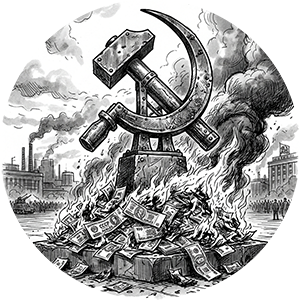
In Detroit, the day after I got back from the Bahamas, the Marxist Union of America was holding a “convention.” It was more of a cattle-call for the candidates they’d endorsed. But PJ was watching it on C-SPAN from the large, overstuffed couch which she’d stolen from my office and put in her Peloton room when I got home.
“Hey, baby,” she said as I kissed her. “How was your trip?”
“Much better than I thought,” I said. “This thing is fully set in motion now.”
“When is Diego going to Havana?”
“All Saints’ Day,” I said. “How about that?”
“Oh, wow. Love the symbolism of that. Y’know, the evil spirits have had their night and now the good guys take over. Or… never mind me. I’m pregnant and I’m tired and disgustingly fat and I can’t make a lot of sense anymore.”
“I disagree,” I said. “You’re doing fine. What are you watching?”
“The Cuban communists aren’t doing so well, but the American communists are havin’ their moment,” she said. “This is their convention, or their summit. Whatever.”
“Yes, but why are you watching it?”
“In case there’s something we can put in the book,” she said. “And also, and I cringe at this, because The Great Peter Chang is speaking in a little while.”
“At the Marxist Union summit?”
“Yep. It’s kind of depressing, I won’t lie.”
“PJ, you don’t have to watch that,” I said. “I don’t want you getting upset.”
“Aww, listen to you. So protective!”
“Great. She complains like she’s dying, and now she’s a rock.”
She laughed. “Maybe I’m rallying because you’re home for a few days,” she said. “You have a magic effect on me.”
“Jeez,” I said, and kissed her again before I went to let the dogs out in the backyard.
And then the phone rang. It was Hal.
“We need to do a Zoom,” he said.
“Let me go sit down in the office,” I said.
Pierce and Roman were also on the Zoom; Roman was actually in Havana. Everybody had grave looks on their faces. I don’t think mine matched theirs, but seeing as though Peter Chang had just taken the podium at that stupid communist rally in Detroit, I doubt I was giving them much of a smile.
“The Great Peter Chang is now giving a speech at the Marxist Union of America’s confab,” I announced, “and it seems that you and I are the subjects, Pierce.”
“What?” he said. “That son of a…”
The next thing I knew, Pierce was doing a screen-share, and we were watching Peter on the Zoom.
“And let me tell you how dishonest American capitalism is,” said Peter. “The whole Compania Todo de Cuba project, behind my back, STOLEN! Just like this land was, just like Venezuela, like they’re trying to do to Iran. They’ve STOLEN Cuba!”
The crowd was screaming. It was like something out of 1984.
“I went there to do a job and to help Cuba,” said Peter, “to repay everything the revolution has done for people like us – the Venceremos Brigades, providing shelter for the persecuted – you know what I’m talking about. The Weather Underground heroes! Robert Williams! Assata Shakur! Yeah, that’s right. I went there to help them. And we put together a great, cooperative enterprise, and then Pierce Polk and Mike Holman STOLE the whole thing. I’m not sure how they did it, but they muscled their way in under the guise of hurricane recovery. And my friend Simon Lim was then suddenly killed, and now this Polk Global Freedom Initiative, this capitalist rape gang, has co-opted Diego Maceo. And they’re mounting a slow-motion coup against the revolution, brothers and sisters.”
Read more Star Trek ’s 60th: Where No Man Has Gone Since
There were loud boos over the audio. I thought I heard one from the Peloton studio as well.
“Oh, yeah,” he said. “But Maceo? He’s sold out his country before. This isn’t a surprise coming from him. Or from Polk or Holman. They’re fascists, you know.”
I could hear PJ shouting something, and then her phone was ringing, and then she went quiet.
“Enough already with this shit,” said Hal. “We need to talk.”
So Pierce stopped the screen-share. Peter was still thundering away on my TV screen, thankfully on mute.
“Mike,” Hal said, “we’ve penetrated DI’s main database, and there’s so much in there it probably changes the world forever.”
“I thought it was impenetrable,” I said.
“Not when you penetrate the human factor,” said Roman. “We got a guy. Actually several guys. The rats are runnin’ from this sinkin’ ship.”
“But what I want to tell you, so you know,” said Hal, “is that the DI had you flagged as Mike Holman back in Vancouver.”
“How come they didn’t take me out?” I asked, disbelieving him.
“They tried. Your plane from Nassau was tampered with.”
“Wow. We had a two-hour delay from Nassau to Ragged Island. You think that…”
“That pilot saved your life,” said Hal.
“But wait – why didn’t they just get me in Gibara, then?”
“Because DI and DSE are two separate agencies with very wide differences in discipline and competence,” said Hal. “DI passed you to DSE and it got lost in the chain. They said Mike Holman was coming to the island. But DSE wasn’t looking for Mike Holman as Douglas Thibaud. And that mix-up never got fixed.”
“I thought you said those guys were good,” I objected. “That’s pretty rank incompetence.”
“DI plays offense,” said Hal. “DSE is the one playing defense. Those guys get paid next to nothing and the regime gets what it pays for.”
“I wouldn’t tell PJ about this if I were you,” said Pierce, as I noticed Peter had finished his speech. Dolores Gramsci-Ramos had run up and was hugging him, while the audience had risen to their feet and was holding their hands high, snapping their fingers.
And I could hear PJ in the hall, waddling toward the office.
“Next subject,” I said. “Are we good to go on the first of November?”
“Diego could go in now,” said Roman. “It’s crazy here.”
“Chaos?” I asked him.
“Actually, not really. It’s pretty calm. But there’s TODO de Cuba graffiti everywhere. The power is really in and out, and there’s supposed to be a nighttime curfew, but people aren’t following it, and it isn’t really being enforced. But I’ve been places where a revolution is goin’ on, and this isn’t what one looks like.”
“You’re saying the regime is… in control, or not in control?” Pierce asked.
“Pierce, I’m sayin’ the revolution has already happened and they’re all just waitin’ for the next thing.”
PJ was now standing in the doorway, her arms crossed over her giant belly. She was leaning against the doorframe, listening.
“Hey,” I said, turning to her. “What’s up?”
“You’re gonna want to say no, but I forbid you to,” she said.
“To what?”
“I want to go with you when you go into Havana.”
“That’s insane. Absolutely not.”
“I forbade you from saying that! Besides, I’ll take pictures for the book, and after what Peter just pulled, I think it’s good if the media sees Hank and Mom and me all there in Havana.”
“Yes!” Pierce was saying. I don’t know how he heard her, but he did. “Absolutely yes. If we’ve got to put her in a wheelbarrow when she gets off the plane, we’ll do it.”
“You see what you’ve done?” I asked her. “I would be off my rocker to bring you with me down there.”
“Mike,” said Roman, “I agree with you, but if she does come, I will make sure that she’s safe.”
“Just a fly-in, fly-out from Palm Beach,” she said. “We’ll get off the plane with you, we’ll ride with you to Diego’s, whatever, and then we’ll get out of there, get back on the plane and leave. I just want to make an appearance to stick it to him.”
“I don’t know a lot about politics,” said Hal. “But if PJ can hack that trip, it would look good. And when the Cubans find out it’s her brother who built the app that gave them free speech…”
“…it’s a win,” I said. “OK, I absolutely hate this idea, but I can see some value in it. But PJ, you can’t put your life in danger this close to your…”
“I’m not gonna have the baby in Havana,” she said. “I’m six weeks out, easy.”
“Yeah, but you said yourself it’s a difficult pregnancy, and your doctor…”
“Has not told me I can’t travel. I’ll be uncomfortable, but I’m also going to get to be a part of history. And all the other stuff we talked about.”
“I still hate it.”
“Pleeeeeeease, Mike?”
I looked at the Zoom screen. They were all nodding at me.
“Assholes,” I said to the grid. “You’re all assholes.”
Just then, Robby climbed up on my knee.
“Even Robby wants you to say yes,” she said. “See?”
I acquiesced. I’d just heard that the Cuban spy service had tried to assassinate me in Nassau, and I agreed to bring her with me to the belly of the beast. There was no weaker, dumber animal on the planet than Mike Holman at that moment.
Flip Johnson, who was turning into Holman Media’s best asset even above and beyond Colby, texted me just before dawn the next morning. I’d missed what he was texting me about, given all the prep work I’d been doing with Trent, Stan, Melissa and Diego’s people in attempting to set up TODO’s takeover of Cuba’s state assets – every Communist Party apparatchik in the country was marching into the nearest TODO office looking to make a deal for everything from equipment to buildings to airports to factories to military bases, some of which had Russians or Chinese sitting on them – and so I was in the dark both literally and figuratively.
“Check the link!” said the text.
So I did, trying not to wake PJ who was, I hate to say it, beginning to develop a snoring problem.
When I did, it was a story Flip had done about the arrest of Prentiss Plantagenet in Detroit.
I’d never heard of him, but what I found out from reading Flip’s piece was that he was the Marxist Union of America member who was the Democrats’ candidate for a House seat in Vermont. That seat was considered pretty safe for the Dems, but there was a Libertarian running, a guy named Chad Dudenberger who ran a comic-book store in Montpelier and was a peculiar guy, but was actually polling halfway well against Plantagenet. So much so that the Republican in the race had dropped out to support Dudenberger.
Then Plantagenet got busted, according to Flip’s story, by the Detroit PD at the hotel where the Marxist Union convention was being held, for – and I had to read this twice – “the abominable and detestable crime against nature” involving a canine.
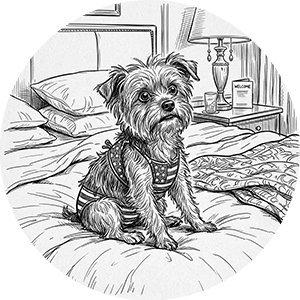
More to the point, Prentiss got caught in a hotel room with a half-dozen very nervous Yorkies in various states of dress or undress, as the case may be – he had them wearing American flag bikinis, per witnesses from the Detroit police.
And Flip might have elicited the greatest quote of all times from Leotis Marshall, the police chief in Detroit.
“There’s just thangs you ain’t supposed to do with no damn dawg,” Marshall was quoted as saying. “Damn!”
Plantagenet didn’t get out of the race. He made bail – Plantagenet was the scion of an old fortune originally made in the whale oil business in the early 19th century; he was the fifth generation of Plantagenets without gainful employment – and held a press conference in front of the jail decrying the Detroit police’s “antiquated, theocratic notions of love and romance,” and vowed to continue the fight to eliminate the Supreme Court and American billionaires.
Flip’s story said that Dolores Gramsci-Ramos, who had endorsed Plantagenet and was photographed embracing him on the stage at the hotel in Detroit, had reached out to Dudenberger’s campaign.
“This is good work,” I texted Flip. “Are we really going to have a Libertarian in Congress?”
“Quite possibly,” he said back. “But nobody knows who he’ll caucus with.”
“How does a Libertarian caucus with Democrats who are basically socialists?” I asked him. “That’s absurd.”
“You don’t know anything about Dudenberger,” said Flip. “All he cares about is whether military spending gets cut in half and weed gets legalized. He actually said it ought to be tax-free.”
“Yep. He’s a Libertarian, all right.”
“This turns out to be maybe the most important race in the midterms,” Flip texted. “It really is close enough that this one could be for 218.”
PJ caught my eye. She had flipped over, and she was looking at me.
“You work entirely too hard,” she said. “I didn’t even hear you come to bed and you’re already doing things. It’s too much!”
“Soon,” I said, “we will get back to normal. I promise. But this is different. I’m texting with Flip. He just broke a story that, well…”
Rather than explain it, I pulled the article back up on my phone and I gave it to her.
“This is…” she said, and then trailed off.
“I know,” I said.
“I’m getting old,” she said. “Because I remember when you had to actually hide how much of a degenerate you were if you wanted to get elected.”
And a few days later, we were on Pierce’s Gulfstream flying into José Martí International Airport in Havana. On the way in, the pilot came over the intercom and told us that Manolo Candela had just left on a chartered jet for Barcelona with 50 other people, which we found out later were mostly his family, and, we also found out later, with about a billion dollars’ worth of swag looted from the Cuban people.
When he got to Barcelona, the local paper reported that Candela had been carrying Fidel’s famous humidor. But Trent said that was wrong; Fidel’s humidor had actually been bought years ago by a sheikh from Oman. “Candela had one of those humidors Fidel signed,” he said. “They sold ‘em for a while, and some of the regime thugs got ‘em.”
So the revolution in Cuba died on a plane carrying a fake box of Cohibas and an even faker revolutionary. And that was that, after 67 years of war, terror, and misery.
Our plane landed and taxied to a spot on the tarmac well away from the buildings, which was a demand from Hal. He wanted to make sure that anybody who wanted to take a shot at Diego would have a tough time. They’d strung up camouflage netting on three sides of where we stopped to obstruct the view a sniper might have, and as Essie got off the plane, Diego was waiting for her. She was wearing a glamorous striped sundress and a pair of cream-colored heels; Diego was in shirtsleeves and sweaty from having bussed in from a morning rally in San Jose de las Layas.
PJ had made it to the door with her camera, and she snapped the pic of Essie and Diego embracing on the tarmac. You probably saw it; Holman Media had it up first, and then the rest of the world got it. I just assumed on the spot that this would be the photo for the cover of the book.
Then we all disembarked and piled into the convoy of Suburbans. Essie was riding with PJ, Marisol, and me in the one behind Diego’s, and as we headed north and found our way onto the Avenue de la Independencia through the city, Essie’s face turned into a scowl.
“This roadway is unacceptable, Mike,” she said as we rolled over a giant pothole.
“It’s pretty bad,” I said.
“And there’s… I mean this is just a street. There’s no actual highway from the airport to the downtown area. Or am I wrong?”
“If you’re talking about something that’s an interstate-quality roadway, not really. They don’t have that really anywhere other than where Jason built that road from Gibara to Vita and maybe a couple other places where TODO has done it.”
She just looked at me, and I could tell she was unhappy. Essie asked a couple of questions of the driver while I turned to PJ, who had her 4K video camera out and was filming away as the convoy plowed past the meager traffic on the avenue. Marisol was translating the signs on the buildings; there weren’t any landmarks to describe yet.
“How are you doing, babe?” I asked PJ.
She just smiled happily at me. We were riding in a Suburban so it was hard to call this an adventure, but I could tell it was enough for her.
The road we were on carried us mostly past what looked like industrial buildings of various sorts, but it didn’t look like many of those places of business were open. Traffic was very light, and there were a few people walking or riding bikes on the side of the road. They seemed friendly.
Then we hit the presidential palace building, driving past it as the road split and traversed around it.
“Glad that’s empty,” said Essie with a not-small note of disgust in her voice as we passed, which only grew as we then passed the Che Guevara memorial.
Then we turned right on Avenue Salvador Allende and followed it as it narrowed to become Avenue Simon Bolivar. Here, the buildings began to resemble Gibara when we first arrived there.
But not all of them.
One block from a destroyed building which had collapsed on itself, with rebar hanging from a ruined wall on the second floor, I saw a large glass monstrosity, a luxury hotel with the name of some Spanish hotel chain on the façade. I almost joked that having a room there would afford an excellent view of the devastation communism had wrought, but it just seemed… obscene to even remark on that.
As we passed a giant pile of trash, Essie let out a groan. I thought that was a commentary on the smell, which hit me like a baseball to the face even from inside the Suburban. The locals, walking around in shorts and flip-flops, were navigating past the trash pile as though the sight and smell of it were unremarkable.
“Mike,” she said, “none of this is acceptable. All of this has to be knocked down and cleaned out. It’s horrible what they’ve let happen to this city.”
“Oh, come on, Essie,” I said, as lightly as I could. “This is the timeless charm of Havana!”
I think there might have been murder in her eyes as she looked at me.
“Not funny?” I asked, as PJ poked me in the ribs.
The convoy slowed, and an old man slapped the window, begging for food, money, anything. Behind him was a line that extended down the block in front of a bakery.
Essie’s horror was growing. I could tell that even though she’d sat through a wealth of briefings as to what was in front of Diego and TODO as it became what would pass for a governing authority in Cuba, the magnitude of how ruined the place was hadn’t hit her.
But that was happening now. Before our eyes.
“PGFI has to take control of this and improve it,” she pleaded. “It’s an abomination. Look!”
We passed another literal ruin of a building, which at one point had been a grand old mansion in a late 19th-century Spanish style. Rubble had piled in the street, though the building looked like it had collapsed years before. The convoy slowed down to pick its way through the debris.
“I don’t understand how that isn’t cleaned up,” said PJ.
“Probably no fuel and no electricity, and nobody with any money to pay a crew to get in,” I said. “It’s very fixable.”
“It had better be,” said Essie, dabbing her eyes with a handkerchief she’d produced from her purse.
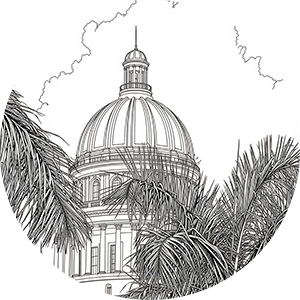
And then, after a long slog from the airport, we could see the one building which did look brand new in Havana, El Capitolio. The National Capitol loomed ahead on the left, and as we got closer, we could see the crowd building outside.
And there were palm fronds in every hand.
“Oh, wow,” said PJ.
“Finally,” Essie muttered.
We pulled into the back side of El Capitolio, where Hal had set up a security perimeter and some big tents covering the road and the back entrance to the building. As we got out, I noticed that Diego had somehow managed to change clothes; he was now wearing a light gray seersucker suit with a bowtie that had the Cuban flag on it.
I thought that was maybe a little more fun than the moment called for, but I looked at Marisol, and I could tell that I was wrong. She definitely approved.
So I grabbed PJ’s hand.
“You don’t want me to film this?” she asked me.
“No,” I said. “Let Marisol do it.”
And PJ gave her the camera, which she accepted happily.
I led my wife up through a rear service entrance into the building, as part of a large procession led by Diego and Essie. Soldiers in dress whites, swords on their belts, escorted us through a hemicycle that led into the Salón de los Pasos Perdidos, the Room of the Lost Steps, which was the long, beautifully decorated hallway of the somewhat recently restored building, and past the 15-meter-high Statue of the Republic into the main rotunda. There, Diego stopped – and Hal was waiting for him with Gen. Ignazio Brigante, who was the head of the Cuban Army. Hal introduced Diego to Brigante, who embraced him. The hundreds of dignitaries in the room burst into applause.
“Wait,” PJ whispered to me after I explained who Brigante was. “The Army is backing this?”
“Pierce did a deal with them. Basically, GAESA, which is the company that owns most of everything in Cuba, is merging with TODO. These guys are all getting really, really high-paying jobs working for TODO, and that merger is going to create one big, giant corporation which pretty much has most of the economy. And then TODO is going to cut loose that monopoly piece by piece, which will give these guys a chance to be business owners with TODO as a silent partner, a capital backer who can guarantee loans, access to equipment and technology and so on. It’s a good deal for them.”
“Yeah,” she said, “but…”
“But what?”
“They’re supposed to be soldiers, not businessmen.”
“Yes, I know. And yet, if you want to run Cuba, this is what you do.”
“OK,” she said.
Then I saw Pierce, who was stepping forward to shake hands with the general and Diego. There were smiles all around as the people in the hall engaged in conversations. I looked at my watch and saw that the time was 3:58 p.m.
“Almost showtime,” I said. PJ squeezed my hand. She smiled when I looked at her. Then she nudged me.
“Diego’s trying to get your attention,” she said. “Go see him.”
“Come with me,” I said. She shook her head and smiled. So I walked over.
Diego introduced me to the general and a few other of the regime holdovers who’d played their cards correctly and didn’t need to get on planes, at least not yet.
“I want to thank you, Mr. Holman,” said Brigante. “Your organization has done what none of us thought possible, which is to bring real change to Cuba without firing a shot.”
“We just… helped people,” I said. “We had the right resources and we came along at the right time. It was the Cuban people who made the change.”
I guess that was the right answer, because Brigante smiled and shook my hand again.
I’d heard that he was a snake. He’d come up as an especially political animal inside the FAR (the Cuban Army), and he’d spent time as an “adviser” in Nicaragua, Venezuela, and Bolivia. I’d not been particularly happy that TODO had absorbed him, and Trent especially was against it. But Pierce had guaranteed Brigante was “a player of the game,” and that once bought, he would stay bought long enough that the project would consolidate its control.
“If not,” Pierce promised, “there’s going to be a different military in charge of Cuba.”
And Pierce was smiling ear to ear as I shook hands with Brigante. PJ had made her way next to Pierce; she gave him a friendly kiss on the cheek.
“Are we ready to do this?” said Diego. There were nods all around. So the soldiers opened the three large double doors leading out onto the 55 Capitolio steps, and Diego led the procession down 18 of them to where the podium and the bank of microphones were, flanked by the Zanelli bronzes of Virtue and Labor which adorned the sides of the building’s portico.
There were large TV screens set up on the buildings across the street and above the park on the south side of the Capitolio. And there were people, and palm fronds, as far as I could see in every direction. The street in front of the building had been blocked off for five or six blocks, and it was filled with a sea of onlookers.
Brigante took the microphone first, his voice booming out over the sound system, and he was congratulating the Cuban people for their patience and perseverance, and he promised that a new day had dawned and many positive changes were coming, as so much of Cuba had already seen. And then he introduced Diego as Cuba’s favorite son and the man who would oversee the next step in Cuba’s development.
He gave Diego a title that we hadn’t discussed. He called Diego “El Interventor de Cuba.”
“What’s up with that?” I asked Pierce, who was standing next to me.
“It’s a Spanish term. It’s essentially like a trustee of a business in receivership. And let’s face it, that’s what Cuba is. So it fits. And it’s specifically not a political term, because Diego didn’t want a political title.”
“Right,” I said, “because he’s not a politician.”
The crowd was buzzing, and Marisol was tapping me on the shoulder.
“Mike, listen!” she said.
So I did.
“Boom-badaba, Boom-badaba, Boom-DI-E-GO, Boom-LA-BA-LA.”
Diego turned back to us from the podium, and he smiled at Pierce and me.
“Thank you,” he said, nodding.
“You’re welcome, buddy,” said Pierce. “This is your moment. Throw strikes.”
Diego turned back slowly, like a man conserving something. The crowd in the plaza below, and on the street, and the park to the south of the building, had gone from jubilant to still in a way that felt almost physical, like the whole crowd had taken one breath and was holding it. Palm fronds everywhere, thousands of them, were catching what little breeze came off the harbor.
What came to mind was that famous moment in Fenway a few years earlier when Diego, in his final season, on the mound for the Marlins against the team with whom he’d built his legend, came set for the 0-2 pitch against Xander Bogaerts with two outs in the bottom of the ninth.
That night, he’d ripped his slider past Bogaerts’ bat for the final out of his perfect game. Seventy thousand people waited to see the result of this latest performance.
“Cubanos,” he said, and let it sit there a second. “You are free.”
The plaza didn’t quite erupt. Something a little different happened.
It made a sound I’d never heard a crowd make before, something between a sob and a roar, like sixty years had been sitting on their chests, and somebody had finally taken the weight off. Essie, who was standing just in front of me, reached back and grabbed my arm without seeming to know she was doing it.
“Communism is over in Cuba,” Diego said. “Not reformed. Not adjusted. Over. You will never again be told what you may own, what you may say, what you may believe, or where you may go, by anyone in this government, for as long as I have anything to do with it.”
More noise. Next to me, I heard PJ’s camera motor whirring, catching all of it.
“I know what comes next in your minds,” he went on. “Because it is the same thing that came after every revolution this island has ever had. You are waiting for me to promise you an election. Fidel stood in the mountains and promised you elections within eighteen months, and freedom of the press, and the restoration of your constitution. That was sixty-seven years ago. I am not going to stand here and lie to you the way he did, because you have been lied to enough for several lifetimes.”
That landed differently. The crowd went quiet again, quicker this time, like they weren’t sure whether to be relieved or afraid.
“I’m not here to govern this country,” said Diego. “Cuba has been governed. It’s been governed to death. You all know it. Yes, we will have law and order. But instead of imposing it on the people, it will come from the people. Where TODO de Cuba has begun operations, a police force has been hired and trained, and its mission is to protect and serve. To keep the peace, not to oppress the people.
“Our experience with governance in this country, going back to before the communists took us over, has not involved protection and service. Accordingly, governance is not our national project. Reconstruction, and repair, are now our agenda.
“We will rebuild our infrastructure, our lives, and our communities. And when that is done, when we are standing, we can talk about who is to govern us.
“For Cuba is not standing right now. Cuba is lying on the ground, flat on its back, and it has been there for a very long time. You know this better than I do. You have walked it, you have starved on it, you have buried people because of it. A country in that condition cannot afford politics. It cannot afford ideologues promising you paradise while the lights stay off and the children go hungry. Politicians and ideologues are what ruined this country in the first place, and I will not add myself to that list by making you a promise I can’t keep so that you’ll cheer for me today.”
He paused, and I watched him scan the crowd, unhurried, like he was trying to actually look at people rather than past them.
“So here is what I will promise you instead. Give me ten years. Not blind faith – I don’t ask you to trust me because I say pretty things from these steps. Judge me by what gets built. Judge me by whether the lights come on, whether the water runs, whether your house is fit for habitation and has modern conveniences, whether your children can go to a doctor or you can buy a coffee and ride a bus that comes when it says it will – or better, whether you can afford a car of your own because the job you work pays you enough for one.
“If, ten years from now, I have not given this country back to you standing on its own feet, then I will be the first one to tell you to throw me out and send me back to my beer company in Miami. But until that day, I am asking you for trust, and I am asking you for patience, because those are the only two currencies Cuba has left, and we are going to need every bit of both.”
He let the silence hang a moment before he said the last line, quieter than the rest, so quiet the PA almost lost it.
“Sesenta y siete años de política te mataron. Dame diez años sin ello y te lo devolveré con vida.”
Sixty-seven years of politics killed you. Give me ten years without it, and I will give you back alive.
Then he raised his arms above his head and smiled, before setting his feet and raising his leg as though he was starting his windup. The crowd went utterly wild, letting out a roar I’m sure Fidel would have turned green as his army jacket with envy over.
Marisol was crying. Essie wasn’t, but her jaw was doing something I’d never seen it do before. And PJ was kissing my cheek.
“I’m so freakin’ proud of you I can’t stand it,” she said.
Diego’s party was staying at the Hotel Parque Central, and I managed to talk PJ into staying the night and flying back the next morning. She was happy to do it, especially since Hank and Mary, who’d come in on a separate flight and had actually been in the crowd on the street, were also staying in our suite.
We didn’t get back to the hotel until well past dark, and Havana at night was the Havana we’d been briefed on — a city that went black block by block as the sun went down, generators coughing to life outside the handful of buildings that had them, everyone else just gone, swallowed into it, like the city was rehearsing for its own funeral every single evening.
I felt guilty that we had power. We were on the hotel’s rooftop terrace with several hundred other people as TODO de Cuba was throwing a reception for Havana’s elites. Looking out over Havana reminded me of all of those satellite images of North Korea after dark – just a bleak void, penetrated here and there by a garbage-can fire or a few lights running on generators.
Other than in the case of the big hotels like ours, which were islands of light in a sea of lifelessness.
The people of the city were nonetheless in the streets, and there was music – the Diego La Bala song was playing throughout Havana, whether over car stereos or musicians giving their own interpretations, and it was liberally interspersed in the playlist the DJ at the TODO party on the terrace was going through.
PJ had found a comfortable chair, and I could tell she’d had it for the day.
“But I wouldn’t trade this for anything,” she said. “What an experience!”
“It’s amazing,” said Mary. “Just amazing.”
Hank had his field glasses out, and he was surveying Havana, or what he could see of it given the meager and spotty illumination.
“This is where RKTech is really gonna shine,” he said. “We get to rebuild an entire city block by block and make it amazing. We’ll use the new AI modeler and create a detailed plan for the place, and we’ll go house to house and show the folks their designs, and…”
“Seems like you’ve got the rest of your life mapped out,” I said.
“It wouldn’t piss me off if I got to do that,” said Hank. “What a totally historic opportunity, huh?”
“It is that. But remember, the people here have the final say about what their city is going to be.”
“Well, sure,” he said, “but how much resistance to fixing up the place can there be?”
“I think you’d be surprised,” I said. “I’m with you, but you’re gonna want to manage your expectations.”
I don’t think that’s what Hank wanted to hear, but he took it in stride.
Then, a little after nine, Trent’s phone buzzed, and he read the text out loud without much ceremony.
“Scarpetta says that barge is now tied off.”
Nobody but Hal and Diego among the partygoers on the terrace seemed to know exactly what that meant, but I could see the folks making their way toward the edges of the terrace.
The folks were expecting fireworks out over the water, I heard later. That’s not what they got.
I don’t think I’ll ever see anything like it again. There wasn’t a countdown, no ceremony, nothing announced. One second the seafront was the same smudged charcoal it had been every night for years, streetlights standing dead like grave markers, windows dark all the way down the boulevard. And then, block by block, starting from somewhere out past Regla and rolling west along the water, the city just came back.
It wasn’t gradual. It was a wave. Streetlights popped on in strings, whole buildings lit up floor by floor like something being switched on rather than something happening slowly, and the Malecón – the whole curve of it, all the way from the mouth of the harbor toward the Hotel Nacional – went from a dark scar along the water to a ribbon of gold in maybe ninety seconds.
The city made a noise. I don’t know how else to describe it. Not fireworks, nothing that organized – just a rolling roar that started down by the water and moved through the streets like the sound was chasing the light, people pouring out of buildings that had been dark five minutes earlier, running for the Malecón with whatever they had in their hands, some of them still holding the same palm fronds from that afternoon.
“They can see,” Essie said, very quietly, and I realized she was crying now too, for the first time since we’d landed. “Mike. They can actually see.”
PJ had rallied, and she had her camera up and rolling. I remember thinking, watching her face lit gold from the streetlights three miles away, that whatever ended up on the cover of the book, it wasn’t going to be that tarmac photo anymore.
What I thought of was CPR. TODO had rolled a barge with an Eagle Model 5 reactor on it into the harbor, docked it next to a power substation, and Scarpetta had flipped the switch on it, and it was just like applying those paddles to the patient’s chest and yelling “Clear!”
And just then the heart started beating. I could feel the pulse, I thought, though it might have been that fourth mojito which did it to me.
PJ lasted another 20 minutes, and then she begged me for a foot rub back at the room. I happily obliged, and she fell asleep with her clothes on only a few minutes into the procedure.
I don’t think anybody else went to bed in Havana that night. I don’t think anybody wanted to risk closing their eyes and finding it had all been a blackout dream.
And the next day, we flew back to Palm Beach.
The day after that was the midterm election.
We were watching the returns on Holman Media’s live podcast channel from the house, and it was something of a combination watch party/reunion for the PGFI team. Stan and Trina were there, Trent had brought a bunch of Colon Conquistadores, though PJ insisted they be smoked outside, Melissa had brought her new boyfriend, who was a speedboat racer from Fort Lauderdale, and Hank and Mary were over.
It was clear the turnover in Havana was making a major difference in race after race. Republicans won Senate seats in North Carolina, Maine, and Michigan, which seemed iffy based on polling; the GOP candidate in Texas won huge, and in Georgia there was a surprisingly comfortable win over the Democrat incumbent who’d run a bunch of commercials late in the race asserting it was only a matter of time before Trumbull plunged us into a war over Cuba.
And the House was also looking good for Team Trumbull. When the party broke up around 10:00, they were projecting Republicans would be holding as many as 227 seats, not including the one in Vermont where Chad Dudenberger, the Libertarian comic book store guy, had throttled Prentiss Plantagenet, the felonious dog lover from the Marxist Union of America convention, by a 59-41 margin.
So as we were getting ready for bed, the guests having filed out and the dogs having been walked, my cell rang. It was the president.
“Hey Mike,” he said, “I just wanted to call and say thanks. You know, you guys took your time, and it was almost too late, but you really pulled our chestnuts out of the fire with that miracle in Cuba. I gotta thank you. You did great.”
“Well, thanks, Mr. President,” I said, getting a smile out of PJ as I plopped down on the bed next to her. “But I really think Diego is your guy. Without him leaning into this and giving it a proper front man, putting his stamp on it, we couldn’t have gotten it done.”
“Yeah, I understand,” he said, “and I’m definitely givin’ old Diego a call in the morning, but I know it was you who recruited him in the first place.”
“Actually, I think that was Stan…”
“Anyway, look – we’re really set up to do some great things, and after the first of the year I want to get you and your crew up to the White House to talk about the future. OK? You have great ideas.”
“Well, thanks,” I said. “Let me give you one right now.”
“What’s that?”
“So earlier today, my guy Jason Belcher, who now runs TODO all over eastern Cuba, calls me and says that the biggest problem they’ve got with this project is that there’s a disastrous labor shortage. Because so many Cubans have picked up and left, and they were all the young people, the population that is there now is really, really old. Jason was telling me he’s got 60-year-olds hauling rebar all over Holguín and Santiago, and it’s not the way to do business.”
“OK, I see that.”
“There are a ton of Cubans in Mexico, and we’re actually flying them back at our cost,” I said. “It’s working out. But honestly, I don’t think that’s enough.”
“Well,” he said, “I got plenty of illegals who need a place to go. I don’t mind sending them to Cuba if that’ll work. I mean, just because they can’t stay here doesn’t mean I don’t want ‘em to have a nice place to land.”
“It isn’t a nice place,” I said. “Not yet. But it will be.”
“Cuba Libre,” he said. “And Cuba Rica. Isn’t that what Stan’s doing, Cuba Rica?”
“Yep.”
“Hell of a guy,” he said. “You, too. Amazing work you’re doing. Nobody’s ever seen anything like it.”
Coming Saturday, September 12: Episode 10, the conclusion, of Scott McKay’s The Necessary Men.
Catch up and follow along at “The Mike Holman Novels at The American Spectator.” Signed copies are available for pre-order at MikeHolman.com!
Read more Spain’s Sánchez Compiles Blacklists of Journalists and Tries to Tamper With the Electoral Roll
About the Author