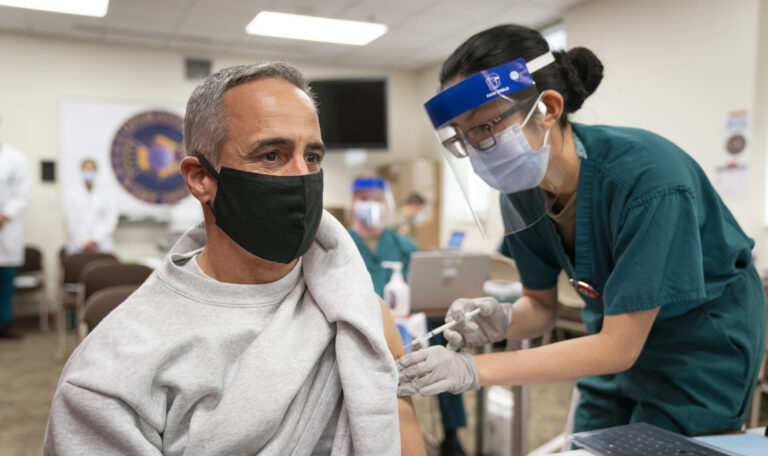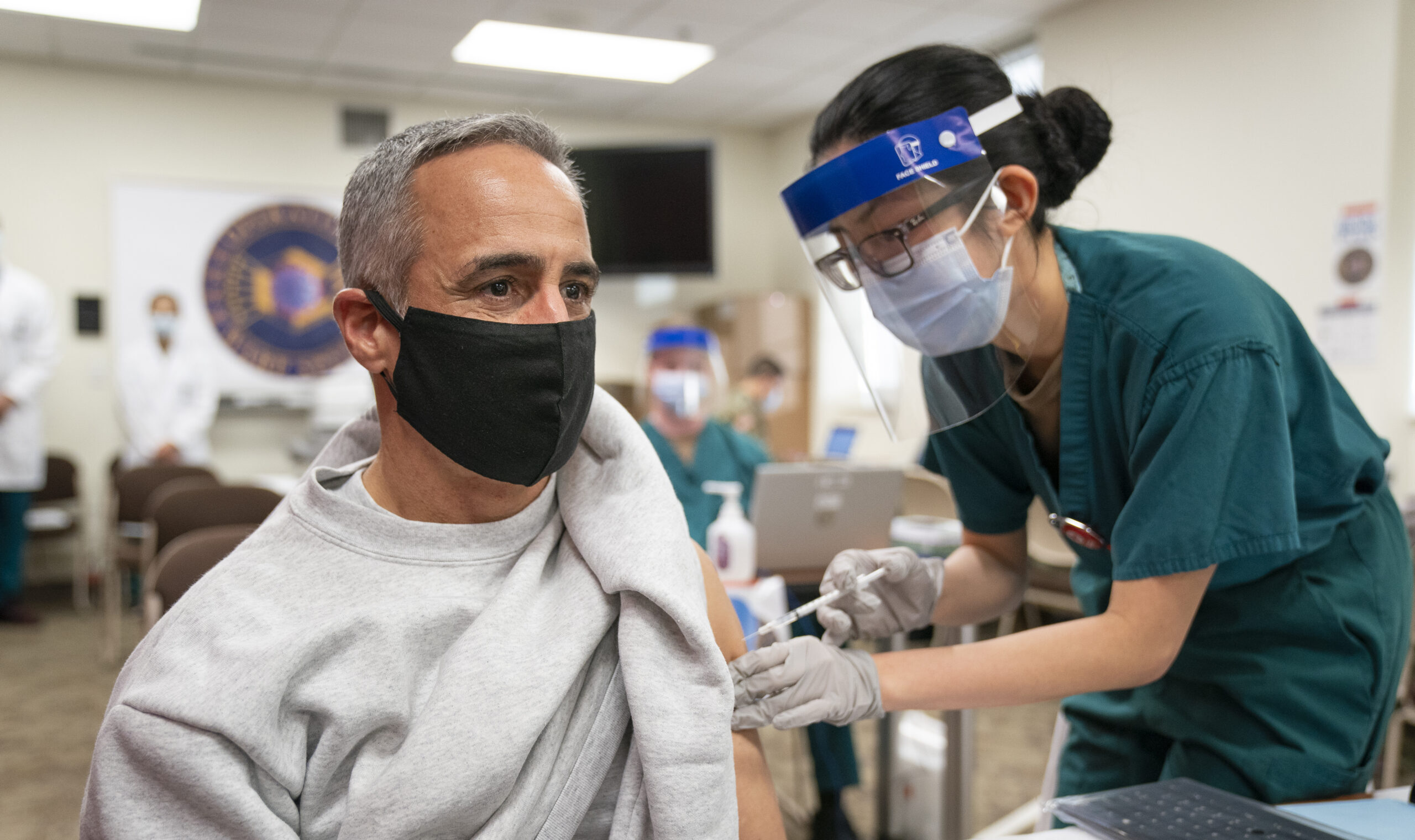
Senior Enlisted Advisor to the Chairman (SEAC) Ramon "CZ" Colon-Lopez receives a COVID-19 vaccine at Walter Reed National Military Medical Center, Bethesda, Md., Dec. 21, 2020. (DOD Photo by Navy Petty Officer 1st Class Carlos M. Vazquez II)
By all accounts, Jacob Clynick was a healthy 13-year-old boy. Like most teenagers, he was obsessed with Pokémon and more than fluent in the language of internet memes. He was supposed to start his freshman year at his local high school in the fall.
Read more The DSA Wants to Overthrow Our Constitutional System
Then, on June 15, 2021, he went to bed and never woke up.
Suddenly, Jacob became politically relevant. Jacob, you see, had received his second dose of the Pfizer mRNA vaccine on June 13, two days earlier. His family was informed that a preliminary autopsy had discovered that his heart had been enlarged at the time of his death and that there was fluid buildup around it — findings consistent with myocarditis.
His case was rushed off to the Centers for Disease Control and Prevention for investigation. Days later, the CDC held an unrelated emergency meeting to discuss the fact that some 1200 young people — primarily adolescent boys — had experienced myocarditis or pericarditis after receiving either COVID mRNA vaccine (usually after the second dose).
By the time the CDC posthumously diagnosed Jacob with a fatal and convenient case of a bacterial infection, Clostridium septicum, his family was convinced otherwise. His father told the Detroit Free Press he was sure his son’s death “had to have something to do with the vaccine. It doesn’t make any sense that it wouldn’t.”
Randy Tashjian, then deputy chief medical examiner at the Michigan Institute of Forensic Science and Medicine, seems to have agreed, although he was more cautious in blaming the vaccine itself. He listed “myocarditis of unknown etiology” on Jacob’s death certificate. Three days before he signed the autopsy, he co-authored a medical paper stating that there was a suspected link between the second dose of the vaccine and the death of Jacob and another teenager, which were attributed to an abnormal form of myocarditis.
Two years after Jacob’s death, Kim Witczak, a former FDA advisor and public health advocate, and several academics used that medical paper as well as medical literature tying the deaths of several German adults to the COVID vaccine to request that the FDA update its vaccine labels. Specifically, Witczak and her fellow academics wanted the labels to list the risk of “sudden cardiac death.” That request was denied.
In May 2025, Donald Trump’s Department of Health and Human Services recommended that the COVID vaccine be administered via shared clinical decision-making for healthy children and pregnant women, rather than outright recommending it. A few months later, in the fall of 2025, a team of FDA safety officers started compiling “a list of children possibly killed by COVID vaccines,” according to a recent RealClearInvestigations piece. Whether Jacob was among those cases hasn’t been made public.
That seemed promising. By December, the team’s leader, Dr. Meghna Alimchandani, was recommending that the FDA update its labels to reflect those “fatal outcomes.” Yes, the numbers were small: the team originally identified 10 deaths in which a link to the vaccine was probable or possible, later trimming that figure to seven. However, warning patients of even rare complications is standard practice.
Read more Direct Democracy and Its Complications
Ten months later, that language hasn’t been updated.
Former FDA leaders have since said that they had reviewed those same cases and reached different conclusions — that might be true, but it’s a reason to publish that review rather than sit on it.
None of this is comforting. For decades we’ve outsourced all sorts of medical decisions — especially when it comes to vaccines — to the government. Why wouldn’t we? The people who work for the FDA and the CDC are experts. Most of us are not, and we don’t have the time to get that way.
But if the whole COVID saga has taught us anything, it’s that the government is hardly an unbiased source of medical information. Remember, the first Trump administration was responsible for fast-tracking the development of the COVID vaccine in the first place; the Biden administration then exerted enormous pressure on Americans to get that vaccine. Admitting the COVID vaccines were less safe than advertised would, for either side, be admitting to a mistake — something no political party particularly enjoys.
Meanwhile, a veritable war has broken out over whether we can trust government guidelines. The Trump administration insists evidence-based scientific data and transparency will do the trick; the media tells us that nobody in the administration is listening to the science. Polling from Harvard T.H. Chan School of Public Health suggests that American trust in our public health institutions pretty much tracks with whether we agree with the politics of the men in charge of those institutions — hardly a good thing if we want stable medical recommendations.
Then again, maybe it’s not all bad.
Maybe the government shouldn’t be the sole source of public health recommendations. We and our doctors should be able to consider the recommendations of the government and private institutions, as well as our own private health needs in medical decisions.
Perhaps a little competition would encourage rivals to publish relevant data and evidence for its recommendations, meaning we have access to more information in our attempt to make the best decision for us and our children. The effect would be similar to going to a second doctor for another opinion.
If we learn anything from COVID, perhaps it will be a healthy skepticism of recommendations and a willingness to look elsewhere.
Read more The Spectacle Ep. 480: The Islamic Influence Fueling the France Riots
About the Author