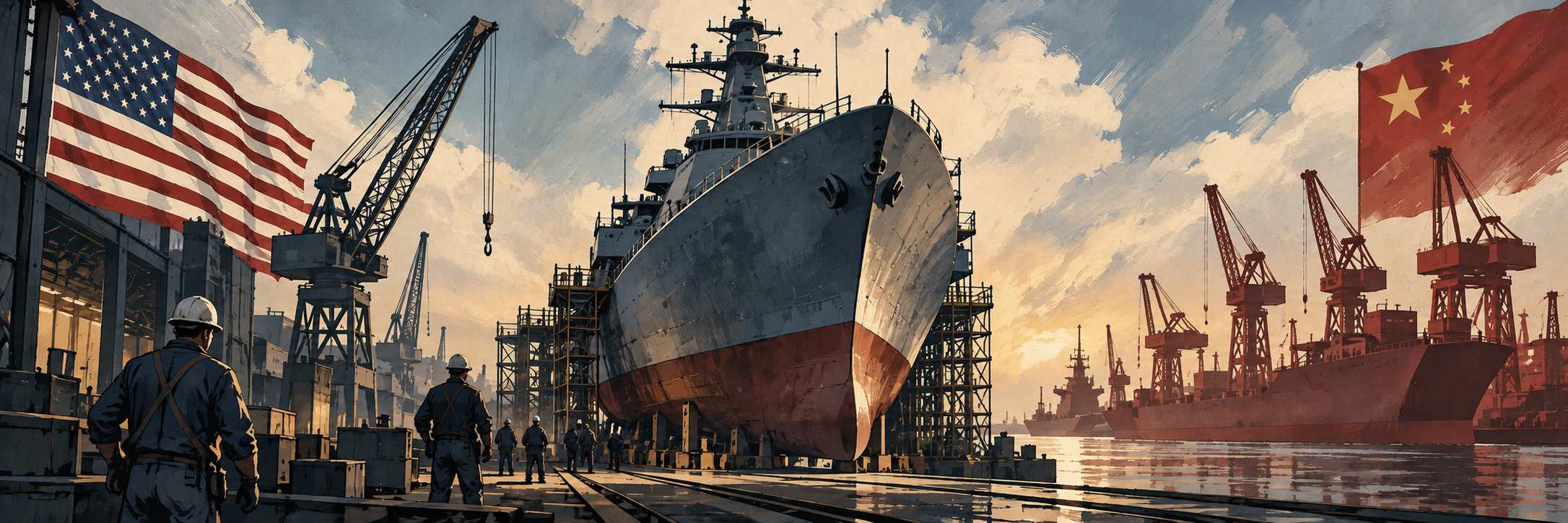
Historian Arthur Herman, more than a decade ago, wrote Freedom’s Forge: How American Business Produced Victory in World War II, which told the story of how the partnership between the United States government and the American business community forged the “arsenal of democracy” that built the ships, planes, tanks, and other weapons and munitions that made victory in World War II possible. America’s industrial might and scientific breakthroughs harnessed by the War Department created the so-called “military-industrial complex.” And after the war, our government created the national security state that harnessed the military-industrial complex to win the Cold War. Those victories were not without costs, including the very real dangers posed by the growth of the national security state and the military-industrial complex, and their influence within the councils of government.
Read more The Anti-Trump Russia Hoax
Today, the United States faces a geopolitical challenge from the People’s Republic of China, a totalitarian power that is potentially more dangerous than Nazi Germany and the Soviet Union were in the last century. If we are going to meet this challenge successfully — which means deterring China without going to war — we will need to revitalize the military-industrial complex to become “freedom’s forge” for the 21st century.
The Trump administration has requested $65.8 billion for our Navy’s shipbuilding with the immediate goal of narrowing the gap between China’s shipbuilding capacity and ours, and with the end goal of restoring and ensuring America’s maritime superiority. It is all spelled out in the administration’s , which was issued in February of this year in compliance with the president’s — Restoring America’s Maritime Dominance. (RELATED: Anchors Away: The Perils of Our Shipbuilding Imbalance)
The Maritime Action Plan recognizes that sea power in its broadest Mahanian sense — commercial and military — is essential to America’s national security.
The Maritime Action Plan sets forth four pillars to achieve Trump’s goals: rebuilding U.S. shipbuilding; enhancing education and training for our maritime workforce; revitalizing the Maritime Industrial Base (MIB); and strengthening and securing the U.S. maritime industry. The Maritime Action Plan recognizes that sea power in its broadest Mahanian sense — commercial and military — is essential to America’s national security. (RELATED: Choke Points and the Future of Naval Power)
Writing in War on the Rocks, Ander Heiles, a surface warfare officer with the U.S. Navy, applauds the Maritime Action Plan as “the most comprehensive since World War II.” But Heiles believes that to implement the plan, the administration has to structure and balance the commercial and naval fleets in accordance with what he calls the “Mahan ratio,” after America’s most influential naval theorist Alfred Thayer Mahan. Mahan wrote in the late-nineteenth and early twentieth centuries about the need for a powerful navy supported by commercial shipping. He quotes Mahan on this point: “Sea power includes not only military strength afloat … but also the peaceful commerce and shipping from which alone a military fleet naturally and healthfully springs, and on which it securely rests.” Warships protect merchant ships, Heiles notes, but merchant ships “generate the wealth that sustains military power.”
Read more Campaign Door Knockers
The Mahan ratio divides the nation’s merchant fleet by its navy fleet. Heiles notes that at the end of World War II, we had 3,364 merchant vessels and 634 navy ships — a 5.31 ratio. When the Cold War ended in 1991, the Mahan ratio was 1.12. President Ronald Reagan’s 600-ship Navy and Navy Secretary John Lehman’s offensive-oriented maritime strategy helped win the Cold War, but as Naval War College professor James Holmes once noted, China “poses a tougher maritime challenge than did the Soviet Union” because, as a Eurasian rimland power, it has focused its naval assets on the western Pacific and the Indian Ocean while simultaneously posing a global maritime challenge to the United States with its vastly larger merchant fleet and its Belt and Road Initiative. Heiles notes that China’s merchant fleet has 8,022 ships to its 395 warships (a Mahan ratio of 20.31), while the United States has only 188 merchant ships to support its 293 warships (a Mahan ratio of 0.65). (RELATED: China, Chokepoints, Blockades, and the Mahanian Revival)
Sea power enabled the United States to intervene in Europe in World War I to help bring about the defeat of the Central Powers. More than two decades later, U.S. sea power helped defeat Imperial Japan and, along with our British allies, won the Battle of the Atlantic, while enabling U.S. forces to invade and liberate Hitler’s fortress Europe. During the Cold War, American sea power played a key role in containing the Soviet Union and ultimately bringing about the fall of the
Soviet empire.
A few days ago, President Trump announced that the government is joining with Anduril Industries to invest $6.6 billion to build torpedo tubes, bows, sterns and other components for Virginia-class submarines in a Baltimore shipyard known as Arsenal-2 at Sparrows Point. This follows a July announcement by the administration that $2 billion will be invested to build two new ships in Philadelphia’s Hanwha Shipyard. Meanwhile, the administration also christened the Lone Star State, a multi-mission vessel “which will train the next generation of merchant mariners at the Texas A&M Maritime Merchant Academy.” Also in July, President Trump announced $10 billion in private investments for defense projects in Pennsylvania, and J.P. Morgan Chase said it will provide $24 million in loans and grants to shipbuilding facilities in Philadelphia. (RELATED: Defense Innovation Summit Looks to Keep America No. 1)
In his farewell address to the nation in 1961, President Dwight Eisenhower prudently warned about “the acquisition of unwarranted influence … by the military-industrial complex” and the “scientific-technological elite.” That phrase is often quoted out of context, because he also said that “A vital element in keeping the peace is our military establishment.” “Our arms,” he said, “must be mighty, ready for instant action, so that no potential aggressor may be tempted to risk his own destruction.” Eisenhower once remarked that the man who won World War II was Andrew Higgins, whose New Orleans-based company designed and mass-produced the landing craft that carried our seaborne troops to the shores of North Africa, Europe, and the islands of the central and southwest Pacific.
More than 100 years ago, Alfred Thayer Mahan understood that the United States was geopolitically an island power for which command of the seas was a vital necessity for our economic and national security. It is no different today, even as the domains of potential conflict have expanded to the realms of space and the cyber-digital-artificial intelligence battlefields. Freedom’s forge for the 21st century will include all of these domains.
Read more El-Sayed Executes Olympic-class, Medicare-for-All Flip-Flop in Senate Debate
READ MORE from Francis P. Sempa:
Realism and Restraint Aren’t the Same Thing
Willie Mays and the Greatest Catch in Baseball History
The Trump-Xi Summit: Geopolitics and Atmospherics
About the Author