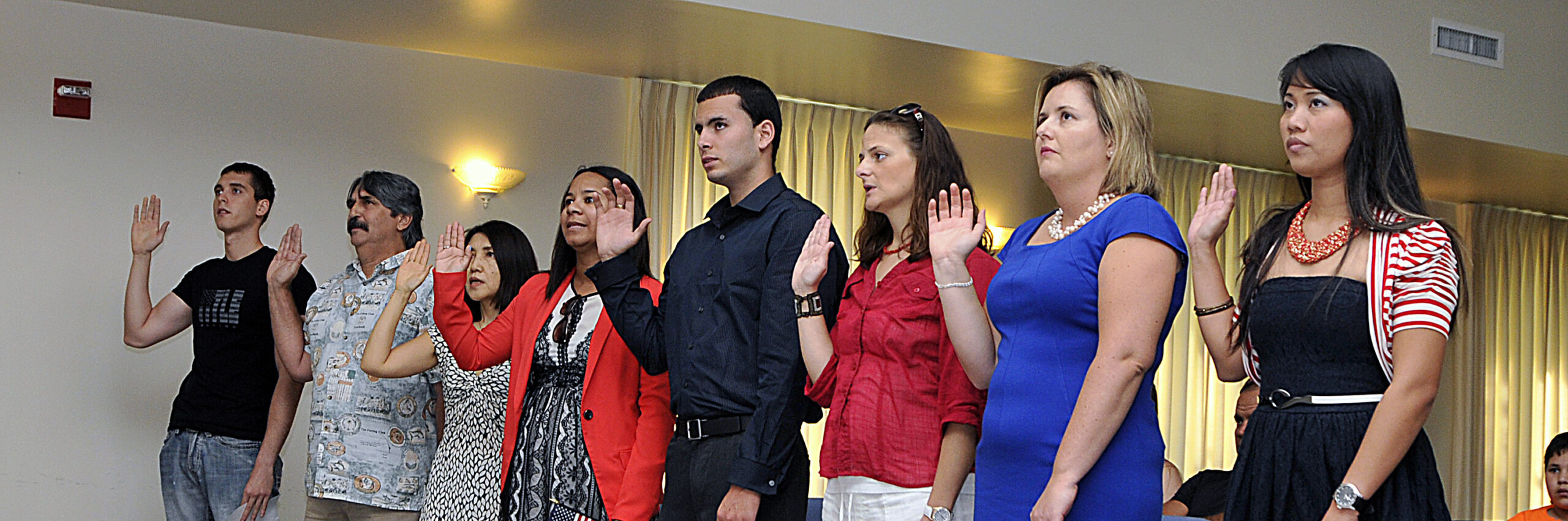
U.S. citizenship applicants from 11 different countries take the oath of allegiance at the Sigsbee Community Center. Naval Air Station Key West is a state-of-the-art facility for air-to-air combat fighter aircraft of all military services and provides world-class pierside support to U.S. and foreign naval vessels. U.S. Navy photo by Mass Communication Specialist 2nd Class Brian Morales/ Released
There has been much heated debate over the decision of the Supreme Court in the case of Trump v. Barbara. The circumstances and facts have ignited quite a firestorm.
Read more Meet the Five Species of Summer Celebrity
The issue at hand is whether the Constitution grants citizenship to children who are born to parents unlawfully or temporarily present in the United States. From the outset, that question is problematic. For starters, it is difficult to determine the number of children in this category. But since border control over periods of years was lax and enforcement spotty, the number of illegal immigrant mothers, according to the Pew Research Center, “grew rapidly” from 2019 to 2023. Pew’s estimate is that births to mothers who are here illegally is approximately 320,000 children annually, meaning that those claiming birthright citizenship over a period of years could well total in the millions. So, the issue of who gets citizenship is critical to a large number of people.
That said, in summary, the reasoning of the majority decision is textually weak … and misunderstands the limits of the actual holding in Wong Kim Ark.
The lawsuit developed because of an Executive Order issued by President Trump aimed at bringing these numbers down. It provided that children born of parents who were here unlawfully or temporarily should not be entitled to citizenship by virtue of their birth. The Supreme Court in a 6-3 decision struck down the Trump executive order and, more importantly, ruled 5-4 that the Fourteenth Amendment guarantees citizenship essentially to everyone born on U.S. soil.
The court’s close divide, 5-4, on the issue of “birthright citizenship” stems from “two competing views” of the 28 key words that make up the beginning of section 1 of the Fourteenth Amendment. It reads: “All persons born or naturalized in the United States, and subject to the jurisdiction thereof, are citizens of the United States and of the State wherein they reside.” Those words constitute the only definition of “citizenship” contained in the U.S. Constitution.
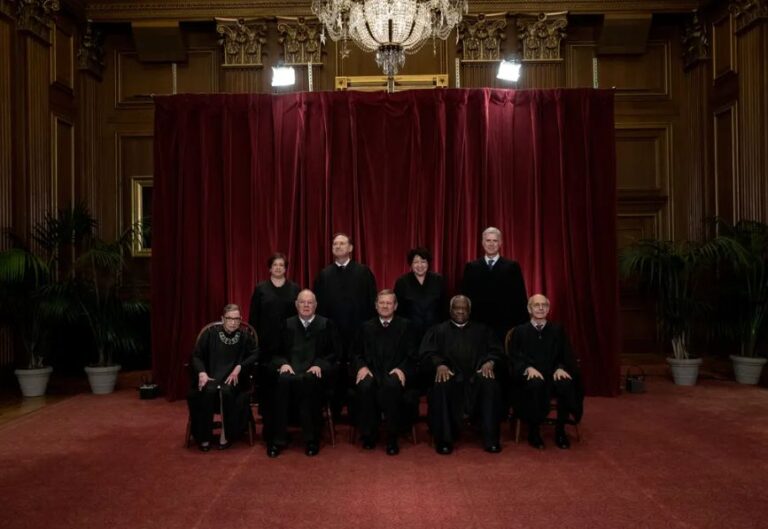
The court’s majority — Justices John Roberts, Amy Coney Barrett, Elena Kagan, Sonia Sotomayor, and Ketanji Brown Jackson — concluded one thing about what these words mean. The Roberts majority opinion was a little longer than the opinion of the court — 7,800 words. And the dissenters — Justices Clarence Thomas, Samuel Alito, Neil Gorsuch, and Brett Kavanaugh, concluded another. The dissenters expressed their serious disagreement with the majority in lengthy dissents, with Thomas’s dissent at 27,477 words and Alito’s at 11,494.
The Battle of the Meaning of Words
The Fourteenth Amendment begins: “All persons born … in the United States.” In order to become a citizen, other than through naturalization, both the majority and the dissenters agree that this event of birth is essential. However, that is the end of their agreement.
Is anything more than being “born on U.S. soil” required for citizenship eligibility? For the court majority, the answer is essentially, no. Respected Fourteenth Amendment scholar Richard Epstein aptly describes themajority position this way: “Mere birth on U.S. soil results in automatic citizenship for the child regardless of the parents’ presence in the United States — whether temporary or permanent, lawful or unlawful.” According to the majority view, these “birthright” claimants are entitled to all the “privileges and immunities of citizens,” the result described in the second sentence in the Fourteenth Amendment.
By contrast, the dissenters argue that there is more to qualifying for citizenship than “being born in the United States” because the Fourteenth Amendment continues with additional language immediately following the reference to being born here. The phrase is composed of two clauses: “All persons born or naturalized in the United States and subject to the jurisdiction thereof are citizens of the United States.” This phrase contains two separate requirements. Grammatically, there is the requirement “to be born,” which is connected byandto a second requirement, to be “subject to the jurisdiction thereof.” Defying the obvious grammatical arrangement, the majority claims that the language does not create two separate requirements. Instead, the justices say, being subject to the jurisdiction of the United States is the natural byproduct of being born here.
The dissenters did not accept the majority’s casually brushing the phrase “subject to the jurisdiction thereof” aside as being merely part of being born. The dissenters, being committed to a jurisprudential philosophy of paying close attention to the textof any document they are considering, insist that the second part of this phrase needs further explanation. They begin by probing the meaning by examining its historical relationship to the Civil Rights Act of 1866 (CRA). The reason for that approach will become obvious.
The CRA’s purpose was to guarantee citizenship to the newly freed slaves born on U.S. soil and making their home/domicile here. However, the CRA was only legislation, and a different legislature could easily repeal it. Consequently, the Fourteenth Amendment was crafted to “constitutionalize” the CRA, a fact which is undisputed, thus removing any doubt about the authority of Congress to pass it. Extremely important for interpretive purposes is the fact that what the Civil Rights Act meant and required should help us to understand what the Fourteenth Amendment means and requires.
Read more Fifth Amendment Fauci’s Narcissism Destroyed Faith in Scientific Methodology
When the dissenters scrutinize the language of the Civil Rights Act, they find that it specifically denies citizenship to anyone born in the United States who is subject to any foreign power. The exact language of the CRA is that “all persons born in the U.S. and not subject to any foreign power” are citizens. Professor Epstein rightly argues that since the Fourteenth Amendment was understood to place the Civil Rights Act on firmer constitutional footing, the amendment itself cannot be read as requiring lessthan the Civil Rights Act required.
Therefore, the dissenters argue that being born plusowing allegiance to America alone — that is, being completely subject to U.S. jurisdiction — are the dual requirements of citizenship under the Fourteenth Amendment. While being a bit complex, the dissenters are using airtight textual analysis. Necessarily, this reading of (1) being born on U.S. soil and (2) not being subject to foreign powers, excludes the children of aliens born subject to another nation’s powers and runs counter to the majority’s stance on citizenship.
There is another counterargument to the majority’s claim that “subject to the jurisdiction thereof” is not a separate requirement, that it is merely a byproduct of being born on U.S. soil. There does exist a broad, automatic expression of jurisdiction offered to all by the drafters of the Fourteenth Amendment. In the Equal Protection Clause of the Fourteenth Amendment, “equal protection” is promised to any person “within its jurisdiction.” The two clauses are different with different purposes. The citizenship clause is a limiting clause, requiring absolute allegiance of those seeking citizenship, and by doing so, explaining who can gain and who cannot gain citizenship. The dissenters argue that the citizenship clause restrains by means of the language “subject to the jurisdiction thereof.” By contrast, the equal protection portion of the Fourteenth Amendment freely extends to “any person within its jurisdiction” the promises of equal and fair treatment. In both cases, jurisdiction is discussed, but one jurisdictional requirement is intended to limit participation and the other, with different language, is to freely offer coverage. If, indeed, the drafters wanted citizenship to be automatic they could have used the all-inclusive “within its jurisdiction” in the citizenship clause. They did not because that was not their intention.
A Feudal Rebirth to Support Birthright Citizenship?
The majority makes another attempt to support its claim of citizenship based solely on birth by making a connection with the English common law doctrine of jus soli, “the right of soil.” This choice is certainly a strange one in the very year America celebrates it 250-year separation from England. Be that as it may, according to the doctrine of jus soli, a doctrine of feudal origin, a child born within the king’s realm was made a subject of that sovereign upon birth, permanently, with no consent or confirmation needed on his part. The child, being born within the king’s dominion, immediately owed obedience and allegiance to the king and the king owed his new subject protection. “This view crossed the Atlantic,” says Chief Justice Roberts, although there does not seem to be strong evidence for that. Justice Alito says frankly that there was “no such thing as a ‘citizen’ of England, Scotland, or Ireland. The inhabitants of the British Isles were the king’s subjects.”
Why the majority chose to endorse this old doctrine is perplexing. Relying on a feudal version of citizenship by birth-allegiance to the king runs afoul of the essence of American citizenship. As Justice Gorsuch says, the glory and dignity of true American citizenship is offered “to any child born in this country to parents who have made this Nation their permanent home.” It is consensual, freed from the bonds of feudal duties. Moreover, as the dissenterspoint out, the Declaration of Independence proclaimed all allegiances to the British Crown absolved. Consequently, the argument of the majority based on jus soli does not seem to resolve but clouds the issue of birthright citizenship.
The Wong Kim Ark case: Convincing or Confusing?
Both the members of the majority and the dissenters made reference to the oldest Supreme Court case that takes up the issue of birthright citizenship: the 1898 case of Wong Kim Ark. The massive immigration of Chinese to this country in the late 19th century serves as the backdrop to this case. That immigration wave was met with hostility. By statute, Chinese immigrants could not be naturalized and in fact, in 1882, Congress banned any further Chinese immigration under the Chinese Exclusion Act.
Now to the case. Wong Kim Ark’s parents, who were of Chinese descent, had arrived in the United States earlier than the ban and were described in court documents as having “established and enjoyed a permanent domicile and residence” in California where Wong Kim Art was born in 1873. He considered his home to be in America. He traveled back to China but at the end of a second return trip he was refused admission on the ground that he was “not a citizen.”
The majority in Trump v. Barbara relies heavily on this case, with Chief Justice Roberts writing: “What the Court held in Wong Kim Ark was simple: the Citizenship Clause incorporated the common law and granted citizenship to nearly all children born in the United States.” That characterization of Wong Kim Ark conflicts with the language of the actual holding of the case. Justice Gray set out the holding: “[A] child born in the United States, of parents of Chinese descent, who, at the time of his birth, are subjects of the Emperor of China, but have a permanent domicile and residence in the United State, and are carrying on business, and are not employed in any diplomatic or official capacity under the Emperor of China, becomes at the time of his birth a citizen of the United States.” How to interpret this?
As Professor Edward Erler explains it: “To say that children of legal aliens are entitled to citizenship is one thing; [Wong Kim Ark] after all, their parents are in the country with the permission of the United States. It is entirely different with illegal aliens, who are here without permission.” Justice Alito puts it this way: “Wong Kim Ark is therefore best understood as holding that people who are lawfully present here, establish the United States as their intended permanent home, and do everything within their power to become United States citizens can be seen as no longer subject to foreign power.” That is, they have become citizens. However, that is a far cry from the far different determination that children of aliens are automatically citizens as the majority maintains.
Obviously, this controversial case of Trump v. Barbara involves many nuances and much dispute. That said, in summary, the reasoning of the majority decision is textually weak, introduces questionable parallels with the ancient doctrine of jus soli, and misunderstands the limits of the actual holding in Wong Kim Ark. As a result, it spawns a new magnet to attract migrants — birthright citizenship. That reality will only compound the already muddled state of U.S. immigration law and policy.
Read more The FCC Pulls the Plug on Beijing’s Bots
READ MORE from John A. Sparks:
A Victory for Women’s Sports: West Virginia v. B. P. J. and Little v. Hecox
Colorado Tries to Ban Faith-Informed Counseling: Chiles v. Salazar
Elementary School Parents Fight Gay/Trans Books
About the Author