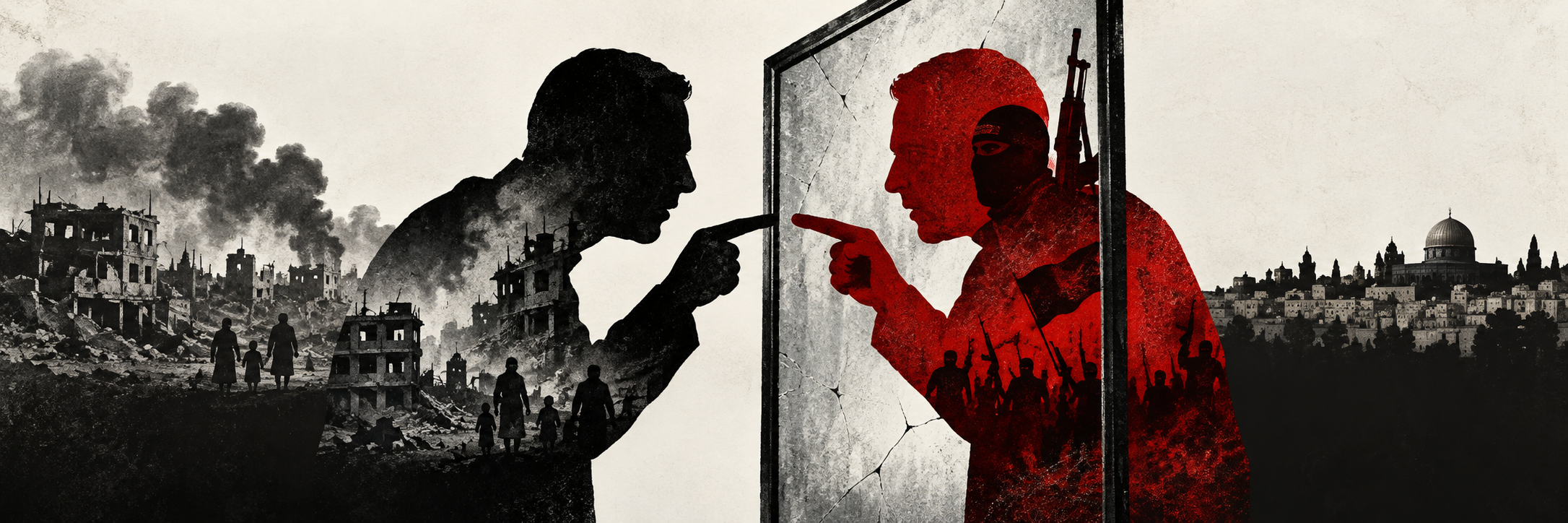
Some lies falsify history; others invert it. The 1903 Protocols of the Elders of Zion, still exerting influence over a century later, falsely portrayed Jews as conspirators controlling the world. Now comes NAZA, a film accusing the Jewish state of genocide — and bearing a title that echoes “Nazi,” while the film invokes comparisons with Nazi Germany. Genocide is the crime at the core of modern Jewish memory, so the accusation is especially cynical because it twists the crime that nearly destroyed European Jewry into a charge against Israel.
Read more Ukraine’s Robot Army Makes Big Strides
The question is whether Israel’s conduct meets the definition of genocide, or is it the latest incarnation of the greatest lie in history? If so, how can we understand this dangerous distortion?
The accusation must be judged by the definition of genocide, not by the emotions behind it. Under Article II of the Convention, genocide consists of specified acts: killing members of a group or inflicting conditions of life calculated to cause physical destruction, “committed with intent to destroy, in whole or in part, a national, ethnical, racial or religious group.” Civilian death alone does not meet that definition. The ICJ opined in Bosnia v. Serbia (2007) that when genocidal intent is inferred from a pattern of conduct, it must be the only reasonable inference the evidence allows. If the conduct is reasonably explained by another purpose, the standard is not met. (RELATED: NAZA: When an Anti-Israel Gaza Documentary Wins at Venice)
Israel had an obvious military purpose. On Oct. 7, Hamas killed 1,200 Israelis, mostly civilians, and took 251 hostages. The intent of the ensuing war was to destroy Hamas’s military capacity and to rescue the hostages. Given the complexity of urban warfare against a vast underground tunnel fortress, the use of private homes to store weapons, and Hamas’s cynical use of human shields, tens of thousands of Palestinians were killed. Yet, John Spencer, chair of urban warfare studies at West Point’s Modern War Institute, argued that Israel took more measures to prevent civilian harm than any other military. (RELATED: Look Back in Anger: The October 7 Commission Report)
A regime bent on extermination does not tell its victims where to go to survive.
The way the war was fought indicates that the objective was not to destroy the Palestinian people. Israel issued evacuation orders through leaflets, phone calls, and broadcasts, and paused operations to allow civilians to move out of danger. Such warnings sacrifice one of warfare’s most basic advantages: surprise. The perpetrators of the last century’s genocides did the opposite. The Nazis used deception to move Jews toward the killing sites. In Rwanda, militias set up roadblocks to catch Tutsi trying to flee. A regime bent on extermination does not tell its victims where to go to survive.
The genocide charge also fits poorly with the position of Arab citizens inside Israel. They vote, sit in the Knesset, and serve as judges, including the Supreme Court. A 2025 study in the Israel Journal of Health Policy Research found that in 2023 Arabs made up 25 percent of employed physicians, 27 percent of nurses and dentists, and 49 percent of pharmacists. In 2010, only 8 percent of physicians were Arab. This 17-percentage-point increase in physicians in 15 years, together with a 35 percent increase in Israel’s Arab population, is inconsistent with an intent to destroy a people.
Psychology offers a possible explanation of how this grave accusation becomes widely accepted: the defense mechanism of projection. In my recent JNS article, “The new blood libel: Hatred of the sacred,” I argued that antisemitic accusations operate by the accuser placing disowned impulses onto Jews, and then condemning them for possessing those impulses. “I want to harm you” becomes “You want to harm me.” The baseless and libelous allegation that Israeli soldiers trained dogs to rape Palestinians illustrated that mechanism in grotesque form.
The genocide accusation is different. Many Palestinians have suffered and died. But when genocide is proclaimed as an established fact while Hamas’s stated aim to eliminate Israel is overlooked, this psychological inversion is worth considering. Projection cannot decide a legal case. But it may explain why some people voice the genocide charge against Israel with visceral certainty while showing little curiosity about Hamas’s declared aim to eliminate it. The concept sheds light on why calls to eliminate Israel are described as liberation while Israel’s war against an armed organization is described as a plan to destroy a people.
Read more The Spectacle Ep. 473: Trump Made CAFE Standards Great Again
The eliminationist language in this conflict is not hypothetical. Hamas’s 1988 charter declared that Islam would obliterate Israel. Its 2017 policy document softened the tone but still rejected any alternative to liberating all of Palestine from the river to the sea. Less than a month after Oct. 7, senior Hamas official Ghazi Hamad told Lebanese television that the attack would be repeated — again and again — until Israel was gone. Hamas’s declared aims, stated openly by the party that began the war, receive no comparable scrutiny from most of Israel’s accusers.
Nor is such rhetoric confined to Hamas. In a 2018 sermon, Jordanian imam Al-Rawashdeh declared that Allah gathered the Jews in Palestine so Muslims would not have to pursue them throughout the world, facilitating their annihilation. The grim historical irony is unmistakable: Nazi Germany devoted enormous resources to transporting Europe’s scattered Jews for extermination; in Al-Rawashdeh’s sinister vision, Zionism accomplished the ingathering. The rhetoric is not merely eliminationist but explicitly genocidal: the destruction of Jews as a people. Seen through the lens of projection, the inversion at the heart of the genocide charge becomes stark — the genocidal intent is directed at the Jews, while Israel is accused of harboring it.
Against this background, the chant “From the river to the sea, Palestine will be free” takes on a darker meaning. Some protesters say it means equal rights for Palestinians and Jews throughout the territory. Yet Hamas’s documents envision a Palestine that replaces Israel, and its leaders have repeatedly coupled that objective with explicitly eliminationist — and at times genocidal — rhetoric. That leaves a plain question for anyone chanting the slogan: what place, and what safety, would Jews have in that Palestine? Considering the history of Jewish persecution and expulsion, the question has an ominous resonance: if Israel disappears as the Jewish state, where are its Jews supposed to go? (RELATED: Michigan AG Dana Nessel to Jewish Democrats: Sacrifice Yourself for the Cause)
Jews have reason to take that possibility literally. In the quarter-century after 1948, roughly 800,000 Jews left or were driven out of Arab countries where their communities had lived for centuries. In 1950, Iraq passed a law stripping Jews of their citizenship, and about 120,000 left within two years. After the 1956 Suez War, Egypt expelled or pressured out most of its Jews. The Jewish communities of Baghdad, Cairo, Damascus, and Tripoli now number a handful of people. A Middle East emptied of Jews is not an imagined fear. Across most of the Arab world it has already happened.
The persuasive power of the images projected in NAZA strengthens an accusation that is hardening into moral certainty in public debate — a concern heightened when a film is presented at an institution with the cultural stature of Lincoln Center, lending a profoundly contested charge an influential platform. Film, as the history of propaganda reminds us, can make an interpretation feel like an observed fact. (RELATED: Has Support for Israel Become Gen Z’s Scapegoat?)
Projection does not prove an accusation false; only evidence can do that. But when those who openly call for the destruction of the Jewish state accuse Israel of the very crime that they themselves envision, the inversion deserves scrutiny. Examine not only the accusation but the accuser. Ask what they have said they want, in their own words, in their own charters, on their own broadcasts. Ask why the charge of genocide is hurled outward with such relentless force. Projection has fueled lies about Jews for millennia. Naming it is where healing begins.
READ MORE from Robert Schwartz:
When Is the Day After in the Middle East?
Israel Must Obtain an Unconditional Surrender
Robert Schwartz, who holds a Ph.D., is a psychologist and former faculty member at the University of Pittsburgh School of Medicine. He has published pioneering scientific articles on positive psychology and coping with stress, as well as social and political commentaries in the Christian Science Monitor, Jerusalem Post, Arutz Sheva, Pittsburgh Post-Gazette, and the American Thinker.
Read more The Spectacle Ep. 474: Should the Federal Government Pay for College Degrees That Don’t Pay Enough?
About the Author