In 1941, a former Trotskyist who would go on to become a luminary in the conservative movement, James Burnham, published a very influential book. You might have heard of it. The Managerial Revolution argued that the age of the capitalist was ending and the age of the manager was beginning.
Read more Realism and Restraint Aren’t the Same Thing
The people who would run modern societies, Burnham said, wouldn’t be the entrepreneurs and founders — or their descendants — who held title to things. Nor would the workers who toiled away at the means of production. Instead, he predicted, it would be the administrators, technicians, planners, and credentialed experts who would control the future.
At the time, American society had spent a generation glorifying the growing managerial class. The New Deal had promised scientific management of public policy through expert executives and the American economy was being rapidly corporatized — in no small part because of the crushing regulatory capture ensconced in the New Deal.
It was easy for Burnham to see that the managers were going to be the winners. He wasn’t wrong in his prediction.
But 85 years later, what’s just as easy to see is that the managerial revolution was overrated. Not as to the amount of societal transformation it has brought us, but specifically to the net benefit we’ve had.
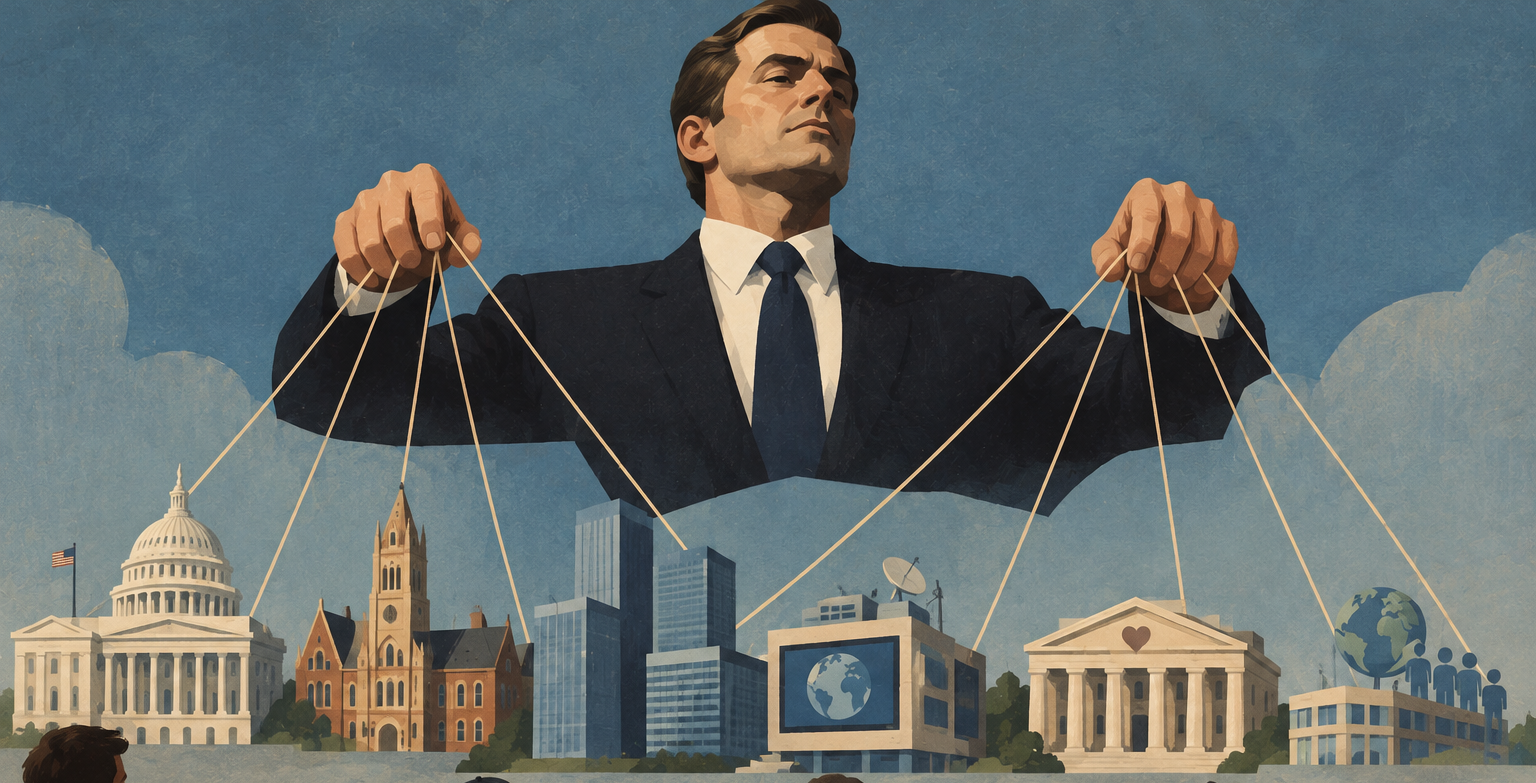
Again, Burnham did prove prophetic. The managerial elite does hold sway over our society. We are overcredentialized to a fault, and we have overbuilt institutions to feed that addiction to paper accomplishments. The managers run our federal agencies, our universities, Corporate America, the media, charitable foundations, and a vast archipelago of NGOs that sits between all of them. The managers, who have taken to emulate the European nobility of old in so many respects, are alumni of the same schools, they read the same publications, they marry one another, and they move fluidly from one of those institutions to the next while ordinary Americans feel like social mobility is more and more difficult in each generation.
But Burnham’s managers are now running into another 20th-century idea that has proven true. Namely, Eric Hoffer’s famous quote that what starts out here as a mass movement ends up as a racket, a cult, or a corporation. That morphed into a better-known quote misattributed to Hoffer that “Every great cause begins as a movement, becomes a business, and eventually degenerates into a racket.” Both are true.
The managerial elite has unquestionably become a racket, and also a cult. It believes things which are patently untrue, and it acts on those beliefs — doing damage continuously along the way. And its values are increasingly corrupted by radicals and disengaged from the society that spawned it.
As such, we don’t trust the managers anymore. And we shouldn’t.
The basic proposition the managerial elite offers is this: surrender your sovereignty to us, we’re professionals, we know what we’re doing, and we’ll make things work. By outsourcing to us, you’ll be freed up to pursue more important things. And yes, we’ll get paid princely sums, but what we offer for that compensation is more than worth your while.
It’s an attractive proposition, in theory. It’s a lot more difficult to satisfy in practice. And the fact that the managers’ institutions are openly hostile to the values and traditions of the public they purport to serve, not to mention the congenital failure of the managers to earn the trust and respect of the public through charisma, means their source of societal legitimacy must come from what Max Weber called “rational-legal authority” — the basic value proposition outlined above.
Burnham’s predicted managerial revolution delivered on that proposition early on, more or less. Why? Because the generation of managers who shepherded America into global primacy in the 1950s and 1960s were by and large hard men who’d been through the crucible of World War II, who were religious Christians with very traditional mindsets on things like integrity and honor. That held, more or less, for quite a long time. The managers won the Cold War, they built the suburbs and the interstate highways and modern-day Corporate America, they created the modern system of higher education, they electrified the entire country, they raised living standards. And they did it all without upending the values of the society they were serving.
What came after, though, as the managerial class began serving itself rather than the society at large, wasn’t so good.
The institutions stopped training for competence in the important disciplines. Those became secondary to perpetuating the managerial cult. Higher education stopped being about teaching the core subjects at a high level and it started being about expanding the needs of higher education. More students, and more administrators. Soon, it became normal to take on massive amounts of debt in order to get a piece of paper credentializing its holder as a member of the managerial elite. And when those so credentialed outnumbered the roles society had for them to fill, it was time for society to satisfy them with new roles.
The lawyers came first. Then the regulators. Then the compliance people. Then the social workers, to deal with the enervation the overcomplicated society enforced on the working class and the new welfare class — welfare mostly benefiting the vast bureaucracy tasked with distributing it and explaining its failure to lift people out of government dependency. Social pathologies that had formerly been treated with derision and social sanction now became opportunities to employ more managers — and once that happened, those pathologies morphed into civil rights causes, which created entire industries full of non-profit functionaries.
Our society suddenly had far more tail and far less teeth.
What do you get for that?
You get armies of women who formerly had married young and started families, keeping a healthy birthrate going for more than two centuries of American history, suddenly occupying cubicles and pushing paper in government bureaus and corporate offices. You get entirely new disciplines spun up which were never needed before. You get carbon-credit markets, DEI, multiculturalism, mass psychotherapy.
You get a society which is overspecialized and deludes itself that it no longer needs the basic fundamentals of civilization. As such, you no longer demand honesty and work ethic as the bedrock of whether somebody can fit into an organization, a neighborhood, a community. You stop teaching the Ten Commandments and you start teaching that America was built on stolen land.
And when that’s how you train your managers you start getting weird results on the top end.
The expert consensus told us Saddam Hussein had weapons of mass destruction. He didn’t. The expert consensus told us the housing market was sound and the banks were well-capitalized, even though they all knew they’d rigged the system to give mortgages to people who couldn’t handle them and securitized all that bad debt and sold it to retirees and other investors, right up until 2008. Then it turned out the experts had built that system on tranches of lies — and the experts then arranged a bailout for the institutions that employed them. Too big to fail, and so on.
They forced their program even on businesses who hadn’t gone down the primrose path, and with the resulting leverage they imposed woke culture and economics. We went from Occupy Wall Street falling apart to Black Lives Matter getting billions in corporate swag with amazing speed. And then we went from Iraq to the Islamic State and Mazar-e-Sharif to the Abbey Gate.
And then we got COVID, which was the event that finally broke the public’s trust of the managerial elite.
Read more Justice Gorsuch, the Ten Commandments, and Our National Identity
The experts — lookin’ at you, Dr. Fauci — were told by the people that gain-of-function research was out of bounds. They outsourced it to a hostile adversary. Then, when the predictable crisis came, they dismissed the lab-leak hypothesis as a racist conspiracy theory and suppressed it on social media before it was quietly acknowledged as plausible — even likely — by multiple federal agencies. Schools stayed closed far longer than they should have been. Guidance on masks, vaccines, and gatherings shifted constantly, while the officials issuing it were photographed ignoring it again and again. Ordinary people lost businesses, educations, and the chance to say goodbye to dying parents; the people giving the orders mostly worked from home.
They expected everyone to stay home and suffer, when it was a national deficit of Vitamin D that exacerbated the problem. Surfers got arrested for taking in the sun while casino gamblers went unmolested. Common antivirals, which worked to kill the virus in the large majority of cases, were derided and made scarce. The managers demanded the whole country take an experimental treatment they called a vaccine, and persecuted those who rightly refused.
The managers used COVID to preside over an election that was irregular in countless ways and resulted in terminating the presidency of the man the public deployed to push back on the elite’s worst abuses. They gave us a president in visible cognitive decline and presented him to the public as sharp and vigorous when his staff, his party, and his press corps all knew better. We now know, from reporting by some of the very journalists who spent years dismissing the question, how much was concealed and for how long. The managerial state, it turned out, was perfectly capable of running itself with only nominal reference to the man who was supposedly in charge of it — which tells you something about who was really in charge.
And everything got worse. Nobody involved paid a price.
Any ruling class makes mistakes. A legitimate ruling class submits itself to accountability: when the experts are wrong, somebody pays a price.
Do we have that? Of course not.
Look at the careers of the people responsible for the failures above and try to find the consequences. The architects of the Iraq war? They’re expert news commentators on cable TV now. The bankers of 2008? They all kept their bonuses. Fauci, Deborah Birx, and the other Covidiot public health officials collected honors and book contracts. The staffers of the Corporate Joe Biden all pulled down comfortable sinecures at nonprofits, PACs, and MSNOW. Failure in the managerial class isn’t disqualifying; it’s now a credential in its own right.
And if you complain, you’re a conspiracy theorist, a deplorable, a “MAGAT.”
Because the managerial elite, from Ron Klain to Angelo Mozillo to Kathleen Kennedy to Claudine Gay, have come to hate you — because they can get away with it.
Consider what it takes to punish incompetence and malevolence on the part of these people. Americans had to destroy Bud Light, the most popular beer brand in the country, just to send a message that its highly educated brand manager, a stunning mediocrity named Alissa Heinerscheid, was way off-base in imposing a man in a dress on the brand. That wasn’t the only example of the public trying desperately to rein in the managers.
And in return, the managerial empire struck back. Hard.
The suits in charge of Hollywood have set their studios on fire attempting to impose woke values on all of the most successful film franchises, utterly destroying most of them. They don’t care — or maybe they’ll care now that Skydance has swallowed up two of the Big Five media companies that were so weakened by the managerial incompetence of the elites.
Our governmental elite said systemic racism and not a poverty of values was the reason people were government-dependent, and now we’re staring down the barrel of a $2 trillion annual deficit and $40 trillion in national debt to sustain a system which floats on a minimum of 20 percent waste and fraud. Where is the managerial competence inherent in the Obamacare Medicaid expansion? The SNAP program? Federally subsidized day care centers?
The public has begun to realize that a system is what it does, and that the people running that system are more about control than they are about competence. This is a late realization, of course — we’ve been told self-serving lies since MK Ultra, the Gulf of Tonkin, and the AIDS epidemic.
And we’re not at the cutting edge of this problem. Europe is. In Romania, the presidential election of 2024 was annulled after the wrong candidate won the first round. In France, the leading figure on the populist right was barred from seeking office by a court ruling. In Germany, the domestic intelligence service designated the country’s principal opposition party as extremist. In Britain, citizens have been arrested over social media posts. In each case, the justification was the protection of democracy. In each case, the practical effect was to protect the managerial class from the voters.
These people don’t have the consent of the governed. They don’t even want it. They’ve been importing ringers to dilute the opinions of the governed for decades, both in Europe and here, and going to Davos to brag about all of their wins.
We covered a lot of this in the first two Five Black Pills columns. The managerial elite cooked up modern feminism in the universities, and then it institutionalized its most destructive form through HR departments, Title IX bureaucracies, and family policy written by people who regard the traditional household as a problem to be managed. The managerial elite certainly didn’t invent Islamism, but it opened Europe’s doors to an invasion from the Muslim world without ever seeking the consent of the people who would have to live with the consequences — and then treated anyone who objected as a bigot. And it’s happening here, with atrocious consequences.
The final two columns in this series will expand on those, but in very broad strokes you can see the effects of this mismanagement. Gallup has measured Americans’ confidence in our major institutions for decades. When it began tracking a consistent set of them in 1979, an average of 48 percent of Americans expressed a great deal or quite a lot of confidence in them. In 2023, that number bottomed out at a record low of 26 percent, and it has hovered near that floor ever since. Universities, the media, government, corporations — people are giving all of them a thumbs-down, and who can blame us?
Legitimacy doesn’t evaporate overnight, but it doesn’t come back on its own, either. The managerial elite has two choices. It can reacquire the right to rule the way it originally acquired it — by delivering results, accepting accountability, and treating the governed as citizens rather than subjects to be nudged.
We might be too late for that. We don’t currently have a class of managers with the integrity and humility to self-police and earn back the public’s trust.
But the other choice is for these people to continue as they’ve been, and thus meet their end — either peacefully, by the institutions from which they emerge dying off, or not-so-peacefully. What won’t happen is the public acceding to their nonstop grasping for control, using more and more absurd justifications for doing so.
What we know now is these people cannot deliver on their promises. And this explains a great deal of our loss of social cohesion.
Read more The Left Has Made It Harder to Kill Christa Pike. She Must Die Anyway.
READ MORE by Scott McKay:
About the Author