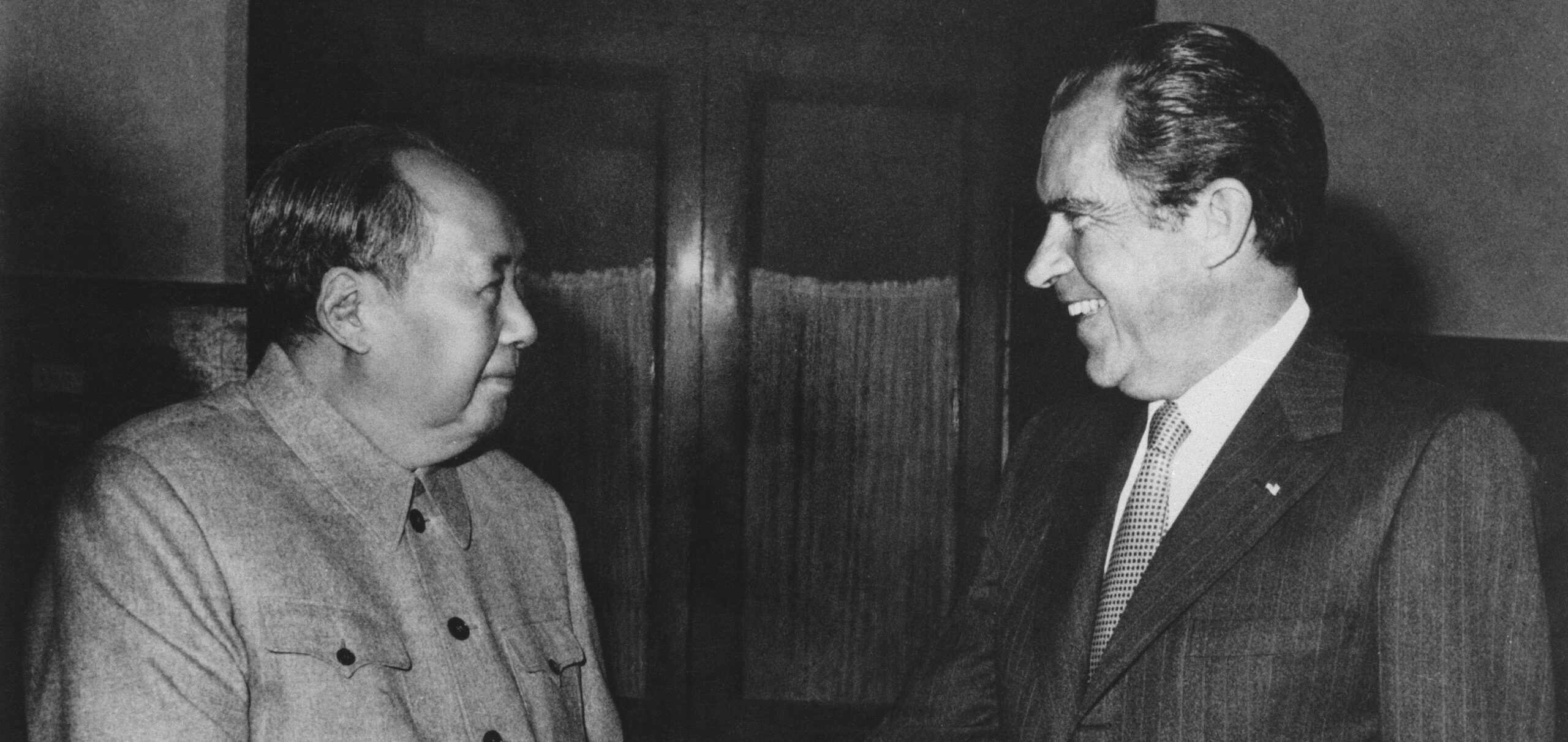
FILE - In this Feb. 21, 1972, file photo, Chinese communist party leader Mao Zedong, left, and U.S. President Richard Nixon shake hands as they meet in Beijing, China. Tossed into the middle of a potential thawing in U.S. relations with China, Judy Bochenski and her American ping pong teammates helped deliver one of the great diplomatic coups of their time. Their hastily arranged trip for exhibitions in three Chinese cities helped part the Red Curtain and open the way to a new world order that included China. It worked so well that President Richard Nixon would get on Air Force One the next year to make a state visit to China that enthralled the world.(AP Photo/File)
National Conservatives and right-wing populists, particularly from the Gen Z variety, have discovered a new hero in the late President Richard Nixon. So much so that a new fad developed this year known as “‘Nixxonmaxing,” which shows historical footage of Nixon speaking over rap music to hype him up, and has spread across social media accounts like YouTube and TikTok. It’s fair to say the Nixon presidency is going through a bit of revisionism.
Read more Population Health vs. Personal Medicine: What COVID Taught Us About Patient Autonomy
It’s easy to see parallels between the Trump Administration and Nixon’s, or even why young conservatives might want to ditch Ronald Reagan as the standard-bearer of conservatism in favor of the 37th president, but Nixon did more harm than good to the conservative cause.
In the end, though, Nixon did nothing to build up conservative institutions and left movement conservatives dormant after he resigned.
Richard M. Nixon was as impressive a public figure as any. He was a Lieutenant Commander in the Navy during World War II, a Congressman, Senator, and Vice President before age 40, and he appeared on five Presidential tickets, winning 4 between 1952 and 1972.
He was an incredibly strategic politician and a masterful statesman who understood the ins and outs of geopolitics. A true intellectual and voracious reader, his anti-communist legacy goes back to his enormously consequential stint as a congressman from California. He was ridiculed for his insistence on the presence of communists in government and for going after high-ranking and respected State Department official Alger Hiss. But after pressing former communist courier Whitaker Chambers for evidence of Hiss’s guilt — some of which Chambers hid inside a hollowed-out pumpkin — the case against Hiss was clinched. Nixon emerged from the “pumpkin papers” saga as a serious and dedicated public servant who legitimized the anti-communist effort. It was a major reason Eisenhower tapped him as his vice president.
His comeback after a devastating, and possibly fraud-tainted, loss to Kennedy in 1960 made him a statesman. Unlike Trump, he chose not to challenge the election results and buried himself in books and writing. He then made the ultimate political comeback, winning the presidency in 1968. His aura was so defining that MLK Jr. once wrote that Nixon “has one of the most magnetic personalities that I have ever encountered.”
Lately, many Republican political figures have become infatuated with the former president. In 2023 at the Nixon Presidential Library, then-presidential candidate Vivek Ramaswamy lauded Richard Nixon as the “most underappreciated president in modern American history.”
Conservative activist Christopher Rufo praised Nixon as the architect of the “blueprint for counter-revolution” against bureaucratic entanglement in D.C. Just recently, Vice President J.D. Vance compared his story to Dick Nixon, saying, “I’ve always liked Richard Nixon.” He went on to say that the Watergate scandal would be a one-day news cycle and that the same ‘deep state’ forces behind his resignation were the same ones targeting President Trump.
Despite being an anti-communist stalwart in Congress and winning the presidency as a “law and order” candidate against the rising tide of urban crime and counter-cultural beatniks, Nixon’s presidential ascension gave grassroots conservatives little to cheer for.
On the domestic front, the Nixon presidency did nothing to slow government growth. In fact, the federal government expanded. Even though Nixon campaigned against LBJ’s ‘Great Society’ programs, the truth is that social welfare spending more than doubled under his presidency. He helped steer Social Security towards insolvency by signing a law that permanently increased benefits by 20 percent. Medicare and Medicaid spending rose astronomically by 246 percent and 120 percent respectively.
The 1970s are remembered for economic hardship and a slide into “‘stagflation,” largely due to the OPEC oil embargo and the Johnson and Carter presidencies. But Nixon’s economic policies also played a significant role. The president instituted wage and price controls to combat inflation, but that only accelerated its rise. Then, to make matters worse, came the elimination of the gold standard, which was the final blow against any fiscal sanity. Nixon even conceded, “I am now a in economics.”
Read more NAZA : When an Anti-Israel Gaza Documentary Wins at Venice
It’s no surprise that columnist Jonathan Rauch nicknamed Richard Nixon “the Great Regulator,” Along with his pro-Keynesian economic approach, the Nixon years oversaw the largest government intervention ever in peacetime. This included creating alphabet soup agencies like the EPA, FEC, OSHA, and extending the regulatory powers of the Equal Employment Opportunity Commission. He also signed the Endangered Species Act into law and expanded the Clean Air Act. Nixon apologists boast that he was a sworn enemy of the administrative state, but he sure loved increasing its role in American life.
Sadly, the Nixon Administration was no friend to social or cultural conservatives, even though he won largely due to the “silent majority” voting for normalcy. Three of Nixon’s four Supreme Court appointees voted for Roe v. Wade, with Justice Blackmun writing the majority opinion two days into Nixon’s second term, and the president offered no response. Nixon also signed Title X family planning grants into law and even invented a new ethnic origin by creating the term ,” which brought together new Latin American groups not only for the Census Bureau but for identity politics as well.
Even worse, he contributed to affirmative action, which he signed as an executive order mandating all federal government programs to comply. This, of course, has evolved into DEI and the racial grievance culture that define us as a society now and which Pres. Trump has been trying to dismantle. Nixon, by the way, was no friend of the NRA, as he personally favored a ban on handguns and endorsed gun control legislation in Congress.
If there’s one area where Nixon gets high marks, it is foreign affairs. Conservatives should admire his foreign policy brilliance and intellectual heft in the Cold War era. Nixon was a student of foreign policy “realism,” and he and his foreign policy advisor, Henry Kissinger, took a consequential step toward victory in the Cold War when they ran heavy emergency military supplies to Israel when it looked on the brink of annihilation during the Yom Kippur War in 1973. Israel’s subsequent victory over several Soviet supported Arab enemies assured American dominance in the region and demonstrated American military superiority over Soviet arms without the U.S. ever firing a shot.
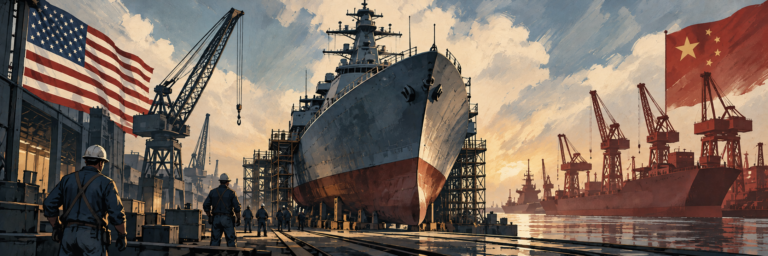
And while it enraged conservatives, Nixon’s opening of relations with Mao’s China and ending the trade embargo was a shrewd history-making move. It effectively split Communist China from Soviet Russia and tilted the balance of power away from the Soviets. While this was a tough bone for conservatives to swallow given Mao’s murderous communist regime, China was a poor undeveloped country at the time and not a threat to American power. The Soviets were the main Cold War adversary, an expansionary and nuclear communist empire and the opening to China hurt them badly.
In fact, the blow to the Soviets was significant enough that its client state North Vietnam was convinced to head to the negotiating table. Nixon had inherited the Vietnam War and embarked on a policy of “Vietnamization,” which combined aggressive bombing of the North with the the training of South Vietnamese troops and the withdrawal of American troops.
But Nixon and Kissinger’s Paris Peace Accords deal with the North Vietnamese was faulty. As American troops withdrew, the Accords cleared the way for the bloody communist takeover of the entire country. Under Nixon, around 20,000 American servicemen died between 1969 and 1971. No victory, no peace.
To the Paris Peace debacle was added Nixon’s strategy of “Détente,” which tolerated the Soviet Union but did little to prevent the spread of communism. While some point to the SALT I nuclear arms limitation talks as helpful for cooling the nuclear arms race, the massive military buildup that would ultimately sink the Soviet Union had to wait until the Reagan doctrine in the 1980s.
The rethinking and temptation to revive Dick Nixon is understandable. He was and still is hated by the hardcore liberals, and the Watergate scandal was a highly politicized affair to oust a sitting president. He should be admired for his intellectual capacity and detailed policy knowledge. In the end, though, Nixon did nothing to build up conservative institutions and left movement conservatives dormant after he resigned, a situation that stood until Reagan was elected in 1980. The Nixon revolution never metastasized, and for good reasons. Conservatives need to turn the page on Tricky Dick.
Read more Trump Faces a Choice on Iran: Make a Deal or Escalate the War
READ MORE from Alex Adkins:
Everyone Hates Milton Friedman Again
Sophie Cunningham vs. the Trans Sports Mob
MLB Does the Robot
About the Author