Scarlet and blue and snowy white,
The guidon flags flutter gayly in the wind.
— Walt Whitman, “Cavalry Crossing a Ford”
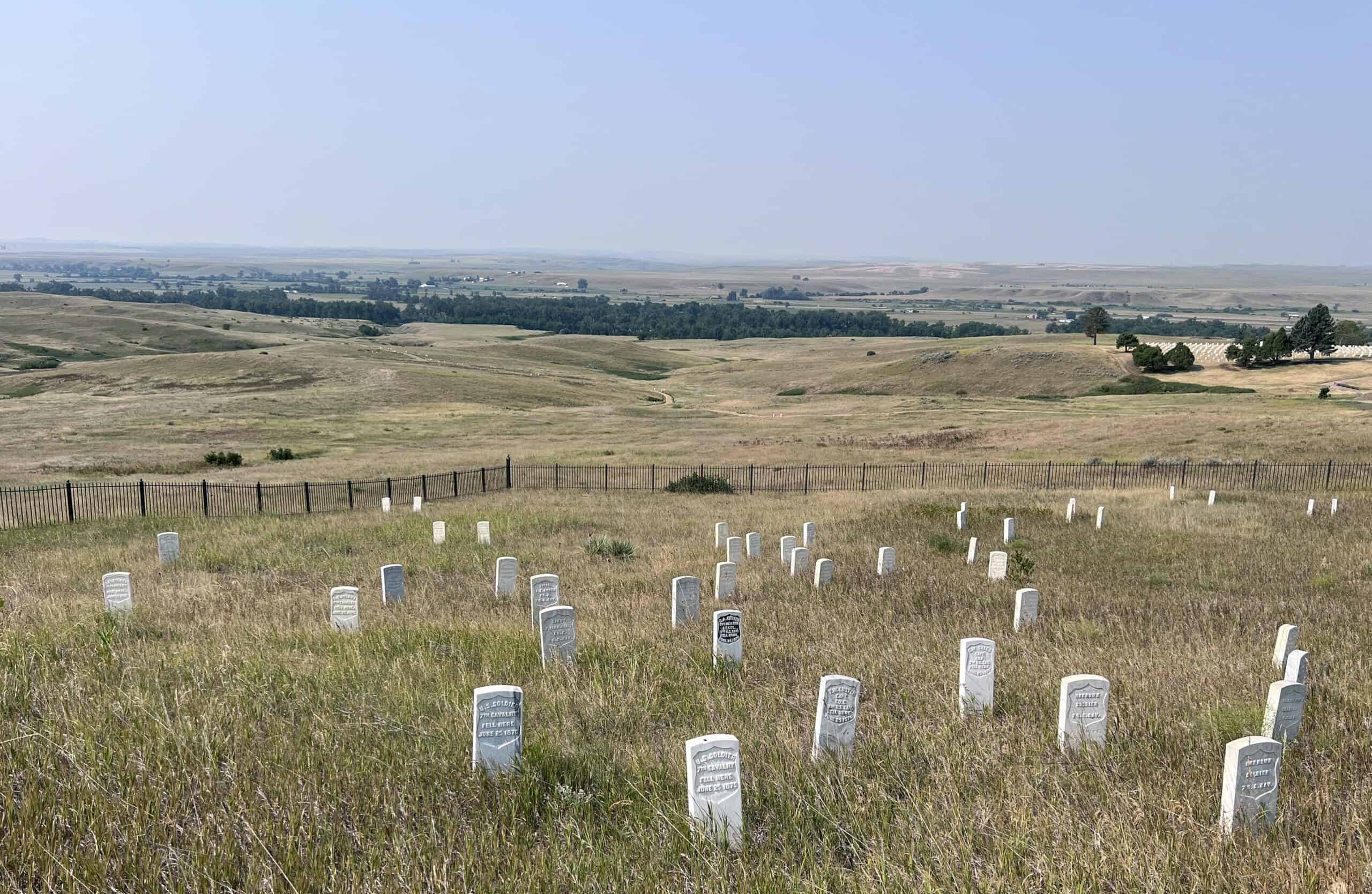
In our brutish age ofshattered monuments and burnt churches, ofravaged beauty and perversely ugly public art — in which a lout spray-paints a World Trade Center massacre memorial and a foreign invader deemed by media savants a “Virginia man” (though only spiritual kin to the neo-Taliban who’d recently removed Richmand’s last statues of men found guilty of fighting for … Virginia) beheads an Iwo Jima flag raiser’s statue —perhaps some acts of defilement can be the more easily overlooked. On June 25, 2026,a United States military cemetery was desecrated — with no response from its caretakers, and not for the first time. Video recordings show a person near a mass grave, childishly stamping on a Stars and Stripes-pattern cavalry guidon, and another modern Falstaff dancing, in a supposedly prohibited area, among marble slabs placed to mark the first hasty burial sites of slain American soldiers. The place was Montana’s Little Bighorn Battlefield National Monument,in the heart of the Crow Indian reservation; the occasion, the 150th anniversary of the annihilation, by Sioux and Cheyenne warriors, of five companies of the Seventh Cavalryunder the regiment’s lieutenant-colonel, Brevet Major General George A. Custer.
Read more Can the AI Revolution Survive the War on Data Centers?
“Custer and the men of the Seventh Cavalry,” writes Sandy Barnard … “must forever pay for the perceived sins of the nation in dealing with American Indians across the centuries.”
The seeds of such calmly accepted defilement had been nurtured over decades, as our National Park Service attempted to manage and interpret that small portionof a sprawling battlefield reserved by the War Department in 1879 as a National Cemetery for most of the 268 soldiers, U.S. Indian scouts, and civilian employees killed or mortally wounded in the two days’ fight on the Little Bighorn. The defilers of simpler days were mere souvenir-hunters, hard to thwart before the advent of proper staffing and the standardized cemetery where the remains of thousands of veterans now lie.(In 1908 a New York Times reporter bitterly decried Uncle Sam’s failure to protect his dead against the chippers and stealers of stones roaming unhindered over a neglected field : “You see, they were only United States soldiers who had died for the flag. They were dead men, with no votes.”) Even as controversy swirled endlessly around one of history’s most famous (indecisive) battles, the field itself, transferred to NPS control in 1940 and declared a national park in 1946, was seldom prominent in the news, apart from certain well-attended battle anniversary commemorations — the 75th, the last attended by Indian veterans who had fought there, falling exactly one year after the start of the Korean War in 1950.
Then, in 1976, at a sadly understated centennial observance (begun a day early in the hope of avoiding confrontation), the shrewd self-publicist and American Indian Movement thug/activist Russell Means appeared, with followers dragging Old Glory on the ground and dancing around the granite obelisk which bears the names of the Army’s dead — and which is surrounded by a mass grave.While Means seized the podium to emit angry tosh, members of the Custer family, who had lost four blood relatives and one by marriage in the battle, were prevented from laying a wreath at the grave until much later that day.
Battlefield events next spawned headlines after a 1983 prairie fire purged away hundreds of acres of vegetation — and energetic superintendent James Court boldly seized the chance for extensive archeological work. The relics found, from spent cartridges to men’s bones, fueled both controversy and popular interest in the fight. (In 1986 National Geographic subscribers risked a mythic overdose while perusing an issue combining Custer archeology coverage with an RMS Titanic cover story.)But Russell Means would return to make his sacrilegious masterpiece in 1988, his vandals literally digging a hole into the soldiers’ mass grave —author Michael Donahue, then a park ranger, recalled fearing that skeletons wouldbe unearthed —andplacingatop ita hideous “plaque” defaming the dead, ostensibly to protest the battlefied’s lack of an Indian monument. The NPS compounded the crime by leaving the monstrosity atop the grave — for months.
This obscenity might have shocked a goodly part of the public — had it happened elsewhere (Arlington, perhaps?), or some decades earlier.But by 1988, the stigma borne by the ever-controversial Custer as symbolic military Indian fighter/oppressor apparently extended to those who fell with him; here, at least, the U.S. Army’s dead simply did not count. While the late military scholar Brian C. Pohanka predicted to me with quiet grimness that vandals would avoid striking a site such as Washington’s Vietnam Veterans’ Memorial — “because they would be killed” — the near-total lack of outcry over his ghoulish felony suggests that the canny Means had chosen his target well.
Leaping madly into a morass of racial appeasement and tokenism, the NPSappointed an inexperienced American Indian lady as park superintendent, leaving her to navigate this sensitive post as best she could. Then, to succeed Barbara Booher, the NPS boldly chose — a second Indian, well-known NPS veteran Gerard Baker.(One must assume — or at least I did —that no blacks, Japanese-Americans, etc. need have applied.) Alas, Baker apparently had as his chief goals ethnic cheerleading, belittling the U.S. Army’s role in the battle, and alienating many of the (for want of a better term) “Custer buffs” with an interest in the battlefield’s welfare. Weirdly extending the annual commemoration to include a day devoted to eachtribe with warriors present at the battle, Baker omitted any day for the more than 600 cavalrymen who’d been there, in favor of the much more important “Arapaho Day” honoring the warriors from that tribe who’d fought — all five of them.
Other 1990s hijinks included a scheme to turn the field into a bizarre semi-privatized theme park (as though federal bigwigs sought to wash their hands of the troublesome site); Baker-encouraged “coup-counting” defilement of the grave monument): Congress renaming, in deference to imaginary rules ofnomenclature, the former “Custer Battlefield National Monument”; and federal approval of an Indian monument which — unlike the obelisk erected in 1881, multi-racial in its carved roster of dead — was necessarily obliged to emphasize race in honoring Indians on both sides of the fight, including the Crows and Arikaras who had served as Custer’s scouts. As for the soldiers, 21st century ceremonies would see them increasingly thrust aside.
Need the Custer fight’s myriad controversies frustrate the efforts of dedicated NPS employees to present the story with balance, objectivity and due honor to both sides?No; but modern discontents lie less with disputed history than in dreams of promoting a satisfying counter-myth — of making of this one-sided fight both a symbol of paleface oppression and the most awesome military triumph in our history — in the face of awkward fact.The cavalry’s defeat, elevating alike Custer and suchleaders as Crazy Horse and Sitting Bull into the American pantheon, stunned a nation; but it decided no issues, and was not even the greatest such Indian victory over the U.S. Army (that being the ill-remembered“St. Clair’s defeat” of 1791).Other commanders, necessarily legendless, would effectively win the “Great Sioux War” less than a year after Custer’s death, forcing his conquerors to accept the miseries of the reservation, or defiant Canadian exile.
Read more What Makes a 35-Point Difference in How Someone Votes?
“Custer’s Last Stand” is not even remembered for its nanesake’s death, but rather for the manner of it —in a battle of annihilation. In his 1974 Custer and the Epic of Defeat,Bruce Rosenberg deemed the degradation of Custer’s popular image in less than a century — from possible “Roland of the Plains” to fool and genocidal villain — “unique in heroic legend.” But healso saw that viewing hisoutnumbered force’s destruction as a symbol of white racism’s most destructive aspects required “a greater suspension of belief than most Americans are able to muster.”
If mythological jiu-jitsu fails, one can simply neglect the actual fight — in the spirit of that Clinton-era NPS cultural advisor who didn’t “care about battles” and wished not to hear about them at Civil War battlefields. Apparently the park’s new visitor center, scheduled to open in time for the 2026 anniversary (it didn’t) will be inferior to that demolished in 2025, with the latter’s distastefulfeatures — such as child-entrancing battle dioramas, a screening room, and the display of priceless relicsdonated, as the general’s widow had desired, by her estate — replaced by an approach evoking Jan Hooks’ Alamo tour in Pee-Wee’s Big Adventure.(“Can you say that with me?Adobe… ”)
Ongoing construction left the park closed on most days at the height of the area’s tourist season, disappointing many surprised tourists and leaving us Custer buffs to mark events as best wecould. A brother Jerseyman secured NPS permission for a rare Little Big Horn Associates bus tour on June 18, and for a brief time I stood alone on a peaceful Last Stand Hill, once the scene of hideous carnage; here stood a lovely wreath, placed by a Custer great-grandnephew and his wife.
The well-attended battle commemoration of June 25 (less-heralded official events were scheduled for the next two days) was marked by a generally good-natured atmosphere, and the fascinating spectacle of several hundred Indian riders converging on a part of the field just outside the park’s limits.There were also disturbing elements. With the Seventh Cavalry’s presence restricted to a black-Stetsoned color guard under a dashing lieutenant-colonel, performing its duties stoically even during a fierce, brief rainstorm, and the regiment’smarching tune of“Garryowen” unheard — save twice, as a ring tone from a friend’s cell phone —Army sacrifices were virtually ignored. Pale-faced politicians’ blah-blah offered nothing to recognize dead soldiers with no vote; indeed, much of this government-organized program seemed based on thepremise that all Americans should join in a massive Gloat-o-Rama, forever seeing in the deaths of hundreds of the government’s own troops cause for rejoicing. (How might the NPS react in theunlikely event of Southrons demanding “Confederate Victory Day” festivities at, say, Fredericksburg National Cemetery?)
A seemingly endless array of Indian speakers offered rambling and sometimes hatefully inane remarks,Cartoonish calumnies against “Long Hair” familiar to viewers ofDr. Quinn, Medicine Woman and Little Big Man were garnished by a puzzling denunciation of the Freemasons and Knights of Columbus and the ironically novel charge that the evil Custer was “anti-immigrant.” We also heard the claim that a single hero, after sending a fatal arrow into Custer’s throat — never mind the two bullet wounds actually found on his body, you racist — had then slain the General’s brother, double Medal of Honor recipient Captain Thomas Custer. Eventually, one speaker did provide a scholar’s judicious perspective on the fight and its historical context; the distinguished Western historian (and lifelong Custer student) Paul Andrew Hutton, author of the bestsellingThe Undiscovered Country, boldly asserted that Custer was far from the incompetent of fable, and that in assigning the young officer to confront the Plains Indian forces of 1876, our army was in fact “sending its best.”
It was not until June 28, two days after the anniversary of the battle’s second day, that members of the Custer Battlefield Historical and Museum Association held a wreath-laying ceremony on Last Stand Hill and another at the distant defensive site where the Seventh Cavalry’s surviving companies endured a two-day siege — neither ceremony being part of any government program.
“Custer and the men of the Seventh Cavalry,” writes Sandy Barnard in his recent book on battlefield commemorations, Celebrating Custer’s Last Stand, “must forever pay for the perceived sins of the nation in dealing with American Indians across the centuries.” If this sad assessment is correct, then perhaps it will be Custer’s strange fate to fall in battle, only to continue serving his country in death — if only as the scapegoat, the sin-eater, of a guilt-addled and ungrateful Republic.
Read more The 2028 Presidential Election Will Be the Last Stand to Prevent Permanent Leftist Rule
READ MORE:
Is the Educational Establishment Finally Starting to Crack?
The Way They Weren’t, and How It Saved a Memorable Film From Disaster
Cybertruck vs. DeLorean
About the Author