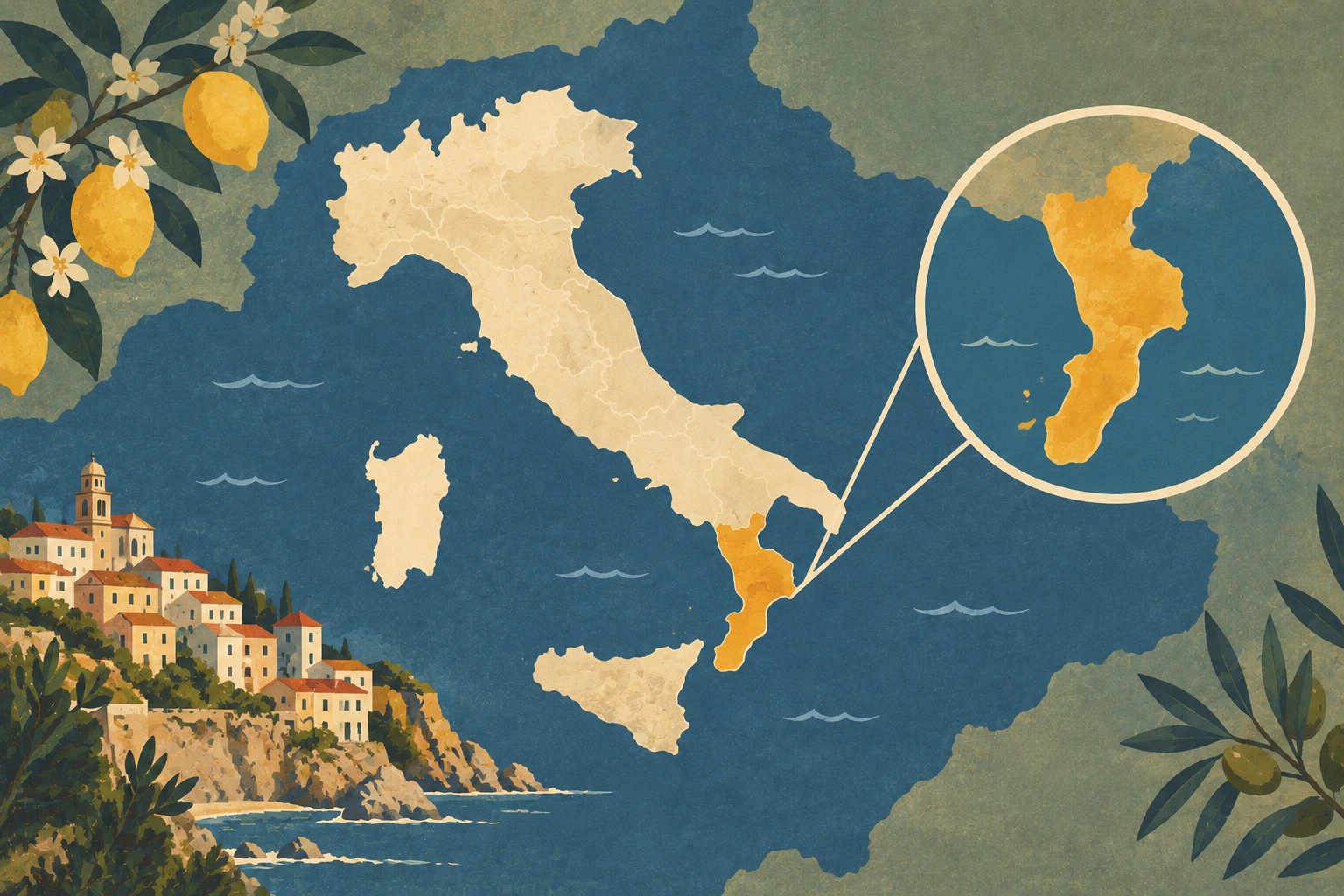
It was October 1906. The place: southern Italy, the boot, Calabria — across the Strait of Messina from Sicily. Our subject: Pietro Giovinazzo.
Read more Trump’s Armenia Corridor: A Strategic Opportunity with Real Risks
Keep your eye on Pietro.
According to family lore, Pietro was a stowaway on a ship from his native Reggio Calabria to America. He couldn’t get the papers to legally emigrate because he had pulled a knife on a policeman during a fight in his hometown. He was quite the rabble rouser, who always had a knife or gun and knew how to use both. “He wasn’t afraid of the Devil himself,” said my Uncle Bruno, ultimately one of Pietro’s many grandsons.
The fearless Pietro was searching for a better life, and the lack of a visa (or whatever the then-equivalent was) wasn’t going to stop him. So, he hopped the SS Virginia and hid until it shoved off deep into the water for a transatlantic trek.
What would happen to Pietro once the ship pulled into Ellis Island? As he and the crew knew, he would be detained, if not arrested, and sent back to Reggio.
But Pietro had other plans. Plans that me and my son-in-law and others have been trying to piece together through family stories, interviews, ship manifests, and immigration records. If our detective work is right, the date must have been October 24. As the boat approached Ellis Island, the 5’9, 135-pound Pietro dove into the Hudson River.
Though he had little money nor English, Pietro apparently knew where to go. Perhaps he had been directed to the Little Italy section of the Big Apple, near Mott Street (that era captured so beautifully in Francis Ford Coppola’s The Godfather Part II). From there, Pietro made his way to Latrobe, Pennsylvania.
He got in trouble there, too.
Eventually, Pietro changed his name to “Pete,” and Giovinazzo was strangely and clumsily rendered “Grovanz,” and he and his wife Rose ended up with a farm outside little Emporium, Pennsylvania, where they lived with a large brood of kids and grandkids. They lived happily thereafter. Although Pete had his share of run-ins there, too, including with guns and police (and even the local KKK — a story I will share in my coming Columbus Day column).
I can say that I exist today because of Pietro. Hundreds of my kin owe our existence to him. More specifically, if not dramatically, we owe our existence to him surviving that swim across the Hudson. Had Pete perished, we would never have been born.
With imaginative flare — call it the writer and romantic in me — I often picture Pietro swimming frantically in that cold water with clothes and shoes, gasping to reach the shore. With a smile and tears in my eyes, I visualize the hundreds of faces of his descendants cheering him on, exhorting and hoping to the heavens: “Go, Pietro, go! You have to make it. Go!”
“That would be a great opening scene in a movie,” I’ve been told by Joe Loconte and Rob Orlando, two of my Italian American friends who make films. Indeed, it would be. (WATCH Orlando’s documentary film on The American Spectator)
Have you seen the 1985 movie Back to the Future with Michael J. Fox? His character, “Marty,” goes back in time and must ensure that his teenaged parents meet and kiss; otherwise, he and his siblings will not be born. They will vanish forever.
To that story I can relate, literally.
Totally Italian — but Without the Cool Name
Pietro (1874–1960) was one of my two Italian great grandfathers on my mother’s side. Among them and their spouses were some cool Italian names: Giovinazzo, Gentili, DeMoro, Rossi. I heard the stowaway story from my uncle, Bruno Carnovale (1927–2022), who spent a lot of time with Pietro. Sitting with another favorite uncle, Joe Labrozzi, Bruno first shared it with me and one of my sons at the funeral of one of many aunts — my grandmother’s bunch of crazy sisters.
I grew up thoroughly Italian. We spent at least every other weekend with my colorful, fun, and happy Italian relatives. We got together for everything and anything and nothing other than the fact that we were relatives. When I watch the wedding scene in the opening of The Godfather, I smile and cry, thinking of how much it reminds me of family weddings in a distant past that’s just gone.
And yet, you would never know any of this from my last name. “Kengor” is a butchered, somewhat Anglicized (but not really) version of a Polish name hard to spell and pronounce. Nothing against the Poles — a people I respect greatly — but I never considered myself Polish. My dad’s side of the family was not close at all, a fact that saddens my dad. When that side did get together, it was a small group once a year for Thanksgiving at the quiet home of those grandparents. To the contrary, every event or evening with the Italian side was a merry, raucous affair with swarms of people and countless cugini (cousins) running around.
It was the Italians who embraced my father. Sticking with Godfather references, my dad was like Tom Hagen, taken in by the family and to this day its stalwart defender. That loyalty was understandable. The famiglia made my dad and other non-Italian guys who married in feel wholly loved. They thrilled in the revelry of this big, new family that became theirs.
Thus, I identify with the Italian over the Polish side because of those experiences. But I also keenly identify through my very DNA, which Ancestry.com pegs at 55-65 percent Calabrian. As Rob Orlando says, “Well, of course you’re 50%-plus Italian. Your mother is Italian.”
Yes, You’re Italian — but Without the Name
And yet — and here’s my main reason for writing today — those who know me would never know this from my last name. It’s a bummer to feel Italian, to have been raised that way, to be so proud of that ancestry — as Italian people are — but not to be known for it because I have a non-Italian name.
Read more Netflix’s Monster and America’s Growing Obsession With Serial Killers
To that end, I’m certainly far from alone. Over the years, I’ve met many people in the same situation. Their Italian mom married a non-Italian man and thus they have a non-Italian last name. No one knows they’re at least half-Italian biologically, if not more so culturally.
I could rattle off examples. When I learn of a new such person, I share my situation and we bond over it—both laughing and lamenting. Some names you might know: Michael Knowles, the Daily Wire podcaster (who hastens to underscore that he’s Sicilian); David Henrie, the actor who played young Reagan in our Reagan movie; Tony Dolan, the Reagan speechwriter.
Ah, yes, Tony. That is, Anthony Rossi Dolan. Tony passed away last year (see my tribute here). I felt an added connection to him because my Italian grandmother wanted my parents to name me “Tony” (or “Anthony”) rather than Paul. With a name like “Tony Kengor,” I might have sounded more Italian. My relations called me “Paulie.”
I think here of our columnist Anthony Esolen. At Ellis Island, Tony’s family last name was changed to Esolen from “Isolano,” though overall his name still sounds Italian enough that most people assume that Tony is a paisano.
Making things doubly worse is that Italians we meet when traveling to Italy can’t pronounce our non-Italian last names. In the Italian language, you pronounce every syllable. Unlike other languages (English, German, Slavic), you don’t take large chunks of letters and formulate a single grunt sound. Italians are baffled by that. Their words usually end in a vowel. Think of a name like “Gentili.” It’s easy to sound out for both an Italian and non-Italian speaker.
A name that an Italian would find impossible to pronounce is Michael Knowles’ surname. For starters, there’s no “k” or “w” in the Italian alphabet. If there was, an Italian would try to sound out every syllable in “Knowles,” stammering something like “kah-no-wah-la-se.” Impossible.
But above all, most frustrating is that people outside our families don’t know we’re Italian. And yet, we’re often more Italian than guys with Italian last names whose dads are Italian but not their moms. Mama mia!
I would be remiss if not mentioning some Italian girls. This name situation can be even more problematic for females.
Two of my favorite Grove City College students who have become known pundits and personalities — the brilliant Rachel Bovard and The Weekend Spectator’s great and gracious Grace Reilly — are both Italian on their mother’s side. Rachel, like Michael Knowles, is Sicilian.
Girls, of course, can doubly lose the Italian name when they marry a non-Italian guy. I think of my friend and talk-show host, Rose Tennent, whose maiden name is “Somma,” and who looks very Italian. Likewise for my wife’s roommate in college, who swapped out her last name “Bruno” for “Anderson” when she married. Folks meeting her today would never know from her WASP-ish married name that she’s a Jersey girl from a big Italian family.
The One Ethnicity You’d Like to Convert to
Alas, for those of us proud to be Italian Americans, this lack of name identity is further frustrating because we possess a heritage that so many people wish they had. Fr. Robert Sirico, founder of the Acton Institute, whose brother Tony played “Paulie Walnuts” in The Sopranos, tells me that “Italian is the only ethnicity to which people want to convert.”
Indeed, as a Jewish friend in Hollywood (Louis) tells me: “If I wasn’t Jewish, I’d want to be Italian.”
Well, many of us are Italian, born that way. But sadly, you don’t know it from our last name. Oh, well. It is what it is.
Either way, I’m thankful to my relatives and especially to that great grandfather who in October 1906 jumped into the Hudson River.
Grazie mille, Pietro. Thanks for getting me here, with or without the last name.
Read more Yale Bans Right Turns: The Latest Campus Safety Crisis
READ MORE by Paul Kengor:
The Stupidity of Baseball’s ‘Artificial Runner’
In Vino Veritas — and Civilization
Fulton Sheen and a Real-Life Miracle
About the Author