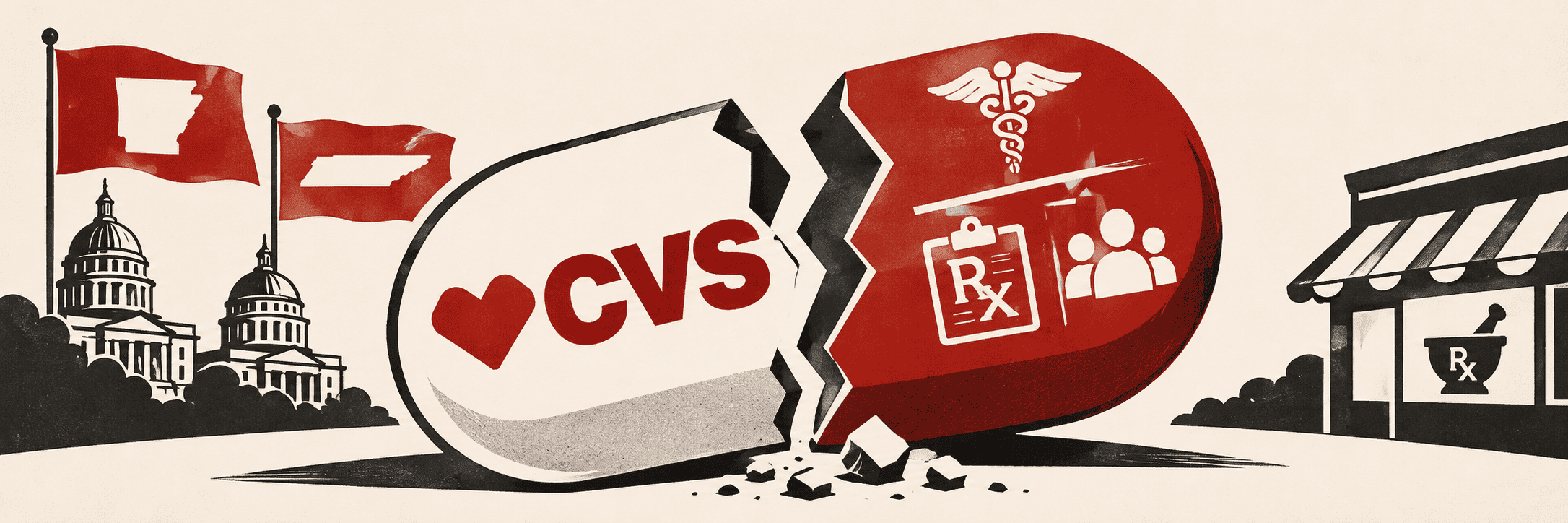
In a major antitrust victory that didn’t even require the involvement of the Justice Department, CVS has just announced that it’s breaking itself into multiple companies by divorcing its healthcare provider, Aetna, and its pharmacy benefit manager, CVS Caremark, from its retail pharmacy operations.
Read more Custer’s Last Stand: Dishonoring the Dead at Little Bighorn
This is not only a victory for consumers, but it’s also a victory over corporatism and the corporatist endeavor to quash small business competition. Credit goes to Arkansas for throwing the first punch, and to Tennessee for dealing the knockout blow.
In 2025, Arkansas Governor Sarah Huckabee signed legislation prohibiting pharmacy benefit managers (“PBMs”) from owning or operating pharmacies. Shortly thereafter, CVS and Express Scripts (Cigna) found an unelected federal judge to issue an injunction blocking implementation of the law, which had been passed by a democratically elected legislature and signed by the elected governor. Arkansas’ attorney general subsequently commenced work on an appeal.
Shortly thereafter, the Tennessee legislature started debating a similar bill, which had bipartisan support in the Tennessee legislature. By early 2026, customers picking up prescriptions from CVS were given flyers warning that their CVS drugstore would be closed if the proposed legislation became law. Tennessee airwaves were flooded with a $1.3 million advertising campaign from CVS, which threatened closure of all 134 pharmacy locations in Tennessee if the bill became law. (READ NEXT: America’s Broken Health Establishment)
CVS’s campaign was ineffective. The “Fair RX” Act passed with overwhelming, bipartisan support in both chambers: 86-7 in the House and 24-9 in the Senate. Governor Bill Lee (R) signed it into law in May 2026.
Naturally, CVS filed suit in federal court (along with Express Scripts) to block Tennessee’s new law from being implemented. Unfortunately for CVS, it already had a record of egregious behavior in Tennessee. Continuing to pursue an injunction through the judiciary might force it to defend its well-documented, anti-competitive business practices and callous disregard for existing state law.
Perhaps most damning to CVS was a by the Tennessee Department of Commerce and Insurance. Among the findings:
Read more Can the AI Revolution Survive the War on Data Centers?
- In a sample of 3,646 prescriptions, CVS Caremark paid a higher reimbursement rate to CVS pharmacies than to non-affiliated pharmacies for 18 percent of the sampled prescriptions.
- Reimbursement appeals from independent pharmacies were often denied by CVS Caremark for “insufficient documentation,” even though the independent pharmacy had, in fact, provided all required documentation.
- CVS Caremark was also not compliant with state regulations for handling reimbursement appeals from independent pharmacies.
- CVS Caremark was not consistently paying dispensing fees to independent pharmacies as required by state law.
- Despite a Tennessee law in 2021 that prohibited Pharmacy Benefit Managers from engaging in spread pricing, CVS Caremark continued to engage in this prohibited practice. (Spread pricing is where the price the PBM charges the healthcare provider exceeds the reimbursement it pays the pharmacy, with the PBM pocketing the difference.)
There were plenty more infractions documented, but these paint the picture of how CVS’ pharmacy benefit operation discriminated against independent pharmacies and in favor of CVS’ own pharmacies.
At the national level, there has also been bipartisan legislation recently introduced by Josh Hawley (R- MO) and Elizabeth Warren (D-MA) that would prohibit PBMs from owning pharmacies. (READ NEXT: Making Health Insurance Affordable)
It’s reasonable to assume that if other states audited CVS Caremark in the manner that Tennessee did, a similar disregard for state laws and regulations would be found. In a world where Enron executives went to jail for ignoring business law, it is also reasonable to assume that CVS executives don’t want any more attention focused on the unlawful activities documented in the Tennessee audit of CVS’ pharmacy benefit manager.
By announcing that it is splitting its pharmacies and PBMs into separate independent companies, CVS is conceding defeat and unwilling to further battle the bipartisan disgust at its anti-competitive behavior.
Contrary to the scare campaign of early 2026, CVS is not closing its Tennessee pharmacies. The Tennessee legislature called CVS’s bluff, and CVS folded. Going forward, CVS pharmacies will be on an even playing field with independent pharmacies when dealing with CVS Caremark’s successor.
READ MORE from Buck Throckmorton:
Repeated Ethical Shortcomings at Instacart Hamper the Task of Those Defending Capitalism
Read more What Makes a 35-Point Difference in How Someone Votes?
Polymarket or Kalshi Markets Don’t Decide the Election
James Talarico’s Political Reversals Stir Trouble in Texas Senate Race
About the Author