Americans can be forgiven for being confused about China.
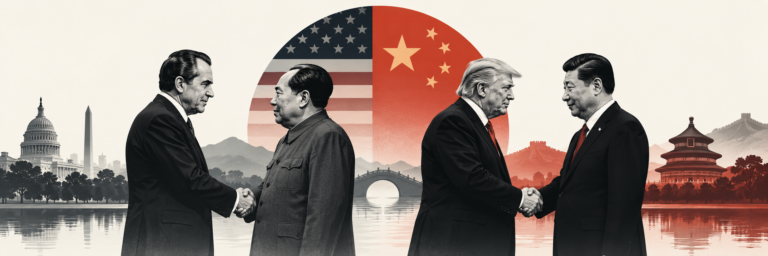
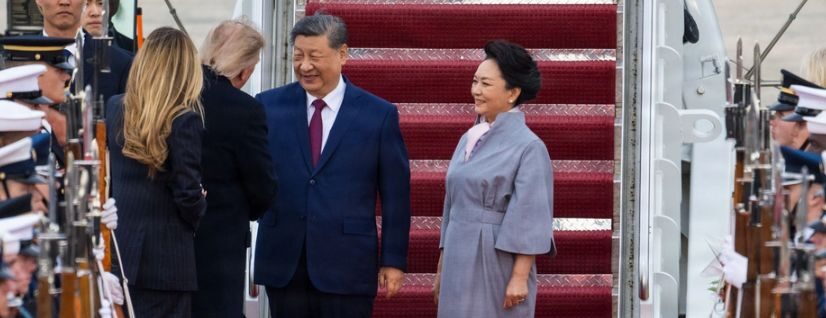
On the one hand, they are increasingly told that China is America’s principal strategic rival. They hear about Chinese cyberattacks, military expansion, unfair trade practices, threats against Taiwan, and Beijing’s support for Russia and Iran. On the other hand, Americans buy enormous quantities of inexpensive Chinese goods. Then Xi Jinping arrives in Washington, the red carpet is rolled out, President Trump shakes his hand, and television screens fill with smiles and ceremony.
Read more The Thorny Issue of Immigration and the Catholic Church
So what exactly is China — friend, competitor, or enemy?
China was integrated economically into the democratic world without being integrated politically into its system of democracy and rule of law.
The spectacle of a U.S.-China summit does more to confuse this question than to answer it. In my view, such meetings are largely a waste of time. Worse, they can mislead the American public about the nature of the Chinese Communist Party and the relationship between the two countries.
The problem begins with a fundamental asymmetry between a democracy and a dictatorship.
When Xi Jinping visits the United States, Americans can see him and hear him. American media cover his visit from every conceivable angle. Xi’s statements can be reported in full. Chinese officials can make their case directly to the American public.
Try doing the same thing in China.
China’s media are controlled by the Communist Party. What Chinese citizens see of Trump and America is filtered through a political system whose censorship apparatus decides what can be reported and how it should be presented.
This means that a summit between a democracy and a dictatorship is not an equal exchange of information. It always gives Beijing an advantage.
If an American president wants to make a summit genuinely useful, therefore, he should put one fundamental demand on the table: Tear down the Great Firewall, just as President Reagan challenged the Soviets in front of the Berlin Wall.
Let the Chinese people visit American websites. Let American newspapers and television networks operate freely in China. Let Chinese citizens read what Americans read and hear what American leaders actually say, without Communist Party censors deciding what they are permitted to know.
Unfortunately, because of the CCP’s effective efforts, American politicians have learned not to speak the truth: that it is the CCP that must change and embrace democracy.
If a summit cannot address that reality, another handshake, another communiqué, and another round of promises will accomplish very little.
Behind the smiling photographs is a profound conflict between two political systems. The United States is a constitutional democracy based on elections, individual rights, competing centers of power, and checks and balances. China is a one-party dictatorship in which the Chinese Communist Party claims a monopoly on political power and controls the press, courts, military, and the whole society.
These are not simply two morally interchangeable great powers pursuing different “national interests.” Their governments operate according to fundamentally different rules.
That difference matters when we consider China’s promises.
In 2015, standing beside President Barack Obama at the White House, Xi said that China did not intend to militarize the artificial islands it had constructed in the South China Sea. Those islands were subsequently equipped with extensive military facilities.
During the same visit, the United States and China announced that neither government would conduct or knowingly support cyber-enabled theft of intellectual property for commercial advantage. Such activity reportedly declined for a period. But Chinese cyber operations and intellectual-property theft subsequently again became major concerns for the United States.
So when another U.S.-China summit produces another declaration, agreement, or promise, Americans should ask a simple question: What reason is there to believe that Beijing will honor it when doing so conflicts with what the Communist Party considers its interests?
This question is particularly important in artificial intelligence, semiconductors, advanced manufacturing, and other technologies that Beijing considers essential to China’s rise. It is difficult to imagine the Communist Party abandoning an important strategic objective because of language negotiated at a summit.
And after all the ceremony surrounding the latest meeting, what substantive breakthrough has emerged?
Read more Calisthenics for the Aging Hippo
So far, the most conspicuous gestures are not agreements resolving the fundamental disputes between the two countries. Instead, Xi has extended what might be called an olive branch with two leaves.
The first is a proposal to invite 100,000 young Americans to China over the next five years.
The second is pandas.
A pair of giant pandas is to come to Atlanta, a plan Xi chose to highlight publicly during his visit.
The combination is revealing.
China today is not the impoverished and isolated country that emerged from Mao Zedong’s Cultural Revolution. In the 1970s, Beijing used ping-pong diplomacy, pandas, and Western fascination with mysterious China to help open America’s door.
Today’s China hardly needs pandas to introduce itself to the world.
It possesses one of the world’s largest economies and one of its most formidable industrial systems. It is a major technological power. Its factories dominate numerous global supply chains. And its government can mobilize enormous resources behind industries that Beijing selects as strategically important.
China’s economic rise has also benefited from what I call the low human rights advantage.
Low human rights are obviously not an advantage for the people deprived of those rights. They become an economic advantage to the state when an authoritarian country gains access to open international markets. Workers with weak bargaining power can be kept relatively inexpensive. Land, capital, and other resources can be allocated or priced through state power. The government can concentrate resources on selected industries. Chinese producers can then compete against firms in democratic market economies that operate under very different legal, political, labor, and environmental constraints.
Combine this low human rights advantage with China’s whole-of-nation system, and Beijing possesses a powerful instrument of international economic competition.
This was globalization’s great mistake: China was integrated economically into the democratic world without being integrated politically into its system of democracy and rule of law.
For decades, many Americans hoped economic integration would change China. Instead, the Chinese Communist Party took full advantage of global markets, preserved its political monopoly at home, and now wants to change the world in its favor.
Now the world is waking up, and the contradiction has become impossible to hide.
That is why I find the return of panda diplomacy so interesting.
Why would a China with enormous industrial, technological, and economic power once again reach for a diplomatic instrument from half a century ago?
And why invite 100,000 young Americans to China?
The purpose of such a massive exchange program is not difficult to understand. Beijing wants to shape how the next generation of Americans sees China. Young Americans will undoubtedly be shown China’s extraordinary infrastructure, modern cities, high-speed trains, technological accomplishments, and hospitality. Those things are real and worth seeing.
But what will they not be encouraged to see?
Will they learn about the Anti-Rightist Campaign and the Great Famine? Will they visit places associated with the Cultural Revolution? Will they learn the stories of Lin Zhao and Liu Xiaobo? Will they be free to talk with dissidents, underground religious believers, or critics of Xi Jinping?
American students should go to China — if they are free to see what they want to see.
And then there are the pandas.
Everyone loves pandas. And Beijing wants Americans to transfer that love to Xi Jinping and the Communist Party — and forget about China’s dumping of manufacturing overcapacity, cyberattacks, and support for Russia and Iran.
But that now looks more like a Hail Mary.
There is an old Chinese expression: yi ye zhi qiu —一叶知秋. Literally, by seeing one leaf fall, we know that autumn has arrived. A seemingly small sign can reveal a much larger change.
A powerful China once relied on pandas and people-to-people diplomacy to open America’s door. Half a century later, Beijing is reaching for the same tools again — not because China has become weak, but because its economic power can no longer conceal the widening conflict created by the Communist Party’s political system, behavior, and ambitions.
Read more The Decline of Bisexuality
The smiling panda tells Americans that China wants friendship.
The falling leaf tells us something else.
Autumn has arrived. And winter may not be far behind.
READ MORE from Shaomin Li:
China Inc. Is Winning the AI Race
Why I Chose America
250 Years and Still Sailing
Shaomin Li is a professor of international business at Old Dominion University.
About the Author