We live in the age of baseball analytics. Everything is based on statistics and probabilities.
Read more China’s Panda Diplomacy Can’t Hide a New Cold War
In addition to introducing a tsunami of recondite acronyms — like OBP, OPS, WHIP, WAR, BABIP, wOBA, and FIP, among a lexicon of others — and a flood of new metrics for evaluating performance — launch angle, exit velocity, etc. — analytics has changed the way the game is played.
Pitchers are often yanked without discussion when they reach 100 pitches or are facing the batting order for the third time. Hitters don’t optimize contact with the baseball but swing for the fences because analytics say home runs are more effective than singles. Power hitters with two strikes wouldn’t think of choking up on the bat and putting the ball in play. They swing away — and often strike out. Formerly an embarrassment, hitters now shrug off strikeouts as an acceptable part of the game — 200-plus a season is nothing to be ashamed of. Hitters spend off-seasons working on bat speed and launch angles rather than contact. Stolen bases are discouraged, and sacrifice bunts are anathematized.
The problem is, home runs and strikeouts stifle action. But a ground ball — once the ball leaves the bat — provides action.
All that is standard baseball practice these days. It’s what the game has become since analytics captured the front offices of Major League Baseball 20-something years ago.
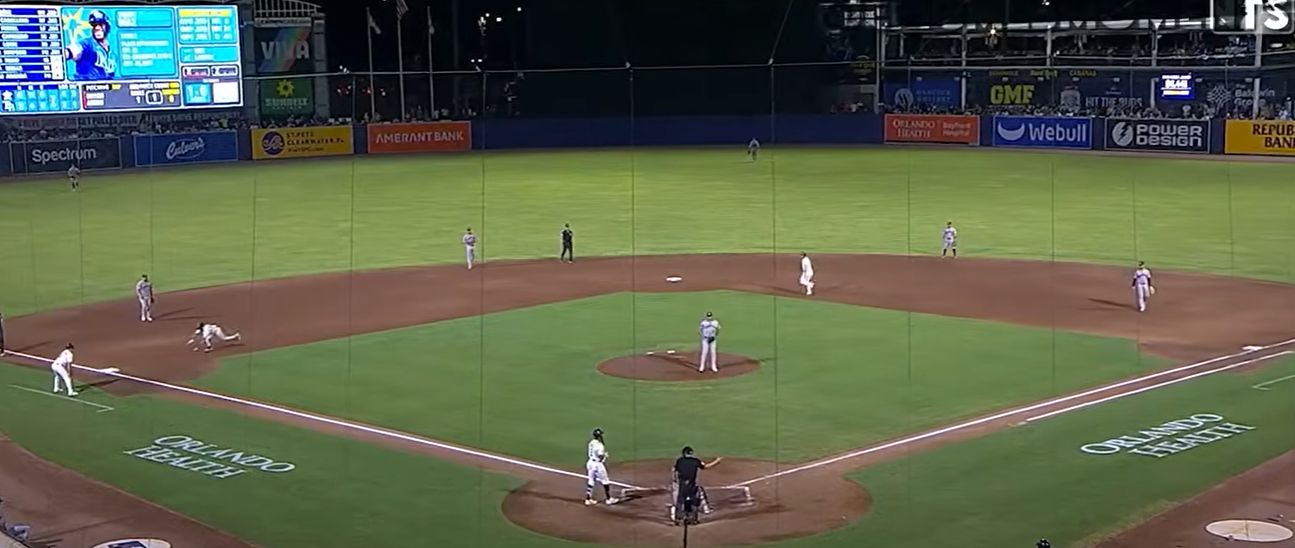
But there’s a player that goes against everything analytics stands for. He specializes in ground balls and line drives, and because he is ridiculously fast, often slaps it on the ground to the left side and flies down the line to beat the throw to first. He leads the league in stolen bases and is so fast that once, in Double-A ball, he turned a grounder down the left-field line into an inside-the-park homer. He has been at the plate over 500 times this year and has hit a grand total of zero over-the-fence home runs. He did hit one off the right-field wall at Tropicana Field once, however.
At the time of this writing, and the end of the regular season, he’s hitting .306, second-highest batting average in the American League, and is a crucial member of the American League’s best team.
What in the name of Richie Ashburn is going on here?
Chandler Simpson is his name, the Tampa Bay Rays are his team, and the Wall Street Journal recently saw fit to profile him as unique to MLB as a pitcher throwing a complete-game shutout these days.
He is a throwback to the game of old, when wins were obtained through station-to-station baseball — getting a guy on base, getting him to second, and driving him in. To the game of walks and stolen bases and sacrifice bunts and moving a runner to third and squeeze bunts to get him home.
Many were the small-ball impresarios back in the day. Ashburn was one, but he was joined by Matty Alou, Rod Carew, Manny Mota, Maury Wills, Luis Aparicio, Wade Boggs, Ozzie Guillen, Nellie Fox, Brett Butler, Ichiro Suzuki, Tony Gwynn, Ozzie Smith, and the entire Whitey Herzog 1980s St. Louis Cardinals.
Slap hitters, banjo hitters, contact hitters, Punch & Judy hitters — there were a lot of names for these sorts of players. And they specialized in bunt singles, infield singles, bloop singles, Texas Leaguers, flares, dying quails, hits that required elite bat control and a refined and particular eye at the plate.
What was Simpson’s secret? A left-handed hitter and lightning fast, Simpson improved his game when he decided to hit more grounders to the left side of the diamond. For a lefty, a ground ball toward short or third is nearly three times more likely to result in a base hit than one pulled to the right. First off, a lefty begins a few steps closer to first base than a right-handed hitter. Second, third basemen and shortstops have a longer throw to first than the other infielders. And third, as a lefty, Simpson’s swing naturally carries his body weight toward first base, giving him a head start down the line. So, he moved his stance in the box up by two inches to allow him to swing later on the pitched ball and be more likely to send it the other way. That little adjustment has made all the difference.
Read more The Thorny Issue of Immigration and the Catholic Church
That’s what slap-hitters do. Now they’re as rare as knuckleball pitchers (of which there are zero major leaguers).
Why? There’s that word again — analytics.
Baseball has evolved into a power-versus-power matchup. Rather than try to manufacture runs the old way — through base hits and sacrifices — hitters swing for the fences. Pitchers, in response, wanting to avoid the gopher ball, try harder to blow the ball past them. The result: strikeouts and home runs.
While getting on base is still a valued quality, once on base, the philosophy is to not trade bases for outs. This rules out sacrifice bunts, and it makes stealing generally inadvisable, because the risk for most runners is greater than the reward, statistically. Even hitting to the right side to move a runner from second to third is trading a base for an out. In practical terms, what this means is, runners get on base and then don’t try anything too daring.
They wait for the long ball. The thinking is, fly balls increase the batter’s odds of getting a hit. They eliminate five players from fielding the ball (the infielders), and they put pressure on the three outfielders, who must cover a vast area to get to the ball before it hits the ground. What gets a lot of attention in baseball circles these days is the angle at which the ball comes off the bat — called the launch angle. So sophisticated has analytics become that an optimal launch angle to produce a home run has been set at from 25 to 35 degrees. That angle, combined with sufficient bat speed — the low number is 75 miles per hour — should give a ball sufficient distance to leave the playing area.
Fly balls are considered more productive than ground balls. At the major league level, most balls hit on the ground turn into outs. Even the grounders that make it through the infield are only singles, whereas the fly balls that aren’t caught and don’t leave the park often result in doubles or triples.
The problem is, home runs and strikeouts stifle action. But a ground ball — once the ball leaves the bat — provides action. Infielder gobbling it up, planting and throwing; runner peeling down the baseline; close play at first.
And if he gets to first. You have steal opportunities; you have time-honored baseball strategies — sacrifice bunts, moving the runner over. Analytics people call it unproductive; fans call it exciting, because things are happening.
Even the granddaddy of analytics, Bill James, has some qualms about where his brainchild has taken the game. Writing on X, he said this: “The vast proliferation of (and fascination with) small measurements (exit velocity, pitch counts, pitch movement, launch angle, etc.) represents not the success of sabermetrics, but its failure. We have fallen back into details. It is like our clothes have been caught in the machinery.”
Will Chandler Simpson unstick the clothes from the dryer? Maybe not. But his old-school mentality is putting spark back in the game.
READ MORE from Tom Raabe:
The Hopeful Protestant Future
Supreme Court to Rule on Religious Preschool Case
Robert Duvall, Movie Preacher Extraordinaire
Read Tom’s new novel, Fall of the Prophet, a hilarious, biting takedown of liberal Protestantism. Available at Amazon.
Read more Calisthenics for the Aging Hippo
About the Author