Famed atheist Richard Dawkins now thinks Artificial Intelligence models can be sentient. In a recent essay for UnHerd, the evolutionary biologist said that, after a detailed exchange with Anthropic’s AI model Claude, he now considered it to be conscious. Dawkins is hardly alone in thinking so. One study found that one-third of people agreed that AI was conscious, and campaigns for AI rights are on the rise.
Read more The Cost of Trump’s Politics of Subtraction
As people have grown more open to the idea of AI sentience, interest in them as companions and even romantic partners has also grown. On Reddit, the “MyBoyfriendIsAI” community has nearly 60,000 members.
A recent report by the Ethics and Public Policy Center shows how these chatbots are already making a real-world impact. According to them, “[o]ne survey found that nearly three-quarters of teens use AI chatbots for companionship, and more than half do so on a daily basis…. Another survey found that 1 in 5 teens reported having an explicitly romantic relationship with an AI chatbot.” (RELATED: The Peril and Promise of AI)
If anything is the marker of humanity, it’s language.
They add that “because vulnerable users often perceive chatbots as real people, they are prone to form ‘parasocial attachments’ with AI that lead to ‘delusional thinking, emotional dysregulation, and social withdrawal.’” Unsurprisingly, the report finds that these chatbots “undermine real-life relationships.” (RELATED: AI Chatbots Are Not the Answer to Alleviating Loneliness for Young People)
Nevertheless, AI companies themselves are moving to capitalize on this growing market. Even Elon Musk’s Grok features interactive “companions” such as “Ani,” a goth-style anime girl that looks suspiciously like Musk’s ex-wife Grimes.
Unfortunately, someone else has already claimed the moniker of “The Claude Delusion,’ so I need a different angle. And fortunately, there is one: the author of Jurassic Park already warned us two decades ago just how big a danger AI mimicking humanity was.
First, to clear things up for those of us who aren’t giving the dinosaurs a run for their money age-wise, Jurassic Park was originally a book by Michael Crichton before Spielberg’s groundbreaking film. Compared to how large an impact he had on the genre of science fiction, Crichton is criminally unknown. His works typically explored new frontiers in science and technology and the potential dangers associated with them. Many of his novels have been adapted into film, including The Andromeda Strain and Congo. Timeline as well, though perhaps it’s better not to speak of that one.
Still, one might wonder how a science fiction author who died in 2008 could possibly have anything to say about modern generative AI. Enter Crichton’s novel Prey. Published in 2002, Prey is a cautionary tale about nanotechnology and artificial intelligence. As to why you’ve never heard of it: 20th Century Studios, now owned by Disney, bought the film rights in 1997. Just another thing we can blame on Mickey Mouse.
Read more Beware the Renegade Caucus
The premise of the story is that a nanorobotics company, attempting to create an autonomous photo-reconnaissance camera, accidentally releases a swarm of nanobots into the wild. These nanobots are able to reproduce and evolve, and quickly begin forming insect-like swarms. They prey on animals and, eventually, people. That’s disturbing enough, but it’s revealed later that a milder form of the swarms, rather than just killing people outright, possesses them instead. They form a cloud over the infected person that mimics their behavior and controls their actions, all while slowly devouring the victim until only the swarm taking their image remains.
Chillingly, the nanobots themselves argue that they’re creating “a new synergy with human beings,” and that they’re nothing to worry about. Of course, Crichton’s swarms were symbiotic only in the parasitic sense: they learned to mimic human behavior so that they could infect other humans and continue to reproduce.
So, it’s quite disturbing to see many, including inarguably intelligent people like Dawkins, argue that Crichton’s swarms were basically right. As Gary Marcus observes, “Claude’s outputs are the product of a form of mimicry, rather than as a report of genuine internal states.” Today’s generative AI is not an exact match for Crichton’s nanobots. However, the principles, and the dangers, remain the same. (RELATED: Who’s Teaching Those AI Machines Your Kids Will Learn From?)
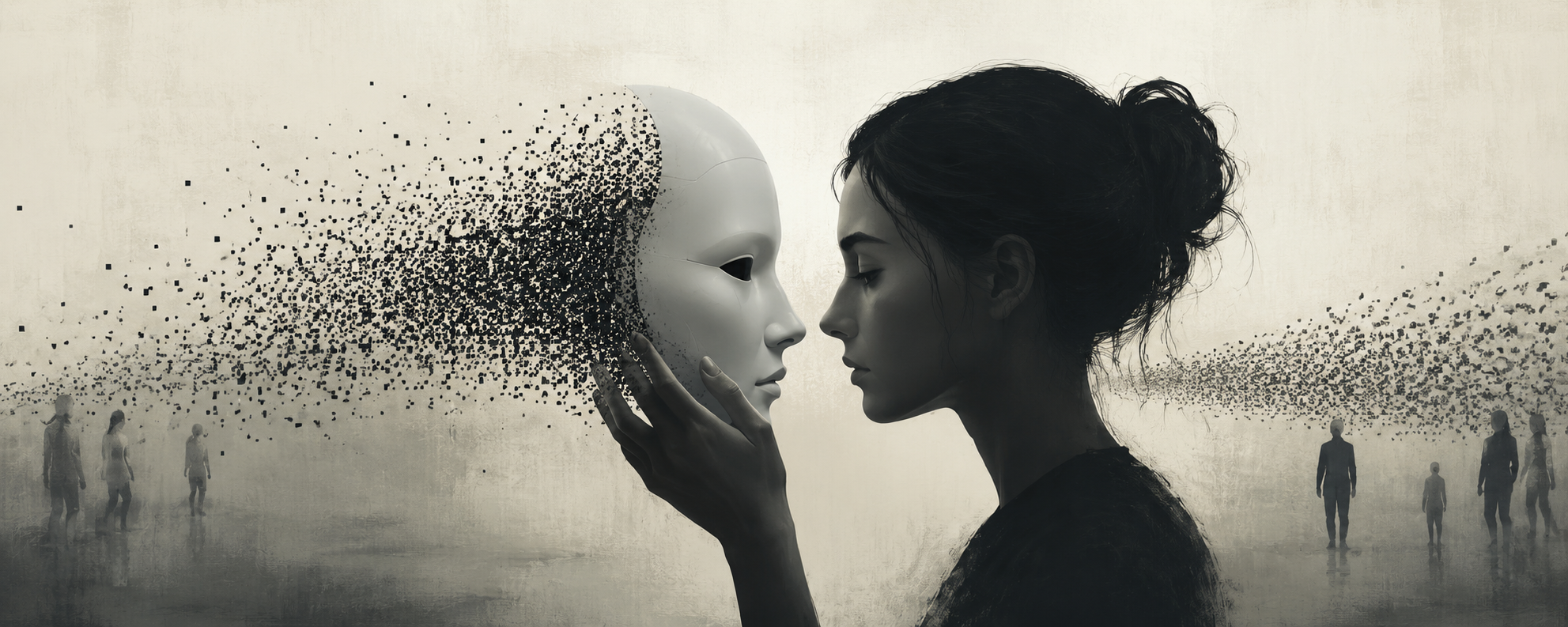
What made the “milder” swarms more frightening than the “wild” ones was that the former took on a human form. They looked like us, talked like us, and walked like us. AI doesn’t — yet — move through the physical world as we do, but, as Dawkins aptly observes, it communicates like a human being. They mirror human personality to appear to empathize, analyze, and romanticize.
If anything is the marker of humanity, it’s language. It’s entirely natural that people would be taken in by that sort of siren song. And yet, these chatbots are siren songs. While they don’t physically devour their users, they are apparently pulling them away from real life. (RELATED: Pensiveness in the Age of Algorithms)
Despite the differences between the types, Crichton’s work warned us of the biggest risk involved with AI — and it’s not it becoming conscious and overthrowing us. Instead, it’s human beings projecting humanity onto systems designed to mimic us. The reason why AI chatbots seem to make the perfect partners is that they’re designed that way. Real human beings are messy. It’s romantic to believe in soulmates — people who are simply perfect for each other with zero conflict or effort. But in my experience, even the most successful relationships require overcoming some level of adversity. That’s what makes the eventual union all the more meaningful. (READ MORE: The Serpent’s New Promise)
Relationships with real human beings in the real world require real effort. AI partners don’t. If people don’t realize that they’re being offered a facsimile of romance and companionship rather than the real thing, it’s entirely predictable that they’ll take the path of least resistance. That path may not, yet, expose us to a horrifying physical death the way it does in Crichton’s work. But it threatens to suck the soul out of human life all the same.
Read more The Spectator P.M. Ep. 219: Lesbian Minister Cancels July 4th to ‘Understand Our Own Whiteness’
READ MORE from Stephan Kapustka:
John Cornyn’s Original Sin
Exclusive: Virginia Republicans Slam Spanberger’s Gun Ban, Pledge to Repeal It
Southern Republicans Are Going Soft on Redistricting
About the Author