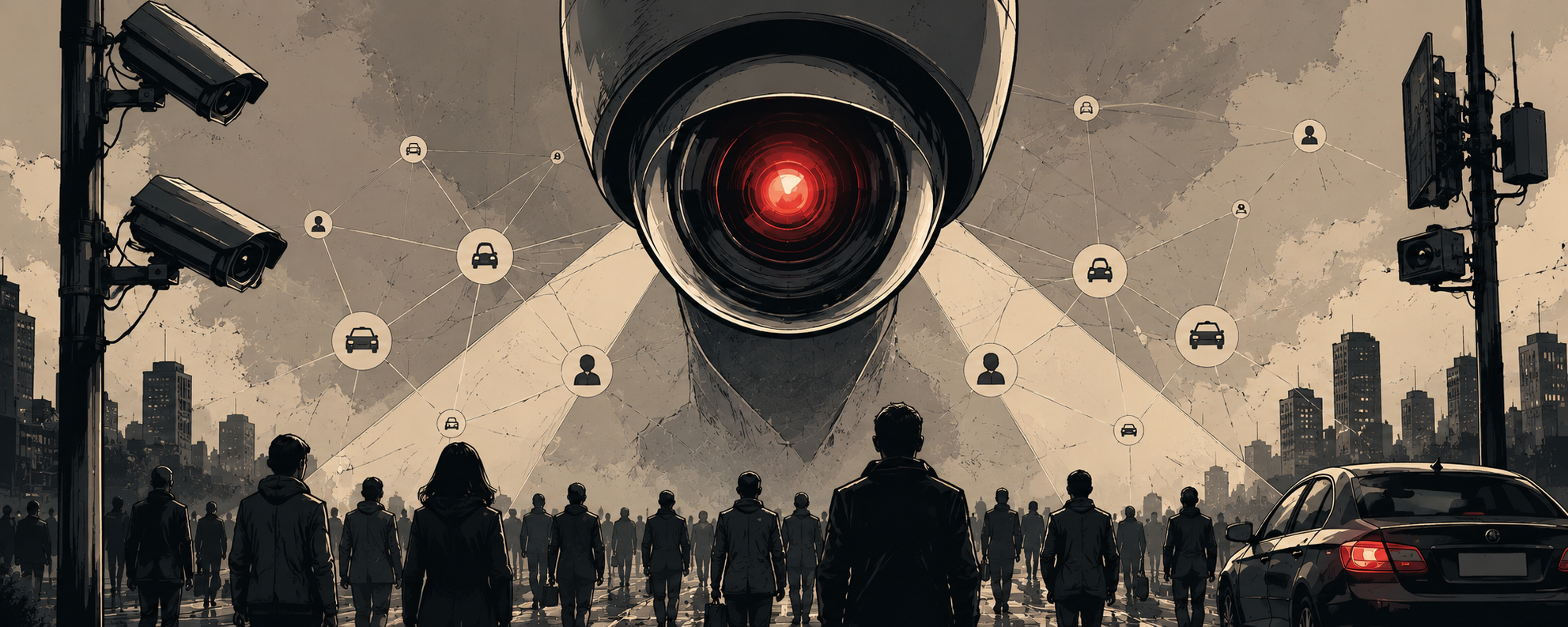
SACRAMENTO — A Chinese man accused by the communist authorities of having committed “economic crimes” figured that he could evade the long reach of the country’s police state by hiding out in plain view: in a stadium packed with 60,000 people listening to a pop concert. Much to his surprise, a group of police officers identified and then apprehended him in the massive crowd thanks to the country’s advanced use of facial-recognition software, The Washington Post reported.
Read more Don’t Forget How Florida Defeated ‘Faucism’ and Vindicated Federalism
That bizarre scenario took place in 2018 — and since then China’s use of Sharp Eyes technology has advanced exponentially. A May 2026 article in DW.com, Germany’s public-broadcasting network, explained that “China’s state surveillance machine … is rapidly evolving from a network of simple street cameras into a data-fused, 24/7, predictive social control behemoth.”
Authorities not only track every citizen’s movement to exert social control, but can even predict their future movements based on a “holistic profile” eerily reminiscent of the Department of Pre-crime in the nightmarish dystopian 2002 sci-fi flick, Minority Report. We can’t chalk it up to a purely Chinese thing, as Great Britain has become known for creating its own system of mass surveillance. And now the United States is hot on its heels.
Even in our relatively free and pluralistic society, the government’s use of security cameras and AI-generated tracking devices is expanding without sufficient oversight. State governments and the feds lack significant restrictions, while local governments are embracing these technologies as a way to battle ordinary crime. Residents in some cities are angrily opposing, say, the use of Flock Safety cameras, but city councils are mostly expanding their use despite the objections. (RELATED: What Google Finds, the Government Sees)
Automated license-plate readers (ALPRs) “automatically capture all license plate numbers that come into view, along with the location, date, and time,” per the Electronic Frontier Foundation. Police say they use them to track down criminals. However, “ALPR data can paint an intimate portrait of a driver’s life and even chill First Amendment protected activity. ALPR technology can be used to target drivers who visit sensitive places such as health centers, immigration clinics, gun shops, union halls, protests or centers of religious worship,” EFF adds. (RELATED: AI: The Biggest Heist in World History)
When police just track everyone without a warrant, it obliterates our Constitution’s protections.
For starters, the systems are easily abused by errant law-enforcement officials. In Costa Mesa, Calif., one former police officer was “accused of accessing the police department’s Flock license plate reader system in order to locate his mistress’ vehicle and the vehicle of the woman’s romantic interests in order to follow them to their locations,” according to the Orange County District Attorney’s Office. (RELATED: In Search of Freedom)
A report from the Institute for Justice, a libertarian public-interest legal group, found 28 similar cases in other places. “The fundamental problem with these systems is that they place private information about people’s movements over time in the hands of every officer,” according to IJ attorney Michael Soyfer, who is challenging some of these municipal mass-surveillance efforts. “Without the constitutional safeguard of a warrant requirement, that predictably allows officers to abuse their access to these systems for things like stalking romantic partners.” Indeed. When police just track everyone without a warrant, it obliterates our Constitution’s protections.
Read more The Cult of Andrew Tate: Modernity’s ‘Men Without Chests’
The accuracy issue is even more problematic than the potential for abuse. A June audit by the Los Angeles Police Commission’s inspector general of the city’s 2,000 cameras found that over a two-month period, “Officers confirmed 161 alerts as accurate matches to the scanned license plate; however, subsequent investigation determined that the vehicles had not been stolen.” The cameras resulted in 337 accurate alerts of stolen vehicles. That’s an astoundingly low accuracy rate. No one wants to face arrest because of shoddy data.
Then there are anecdotes that should shock and frighten us. One involved a woman who was wrongly accused of theft based on inaccurate information. I found the police officer’s reported comments to her most chilling, per CBS News: “You know we have cameras in that town. … ‘You can’t get a breath of fresh air in or out of that place without us knowing, correct?’” In another case, per the ACLU, a car wrongly flagged by a camera caused police to hold a family at gunpoint. Sure, police make mistakes even without technology, but snafus are bound to escalate when the authorities are constantly monitoring our every movement.
At least in our decentralized system, there’s still some hope to keep the hounds at bay. Newsweek reported this week that “dozens of cities and local governments [are] rejecting proposed systems, canceling existing contracts, deactivating cameras, or declining to renew agreements amid concerns over privacy, data sharing and government surveillance.” Yet it notes that 122,000 ALPR cameras nationwide are still monitoring our movements, and the number will likely grow if the past serves as a guide to our Minority Report future.
“Some cities have recently removed Flock cameras, not because the technology failed, but because public trust was strained amid broader political debates around data sharing and federal enforcement,” Flock Safety explained in response to the brouhaha. Sure, few people doubt the capabilities of the technology and its ability to help police solve crimes, but a free citizenry should always be concerned by how our governments use such technology.
That, of course, is a political matter — and public trust will always be eroded when police treat our liberties with disregard. China remains a largely unfree society, where people’s lives are controlled by the dictates of the Communist Party. We shouldn’t be surprised when police there pluck a man out of a crowded stadium. But in the supposedly freedom-loving United States, we should of course insist on strict limits and controls when our government tries to monitor and control us.
READ MORE from Steven Greenhut:
California’s Recycled Enviro Strategies Keep Backfiring
California Wants to Make it Easier to Sue Businesses
What’s Next for California’s Battered Insurance Markets?
Steven Greenhut is Western region director for the R Street Institute. Write to him at [email protected].
Read more Five Quick Things: Let’s You and Him Fight, Bernie
About the Author