I’ve written a lot lately about being raised an Italian in western Pennsylvania, albeit with the Polish last name that wouldn’t suggest that I’m half-Italian. That aside, there’s something distinctive and special about being part of the huge Slavic community that worked the steel and coal mining industries of this region. My Italian articles made references to the wedding scene in The Godfather. For a Slavic example, see the wedding scene — and everything else — in the epic 1978 film, The Deer Hunter. That movie epitomized the mill towns of western Pennsylvania.
Read more Threatened by Fire
You feel that Slavic influence deeply in the Pittsburgh region, immersed in an environment of food like pierogies and kielbasa, and where “mill hunky” is a word known to everyone because so many of us were, in fact, just that. I’ve always been struck by how alien that word is to those not from these parts. Wikipedia, not surprisingly, lists it as an “ethnic slur.” But to those whose Slavic forebears worked like dogs in the mills forging the steel that built America, it’s a badge of honor. They literally built statues honoring the mill hunk.
Common to this region are ethnic names that end with suffixes like “ski” and “schak.” A mentor of mine who rose high in the medical community in Pittsburgh — and whose name ended with “schak” — described herself to me as “just the daughter of a mill hunky from Ambridge.” That’s Ambridge, named after “American Bridge Company,” truly a company town, a steel town, like so many along the three rivers — the Allegheny, Ohio, and Monongahela.
Another friend of mine with that suffix is Mike Palaschak, whom I met when we both started our careers in Washington, D.C., at the Center for Strategic & International Studies in the early 1990s. Mike and I one day at CSIS were talking football after a pivotal game when two local products of those mill towns — quarterbacks Dan Marino and Joe Montana — squared off once again. We started talking about other western PA quarterbacks from those towns, such as Joe Namath and Johnny Unitas and Jim Kelly and George Blanda and many more. Mike then told me a story about his uncle who was a sports reporter for the McKeesport newspaper. The uncle never forgot covering a high school game with the feted Aliquippa Quips and marveling at a young man on the field who was just destroying people. The uncle chased him down at the end of the game and said, “Son, that was an incredible performance. What is your name?”
The kid answered: “Mike Ditka.”
Michael Keller Dyczko from Carnegie
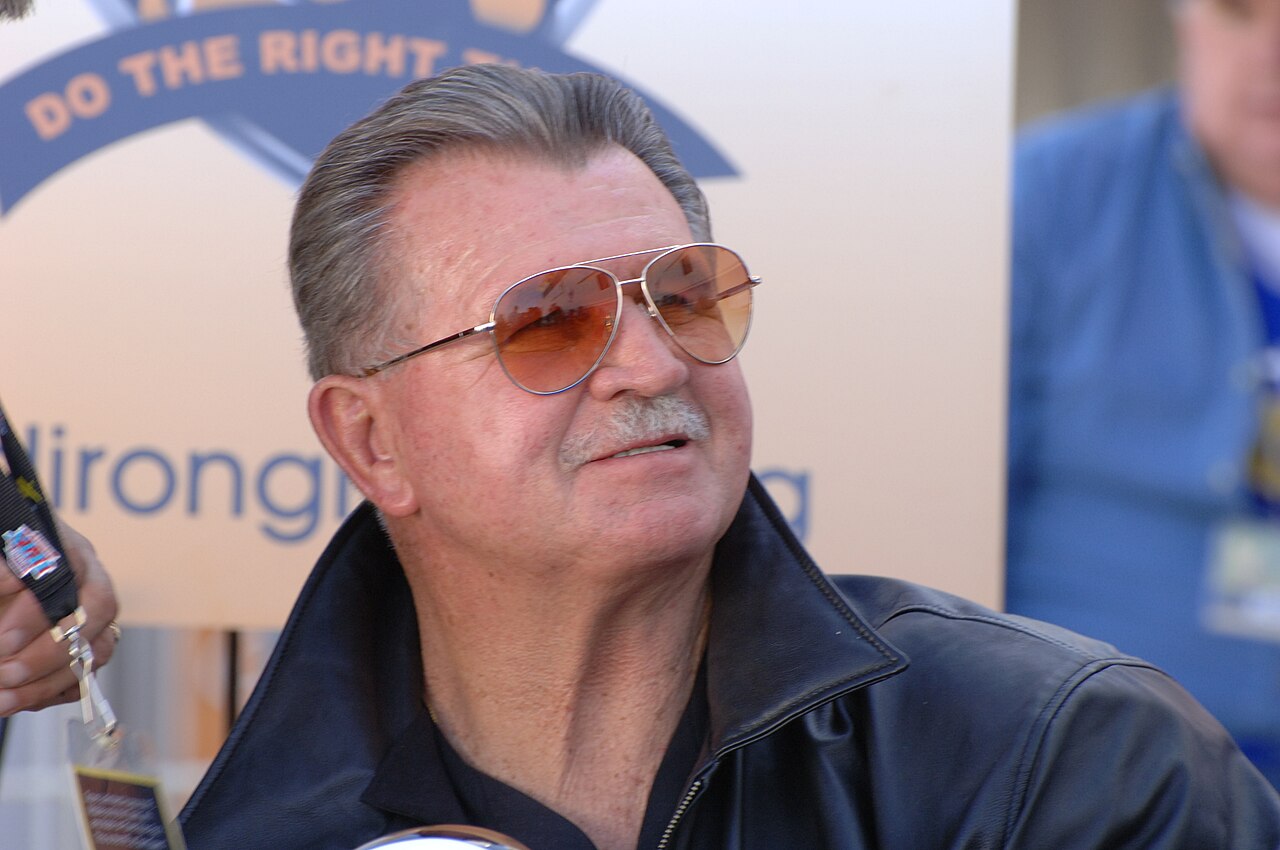
Yes, Mike Ditka. He was a product of those mills and the kielbasa and pierogies. A family of mill hunks. He became a legend. He became Iron Mike Ditka. And of course, he passed away last week at age 86.
Born in October 1939 in Carnegie, PA, home of baseball immortal Honus Wagner as well as my wife Susan’s mill-hunk family of Slovenians, his birth name was Michael Keller Dyczko, the son of an Irish German mother and a Polish Ukrainian father who was a welder at the steel mill. Typical of such surnames, no one could pronounce it, and so the family name was changed to Ditka.
Mike was an altar boy at the parish down the street, and he and his brothers attended the local Catholic school. What he learned would become foundational to his life.
“I am so grateful for the Roman Catholic faith with which I was raised,” he told Catholic author Tim Gordon in 2018. “My mom was a terrific Catholic … and always saw that we went to Mass and Catholic school…. [G]rowing up, the most important thing was the sacraments with my family…. Growing up in a small town, a Pennsylvania steel mill town, we loved everything about the faith. Going to Catholic school and learning the faith, I wouldn’t trade that for anything.”
He also wouldn’t trade what he learned from the nuns: “The Sisters of Saint Joe taught us so much at St. Paddy’s Church and school in Aliquippa, Pennsylvania. The nuns, they were really tough — they’d hit you if need be — and they taught us everything we needed. It was really great.” Ditka doubled down on that point: “I don’t care how many times I got hit by a nun, it was good for me. Today a teacher would get sued for that stuff.”
The nuns would hit Ditka, and Ditka would hit guys on the football field. They instilled in him a toughness that never left him.
A football legend — in high school, college, and the NFL
From there, Mike made his way to Aliquippa High School, one of those western PA schools that breeds professional athletes and especially football players. In fact, Ditka is one of three from Aliquippa — along with Ty Law and Darrelle Revis — who today are in the Pro Football Hall of Fame.
Notably, Ditka met other sports legends at Aliquippa. He played basketball for local coaching legend Press Maravich, a son of Serbian immigrants whose own son, Pistol Pete Maravich, became the most prolific shooter in the history of NCAA basketball, and an NBA great as well.
Ditka is so legendary there today that a friend tells me that the school boasts a wall of honor with photos of three great historical figures: John F. Kennedy, Martin Luther King Jr., and, positioned not beside but above them, Mike Ditka.
At Aliquippa, Ditka was recruited heavily by college scouts, narrowing down his choices to Notre Dame, Penn State, and Pitt. He chose Pittsburgh. He had to stay close to the smokestacks. They were his roots, his patrimony.
At Pitt from 1958-60, Ditka played baseball and basketball as well as football. For the Panthers, he played both offense and defense, but was a standout All-American tight end, so outstanding that he received Heisman Trophy votes and became a number one draft pick (fifth overall) by the Chicago Bears in 1961. He eventually made the college football Hall of Fame.
Read more Israel’s Exodus Is Only Half the Story
In the NFL, Ditka also played for the Philadelphia Eagles and Dallas Cowboys. Here, too, he was All-Pro. He ultimately became the first tight end with a bust in Canton, Ohio.
Yes, Mike Ditka made both the Pro Football Hall of Fame and the college Hall of Fame.
And that all occurred even before he reached his true legendary status as head coach of the Chicago Bears. With his fiery, intense persona, he was the face and heart and soul of the terrific 1985 Chicago Bears team, which, like him, was known for its flare and toughness. His coaching record alone could have merited a place in Canton.
Perhaps the most colorful capturing of that team in that period was the hilarious Saturday Night Live skit of fictional Chicagoan “Bill Swerski” and his “Da Bears,” featuring actors Joe Mantegna, Mike Myers, Chris Farley, Robert Smigel, and George Wendt of Cheers fame (“Norm!”). Ditka himself made a hilarious cameo with the group. The guys went wild.
“I’ll whip your ass”
One more funny, typical Iron Mike story. One day on his radio show in Chicago, a caller called in to insult Ditka. In 1992, the coach had a weekly show on Chicago’s WSCR-AM. A caller accused the Bears coach of being a crybaby. Ditka was offended and promptly offered to meet the caller at the coach’s downtown office to settle their disagreement like men. He barked out the address. “You tell me what time and when,” said the 53-year-old coach, “and I’ll whip your ass.”
Classic Mike Ditka.
A conservative Republican — who almost ran against Obama
Though everyone knew about Ditka and football, less known are his politics, and what they could’ve meant to the U.S. Senate and even the presidency.
Ditka was very conservative. His views on everything from masculinity to Islam to athletes taking a knee during the national anthem infuriated the woke, and still do.
“Men are the leaders,” he told Tim Gordon in 2018. “That’s the way it is. Men take care of women, like Adam should have taken care of Eve. A man’s a man. I didn’t make the rules; I’m just saying the obvious…. There are plenty of strong, great women, sure. I’m not saying there aren’t. But men are leaders, and we need them to realize that.”
As for athletes taking a knee: “This is a kid’s game played for millions of dollars, and these guys feel they have to protest it. It’s bullshit: people taking a knee during our anthem. America is about the only country in the world where you can even play football for money, and these whiners feel the need to protest it. It makes no rational sense at all. Don’t even try to reason about it. There’s no rhyme or reason to their thinking. What they’re doing is a disgrace to the sport and to the country.”
As for those who want to remove God from the country, Ditka said this: “Well, if you take God out of your daily life, that’s scary…. They seem to believe that America and Christianity are not good. That’s crazy. Well, if you don’t like how we do things in this Christian country, then get your ass out of Dodge.”
Pure Iron Mike. With those views, he could’ve entered politics. In fact, he nearly did. And therein may have been his greatest loss.
In 2004, Michael Keller Ditka was recruited by Illinois Republicans to run for the U.S. Senate against a radical, upstart state politician named Barack Hussein Obama. He declined. His life was just too busy. Had he run, Obama surely would have lost, and no one outside Chicago would’ve ever heard of him. Ditka knew that and later regretted his decision.
“Biggest mistake I’ve ever made,” Ditka said later. “Not that I would have won, but I probably would have and he [Obama] wouldn’t be in the White House.”
But alas, politics wasn’t for Mike Ditka. Football was. It really, truly was. And for that, we’ll always be thankful for Iron Mike.
Read more The Emperor’s New Running Shoes
May this tough guy who battled fiercely on the gridiron rest in peace.
READ MORE from Paul Kengor:
Anti-Italian Discrimination: The Bigotry Behind the Columbus Cancellers
Italian Without the Name
The Stupidity of Baseball’s ‘Artificial Runner’
About the Author