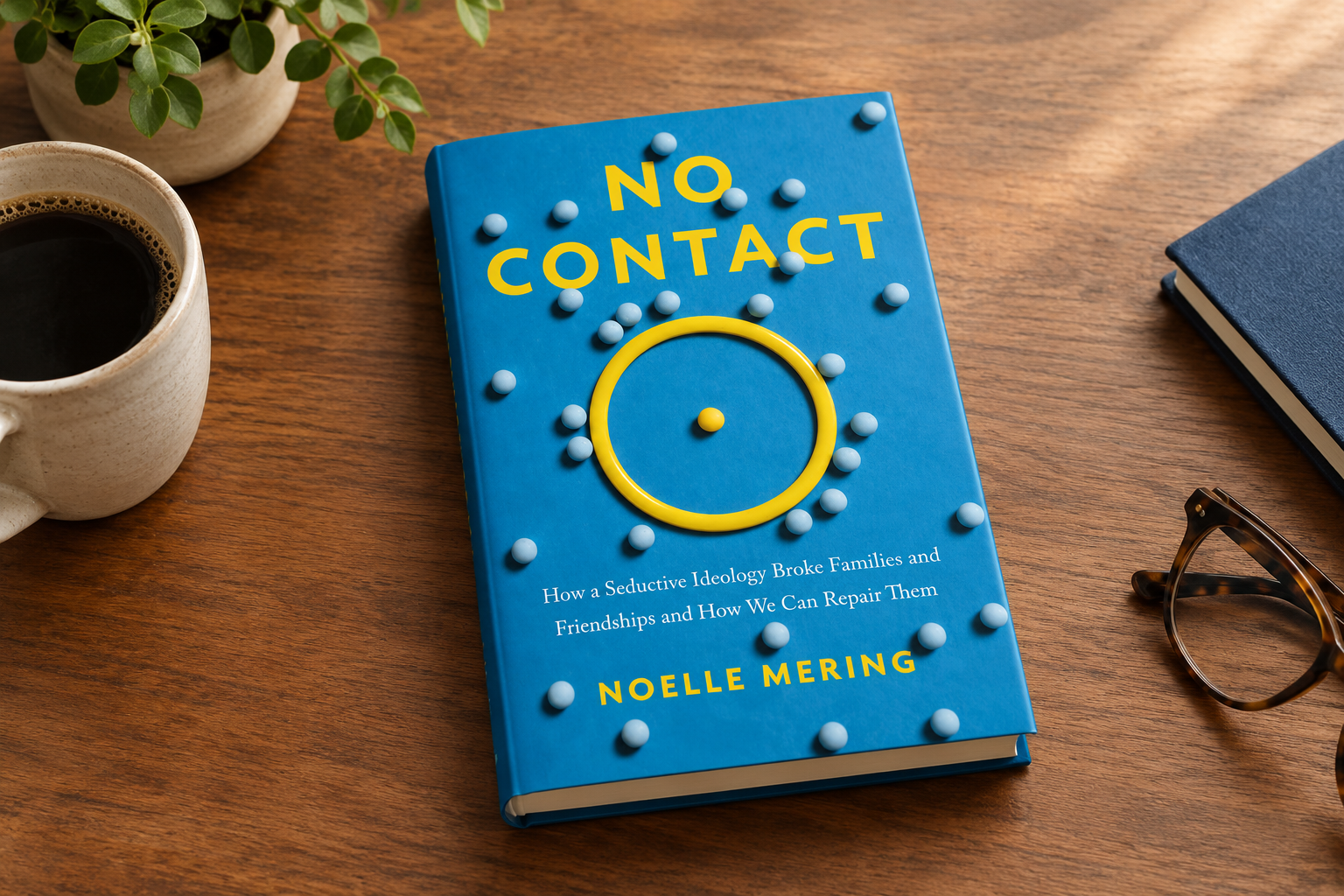
No Contact: How a Seductive Ideology Broke Families and Friendships and How We Can Repair Them
By: Noelle Mering
Forum Books, 288 pages, $28
Read more Abdul El-Sayed: A Muslim Brotherhood Puppet and a Grave National Security Threat
A study from Cornell University recently found that 27 percent of Americans are estranged from a close relative. In many cases, and increasingly so, it is adult children who are estranged from their own parents.
The Ethics and Public Policy Center’s Noelle Mering tackled the phenomenon in a new book published in September, No Contact: How a Seductive Ideology Broke Families and Friendships and How We Can Repair Them. Mering brilliantly diagnoses the many cultural maladies that have created this situation, and offers hope and good advice to those in estranged situations.
Earlier this month, the issue of parental estrangement received some attention when an aggrieved grandmother asked Florida Rep. Byron Donalds what he would do about “grandparents’ rights.” She complained that she hadn’t seen her grandchild in a few weeks and said that she was working with her local representative “to see if we could do a federal law so [grandparents’ rights] could be nationwide.” Just from the woman’s annoying tone of voice, which reeked of entitlement, you could tell that, at least in this situation, the parent rather than the adult child was probably at fault.
But let’s be real: in most cases of estrangement these days in the United States, the majority of the blame lies with the adult child. That seems to be the perspective of Mering, though she doesn’t entirely let parents off the hook.
Mering explains the five “core conditions” driving the phenomenon of parental estrangement: “(1) demythologizing the family, (2) social hygiene, (3) broadening the definition of trauma, (4) the infallibility narrative, and (5) cultural narcissism,” and I am thoroughly convinced by her diagnosis.
At the root of these five conditions, writes Mering, is “a radical revision of what it means to be human” that “recast[s] the person around two opposing principles: the exaltation of autonomy and the incentivization of victimhood.”
Here are her five core conditions:
1. “Demythologizing the Family”: The Bible commands us: “Honor thy father and mother.” Mering informs us that radical progressivism teaches something entirely different. In its understanding, the Bible’s morality of demanding special obligations toward one’s family in fact functions to “hide oppression, abuse, and other toxic behavior.” Therefore, progressives seek to “demythologize the family” by dismantling the supposed “myth” that one’s family is worthy of special regard. In a culture in which family is supposedly arbitrary, and in which moral demands to them only “serve harmful power interests,” one is better off prioritizing oneself as an individual and therefore casting aside one’s obligations toward one’s parents.
2. “Social Hygiene”: In an age of identity politics, people increasingly “evaluate a person’s character, and therefore their social acceptability, based on political tribe.” In this environment, many a progressive young person decides their parents are immoral because they are aligned with political conservatism. This is exacerbated by progressivism’s tendency to have a “dynamic of low differentiation,” that is, a low tolerance for those with convictions different from one’s own. The combination of judging people’s character based on their political tribe and having a low tolerance for those with different beliefs leads, Mering argues, to “social hygiene,” meaning “scrubbing our social circles clean of toxic ideas by cutting contact with those who hold them.”
3. “Broadening the Definition of Trauma”: People once understood trauma as stemming only from things as severe as war and physical abuse. Now, however, anything can be traumatic. A parent telling you to do your laundry when you’re 12 can lead to “trauma.” Mering explains that many of the parents she spoke with who experienced estrangement from their children had made missteps as parents, but “theirs were the ordinary parental failings that, in previous generations, would have been absorbed or forgiven rather than collected, catalogued, and marshaled retroactively to support a narrative of childhood harm.” When young people are told on social media and with their therapists that ordinary experiences of hardship and imperfect familial relationships are traumatic, they “search for [trauma] in their own lives, and perhaps even retroactively project it onto their past.”
4. “The Infallibility Narrative”: Mering explains to us that there are copious social media influencers, on TikTok in particular, who essentially cheer on their viewers in cutting off contact with their parents. One such person is Patrick Teahan. In one video recounted by Mering, Teahan asserts that parents who push back against their adult child’s decision to cut off all contact are proving just how toxic they are: “When estranged parents reactively believe that their child has been wrongfully influenced by a therapist or whatever, by TikTok or whatever, it kinda implies that the child has no … thoughts of their own and that … the parents [see] them as an object and not as an individual. It’s kind of like a clue.” Of course, as Mering points out, any parent who has been wrongfully estranged will of course push back against their child’s decision. But in the progressive mindset, an adult child who estranges themselves from their parents must necessarily be right. This is the “infallibility narrative”: “Parents who have been cut off and tell their stories online are regularly subjected to derision and armchair psychoanalysis, while adult children are almost unanimously affirmed in their decision in such forums.” It is, writes Mering, a philosophy of “Believe all adult children” that is akin to “Believe all women.” In this environment, young people are very much cheered on to cut off their family.
5. “Cultural Narcissism”: Mering points us to Christopher Lasch’s 1979 book The Culture of Narcissism, which posits that the rise of individualism and consumerism leads to, as she puts it, “widespread narcissistic behavior.” Lasch’s predictions proved true, Mering writes, in that narcissistic traits have risen dramatically in the United States since the time that book was written. Between 1979 and 2006, narcissistic traits, like a focus on money, fame, and image, rose while empathy declined. A further study carried out for the Financial Times between 2014 and 2025 found a huge rise in neurotic traits such as “emotional fragility and self-preoccupation” and a corresponding decrease in agreeableness.
This is where both sides — adult children and parents — are at fault. While this rise in narcissistic traits is “most pronounced” in young people, older Americans have also been sucked into this narcissism. Mering writes: “The cultural currents fueling narcissism and emotional fragility affect us all, not only the younger generation nor the ideologically possessed. Family breakdown didn’t begin with Gen Z; its logic has been unfolding for decades.”
This can be seen most clearly in the drastic rise in divorce rates in the latter half of the 20th century. “The normalization of divorce has communicated a quiet but devastating message: Family members are replaceable,” she writes. “We can’t sit comfortably within a culture that treats divorce casually and then condemn young people for ‘divorcing’ their families.”
Mering spoke to a psychoanalyst, Erica Komisar, about this problem of narcissistic traits. Komisar told Mering: “The repercussions of three generations of self-centeredness means parents are modeling selfishness and emotional fragility to their children. The shift in values to a more self-focused parenting style is contributing to a rise in disorders of the self, otherwise known as narcissistic disorders.” This phenomenon, Mering explains, is made worse by social media.
With the rise of narcissistic traits and systemic divorce, some of these parents are, in fact, bad parents. That grandma who told Byron Donalds she was working with her congressman to make a federal law that would force her daughter to let her see her grandchild is probably an example of that.
But young people’s increasing propensity to prioritize their feelings over everyone else is the real problem today. In our culture of selfishness, Mering writes, “Every person becomes the sole author of themselves, bound by nothing higher than the demand to be true to themselves.” This is a very dangerous pathology, and it is one many young people are succumbing to.
I once attended a brunch in which the women, all in their 20s, spoke about how they learned when they became adults that their parents had made tons of mistakes and were deeply flawed. They warned me that soon I would realize all the many faults with my parents. I told them that no, that wasn’t the case for me; my parents are wonderful parents. Just wait, they told me, and you’ll see that they’re actually bad. They were, of course, wrong, but the sentiment expressed is deeply worrying. Young people are collectively deciding that all the members of the older generations traumatized us and emotionally abused us.
Noelle Mering does an excellent job setting out how this pathology seeped into our culture, how it manipulates people into destroying their families, and what we can do about it. We’re well-served by learning from her.
Read more The Democrat Campaign to Destroy Kamala Harris
READ MORE from Ellie Gardey Holmes:
The Democrat Campaign to Destroy Kamala Harris
Canada Doubles Down on Letting Indigenous Criminals Off Easy
What an Awful Woman
About the Author