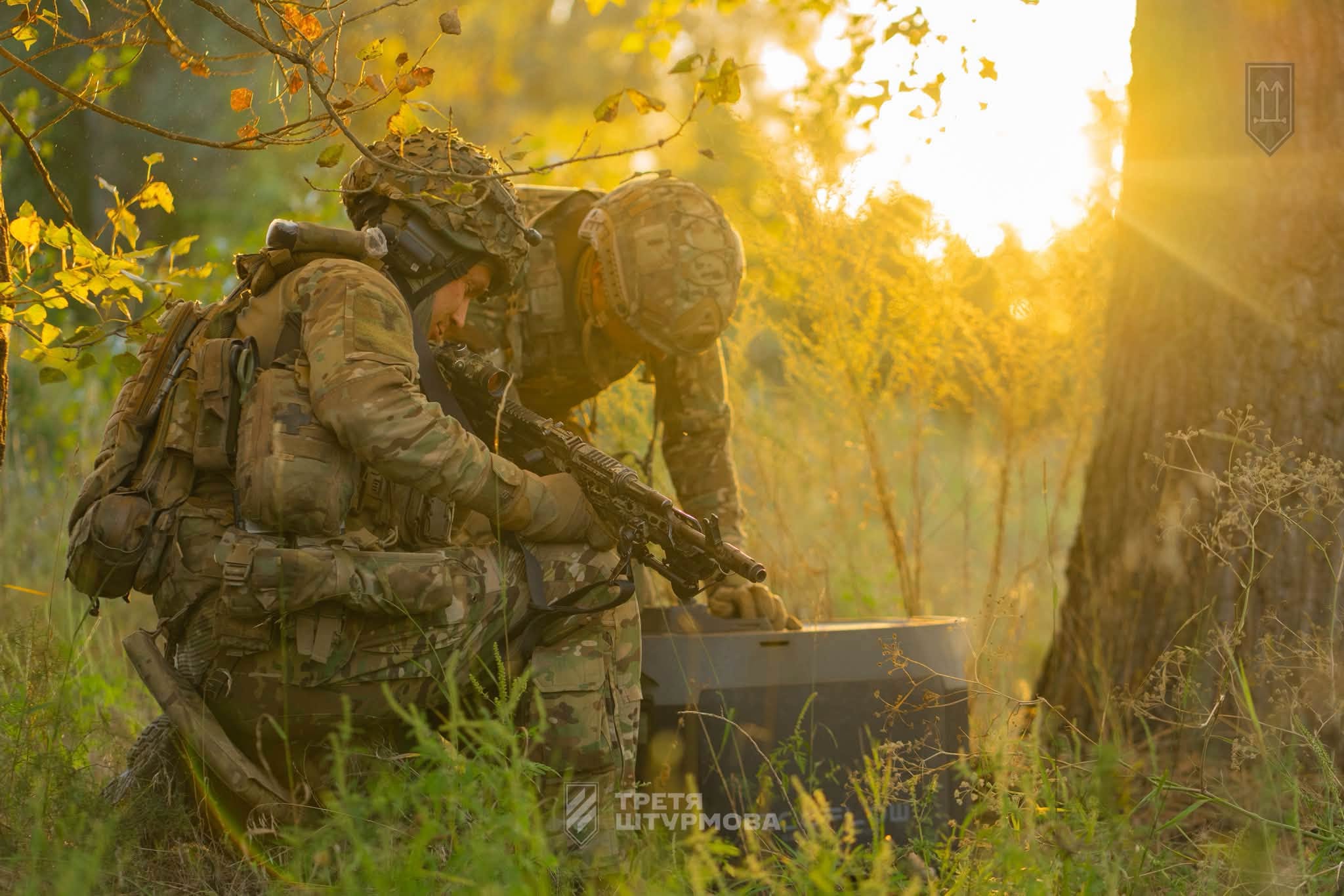
It’s history’s first robotic airborne landing operation. Last week, Ukraine dropped grenade- and machine gun-firing robots behind Russian lines to assault logistics and command bunkers for ground troops moving quickly against positions at the front, threatening the fortress belt city of Sloviansk, dealing what some analysts interpret as a major blow to Putin’s strategy to take eastern Ukraine.
Read more The Spectacle Ep. 473: Trump Made CAFE Standards Great Again
“Operation Vivaldi” aimed at pushing Russian forces back from Ukraine’s key remaining strongholds in the key province of Donetsk. It relies on electronic warfare systems developed by the besieged nation’s inventive arms industry to compensate for a lack of manpower to counter Russia’s numerically superior army swarming into the region on Putin’s main sites. Ukraine has long been at the vanguard of drone technology now being applied on the ground. (RELATED: Drones Are Not Enough)
Last spring, The American Spectator reported on plans to deploy 25,000 newly developed tank-tracked ground robots in combat operations that could further revolutionize Ukraine’s electronically saturated battlefield. (RELATED: The War in Ukraine Is Becoming Robotic)
Robotic mini-tanks armed with “Bullspike” grenade launchers and embedded explosive charges for auto-immolation were inserted at night some ten miles inside Russian-held territory by “heavy bomber” Hryphon drones (named after a mythological creature combining features of an eagle and lion). They blasted the Russian rear, generating panic among soldiers chased into their shelters by the robots, which detonated inside.
The buttons were being pushed by operators ensconced in distant control bunkers, from where they directed their electronic Rambos at targets cross-haired on thermal screens. They celebrated as Russian bunkers went up in smoke.
Meanwhile, explosive-packed vintage Soviet-era BTR-60 armored personnel carriers converted into unmanned kamikaze vehicles blew up the main Russian fortifications, including a command and communications node, allowing assault troops to break through the defensive positions.
The combined robotic arms offensive was preceded by an equally elaborate electronic deception using fake signals to make the Russians expect attacks in a different area, while jamming sensors blinded them to air and land movements where Ukrainian forces concentrated.
“The enemy was convinced that the axis of the attack would be Shandryholove–Zelena Dolyna. This forced them to waste their reserves in pointless counterattacks there. The Russians slept through the real strike, which was focused on taking Nove,” says Brigadier General Andriy Biletsky, commander of the Ukrainian army’s Third Corps, which conceived the strategy and improvised some of the technology employed.
The Third Corps’ novel idea of using old Russian APCs as guided kamikazes worked so well that Russian defenders believed that the approaching vehicles were reinforcements — before they exploded in their faces.
Nove is positioned on high ground controlling a vital bridgehead over the Donetsk River into Lyman, the region’s major railway hub and industrial zone some 20 miles north of Sloviansk, at the northern point of Russia’s slow-moving pincer on the region.
Rapidly charging past Nove, the Ukrainians took several more settlements, forcing the shocked Russians into a virtual rout, dragging out remains of a “Rubicon” unit whose wire-guided drones impervious to electronic jamming no longer threaten Sloviansk.
Read more The Spectacle Ep. 474: Should the Federal Government Pay for College Degrees That Don’t Pay Enough?
Ukrainian estimates of Russian casualties around Nove run between 2,000 and 3,000, equivalent to an entire brigade. Some 250 Russians have been taken prisoner, including artillerymen, drone pilots, and officers. “Entire units surrendered,” according to Biletsky.
The high-tech blitz to clear Russians from the outskirts of Lyman, where the Ukrainians have been struggling against their encroaching advances for months, has been the main thrust so far of counteroffensive operations all along the Donetsk contact line.
Ukrainian tactics center on severing Russian communications and logistic connections to advance units often consisting of little more than platoons or squads around a Russian flag over some ruined structure. The significance of often symbolic advances tends to get exaggerated as they are reported up the chain to Putin, whose generals are primarily concerned with keeping him happy.
Drone-headed attacks are reported to be intensifying around the heights of Chasiv Yar to disrupt Russian advances from the east towards Kramatorsk, the largest fortress belt stronghold. According to the Institute for the Study of War, Ukraine is also closing on Russian units infiltrating Drushkivka, some 15 miles south of Kramatorsk, to blunt the southern point of Russia’s pincer. There are reports of Ukrainian incursions into Kostiantynivka, which Putin declared to be under his army’s control over a month ago.
Overall Russian casualties in the Donetsk sector during the past week are estimated at 5,000. The figure is over 10,000 throughout eastern Ukraine, where fighting has also intensified around Sumy in the far northeast and in the outskirts of Zaporizhzhia in the south, where a Russian armored offensive has become entangled in Ukrainian “drone traps.”
While Ukraine may be succeeding in checking Russian advances along key zones of the front, it’s too early to determine the lasting effects of “Operation Vivaldi” on the war’s eventual outcome or on forcing Putin to the negotiating table. He has survived major battlefield reverses in the past.
The northern point of Russia’s pincer drive on Donetsk has been broken. But the southern sector around Kostiantynivka is largely holding, so far. The city of Dobropillia west of Kostiantynivka is under increasing Russian pressure, and if Putin’s motorized and assault brigades manage to draw a new battle line between both points, his strategy could pivot towards a wide enveloping movement on Kramatorsk along the southwest.
But Russian chances for a decisive breakthrough in the coming months have been put on hold in Nove. Putin will be forced to mobilize hundreds of thousands more Russian men through an unpopular draft for what will likely settle into yet another prolonged winter stalemate.
Ukraine’s robot army will need to develop and grow fast in order to break it before Russia’s ballistic missiles and newest drones — jet-powered Geran-5s with speeds of 400 miles per hour that outrun Ukrainian interceptors — degrade the country’s power generation to the point that Kyiv is left entirely without heat and people begin to starve.
Read more The 5QT Presents: The Five Black Pills, Part 2 — Islam, Islamization, and Third-Worldism
READ MORE from Martin Arostegui:
Trump’s Final Showdown With Iran
Spain’s Pedro Sánchez and the Media’s Ceuta Invasion Blind Spot
The War in Ukraine Is Becoming Robotic
Image licensed under Creative Commons Attribution 4.0 International.
About the Author