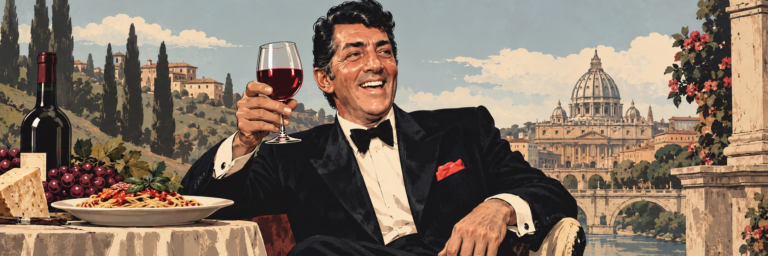
“I feel sorry for people who don’t drink.”
So said Dean Martin, a man known for drinking. (The quote is also attributed to Dean’s paisano, Frank Sinatra.)
Read more Blessed Fulton Sheen: A Saint for America
Dino loved his vino. He not only knew how to drink but how to act like a drunk. He played an outstanding drunk sheriff in the 1959 film Rio Bravo, co-starring John Wayne and Walter Brennan. Lam-w.comter, in December 1975, it was unclear whether Dean was acting during his epic performance on The Tonight Show with Johnny Carson (seated between Carson and Bob Hope). He was either pretending to be inebriated or had too much sauce in the green room. The man could certainly handle his booze. While on stage with Sinatra and Sammy Davis Jr. and the Rat Pack, Martin deftly balanced a Martini in one hand and a microphone in the other while crooning about having too much wine in “That’s Amore.”
For the record, his real name wasn’t Dean Martin, you know. It was Dino Crocetti. (For an outstanding recent documentary on Martin, see the 2021 King of Cool.) He was no WASP. The Anglicizing of that beautiful name from the Abruzzo region of Italy is a tragedy. One almost feels sorry for the idiot responsible for that egregious sin.
Dino, however, felt sorry for people who don’t drink. His ethnicity helps explain that. He was an Italian who grew up with wine at the table. I can relate to such an upbringing on my mother’s side, as well as to feeling sorry for people not reared with vino at meals. I’ve been a guest at Baptist-ish functions where a decent dinner is served with — gag — water as the “beverage.” An attempted step up from water at these functions might be a sugary iced tea. Worse might be a soda — Pepsi, Coke. That stuff is poison. It certainly doesn’t complement food. I’ve pushed through too many dinners where I’ve politely muttered to myself, “I can’t believe there’s no wine here.” Alas, I bite my tongue — sometimes literally, to not rudely protest to the hosts.
Then again, I suppose it depends on the food. If you’re ingesting, say, English or Irish “cuisine,” you don’t crave a fine Chianti or Cabernet Sauvignon to enhance the rubbery hunk of dry meat, stale potato, and dollop of mayonnaise.
Is it any wonder the English and Irish are known instead for beer? You need beer with their meals to give you calories and sustenance after half-finishing the gruel set before you.
Beer, of course, doesn’t go with food. If you order a beer before your main course, it partly fills you up. There’s less room for food. And when the food comes, it doesn’t go with beer.
Sure, frat boys can drink beer with pizza, and you can guzzle down red solo cups of lager from a keg while tailgating with bratwurst at a football game, but don’t try to convince me that such is anything but barbarism.
In fact, the ancients understood this. One of my favorite readers, Frank Natoli, noted in the comments section of my column last Saturday that Roman military historian Tacitus defined the boundary between civilization and barbarism as the preference of the former for fermented grapes versus the latter’s consumption of some concoction of hops, wheat, and barley.
Indeed, he did. Tacitus lamented these brutes: “For drink they have a liquid made from barley or wheat.” That liquid paled in comparison to wine, which was the choice of not only sophisticates but, obviously, of the gods.
Frank is Italian, as is another of my favorite readers, Albert Alioto. Albert chimed in with similar thoughts last week, as did a reader identified as “May.” Here’s their incisive exchange:
May: “I remember reading Dumas Malone’s epic tome about Thomas Jefferson. When the French diplomats visited the White House at that time, they commented that Americans were ‘barbarians,’ since they drank water at meals, and not wine. LOL.”
Albert: “The Russian diplomat Sergei Witte said the same thing when he came to the US for Teddy Roosevelt’s mediation of the Russo-Japanese War in 1905.”
Indeed, French diplomat Louis-Guillaume Otto observed that “the Americans are barbarians because they drink water at dinner.” And Russian Count Witte complained to TR not only of the lack of wine but the nearly “indigestible food.” Fine alcohol can help with digestion as well — such as an aperitivo, Limoncello, or fine Fernet Branca, but sure as hell not a 16-ounce Guinness stout, which only makes you burp, bloated, and fat.
Read more Bibi’s Churchillian Speech at the UN
One surmises that TR, the product of Dutch and Scottish ancestors, merely grunted at the objection.
In their defense, our almost exclusively Protestant founding fathers and first nearly three dozen presidents (men like TR) gave us a wonderful republic. For that I’m grateful. But because of their upbringings — too many of them teetotalers — they didn’t give us decent cuisine or bestow any legacy of fine dining. Wine was as alien to them as masculinity is to a blue-haired, “misgendered” Starbucks barista.
It required the forebears of Frank and Albert and Dino and my mother’s people from Calabria to bring to America the blessed likes of pasta and pizza and olive oil and risotto and lasagna and spaghetti and rigatoni and ravioli and pappardelle and parmesan and ricotta and bruschetta and ciabatta and prosciutto and mozzarella and biscotti and wine, wine, and more wine to our shores. (Don’t dish me some bunkum about Koreans or Chinese inventing pizza or pasta. I don’t want to hear it.) They were masters of the art of cuisine. The British were clueless. Look at something as simple as Italian gnocchi and ask yourself: with their obsession with potatoes, couldn’t the Irish come up with even gnocchi?
Apparently, not. That’s why you don’t go out for “Irish” for dinner.
Indeed, what would Americans do for decent dining if not for the Italians?
Frank Natoli points to a funny scene from The Sopranos when “Paulie Walnuts” (played by Tony Sirico) and Salvatore Bonpensiero (played by Vincent Pastore) visit a Starbucks-style coffee shop and complain about the menu. Paulie gripes: “All our food: pizza, calzone, buffalo mozzarella, olive oil. These f–ks had nothin.’ They ate puzzi [foul, rotten grub] before we gave them the gift of our cuisine.”
And who knows what they would be drinking. Maybe no alcohol at all! These clowns gave us Prohibition. In fact, as our Dan Flynn has written about so eloquently, it was 1920s progressives — especially fanatical progressive Protestant women — who took our booze. To borrow from Frank Sinatra, these broads were a miserable lot. Just look at a photo of Carrie Nation and tell me that woman didn’t need a good, hard drink.
Invoking Dino Crocetti again, I especially feel sorry for people who don’t drink because of their religion — and more specifically, Christians who don’t drink because they think their religion prohibits it. What’s up with that? The great C.S. Lewis found it perplexing. He mused in his classic Mere Christianity — pointing a finger at dry Protestants — that it’s “Mohammedanism” that’s the religion of teetotalism. “It is a mistake to think that Christians ought all to be teetotalers,” wrote Lewis. “Mohammedanism, not Christianity, is the teetotal religion.”
That would be Muslims. Muslims and, I guess, Mormons and certain boring branches of American Christianity.
Catholics don’t suffer from this at all, of course. That’s because we drink wine as a literal sacrament, one instituted by Jesus at the Last Supper. And despite what I’ve heard on occasion from stuffy Protestants, Jesus wasn’t serving some first-century version of Welch’s grape juice. When I was a Presbyterian, and we celebrated communion on occasion (depending on the church, sometimes monthly, sometimes quarterly), it just didn’t feel right eating a nugget of cookie dough and washing it down with sweet grape juice.
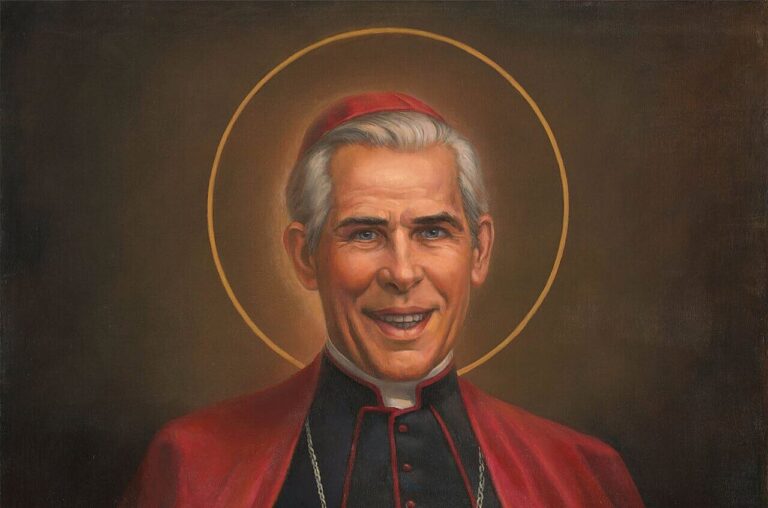
Sorry, folks, but Jesus drank wine. To borrow from the Blessed Fulton Sheen, at the Last Supper, Jesus drank wine, and then He turned wine into His blood.
And holy Moses, let’s not forget the wedding feast at Cana!
For any follower of Christ who thinks that the dear Jesus doesn’t want us to have a little vino with our food, how do they deal with the mighty theological problem presented in their Bible in John 2:1-12? There, with the intercession of the Blessed Mother, Jesus performs His first miracle. No, he doesn’t resurrect a British boiled potato as a plate of Spaghetti Carbonara or Cacio e Pepe; he transforms water into wine. Not milk. Not orange juice. The master of the feast then marvels at the extraordinary taste.
How much wine did Jesus create at Cana? A bottle or two? A large carafe? A couple of glasses for the bride and groom? No, no, no. Read your Bible. The Son of God filled to the brim six 20–30-gallon stone jars. That was more than enough for the wedding reception. That was enough for the whole village for weeks.
The guests then drank up, for the taste and for the merriment. The wine went with the food and with the occasion and with the celebration. Without it — no fun.
Read more Clash of the Money Giants: China Lays the Groundwork to Rival the Dollar
I agree with Dino. I feel sorry for people who don’t drink.
READ MORE from Paul Kengor:
Fulton Sheen and a Real-Life Miracle
On Cappuccino and Standards
The Democratic Party Leaves John Fetterman
About the Author