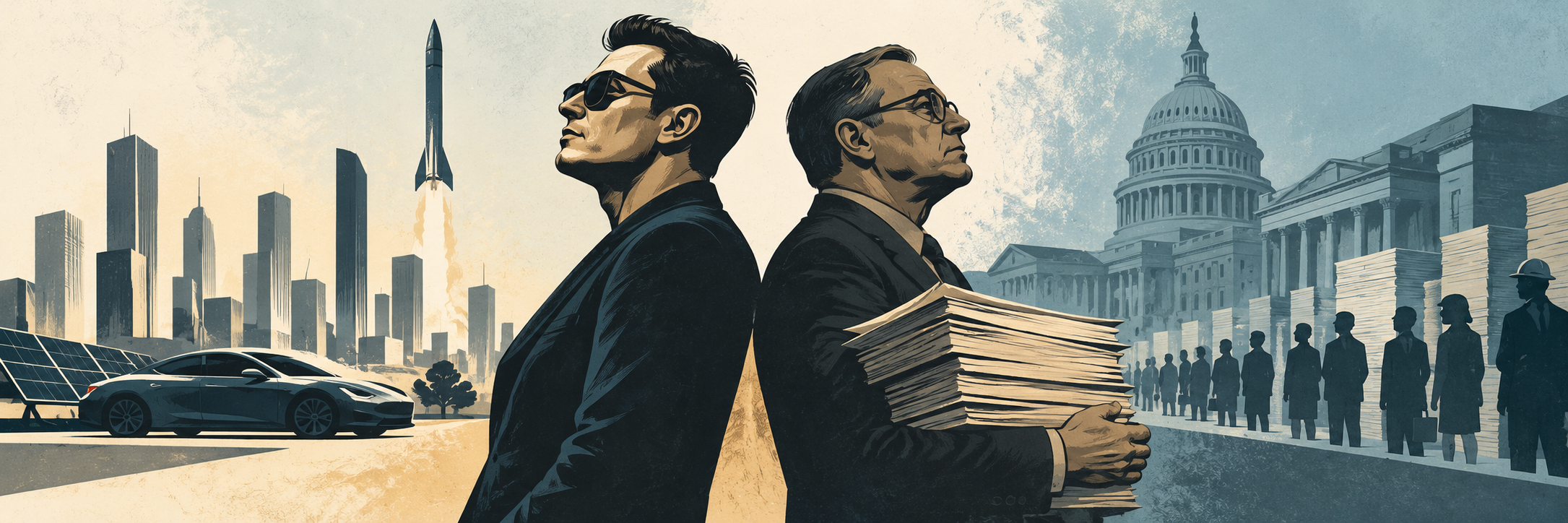
People have always been suspicious of the wealthy — from the Medicis in Renaissance Italy to modern tech titans in Silicon Valley. Over the past two decades, the combined net worth of the world’s 100 wealthiest individuals has surged from roughly one trillion dollars to over five trillion (though as we have seen with Elon Musk, these wealth estimates can fluctuate dramatically). Yet fears that this unprecedented accumulation translates to unchecked social control are fundamentally misplaced.
Read more ‘Trump Power Plant’ Coming to Fayette County, Pennsylvania
Over that same period, U.S. household wealth increased by a factor of three. So the share of overall household wealth held by the 100 wealthiest Americans has almost doubled. People’s concerns about this great accumulation of wealth are largely misplaced. Much of their anxiety stems from a confusion between economic success and political power. Still, many politicians and pundits rally supporters by decrying wealth concentration. (RELATED: The Wealth Tax Endgame)
Ironically, billionaires have less control over my life than unknown bureaucrats and low-level government officials do.
Ironically, billionaires have less control over my life than unknown bureaucrats and low-level government officials do. Elon Musk cannot tell me whether I may or may not build an extension on my home, but my local building department, planning and zoning commission, and historic preservation committee all can. Musk cannot make me install an electric vehicle charger on my new commercial construction, but the Colorado legislature can.
Of course, wealth can be used to lobby legislators. It can be used for marketing and campaigning for candidates who favor what a wealthy donor wants. But there is no guarantee of success. Many campaigns have outspent their opponents by 2 to 1 (South Carolina Senate race in 2020), 5 to 1 (Texas Senate District 9 special election 2026), and even 10 to 1 (California Assembly District 60 in 2024) and still lost.
Elon was not able to get his preferred candidate elected in the 2025 Wisconsin Supreme Court race despite spending 20 to 25 million dollars on the race. He supported Brad Schimel against Susan Crawford. While estimates of total spending on behalf of Schimel were huge (~$54 million), Crawford had the backing of wealthy left-leaning individuals with about $46 million spent on her behalf.
The danger we should guard against, however, is not fortune-making or company-building and technological advancement, but against the extension and use of political coercion to make the market less competitive, to force consumers to buy specific products or services, or to reward those with political connections with taxpayer money. All of those problems can emerge just as easily under democratic-socialist regimes like Mayor Mamdani’s as the venture capitalist state under President Trump.
Large incumbent firms often ask government officials for more regulation. When firms ask for regulation, they look publicly minded. But they actually want to pull the ladder of success up behind them because new regulation increases the cost of doing business — which reduces new competition. Economists call this phenomenon “regulatory capture.”
Read more Nepal Green Vultures
We saw this in social media when Mark Zuckerberg asked Congress to increase regulations on the industry. And we see it in the artificial intelligence race when Dario Amodei and Sam Altman trumpet the dangers of “unregulated” AI and lobby for more rules and government oversight.
The danger we face comes through the ballot box, not our purchase decisions. Elected officials appeal to people’s fears and offer them benefits to garner support. And they maintain power by protecting incumbent firms that donate to their campaigns. This is often true even when they criticize these industries publicly.
Consider the current juggling being done by Texas Republican Ken Paxton, who has accepted money from data center companies and yet recently criticized data center development. Political contributions do not guarantee long-term favoritism, though they can certainly help!
Instead of seeing these companies, and their ultra-wealthy owners and investors, as a threat to be contained, we should cheer ingenuity and wealth creation in the marketplace. Rather than trying to hobble or break up successful companies, public policy should dismantle special legal protections and expose every enterprise to rigorous competition under clear rules.
The ultimate solution to the influence of billionaires is not to redistribute their wealth but to create more of them. Doing so increases competition. Indeed, this is the market equivalent of Madison’s constitutional design of using ambition “to counteract ambition.”
People will flourish the most in an economy where more and more billionaires create jobs, technology, and wealth and check one another’s ambitions.
Read more House Democrat Leader Jeffries Demands His Party Stand Up for Socialism
READ MORE from Paul Mueller:
The Trillion-Dollar Illusion
Real and Imagined Benefits of Trump Accounts
Baby Bonds, Billionaires, and Making Capitalism Cute Again
About the Author