As the “Big Three” convened in Potsdam in July 1945, Britain counted votes from its first postwar parliamentary elections. Prime Minister Winston Churchill departed for London, soon to be replaced by Labour leader Clement Attlee. Stalin, confident that Western elections could be rigged or substantially influenced, was especially astonished at the result; he reportedly suspected it was a ruse of British intelligence. Having led the country through its darkest hour, the war hero Churchill was unceremoniously booted from office.
Read more Trump v. California: Election Order Survives the Lawfare
Now the country is rushing to discard this identity in favor of a globalist hyperliberalism that has never looked less appealing.
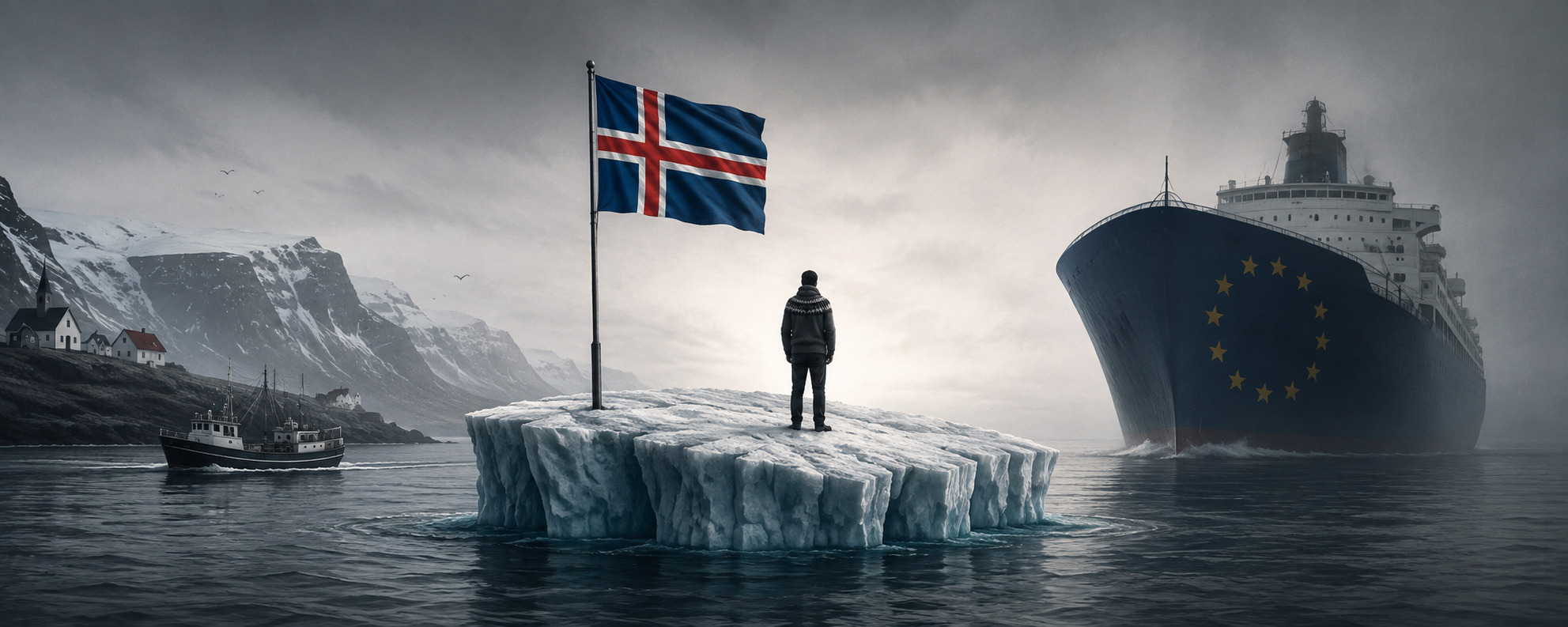
Across the North Atlantic, secluded Iceland had just achieved full independence from Denmark, following several years of British and American military occupation. Nearly a century later, the Churchillian lesson feels especially relevant on Icelandic shores, where a dogged sovereignty has prevailed for eight decades. Now the country is rushing to discard this identity in favor of a globalist hyperliberalism that has never looked less appealing. On Saturday, the country could take a decisive further step in this direction with a referendum on commencing EU membership negotiations.
In hindsight, Stalin’s presumptions about Western elections might not have been terribly far off the mark, for critics have asserted this referendum is illegitimate, rushed, and fabricated to serve a predetermined policy preference. The measure only has the support of two of the three parties in the current governing coalition, and all three opposition parties reject it. The referendum was originally slated for 2027, but its timeline has advanced for ill-defined reasons, and it will coincide with the end of the country’s summer holiday period. Foreign Minister Þorgerður Katrín Gunnarsdóttir, an avid “Yes” campaigner, has already conducted extensive accession diplomacy in Brussels and has publicly discussed a bullish 2028 accession timeline.
“[T]he leaders of the government have either intentionally or unintentionally told the parliament and the nation a lie about the accession negotiations with the European Union and plans for a national referendum on the matter,” said former prime minister and current Centre Party (Miðflokkurinn) leader Sigmundur Davíð Gunnlaugsson in a speech in the Alþingi (parliament).
“Yes” advocates insist a bid to open negotiations does not obligate accession. This overlooks the EU’s extensive record of re-running referenda and tailoring outcomes to fit preordained conclusions. Denmark and Ireland (twice) famously rejected referenda on EU integration, and all three were rerun to obtain the preferred result. France and the Netherlands rejected the EU Constitutional Treaty in 2005; the subsequent Lisbon Treaty bypassed truculent voters through simple parliamentary ratification. Brexit negotiations left the U.K. with innumerable European strings attached. Counting on full sovereignty later in the process is a risk indeed.
That same blind faith extends to Iceland’s vaunted fishing industry, arguably the most contentious aspect of the referendum. “Yes” voices insist the country would approach negotiations from a position of strength, and that existing fishing rights would be nonnegotiable. “No” figures respond that these promises would exceed Icelandic negotiating capabilities, that there is no precedent for such concessions, and that the migratory patterns of fish would complicate matters. Such an outcome would entail an anti-climactic end to the rights won through the three “Cod Wars” of the last century, to which the National Museum of Iceland and Icelandic history textbooks devote significant space.
Read more When Paradise Overheats
As pseudo-wars go, more than cod is on offer in this referendum campaign. “Yes” advocates have pointed to President Trump’s aggressive rhetoric on Greenland and the Russian invasion of Ukraine and insisted the country should more firmly embed itself in a common European security apparatus (Iceland is already a NATO member). Soviet and American forces battle in Iceland in Tom Clancy’s 1986 novel Red Storm Rising, but reality has yielded nothing approaching such a cataclysm. If anything, recent events should dispel any notion that Washington or Moscow could or would project such force into the North Atlantic.
Then there is the inescapable topic of migration, which even the North Atlantic can no longer subdue. Just a decade ago, in the years following the 2008-11 financial crisis, Iceland remained largely homogeneous, and its foreign residents were primarily Poles and other Eastern European guest workers. Over the last decade, non-European migration and its concomitant social effects have exploded. How does a nation that barely has prisons approach child rape, gun crime, and Islamic extremism? (RELATED: The Extinction of Icelanders)
Heterodox views on the issue remain effectively taboo in Icelandic media and polite society. Only the Centre Party, currently the fifth-largest in parliament, offers any considerable public opposition to the deluge. Icelandic politicians have regularly debated whether Iceland’s membership in the European Economic Area allows any real ability to stem migratory flows. One can assume prospective EU members will not earn any carve-outs from EU migrant-redistribution schemes.
“Accession negotiations are not a neutral dialogue to see ‘what is in the package,’” said Guðrún Hafsteinsdóttir, leader of the Independence Party (Sjálfstæðisflokkurinn). “They are a route to one outcome — membership of the European Union.”
The sudden rush to board a sinking ship is among the most remarkable features of modern Iceland. Fertility rates remained above replacement until 2012. Companies like deCODE genetics earned global attention while remaining indisputably Icelandic. Immigration levels were moderate and largely European.
These are all distant memories now, as a decaying EU leviathan lurks offshore.
READ MORE from Michael O’Shea:
The ‘Black Insurgent’ and Americanization of Polish Society
‘Africa Days’ in Eastern Poland
Towards the ‘Triumph of Free Trade’
Michael O’Shea is an American-Polish writer and translator. He is a former Visiting Fellow at the Danube Institute in Budapest.
Read more Scott McKay’s The Necessary Men — Episode 6: Storms
About the Author