Welcome back to the world of Mike Holman.
If this is your first stop, here’s what you need to know: Mike Holman is the independent journalist, podcaster, and inveterate maker-of-enemies at the center of Scott McKay’s bitingly satirical thriller series — four novels (so far) chronicling one man’s habit of ending up in the middle of the very stories the rest of the media is too scared, too compromised, or too incurious to tell. Catch up on the whole series, read past episodes, and find links to every book at “The Mike Holman Novels at The American Spectator” and soon, see the video-novel version of this and the previous books at MikeHolman.com.
Read more The Spectacle Ep. 460: Bring Back Bullying: Make Better People!
We’re now serializing the fourth Mike Holman novel, The Necessary Men, right here at The American Spectator — new episodes dropping every Wednesday and Saturday. The full book goes on sale September 26th at Amazon and the new MikeHolman.com site, and you can pre-order a signed copy right now.
Where we left off: Mike’s Canadian disguise isn’t the best, but it’s holding up so far, and the friendly invasion is fairly well received, but Col. Cabrillo is beginning to grow suspicious of his “Canadian” partners.
Here are Chapters Eleven and Twelve of The Necessary Men.
Chapter Eleven
Gibara, Holguin Province, Cuba — July 16, 2026
I had a special little present from Pierce deposited at the seaport and delivered to me at the Hotel Ordoño the morning after I got back from Nassau.
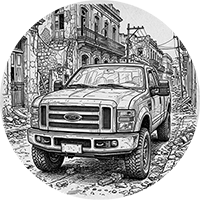
It was a brand-new Ford F250 truck.
He sent me a Conduit message telling me it was coming. “Did this for two reasons,” he said. “First, they’ll know it’s not a vehicle from anybody in the regime. And second, a high-end pickup truck is the best manifestation of what we’re doing. We’re awesome, but the main reason we’re awesome is that we’re productive as hell.”
“Well, it isn’t subtle,” I responded. “I guess we’re through being subtle.”
“The time’s coming,” Pierce responded. “The regime is cracking.”
I generally thought he was right, and the corporate reports I was reading from the other LCTC sites indicated that.
But where we were, there wasn’t a whole lot of evidence the regime cared what happened to us. At least, not so far.
Part of that was the never-ending belly rubs I was giving to Aldo Pupo.
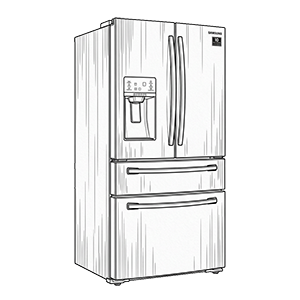
My first major use of that F-250 was to drive it to PCIA and pick up that Samsung refrigerator which had come off the Cessna Caravan shuttle from Nassau. I got a couple of the Cuban guys who were hanging around the airfield looking for work to jump in with me and we brought the fridge to Pupo’s office. The three of us hoisted that thing out of the truck, put it on a dolly and rolled it in, and Pupo’s jaw just about hit the floor when he saw a shiny stainless-steel middle-of-the-line First World fridge rolling to the little kitchen space.
“You mind if Pablo here gets a crack at your old machine?” I asked him. “He says he might be able to restore it.”
Pupo shrugged. I plugged the fridge into the wall.
“No, no,” he said. “The propane…”
“Aldo, do you trust me?”
“Well, yes, yes, I do.”
“Why don’t you come for a ride with me?”
I dropped Pablo and Hernan off at a shanty on the north side of town with that old Biryusa icemaker of Pupo’s, and then the party boss and I rolled up the hill to the power substation on the west side of town.
Belcher and a couple of his guys were up there with about 20 Cubans. We weren’t doing a ceremony or anything for this, but the word had gotten out and a little crowd was waiting for us.
Pupo was pissed that he was the last to know we were turning the city’s power back on, finally, after rebuilding the grid from decades of damage and neglect. I told him he wasn’t, but that he was officiating it. Belcher let him throw the switch and turn on the power for the town and everybody applauded.
I think that was probably the highlight of his political career. I guess I can take credit for giving it to him, though I’ll admit I was at best a mixed bag for Aldo Pupo at the end of the day.
We drove back down the hill, and Pupo was smiling and chatting animatedly with me. He was asking me if LCTC had any management positions open.
“Well, not as yet. But it’s so early, Aldo. We’re just getting started. There’s a great deal yet to do, and the opportunities are going to be endless eventually. Why? You looking for a new job?”
“I don’t know if Gibara is my future. I’m not… very popular with the people here.”
“Oh, I mean, I don’t know anything about that, but the party bosses above you aren’t upset with you, are they?”
“Oh, no. But LCTC is…”
He trailed off, realizing that he’d already said too much.
Pupo could see that LCTC was the future. Not the communist party that his job title said he represented in that town.
I parked the F-250 by the plaza downtown, where we were setting up for a celebration. This was of a piece with what Pierce and I had talked about – we were going to begin leaning in.
“What is the celebration?” Pupo asked, looking at all the lights being strung all along the outside of the plaza and the giant TV screen and sound bank being set up on the little stage in the southeast corner of the plaza.
“For the lights coming on, Aldo. Hey, follow me.”
There was a big La Bala beer truck parked on the north side of the plaza. Yes, we were doing free beer for the folks, and for a significant reason. We also had four food trucks which had come on a boat from the Dominican Republic.
The Cubans we’d hired to help us set up were setting up tables, hooking up cables, putting out trash cans, the works, and the humming was practically uniform.
Boom-badaba, boom-badaba.
“You know that the song they are humming is an illegal song,” said Pupo.
“Not my department, Aldo.”
“The police will arrest them.”
“I don’t see any cops, though.”
For a police state, Gibara was amazingly bereft of law enforcement. The rumor was that the cops in town had basically quiet-quit months ago for a lack of pay and equipment. That was something we were going to address soon.
“It looks bad for the Party Secretary that they call the Presidente a pendejo,” Pupo muttered.
“Well, they aren’t doing that. I don’t hear the word pendejo.”
He looked at me as if to thank me, but I could tell he was worried.
And I did feel for him… a little. On the other hand, Aldo Pupo was the guy we’d come to displace. And while he hadn’t seen that, he was starting to.
But if I could placate him a little longer, it wouldn’t make a difference.
Pupo took a walk back to his office. My guess was that he wanted to see if his new fridge was making ice yet. I gave him a six-pack of La Bala from the beer truck. It was already cold. And he drank one as he took his walk. I guessed they didn’t care much about open-container laws in Candela’s Cuba.
And that night Selena got to MC the celebration. The whole town came out, and we didn’t need to advertise it. They all knew their power was on and the word got out that there was food and cerveza at the plaza.
Selena waited until the crowd got really big, and then she announced that a new stage of our operation was coming, but in advance of that everybody was going to want to sign up for a TODO card. She said LCTC’s employees were already getting theirs, but you didn’t have to work for the company to have one; eligibility was expanding.
The word was getting out that LCTC’s people could opt in to get paid on their card, which made it essentially a debit card. But people weren’t doing a lot of that, because they were getting slaughtered on exchange rates at all the government stores since the LCTC card account balances were in Canadian dollars. But there was a rumor that was going to change.
And it was already changing. More on that in a minute.
The celebration was a big party; everybody was having a great time, and then Selena said she had a special surprise for everybody.
And she directed the folks to the giant TV on the stage, which burst to life on cue.
It played an hour-long ESPN Deportes documentary on Diego La Bala Maceo, the Major League Baseball Hall of Fame pitcher who was born and raised in Gibara, Holguin Province, Cuba.
That crowd was rapt. Why? Because it was about Diego, who was a god in that town. And also because the regime had banned the documentary. It treated the Castros as villains, and correctly so, but you couldn’t do that in Cuba and get away with it.
But we were getting away with it. And when it ended, the folks were standing and cheering.
But Pupo came up to me when it was over. And I could tell he was really worried.
“This will not be well-received,” he said.
“Well,” I said, “we had some folks request that we find a tape of the documentary. So we did. I don’t have anything to do with politics. I thought they’d enjoy it; Diego Maceo’s obviously still a big deal here. I’m not really – hockey’s more my sport, you know, eh?”
“Yes, but this is forbidden, and with the song…”
“Again, not my department. But I’ll tell Selena that you have concerns. By the way, do you have ice yet?”
That seemed to slow Pupo down. “Yes, I do,” he said.
But the word did get out about the La Bala documentary. And I assume it got to Havana.
Because the enthusiastic cooperation the regime had thrown our way in the early days after LCTC’s arrival in Cuba was melting into something else.
Three days later my bed finally showed up. I guess there was a bottleneck in Nassau or something.
It worked out all right, though, because the bed wasn’t the only thing that came from Nassau for me.
PJ had hit me up on Conduit for pictures of my room and measurements for everything. So I did that and sent them to her.
And she went on Wayfair and used their app to decorate the room, bought all the stuff, and had it sent to Sino Solutions’ Nassau facility.
Then they put it on the caravan, and it landed at PCIA. They called me and told me to come and get my stuff. I wasn’t even sure what they were talking about. But I rolled up in the truck and then made my way back home with a bunch of boxes, and that night a bunch of the hotel staff people helped me put the room together the way PJ designed it.
“You have a girlfriend you no tell us about,” said Tina, as she was turning an Allen wrench, following instructions to put together one of the very fetching rattan-looking nightstands PJ had bought.
“What makes you say that, Tina?” I asked her.
“Because you no gay. And only gay man have taste to decorate room like this.”
I told her I couldn’t argue with that logic and left it at that. It struck me that letting the hotel staff, all of whom were certainly on DSE’s payroll (though they were all making a whole lot more money from LCTC hiring them to do side jobs than they were from the hotel or the spooks), pry into my personal life was a great way to end up in the gulag. Or whatever they did to foreign saboteurs and spies in Candela’s Cuba.
It took most of that evening, but we finally put that room together, and honestly, when it was done it was awesome. The place looked like a setup Ernest Hemingway would have been happy with. I was certainly happy with it. And I sent PJ pics of the hotel staff smiling and holding up their hands to welcome the camera into the room.
“LOL,” she Conduited back. “Enjoy! And send a boring corporate report this weekend.”

The thing was, the corporate reports were getting a lot less boring.
A week or so after the room redecoration, Belcher, Hal, Jack Gray and I hopped on a King Air 350 out of PCIA and landed at Duncan Town for a meeting. Pierce had called it because he was getting – in the classic words of Gabriel Byrne’s character Tom Reagan in Miller’s Crossing – a “wart on his fanny, givin’ him the fidgets.”
We landed at a site which didn’t look much like it did when I’d first seen it.
They’d replaced the old airstrip shack with what was more like a terminal building and it had a tower now. The man-camp trailers had been moved inland and put on stilts, and on the water were two-story apartment buildings, also on stilts. There was a marina, with fishing boats and houseboats parked all around.
Because I found out later that the fishing off Ragged Island was amazing, and the guys working there were spending all their free time on the water having at the marlin and red snapper that prowled around in the Caribbean waters surrounding the island. When the Cuba project was over, this place was destined to become a fishing resort and, potentially, a cruise ship stop.
And there were large warehouses where the forest of shipping containers had rested. The shipping containers were now stacked up on a wharf that was surrounded by an artificial harbor they’d built.
“Good Lord,” I said, getting off the plane. Gus Minor, who was there to greet us, said: “I told you this place was going to be something once I got it off the ground.”
“Well, you weren’t lying,” said Jack. “Any chance I could bum a rod and reel and a ride on one of those fishing boats?”
“No,” Hal said. “We don’t have time. Not today, at least.”
“Fine, but we’re coming back.”
Hal agreed.
Gus led us to the command center just back from the terminal building, and there was a sizable conference room waiting for us. On the credenza on the far wall, they’d put out a huge spread of sandwiches and other stuff, so we got plates and waited for the rest of the meeting’s participants to assemble.
Pierce came next, and he had a couple of what looked like shoe boxes with him.
“These are for you,” he told me. “Go ahead, open ‘em.”
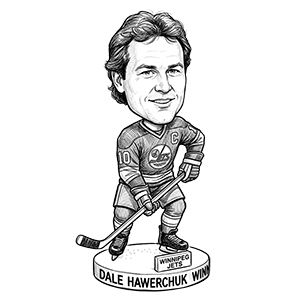
They were a couple of bobblehead dolls. One was a hockey player; another was a football player. I recognized the Winnipeg Jets and Blue Bombers uniforms.
“This has to be Dale Hawerchuk,” I said. “Who’s this guy?”
“It’s only Milt Stegall, maybe the greatest wide receiver in the history of the CFL!” said Pierce.
“Right, OK. Gag gift for Douglas Thibaud. I get it.”
“Actually, not really. These have some… special features to them.”
And he showed me what the bobbleheads were really for.
You tapped the head and it stopped bobbling, and that’s how you knew the camera inside was recording. Then you tapped it again and it was a bobblehead again, and that’s how you knew the camera was off. And in the base was a port for a SIM card.
“You’re going to want these,” he said, “because the phase of this that’s coming is where you get to shine. I can guarantee you’re going to want to record some conversations both in your office in that ballroom and maybe in your room.”
“All right, I guess,” I said.
And just then Stan and Trent made their way in; Trent bitching about the turbulence on their Cessna flight from Palm Beach International.
“Let’s get started,” said Pierce after everybody had said hello and filled a plate with sandwiches and chips. “Here’s the thing: I want to move faster on the political side of this. By which I mean, I want to move faster on the commercial side of this, and that’ll make it political.”
“You want to accelerate the TODO card operation?” asked Jack. “Because if you do, everything is ready. Those cards are all loaded with biometrics, Conduit is ready to add online commerce, all of the LCTC employees got phones as part of their employment, and they’ll read fingerprints for passkeys. We’re ready to go.”
“We came up with a little extra, though,” said Stan. “Here’s what we’re gonna do…”
It took a couple of weeks to stand it up, but on Calle Independencia across the street from Pupo’s Communist Party headquarters, a sign reading “TODO Catálogo” was hung on a refurbished storefront building. And when the building opened its doors, a line soon extended to the sidewalk.
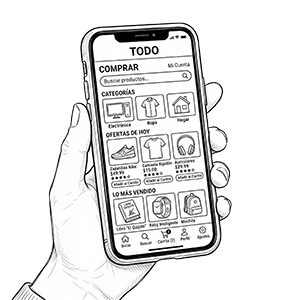
What was TODO Catálogo? Well, it was the LCTC company store. What happened there was that all of LCTC’s employees had received catalogs of merchandise that Gus had sitting in his warehouse. They could bring their catalogs into the TODO Catálogo, or just pick one up from the stack just inside the door, then sit down at one of the desks set up in the location and an employee would scan their TODO card, have them press a fingerprint onto the scanner to match the biometric on the card, and then they could just point out the stuff they wanted in the catalog and the employee would use her scanner to scan it in.
And that was it. The card would deduct the purchase amount from the balance of loonies in their LCTC account, and they were off. Gus’s guys at the warehouse on Ragged Island would load the Sunset Harvest, and the stuff got delivered on the boat two days later, or maybe the next day depending on the timing.
The TODO Catálogo opened on Monday. Pupo came to see me on Tuesday, very nervous. I showed him my Milt Stegall bobblehead.
“Here,” I said. “It has a setting that stops the head from bobbling. I don’t want us to get distracted.”
Pupo looked at me like I was insane.
“Milt Stegall!” I said. “He’s the greatest player the Winnipeg Blue Bombers ever had. You never heard of him?”
“Someone in my office, and I don’t know who, has called Havana,” he said. “The store across the street is illegal. They are very angry…”
“Store? What store? You mean the TODO Catálogo?”
“Yes, Douglas. Commerce must go through the state shops. No exceptions.”
“Your refrigerator didn’t go through the state shops. Nor did the La Bala beer in your refrigerator. Or the cool Sino Solutions gear. By the way, I got you something else!”
And I handed him over a Tern2 600X rod and reel combo with a full set of tackle, not to mention a fishing vest with the Sino Solutions logo on it.
His eyes lit up. “Douglas, you shouldn’t have!”
“Well, they tell me you’re a big fisherman and that you’re always out on your boat, so I figured I’d pick you up some fishing gear. Anyway, you were saying?”
“They are going to shut down your store.”
“Aldo, it isn’t a store. There’s no merchandise in there. This is where LCTC employees can use their TODO cards to buy stuff. New shoes for the kids, a microwave oven, blinds for the windows, whatever. This is just a convenient spot for folks to order things. I mean, it’s right there on the main drag in the middle of town so everybody can get to it.”
“It’s across the street from party headquarters, Douglas!”
“What do you want me to do? The space was open. I assume you want us to use downtown space that’s available to make things happen in the town, right?”
He just looked at me like I’d kicked his puppy.
“Hey,” I said, “if they shut down the store, they shut down the store. But it isn’t actually a store. It’s an office. Go in and look around. Actually, Aldo, you have a TODO card too, you know. Maybe use it in there.”
Pupo looked at his new fishing rod, a wistful expression crossing his face. “I will do what I can to help,” he said, “but this may be out of my hands. You should really come and talk to me before you do anything more to provoke the government. You pay me to consult, after all.”
“Well, that’s true,” I said. “In the future I’ll certainly do that.”
I didn’t do that.
But Pupo was unsurprisingly prophetic, because on Wednesday the Holguin Province cops showed up and closed down the TODO Catálogo, and what’s more, they went to the port, and they seized the shipment of stuff that the folks had ordered from the store when it came on the boat.
As “contraband.”
And then I got a visit from the provincial party secretary, a guy named Rigoberto Hamza.
PJ had told me I didn’t look Cuban with my black beard. Rigoberto Hamza also didn’t look Cuban. He looked more Palestinian. But anyway, he rolled into the Hotel Ordoño demanding to see me, and when I tried to sit him down at my desk in the hotel ballroom, he refused. He said he didn’t want to embarrass me in front of my people, and suggested that I meet him in my room instead.
I shrugged and led him up to the third floor.
I offered him a seat at the little meeting table PJ had picked out on Wayfair, and showed him my Dale Hawerchuk bobblehead. Hamza wasn’t amused.
“Here,” I said. “Let me stop his head from bobbling. We don’t need the distraction.”
Then I moved it to the side of the table, out of the way. But Dale’s head was facing Hamza.
“You have committed a crime, Mr. Thibaud.”
“I’m assuming that you’re referring to the TODO Catálogo? See, you guys have this all wrong. It isn’t a store open to the public. I don’t know why Secretary Pupo didn’t explain this earlier. This is a company store for our employees. So I don’t see where there should be a problem.”
Hamza started yelling at me. He said all commerce had to go through the state stores, and he didn’t care whether the people ordering things from the TODO catalog were LCTC employees.
“Yeah,” I said, “but Mr. Hamza, let’s face it. The state stores suck. They don’t have anything in ’em. And worse, my people can’t use their loonies in the state stores without getting ripped off. I thought you wanted to get some hard currency into your economy. I mean, I don’t know anything about politics, or, really, macroeconomics; I’m just saying what the folks here have told me. And here’s the thing – if you insist on making this change, what it does is it causes a degree of chaos that’ll make my job and your job, and especially Senor Pupo’s job, way harder.”
“No,” said Hamza. “You may be here in Gibara, but you are a foreigner. And this is not your business.”
“But Mr. Hamza, I’m the project manager here in Gibara. It’s literally my business – my job – to get this place rolling and prove that socialism can work in Cuba. My boss, Peter Chang, is all over TV telling everybody that’s what we’re proving. You can’t prove it if the worker can’t buy things with the money he earns by the sweat of his brow.”
“I’m not here to debate the plight of the working man,” said Hamza. “I’m here to tell you the law. And the law is that consumer goods must go through the state stores.”
“OK,” I said. “But I have an idea – why don’t you contract out the state stores to LCTC? I mean, you know that we can run them a lot better than whoever’s running them now. And the chances are pretty good we’ll turn a profit, and we’ll just, y’know, cut the party in for a piece. Hey, what we can do is pilot this idea in Gibara. Why not?”
Hamza softened, just a little.
“Oh, that would be highly irregular,” he said. “I don’t believe Havana would go for it.”
“We don’t have to decide this today,” I said. “How about we think about it, keep talking… you’re going to need to release the goods at the party headquarters, though. If you don’t, then we’re going to have to do a make-good to the folks, because they’re going to be really angry if we try to give them their money back and force them to go to the state stores.”
“That’s your problem. The goods will not be released. But I will allow you to fulfill your current orders with another shipment if you shut down your store.”
“Well, OK. My boss, Mr. Chang, will NOT like this, but if that’s how you want to resolve it, so be it. But if you’re going to seize all the merchandise, then you should take that with you.”
“What is that?”
“It’s a Toshiba microwave oven. I got it on the shipment you seized. I don’t have a microwave in the room, so I ordered it out of the TODO catalog. If you’re going to take the stuff from the shipment, you should take this.”
“I admire your integrity. I will take it.”
“OK. I opened the box. And the thing is, there’s a chance there is $5,000 Canadian in there. I’ve misplaced it, and I’ve looked everywhere but in that box. If you find it, can you get it back to me?”
Hamza just looked at me. Then he grabbed the box with the microwave in it and left.
So I called Pupo. Who answered on the first ring.
“Well, Aldo, you were right,” I said. “They impounded everybody’s stuff. Now I have to replace it all for the folks, or else give them a refund, and that’s just a real pain in the ass.”
“I told you so,” he said. “You need to call me when you make these moves so that I can navigate them for you.”
“I’m listening. Hey, where is all the stuff? They carted it off to Holguin?”
“No. They would have, but the truck broke down in the receiving yard at the port.”
“Wait, what?”
Pupo laughed.
“All of the merchandise is here,” he said. “It is piled up at Party headquarters. The Army is sending a truck tomorrow to take the contraband to Holguin.”
“Well, how did it get there?”
“Your man Belcher sent his trucks to transport the load here. It was his suggestion; I agreed.”
I had to hold the phone away from my mouth to keep Pupo from hearing my chuckle.
“All right,” I said, after I composed myself. “Well, I guess we’ll just chalk this up to a lesson learned.”
“Hopefully so,” said Pupo. “I do not like being in a position to have to impose discipline on my new friends at LCTC. I want to work together with you, but this can only happen if you are willing to abide by the government’s rules.”
“I appreciate the position you’ve been put in,” I said. “And I recognize that it can be a little… unenviable. Change can be hard.”
“Thank you, Douglas,” he said.
And that night, after the whole town had seen their stuff brought to the party headquarters, the people of Gibara broke in and cleaned the place out.
The Army showed up with that deuce-and-a-half truck to confiscate the swag, and there was nothing for them to do. So they just went back to Holguin, and that was it.
The thieves were quite efficient in carrying out that mission. Including the fact that somebody carried off Pupo’s new fridge. And his big-screen TV.
When he called me about that, he said he was going to go house-to-house looking for his new fridge. I cautioned him that his was only one of four or five Samsung fridges that folks had ordered, and he’d make somebody really mad if they’d had to break in the party offices to get a refrigerator they paid for, only to have the Party steal it from them again.
“It’s a really, really bad idea, Aldo,” I said.
Rather than that, I told him just to order the replacements from the catalog, and that he could use his LCTC phone to do it.
“That app went live last night,” I said. “We don’t need the store anymore.”
None of us figured that stitching up the regime like we did with the TODO Catálogo store would go without consequences. The eight of us around that table on Ragged Island knew differently. But interestingly, according to Pierce, based on reports he was getting from Simon, was that Peter Chang and Manuel Cabrillo were working overtime to contain the regime’s hostility.
Pierce noted that was starting to get expensive. Which, being Pierce, he didn’t like. But on the other hand, he said that was a good sign.
“When they start demanding a big wire transfer to their account in the Caymans, that means they’re packing the get-out bag. These guys in Havana, the smarter ones, are doing that now.”
“What about the dumber ones?” Belcher had asked him.
“That’s the fun part. Simon says Cabrillo is gathering those guys up to be part of the outfit he’s building. Peter is telling him to build a machine because he might just be the next guy in charge of the country.”
Read more AI Won’t Ruin Civilization — Unless We Let It
Belcher, Hal, and Jack did NOT like that. Pierce’s smile didn’t waver.
The point of bringing that up is that we didn’t really anticipate that we were at a point where any of Candela’s people would choose violence.
But what they did was pretty reprehensible.
Gibara wasn’t alone in the fact that very few of its buildings could stand up to any credible building codes. The whole country was a collection of ruins, barely held together and waiting to come apart at the next threat to their integrity – an earthquake, a hurricane, a stiff breeze.
One of the chief missions of LCTC, and this was what most of our employees in Gibara were doing all day, was refurbishing and shoring up the city’s housing stock. We’d gone house to house and done First World-style inspections of structural integrity, windows, electrical, water pipes, the works, and put each house on a list.
In the worst-off places, we offered to lease the house from them on a long-term basis with a one-time payment. That was a way to skirt some legal issues the government threw in the way of corporate ownership of housing stock. But it gave us the ability to knock down the houses which needed it and restore the ones which didn’t.
Others we gave grants, which the folks would then use to hire LCTC’s construction arm to renovate or remodel their houses.
If this sounds like it was a staggering expense, the thing was it really wasn’t as costly as you’d expect.
Because of the big 3D construction printers we’d brought in. We were gathering up all the rubble from the collapsed and ruined houses and the ones we’d demolished and putting it through those machines, and they were cranking out bricks and roof tiles at a volume nobody had ever seen before and doing it at a minimal expense.
And our labor costs were also minimal – and there was a whole lot of available labor.
People don’t realize just how crushing the unemployment problem is in a late-stage communist country. There were massive swaths of people who hadn’t had a job – any job – in years. The younger ones had never had one. Their job was survival. Standing on the shore trying to catch fish their family could eat that night; that’s what they’d do all day.
So we hired these people and put them to work doing things like stacking bricks or chunks of concrete from the ruins, or wheelbarrowing rubble from one place to another, or loading trucks. Then we’d train them for something a little more complicated. Then they’d get a hammer. Or we’d put them on a crew picking up trash, which had been everywhere in Gibara when we arrived. Or they’d go around with a clipboard and a map and they’d mark potholes in the streets and turn the map in so the pothole-filler crews could come and drop Quikrete in to at least create a temporary fix to the moonscape Gibara’s streets had been.
And over the first part of the summer, we’d essentially created an economy in Gibara that Belcher joked was a little analog for semiconductors in Austin or finance in Manhattan.
“If this place isn’t the brokedick-housing restoration capital of the world I’d be shocked,” he said.
Gibara’s population had been about 15,000 in the city itself, and something like 69,000 in the municipality which included a bunch of the surrounding area. We’d gotten to the point where more than 7,000 of them were working for LCTC at least part-time doing every kind of infrastructure work imaginable.
That was a lot of TODO cards. But it was also something like a plague of locusts when it came to a house somewhere that was either abandoned or ruined. Our crews would show up and reduce such a place down to its foundation and leave the materials in neat stacks for another crew to haul away for reuse.
And what Hamza did, assumedly on orders from Havana, and the mean bastard left it to Pupo to carry out, was to drop the hammer on using the rubble in those stacks.
The regime issued, and enforced, an edict that as abandoned housing reverted to the state, no building materials could be harvested from those locations. Pupo had to stop those crews.
Which they didn’t like one bit.
They already didn’t like Pupo. Now he was telling them they couldn’t do their jobs, and as a result a whole bunch of remodel/renovate jobs in town would grind to a halt.
And Pupo whined to me that somebody spit on him in the street.
“I know that there are people angry,” he said. “But that is very rude.”
I almost told him the regime he served had been doing a lot more than spitting on people for close to 70 years, but I didn’t want to hurt his feelings more than they’d already been hurt.
Bear in mind, this was happening following the official start of hurricane season, which in Cuba is a whole lot bigger deal than it is in the States. If you live on the Gulf or Atlantic coast in the U.S., hurricane season starts, and you wonder if a storm will hit you this year. In Cuba, you don’t wonder that. In Cuba, you know you’re going to get hit by a hurricane this year; the questions are how many you’ll get hit by and when.
So when the regime told people they wouldn’t have access to building materials that could have made the difference in saving their house from a big storm, you can imagine how well that went over. Or how well Pupo was received when he had to be the instrument of that rather cruel edict. Or how well the folks reacted when the provincial police arrested and carted off some of the guys who defied the edict and hauled off the rubble anyway.
Belcher had a solution.
“We’ll just cut out the middleman,” he said.
The rubble from those houses had originally been clay from the hillsides, so he just sent people with shovels and wheelbarrows to the hillsides, and he was loading trucks with that clay and putting it through the 3D printers.
We thought that was a good resolution, and, at least for now, we thought maybe we’d stabilized the situation.
And I was Conduiting with Pierce, letting him know about Belcher’s new plan.
“But there’s another problem,” I said, “which is that we’re at the limit of how much diesel we can bring in with our current infrastructure and offload capacity. It’s running through those generators at the power station, and we’re nearly to the point where we can’t handle the demand load.”
“Oh, don’t worry about that,” he said. “What you need to do is look for industrial sites and start putting these people to work doing something other than just spending my money. This operation is going to have to start turning out products it can sell to the world. I didn’t get where I am having my investments not make a return, dammit.”
“Pierce,” I said, “you didn’t hear me just now. We don’t have enough juice to run factories.”
“Oh, but you will,” he said. “Just wait for the flip. And by the way, you might want to check the weather report.”
Chapter Twelve
Gibara, Holguin Province, Cuba — August 12, 2026
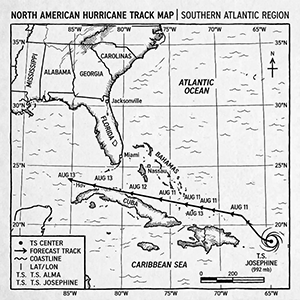
The name of the storm was Josephine, which I thought was a cool name for a hurricane. But as we watched the forecast tracks and the computer models kept dragging them over the top of Cuba’s north coast, my fondness for the name soured pretty thoroughly.
The people of Gibara didn’t panic. They were old pros at dealing with hurricanes. That said, everybody knew this year was different.
After all, when you don’t have nice things, you don’t care all that much if you lose them.
But Gibara was starting to have nice things.
There were vendors everywhere selling stuff. People were walking around with new shoes, new shirts, new sunglasses. People were painting their houses that had just been re-roofed and renovated. Everybody seemed to have a new bike. The restaurants were full, and that was another source of conflict with the regime – the restaurateurs all had TODO cards, and they were now ordering supplies through the app on Conduit, which meant that the state monopoly restaurant supply, which was universally unreliable and obnoxiously shitty, was all but out of business. It got so bad that the lady in charge of their operation in Holguin Province called Belcher and offered to sell wholesale to him.
And then he canceled the deal with her when the state restaurant supply products couldn’t pass quality control.
The point was, these people had something to lose. And that’s a very different mentality than you carry into hurricane season when all you really have to do is not die, and you’re not out anything.
I should back up here, because at the beginning of June, when hurricane season officially began, Trent Gardocki held a big ribbon-cutting event at NOAA’s facility in Miami announcing that PGFI was debuting a hurricane recovery initiative available to all of North America. He gave a big speech about the fact that with the construction technology Sentinel Construction was pioneering and the logistics capacity Sentinel Ports Management brought to the table, there was an opportunity to help people come back much faster in the aftermath of hurricanes – and leveraging that opportunity would have the effect of making the coasts of the Atlantic, Gulf of America, and Caribbean a lot more insurable than they currently were.
And very quietly, the Trumbull administration pre-approved PGFI to get waivers from all the different embargoes which affected Cuba. With that, and with the lawyers and consultants getting involved, it was only a small matter of time before Trent’s initiative was set up to operate anywhere a hurricane came ashore.
For example, when Hurricane Gonzalo hit Tampico in Mexico in late July, it didn’t do a ton of damage. But PGFI rolled in with linemen and generators and construction printers and did a fast rebuild, paid for by the Mexican government through a long-term loan secured by oil revenues.
That was infrastructure nobody in Gibara paid a whole lot of attention to. Some of the regime people might have thought twice about that in retrospect.
If they had, they might have made a different decision about Belcher’s project on the hillsides west of town, for example.
Hamza was taking orders from Havana, so maybe it wasn’t just him. But he did show up with the Cuban army, guns drawn, and told Jason Belcher and the 600 people who were digging clay out of the hills, wheelbarrowing it to trucks and trucking it to the 3D printers in town to make bricks and roof tiles with, that their project was canceled.
And when Belcher, who spoke Spanish, asked him what the hell he was doing, Hamza told him “La tierra pertenece a la revolución.”
Which literally translates to “the land belongs to the revolution.” And functionally translates to “the revolution owns the dirt.”
Belcher sighed, threw up his hands, and sent everybody home. They went home pissed.
And then Josephine started bearing down on Cuba, and the “brokedick housing reconstruction capital of the world” shut down.
I felt like a jerk for abandoning Gibara, but PJ absolutely ordered me home when the forecast track locked over Cuba. I caught the last flight out of PCIA to Nassau and then came home to Jupiter. We were eating dinner at the Admiral’s Cove Club the night Josephine hit as a Category 2 hurricane, after jogging a little south of its forecast track and passing along Cuba’s southern coast.
But I wouldn’t have traded it, because a miracle happened. Little Mike took his first steps while I was at the house for those two days. I felt horrible being gone for most of his first few months on this earth, but at least I got to see that.
And I noticed PJ was getting her baby bump again.
It was very, very hard to get back on that plane to the Bahamas.
And when I landed in Gibara, all I really wanted was to get back on the plane and go home.
PCIA had survived. Belcher’s port facility had been less fortunate. The seven feet of storm surge Josephine had pushed into the Bahia de Gibara had largely trashed his receiving yard; they’d lost one of their mobile cranes, and several of the shipping containers had been washed into the bay, their contents spread to the winds.
In the city, the damage was horrific. It seemed like virtually every house we hadn’t redone had been at least partially destroyed.
Amazingly, though, the power never went out other than a few localized outages that were rectified quickly.
The people I met as I drove around on my way from the airport to the Hotel Ordoño were uniformly grateful for what work we’d done shoring up the parts of town that survived. But it was heartbreaking to see how little of Gibara that was. We would be starting over.
I made it back to the hotel and checked in with Claudio at the desk.
“How did your people make out, Claudio?” I asked him.
“We’re okay,” he said. “The house took on a little water, but no permanent damage.”
“That’s good,” I said.
“Mr. Mike…”
“Who? Claudio, I’m Douglas.”
“Mr. Mike, we’ve known for weeks who you are.”
“I don’t know what you’re talking about. Claudio, have you gone loco?”
“You’re Mike Holman. We’ve been watching your podcasts. Your disguise has always been… no bueno, Mr. Mike.”
“You will tell no one that. Do you understand me?”
I could smell a shakedown, if not a full-on blackmailing. Instead, Claudio smiled.
“Everybody knows,” he said. “Nobody’s gonna say nothing. We all love you and what you’re doing for us.”
And all of the hotel staff people I passed in the corridors or in the lobby were smiling and winking at me.
In retrospect, it was kind of a funny inside joke. At the time it absolutely freaked me out. And Hal and I had a conversation about that.
“Under no circumstances can you be arrested,” said Hal. “Douglas Thibaud is an easily-identifiable fiction once he’s fingerprinted.”
“I should probably start carrying,” I said. “I need to be a hard target, I think.”
“We’re going to go further than that,” said Hal, and that’s how I picked up Victor and Chris, my two Sentinel Security bodyguards who came with me everywhere I went in Gibara. Victor turned into the wheelman on the F-250, which was a shame; I loved driving that truck.
And we had a lot of driving to do. In the aftermath of Josephine, Gibara needed our help more than ever.
There was no industry of any kind in Gibara. There was the pretense of industry, though.
In fact, on the western side of town, up the hill the regime wouldn’t let us dig clay from, was a very interesting facility.
They called it the Hilandería Inejiro Asanuma. It was built, peculiarly enough, by Che Guevara in the 1960s and named in honor of a Japanese communist, sort of a Tokyo version of Bernie Sanders, who was giving a televised speech when some kid with a sword showed up and more or less turned him into sushi.
The Japanese were less tolerant of communists than the Cubans, and naturally they profited from that intolerance – relatively speaking.
Anyhow, the Hilandería Inejiro Asanuma made cotton yarn. Or more to the point, it had made cotton yarn. It wasn’t making much of anything, with a maximum of two hours’ worth of juice per day coming through the wires that led in.
The guy in charge of the Dead Japanese Bernie Cotton Factory was a husky 30-something fellow with a scraggly late-stage Fidel Castro beard. His name was Cesar Iniguez, and he had a perpetual expression on his face like he needed a drink. I didn’t get the impression that he felt like communism was his ticket to being all he could be.
That said, Cesar was a pretty zealous guardian of the fake factory they’d put him in charge of.
Before the hurricane came, Hal, Selena, and I had run up to the Hilandería Inejiro Asanuma in the F-250 to see Cesar. He was the only one on site; the state power grid’s allotment of electricity to his factory had given out at 9:30 that morning, and he’d sent everybody home, but he was still there.
Pretending to be in charge, I guess.
Cesar didn’t speak any English, but Selena explained to him that given the elevation and sturdy construction of his building, he was about to be in charge of Gibara’s hurricane shelter. He didn’t like that idea at all.
And then I told him we’d lease the factory from him for a week for what it would normally do in revenue for a month, and he changed his tune.
He didn’t like it when we sent folks in to take his looms apart and stash the pieces in a corner, but when the storm hit, there were 1,900 people, including most of the employees of the Hilandería Inejiro Asanuma who were barely able to get any work there anymore, camped out with blankets and pillows on the factory floor.
Then we hooked his facility up to our generators, since a big chunk of Gibara’s electrical customers had gone offline and we had the excess juice to light the place up, and Cesar was suddenly anxious to kick the people out and reinstall the looms.
But the momentum was going the other way altogether, because people kept coming from out in the country where the storm had destroyed their places, and soon there were 2,300 people at the factory and the loom equipment got moved outside.
Cesar was furious. He calmed down when I leased his place for another week at the same rate.
And then, in a pristine example of Candela’s Cuba, Cesar got fired because his factory was missing its quota. But they didn’t hire anybody to replace him, which was pretty much on-brand for the same people who didn’t bother to supply electricity to a factory they were attaching production quotas to.
That put Cesar in a position to be a lame-duck factory manager with no further accountability in sight.
And I don’t know how advanced the Latin American cotton yarn factory community grapevine is, but it was apparently far enough along that a Salvadoran investor reached out to Cesar and asked if he’d quote a price for the loom equipment sitting under a tarp outside of the factory.
So Cesar did, and Belcher shipped that stuff out, where it was shortly put to use at a brand new facility in San Miguel.
That haul should have been enough to get Cesar started comfortably somewhere else. But he didn’t keep the money. He sent it to Havana. And now he was out of work. So Belcher hired him as an LCTC local-relations consultant and paid him eight times his previous salary.
All of a sudden Cesar’s pouty expression was a little softer.
And that was when Trent Gardocki and Mariano Ruiz, his cigarmaker pal, flew into Gibara on a fact-finding mission.
I picked them up at PCIA in the F-250. Trent made me stop the truck on the access road so he could take a picture of the sign, which had miraculously survived the hurricane. And then we fought our way past all the debris removal and fast construction happening on the south side of town, where LCTC had done a lot less shoring up before the storm, and the damage was comprehensive, up the hill to Cesar’s factory. He was there to meet us.
By then, most of the storm refugees had left, but there were still a few hundred people there. I told Trent he needed to use his imagination in evaluating the place.
Mariano didn’t have any trouble doing that.
“Magnifico!” he told Cesar, and the two of them had a long conversation in Spanish. Selena – she was tired of being Selena, she said, and starting to whine about becoming Marisol again soon, and I satisfied her by telling her it was coming – told me that Mariano was grilling Cesar about how much light was coming in through the big slats in the roof, asking him about ambient temperatures and lots of other things.
Eventually, he was finished.
“I like this guy,” he said, gesturing to Cesar. “Trent, he’s the one you should hire to run it. And you gotta get this facility for us, Mike.”
“Talk to Cesar,” I said. “Stuff like this is what we’re paying him for.”
Mariano asked Cesar whether Trent could buy the place from whoever owned it. Cesar said it was the Ministry of Industry whom it belonged to and the chances they’d sell it to an American were slim and none. But he said that he didn’t expect a problem if LCTC were to propose a lease; it was clearly not going to make cotton yarn any time soon.
So, Trent had a lawyer in Miami draw up a lease for use of the factory as a hurricane shelter/multipurpose facility, and Cesar pushed that up the line to his old bosses, and they signed off on it right away.
We got the very strong impression that the fatcats in Havana were fire-selling the whole country in the wake of that storm. As bad a shape as Gibara was in, our situation was practically nirvana compared to what was happening to the non-LCTC places. The roads were jammed with people, and they were walking.
Which is never good. Combine a population of homeless refugees with a corrupt, incompetent, and highly unpopular regime and what you get is chaos.
And the people in that regime suddenly become very friendly to anybody who’d like to do business.
Another really good example of that came courtesy of Belcher.
As I said, Josephine had trashed his little port in Gibara, flooding his receiving yard, taking one of his mobile cranes for a swim, knocking over some of his container stacks and emptying a few of them into the bay. There was stuff everywhere.
Jason had to work 24/7 with a big crew of people just to put that port in anything resembling working order, and he threw a fit about it.
“This isn’t worth a shit,” he said. “To make this thing a facility worth having, I’d have to dredge out the bay and build a proper seawall, and… it’s not worth the trouble.”
“Well, what’s the solution then?” I asked him.
“It’s two bays away in Vita.”
Vita was a little place about 15 miles east which had a port facility. If you were to design the geography for a world-class port setup, you might make it look like Vita – there was a somewhat narrow inlet from the Caribbean into the bay, then it widened, and there was a little peninsula sticking out into the water where the main dock was. The port dated from the late 19th century, and it had been a sugar and rum export facility that had turned into almost nothing after the Castros stole it from the Big Sugar family who had owned it.
But – and this was what Belcher was most torqued up about – the Naranjo Bay the port jutted out into was a deepwater bay. Big ships could navigate into that thing.
He could bring actual container ships in. Not just little freighters like the Sunset Harvest.
But of course, the Vita port was owned by GAESA (Grupo de Administración Empresarial S.A.), which was the dysfunctional commercial empire the Cuban military owned. I couldn’t go and grease Pupo or Hamza to get that thing for Belcher.
But he decided to have a go at it himself. So he got in a speedboat Pierce had sent to Gibara for him and zipped into the marina they’d set up, looked around and asked to see the guy who managed the place.
And the next thing I knew, Belcher said he’d leased out half the dock space at the Puerto de Vita.
And then he sent some trucks to run over there and set up an operation, and Jason found out that the route between Gibara and Vita was a 22-mile trek over winding two-lane roads that were all but impassable. It ran through a succession of little towns where the fact that nobody had a car was more of a problem than an asset.
“You get stuck behind kids on bikes, donkey carts, people are walking,” he said as he nursed his La Bala at the hotel bar. “It’s a complete freaking nightmare.”
“Welcome to Cuba,” I said. “But if the problem is a road, that’s actually easier than you think.”
“Yeah. We’ll just build it. I mean, somebody needs to stop the Army from coming in and arresting us for doing that, but I gather that’s less of a problem than it was when we got here.”
“Exactly,” I said. “Let me work on that for you.”
Then I got on the King Air 350 and flew to Nassau, and then I got on a commercial flight to Miami.
Why? For the press conference.
Pierce was there. So were Stan and Trent. Stan was jealous as hell toward Trent that he’d cut a deal to own a Cuban cigar factory that could export to the U.S. under the ambit of the hurricane recovery waiver. Trent shot back that Stan could do the same thing for that precious rum distillery he said he wanted to build.
But they had me do the announcement along with Secretary Burro. It was decided that since Mike Holman had all but dropped out of public view for six months, it was time to put to bed the rumors about me that Candace Owens was spreading.
The announcement was that PGFI and LCTC had entered into a joint venture to develop infrastructure in Cuba as a continuation of LCTC’s humanitarian mission.
And that went really well. The Cuban community came out in strength for it. Diego and Essie were there, simply as a show of support. The media had tons of questions, though, and they grilled Burro over why the administration was willing to grant a waiver for PGFI to get past the embargo.
“Well, the short answer is that Josephine changed everything,” Burro said. “The long answer is, well, longer.”
The other question, which was asked several different ways, was, “Where is Peter Chang?”
And I gave a bullshit answer, which is “he had an unscheduled complication.” Which was bullshit for “Hell, I have no idea.”
Nobody could find Peter. He wasn’t answering his phone. Cabrillo wasn’t answering his phone, either.
Nor was Simon.
And we found out why the next day.
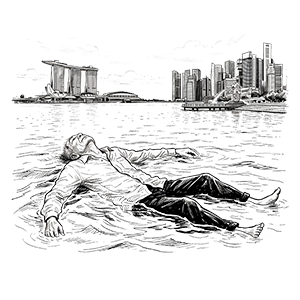
Simon’s body was found floating in the Singapore Strait, with two bullet holes in his skull.
Coming Wednesday, September 2: Episode 7 of Scott McKay’s The Necessary Men.
Catch up and follow along at “The Mike Holman Novels at The American Spectator.” Signed copies are available for pre-order at MikeHolman.com!
Read more Reagan Gets a Director’s Cut — and Hinckley Shares Some Words
About the Author