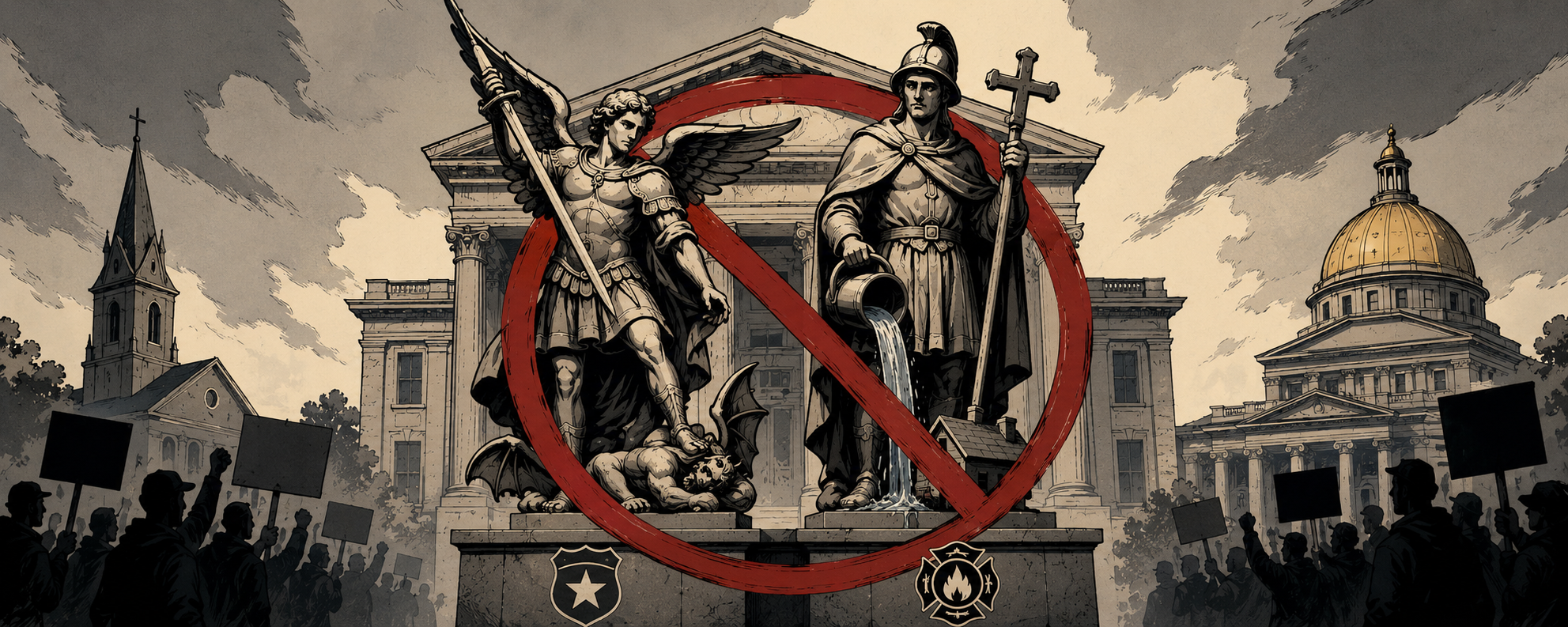
Is St. George of Minneapolis the only venerated holy man American cities can honor without incurring the wrath of the American Civil Liberties Union (ACLU)?
Read more Team Trump Is Touting Its Wins. As It Should.
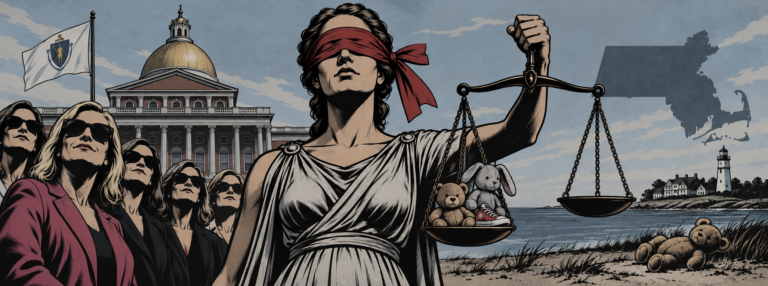
The Massachusetts Supreme Judicial Court, which once boasted a chief justice who attended a foundational meeting of the North American Man-Boy Love Association, issued a preliminary ruling against the placement of statues of the patron saints of firefighters and police officers outside a new public safety building in Quincy. The Italian-crafted, ten-foot-tall statues cost about $800,000, or less than half a percent of the project’s cost.
The ruling that sides with the ACLU-represented plaintiffs admits:
Saint Michael and Saint Florian have both religious and secular significance. They are recognized as saints in the Catholic Church. In Catholicism, Saint Michael is so recognized as a celestial archangel, the leader of God’s heavenly army who cast the devil, Satan, out of heaven. The sacred scriptures of other faith traditions, including Judaism and Islam, also recognize the archangel Michael as a significant figure. Saint Florian is canonized and venerated as a saint in the Catholic Church because “he was martyred for his faith and because he saved a town from [burning] by praying for divine intervention.”
The court also concedes that “municipalities across Massachusetts, including Quincy, use the ‘Florian Cross’ on their fire department badges; a union hall for firefighters in Massachusetts is called Florian Hall; International Firefighters’ Day is celebrated on May 4, Saint Florian’s feast day in the Christian tradition; and an oft invoked poem for fallen firefighters invites the deceased to ‘[r]est with Saint Florian.’” The Archangel Michael plays a similar outsized role for policemen.
The unanimous ruling claimed “reasonable support” for the supposition “that the statues have caused divisiveness.” Examples cited to buttress this belief include attendance of 200 — the judges do not break down pro and con — at a city council meeting that discussed the statues and an online petition that garnered 1,600 “signatures” in a city of 103,000.
The divisiveness standard, heretofore ignored whenever a handful of people dictate the removal of nativity scenes over the objection of vast majorities, itself seems divisive in that it only applies to those which progressives object. Presumably the perpetually reelected mayor for the last 17 years who authorized the statues, Thomas Koch, amounts to a more unifying figure in Quincy than the handful of people who sued. And, as the father of a Quincy police officer and a Quincy fireman, he presumably has a bead on the desires of first responders.
A similarly strange justification came from the decision’s reliance on the outdated Lemon Test. “We recognize that the Supreme Court has since abandoned Lemon and substituted in its place an analysis by ‘reference to historical practices and understandings,’” the court admits. Historical practices, as attested by the uses of St. Florian above, would certainly undermine the ACLU’s case. The Massachusetts high court nevertheless clings to the somewhat restrictive vision of religion in the public square found in Lemon and runs from the more expansive vision that now stands as Supreme Court jurisprudence. In a nod to the current prevailing judicial ethos, it excuses, for instance, the commonwealth’s use of legislative chaplains. How chaplains who represent specific denominations meet the amorphous standard but public art depicting holy men recognized in scores of religions do not lacks an adequate explanation.
Read more Just When You Thought Girl Scouts Couldn’t Get Worse, the Muslims Take Over
One wonders whether the judges who cite the state constitution to justify the Talibanning of the Archangel Michael and St. Florian statues also regard the state constitution as unconstitutional.
Its third paragraph acknowledges “with grateful hearts, the goodness of the great Legislator of the universe, in affording us, in the course of His providence” and “devoutly” asks “His direction.” Further therein, the oldest constitution in the U.S. states:
As the happiness of a people, and the good order and preservation of civil government, essentially depend upon piety, religion and morality; and as these cannot be generally diffused through a community, but by the institution of the public worship of God, and of public instructions in piety, religion and morality: Therefore, to promote their happiness and to secure the good order and preservation of their government, the people of this commonwealth have a right to invest their legislature with power to authorize and require, and the legislature shall, from time to time, authorize and require, the several towns, parishes, precincts, and other bodies politic, or religious societies, to make suitable provision, at their own expense, for the institution of the public worship of God, and for the support and maintenance of public Protestant teachers of piety, religion and morality, in all cases where such provision shall not be made voluntarily.
Should this surprise? The primary author of that document, John Adams, descended from Puritans. Elsewhere in what became the state of Massachusetts, the Mayflower Compact, an antecedent to U.S. governing documents, listed four purposes for their community: the glorification of God, the advancement of Christianity, to honor king and country, and a better order. Not just the progenitors of Adams’s generation but posterity recognized the centrality of Christianity. Until 1833, Massachusetts supported, as the state constitution indicates, Congregationalism as the official religion of the commonwealth.
One can, and perhaps should, regard some such past choices as unwise. But the Massachusetts Supreme Judicial Court makes a farce of itself when it appeals to the state’s written constitution and past custom in its intolerant attempt to ban public art it dislikes.
Six years ago, progressive goons decapitated a local statue of Christopher Columbus and pressured Boston to tear down a statue of Abraham Lincoln. The censorship of public art that thugs achieved in 2020 robed jurists with law degrees from Harvard, Yale, and Stanford effectuate in 2026.
Read more Truths and Omissions As US Hits $40 Trillion in Debt
READ MORE from Daniel J. Flynn:
Why Democratic Socialists of America Cannot Win in a Democratic America
Kruger’s Korps: The Secret of Success for Conservative Novelists
Is ‘Cancel Thanksgiving’ Really a Winning Message for Democrats?
About the Author