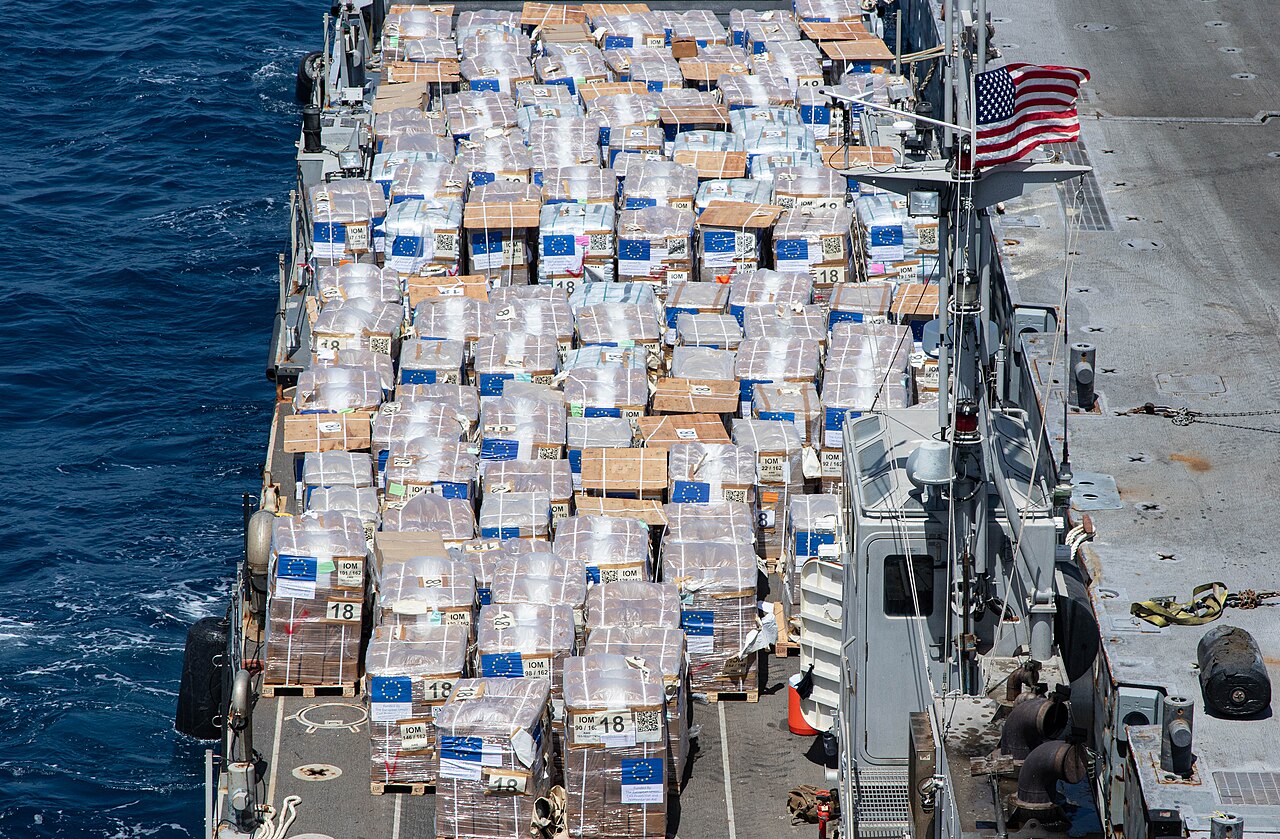
U.S. Army Soldiers assigned to the 7th Transportation Brigade (Expeditionary) move pallets of humanitarian aid aboard the MV Roy p. Benavidez, June 6, 2024, near the Port of Ashdod, Israel. The temporary pier, part of the Joint Logistics Over-the-Shore capability, enables the maritime delivery of international humanitarian aid to Gaza for distribution to Palestinian people in need. (U.S. Army photo by Staff Sgt. Malcolm Cohens-Ashley)
On July 31, the U.S. Justice Department announced the arrest in Britain of Mohammad Yousef Hasna, also known as Orhan Korkmaz and Abu al-Baraa, a Turkey-based aid executive charged with conspiring to support Hamas. Hasna, who is presumed innocent, faces three counts carrying up to 20 years each. The 46-page complaint builds its case less on ideology than accounting. A July 29, 2024 invoice listed $661,500 for 20,000 food parcels and $66,000 for 30 trucks. Those items total $727,500; the amount written out appears as $772,560, a $45,060 discrepancy.
Read more New Executive Order Announces New Federal Vaccine Guidelines
Prosecutors allege that Hasna set aside 5,000 parcels, worth $165,375, at the request of Hamas Politburo member Ghazi Hamad, then arranged $3,000 in cash. Hamad allegedly asked that delivery videos keep warehouse signs out of frame. Hasna said seven charity trucks had arrived on July 26. On Oct. 28, he reported eight trucks in a warehouse he called “ours” and three Jordanian trucks still at Al-Arish, Egypt. The complaint does not identify the warehouse. It later describes four truckloads of commercial goods allegedly presented as charity cargo and sold for Hamas’s profit; 18 of 25 trucks under charity control; two computerized warehouses; and $60,000 for storage and staff. Hamad supplied recipient data; Hasna allegedly offered to add “whatever names” he wanted.
Prosecutors place those logistical decisions with a senior Hamas official who formerly ran Gaza’s Hamas-controlled Social Development Ministry. The Treasury Department designated Hamad, alleging that crossings under his supervision moved weapons and tunnel-building materials. A recovered ledger recorded 5.258 million in inflows against 3.125 million in expenses, apparently in dollars. It assigned $700,000 — 13.3 percent of inflows —to “Dr.,” whom the FBI identifies as Hamad. Another 2.133 million was not explained by the listed expenses.
Hasna also allegedly proposed routing a Hebron merchant’s goods through an unnamed U.S.-headquartered charity for resale, inserting another party between seller and buyer. The British organization in the complaint is identified only as “Sham Charity.” Al-Khair Foundation states Hasna worked for an implementing partner; the U.K. Charity Commission has opened a statutory inquiry. Al-Khair’s income rose from £31.275 million in 2023 to £74.790 million in 2025. Its list £22.422 million in overseas cash aid and £18.972 million in gifts in kind. Those figures establish scale, not culpability; the inquiry must trace the funds and goods beyond the accounts.
The Charity Commission has ample warning from abroad. In June 2025, the Treasury Department sanctioned five people and five charities accused of financing Hamas or the PFLP under humanitarian cover. Six months later, Italy arrested nine people over an alleged €7 million diversion of aid funds; police seized more than €8 million, including €1.08 million in cash. After a high-court remand, a review court again confirmed custody for four defendants. Treasury had previously alleged that an Italy-based charity connected to Mohammad Hannoun sent Hamas at least $4 million over a decade. Canada revoked IRFAN-Canada’s charitable registration after finding it provided more than $14.6 million to Hamas-linked partners; Canada listed it as a terrorist entity in 2014.
Read more Reagan, Gorbachev, and The Brink of War That Changed the World
Dutch prosecutors separately alleged that €5.5 million reached Hamas-related organizations through intermediaries. A U.S. civil action sought forfeiture of roughly $2 million in cryptocurrency tied to BuyCash; one account allegedly received at least $4 million. The Washington Post reported more than 300 crypto transfers flagged since 2020 for possible terrorist financing. By early 2024, Treasury estimated Hamas may have been receiving as much as $10 million a month through sham charities. These cases do not establish one network; they show how layered intermediaries leave each institution auditing only its fragment.
Qatar, meanwhile, supplied Gaza with more than $1 billion after 2014, at times $30 million monthly, for fuel, poor families and public employees under Israeli-U.N. monitoring. A European Commission review found no evidence that its aid was diverted. Yet Treasury says Hamas extorted Gazans, received roughly $100 million annually from Iran and maintained an investment portfolio worth . Foreign aid could therefore carry civilian costs while Hamas preserved other revenue for its own purposes.
Trump’s Board of Peace will oversee a recovery effort the World Bank estimates at . A day before Hasna’s arrest announcement, Trump said the Board had secured Hamas’s “complete disarmament.” Hamas instead said its weapons would enter storage, leaving open their return to service. A 2025 PCPSR poll found 55 percent opposed disarmament, while warns against directing jobs or money to Hamas-linked actors. Disarmament cannot stop with weapons. It must reach procurement, payrolls, warehouses, and beneficiary lists. (RELATED: Iran Is the Key to Trump’s Gaza Challenge)
A conventional financial audit would miss the very gap alleged in Hasna-Korkmaz. The Board must identify each contractor’s beneficial owners and reconcile bills of materials with cargo tracked from port to worksite. Inspectors need authority to freeze payments when the ledger and the ground diverge. Proof is concrete poured, steel fixed, fuel consumed, and machinery present-not invoices. USAID’s inspector general has documented . Aid can clear formal checkpoints while slipping beyond donor control. Once cargo reaches a warehouse, tonnage delivered becomes the wrong metric. Trump’s Board must know who holds the keys.
Read more The New IRA, Irish Migrants, and the Breakdown of Social Compacts
READ MORE from Kevin Cohen:
Breaking Iran’s Chokepoint Strategy
Trump’s Crypto Empire Has an Iran Problem
The End of the Old Coalition
About the Author