Lightning in His Blood: A Son’s Journey Through War, Sacrifice, and the Life of a 78th Infantry Division Soldier
By Anthony Guinta
SRECS, LLC, 2026, 183 pages, $18
Read more China’s Unrestricted Warfare: The CCP’s Blueprint for Victory Without Fighting
Few self-published books repay the reading time. Lightning in His Blood, is a happy exception. It’s not only a moving tribute to an exceptional, departed father from a grateful son, but a well-told personal look into the dark days of the Great Depression and the horrors of World War II.Perhaps most of all, taking the example of one disciplined and determined man’s history, it helps demonstrate how the Greatest Generation came to be known as the Greatest Generation.
Full disclosure: Author Tony Giunta is a friend. I’m always hesitant, even fearful, about reading and writing about books written by friends or relations, afraid the book won’t support the positive things they would like me to say about it. But after turning just a few pages of Lightning in his Blood my fears evaporated. Lightning is not only well written, but well researched. It leans on historical study as well as archival and public records, not just on exaggerated tales told by Uncle Nunzio at family gatherings after he’s had more grappa than he should have. I can honestly give this book two thumbs up. It tells a lot worth knowing about a man and about a country.
If America were still turning out Guy Giuntas, and others like him, in the large numbers that it used to, “Make America Great Again” would not have worked as a campaign slogan.
When people say “America is a nation of immigrants,” and mean this in a positive way, they’re speaking of people like Gaetano “Guy” Guinta, born to poverty in 1913 in Olivardi, a hilltop village in the Calabria region of southern Italy. There was love and beauty in Olivardi, but it was crystal clear then that a life of unending poverty would be the lot of those who remained there. So, along with millions of other Italians, the Giuntas made their way to America for a better life, a move that greatly benefited both the Giuntas and America.
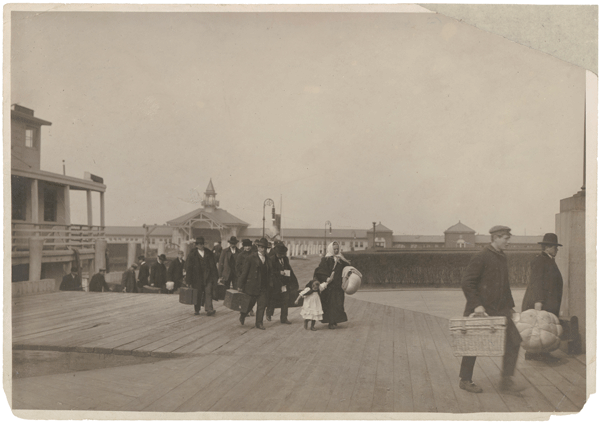
For the Giunta family it was a two-step process to move from small and familiar Olivardi to a sprawling and unfamiliar America that millions of Italians, and others, saw as the land of milk and honey. Guy’s father, Joseph, made the trip in 1920 in order to establish a place for the rest of the family, which followed in the summer of1927, when Guy was 14. The family made the voyage on the S.S. Duilio in steerage, the only level of accommodation they could afford. Steerage was crowded, loud, and poorly ventilated. It provided little food and no privacy at all. But the Giuntas endured it for the promise of America. On September 12,the Duilio docked in New York. After clearing immigration, the family stepped out into the Manhattan madhouse, which had to have been a Cat-5 culture shock after the thinly populated and easy-going Olivardi. Welcome to the land of milk and honey.
The Giuntas didn’t linger long in New York, which was probably for the best. They settled just south of Boston, where they learned that the American dream was real enough, but it would take a lot of work, determination, courage, and discipline to achieve it, the same values and habits Guy internalized, never abandoned, and passed on to his own family.
It was not a smooth journey.The first hard knock came less than two years after the family arrived in America with the untimely death of Joseph, leaving his wife Rose a widow in a strange land, and 15-½ year old Guy the man of the house. At this time in U.S. history the economic safely net had not been invented. (Nor had mental health days, minimum wages, time-out rooms, comfort animals, -isms without end, or the famous balance of work and personal life Gen-Z makes rather an issue of today). Mere survival was not guaranteed. And very soon the crucibles of the long Depression and a world war would make that survival more difficult, even in the land of milk and honey, let alone on the blood-soaked battlefields of Europe and the Pacific.
Guy made it through the Depression and met the needs of those who depended on him by becoming a machinist for the B.F. Sturtevant Company, of Readville, Massachusetts. Guy, barely 16, spoke little English and lied about his age to get hired, and accepted without complaint the lowest, dirtiest jobs in this loud and dangerous factory. He swept floors, schlepped heavy material around, worked whatever hours were necessary, learned English by listening to his co-workers, and in due course first became a machinist, then a very skilled one.
Read more Sophie Cunningham vs. the Trans Sports Mob
Guy’s skill as a machinist could have kept him out of World War II. Sturtevant made critical equipment requiring precision components for the Army and Navy. Producing these required the skills, long in perfecting, that Guy had acquired. So every six months after the start of the war a draft deferment arrived for Guy on the basis that his civilian work was vital to the war effort. But in the fall of 1943, when his sixth deferment was offered he turned it down with, “No! My friends, my buddies are there fighting. I’m going too.” Guy did not make this decision lightly, or for glory. He extended the duty he felt for his family to his new country that he had come to love. Duty and devotion again. This time at great risk.
By the fall of 1944 Guy was in combat against Germans as an artilleryman in the 78th Infantry Division, called the Lightning Division. (Thus the name of the book.) He was just in time to take part in not only the fiercest fighting of the European war, including the Hurtgen Forest and the Battle of the Bulge, but in time to endure one of Europe’s most severe winters. The cold was as dangerous as the Werhmacht. No hot meal at the end of the day, just army rations when they were available. No warm barracks to sleep in at night. Just a shallow fox hole chopped out of frozen ground and temperatures often below zero. It wasn’t Jack Frost but frostbite that was nipping at their nose and other parts. Then there were the unspeakable horrors of combat.
The chapters on Guy’s war experience are hard to read. Guy and his fellow soldiers were obliged to do and see what no one should be obliged to do and see. There’s no way on earth to fully thank or repay those who went through these horrors for our benefit. And there’s no mystery why most veterans who returned from this didn’t want to talk abou tit. And why would they? They just wanted to forget. This wasn’t easy for many, including Guy,who suffered from what today would be called PTSD.
As son Tony describes it.“War conditioned Guy to live on high alert, to sleep lightly, to expect danger where none existed. Loud noises made him jump. Sudden movements triggered instinct. Silence felt unnatural. Crowds felt dangerous.” And thanks to the extreme cold he had endured, Guy always kept his home warmer than many would find comfortable, He adds: “Where some men came home lost, Guy came home determined…. The war had taken pieces of him, but it had also forged him into the man he would become — a man defined by responsibility, strength, discipline, and an unbreakable sense of duty. These traits would shape the rest of his life and the household he would one day lead.”
Home after the war at 33 he was free to marry and start his own family, which he did with his Pierina.Together they raised four sons who went on to successful careers and lives based on the values and habits of hard work, discipline, self reliance, courage, and honesty they learned at home. The rules of engagement chez Giunta included: “Work hard, even when no one’s looking. Take care of your family first. Respect others — and demand respect in return. Be disciplined, not because someone tells you, but because life requires it. and, above all, never quit, no matter how hard the road becomes.”
Author Tony held positions of President and CEO of successful businesses. He also served on the school board, on the town council, and as mayor of Franklin, New Hampshire before retiring to Lake Wales, Florida Lightning is his first book. We have reason to hope it won’t be his last.
This well wrought book has obvious value for the Giunta family, giving them a fuller understanding of the family patriarch. It also has value to anyone seeking to understand how America became the free, affluent, apex nation that it is. Considering how rapidly these values are receding, we’re entitled to wonder how long it will remain so.
If America were still turning out Guy Giuntas, and others like him, in the large numbers that it used to, “Make America Great Again” would not have worked as a campaign slogan, because there never would have been any doubt about America’s continued greatness.
Read more My Life in Pain After the Government Took My Drug
RIP Gaetano Giunta, a man to build a nation around.
READ MORE from Larry Thornberry:
Don’t Panic Over Democratic Socialism
When Newspapers Ruled Morning and Evening
Futbol: The Beautiful Game, Allegedly
About the Author