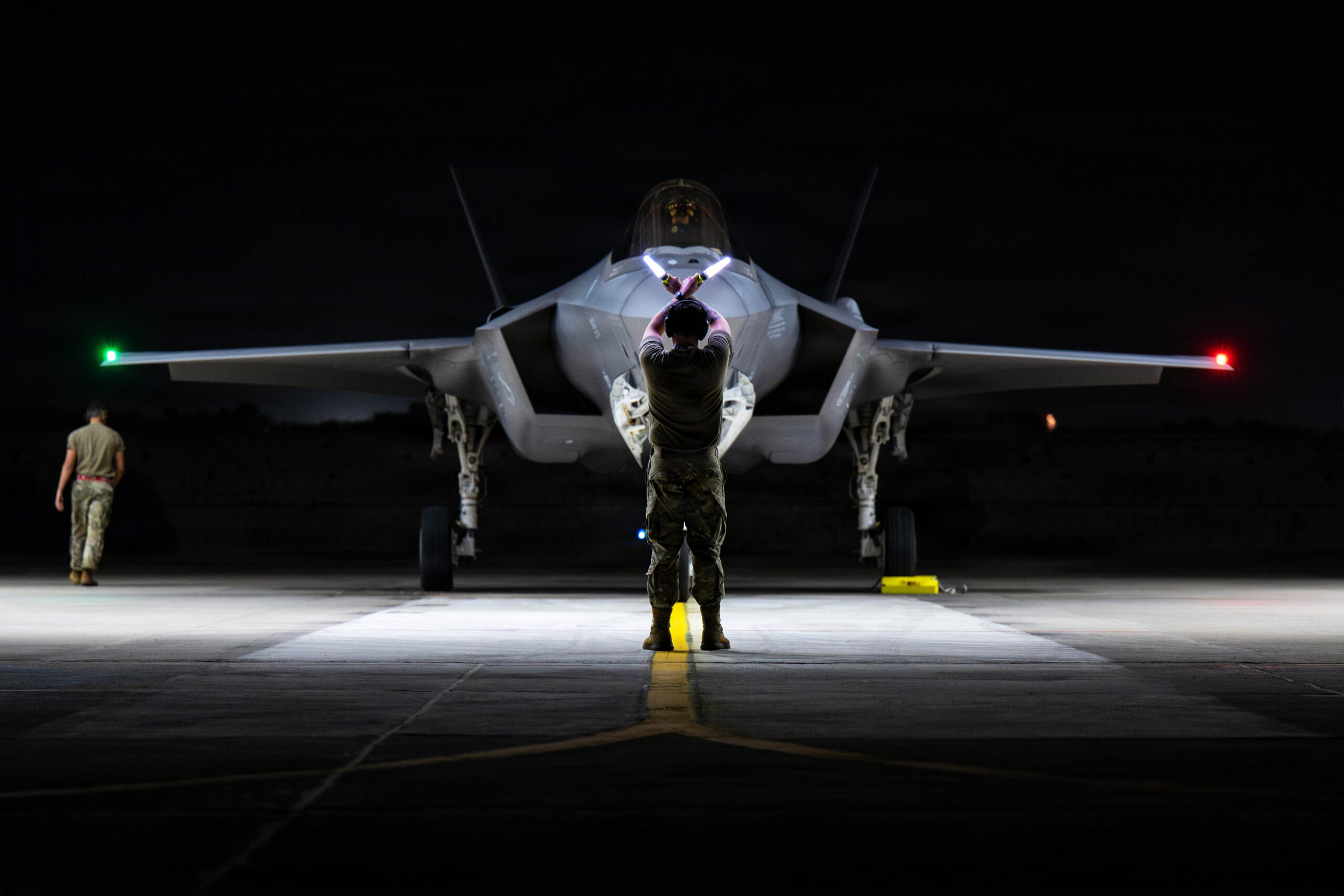
A U.S. Air Force Airman assigned to the 13th Aircraft Maintenance Unit directs a U.S. Air Force F-35A Lightning II assigned to the 13th Fighter Squadron, Misawa Air Base, Japan, into its parking position during Tarang Shakti 26 at Jodhpur Air Force Station, India, Sept. 26, 2026. The arrival of the F-35 marks the first time fifth-generation fighters have touched down at Tarang Shakti 26, bringing advanced airpower capabilities to the multinational exercise. (U.S. Air Force photo by Airman 1st Class Nathaniel Jackson)
To say that the war with Iran has been poorly fought is a gross understatement. It has been badly handled at all three levels of war; those being strategic, operational, and tactical. Think tanks and historians will undoubtedly dissect its lessons for years. But having been a military analyst for several decades, three immediate lessons jump out at me.
Read more Sánchez Calls Early Elections in Spain: ‘Pour Me Another Whisky!’
At the strategic level, the U.S. failed to state clear and achievable objectives and articulate a coherent end state. The articulated end state has varied seemingly from week to week. It has drifted from eliminating the Iranian nuclear program, to regime change, to total economic destruction, to opening the straits of Hormuz. After Iraq and Afghanistan, we vowed never to get into another “endless war,” and we quickly stumbled into another one.
Carl von Clausewitz identified two kinds of war. In the first, the enemy is militarily beaten to a state where he is conquered or militarily crushed to a point where he is forced to accept any terms the opponent dictates. This was true in the early stages of the Napoleonic Wars, but it has been rare since then. The Second World War, the American Civil War, and the collapse of the Afghan government to the Taliban have been relative outliers. In the second form of war, the winning side places the loser in a situation where it has to negotiate on terms favorable to the winner. The German Wars of Unification, the Spanish-American War, and the Russo-Japanese War are examples of the latter. In some situations, a nation sets out with limited objectives, but somehow achieves near total victory. This was apparently the case in the 1967 Arab-Israeli War. Again, such instances are relatively rare.
Most of our Iran War strategic woes can be laid at the feet of President Trump; his occasional claims of aspiring to total victory or annihilation have muddied the water and made diplomatic efforts much more difficult. In any case, that muddied water has gone under the bridge. Good advice for future presidents is: have limited but achievable bottom-line stated goals, be happy if things turn out better than expected, and “Never waste an opportunity to keep you mouth shut once the shooting start starts.” Bluster only works until your bluff is called.
However, neither the president nor Secretary Pete Hegseth is a trained strategist. Presidents such as Lincoln, Wilson, and Roosevelt laid out broad objectives and expected their generals to figure out how to achieve them. In the case of Wilson and Roosevelt, they had flag-level leadership in Pershing and Marshall who could fill in the blanks. In Lincoln’s case, he went through four generals until he found Grant. We appear to lack that kind of military wisdom today.
Hegseth apparently realizes the problem, and he is trying to fix it with a Joint Warfighting Evaluation program, which is designed to try to select colonels and Navy captains with war-fighting potential to promote to flag rank. This is done through a series of wargaming decision problems and other evaluations that weed out those who are incapable of making sound and timely operational and strategic plans and decisions. It will be too late for Iran, but it may give us better military leadership in the future. I’ve advocated such a system for years.
Read more Judge the ‘Populist’ Push for Price Controls on Populist Grounds
At the operational level, John Lehman and Bing West posited the problem best in a recent Washington Post op-ed in which they frankly stated that at present the U.S. has no current naval warfighting strategy. What passes for an operational warfighting naval concept that contributes to the execution of grand strategy is a fruit salad of often conflicting Navy and Marine Corps programs. If current American naval strategy can be summed up in a few words, it is “Sink the other guy’s ships.” There is not a coherent concept for defending and clearing choke points or the use of attack submarines to wage economic commerce warfare on the high seas. Lehman and West argue for a return to real strategic thinking in the naval services. They are correct.
At the tactical level, our hope for victory has been to win through airpower alone. Our Air Force and naval air arm do a superb job of targeting and using defensive tactics to minimize air crew loses. Unfortunately, like the North Vietnamese a half century ago, the Iranians have taken our measure and decided that they can take the worst we can throw at them from the air short of nuclear weapons. We have no viable plan to project ground power in any meaningful way.
Given the geography of the region, the only way for us to apply land power is through amphibious operations, and the United States no longer has a serious capability to project power ashore. Seven years ago, a Marine Corps commandant decided unilaterally that amphibious operations were obsolete and stripped the Corps of the tanks, heavy engineers, and other assets necessary to conduct large-scale, worldwide amphibious operations. This was to be replaced by a missile-oriented anti-ship force centered on the South China Sea that still exists mostly on paper. Most of the American public and Congress don’t know that. In other words, aside from bombing, we are out of tactical options.
We can blame Trump for poor strategic decision-making, but our admirals and generals are negligent or unable to give him operational and tactical options to fall back on. A lesson learned is only a lesson learned unless you act on it. Sometimes, we Americans are slow learners.
Gary Anderson retired as Chief of Staff of the Marine Corps Warfighting Lab. He served as a Special Advisor to the Deputy Secretary of Defense and is the author of Beyond Mahan: Proposal for U.S Naval Strategy in the 21st Century.
About the Author