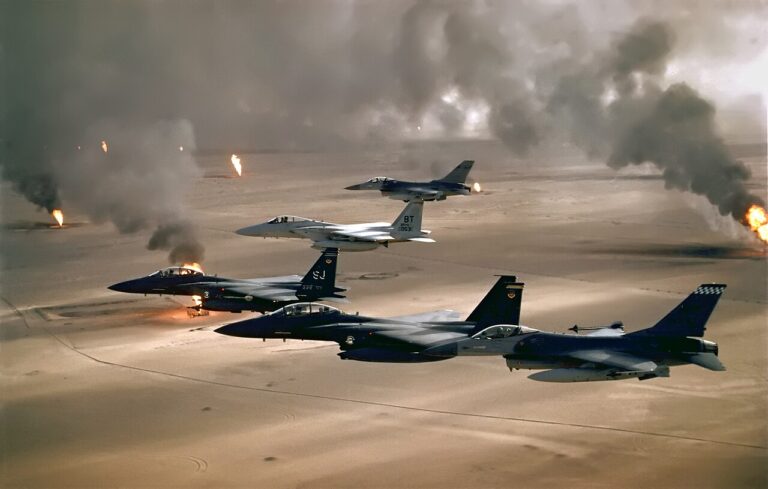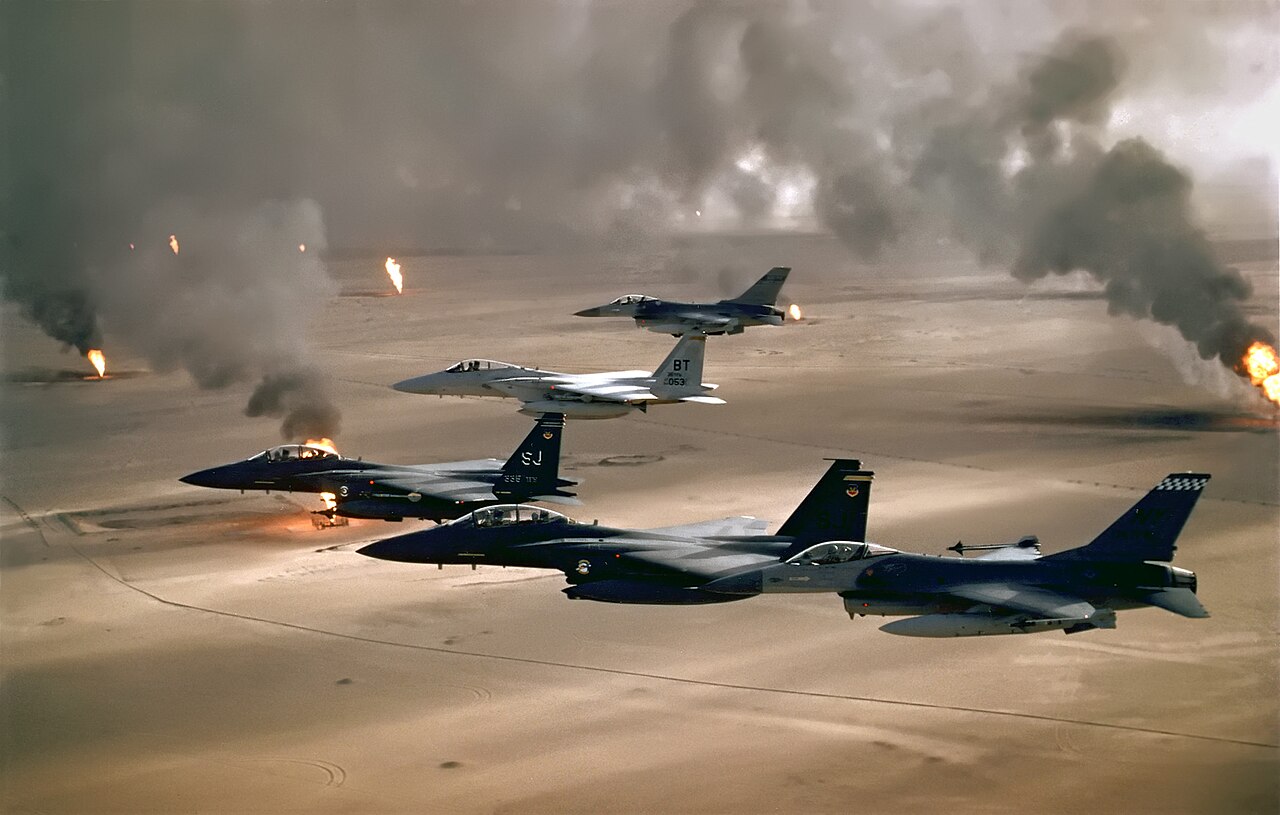
Operation Desert Storm in 1991 was the high-water mark of U.S. military power. Precision missiles such as the Tomahawk proved devastating. A combination of electronic warfare and superior defensive avionics made Air Force and naval aircraft virtually invulnerable against the once-vaunted Soviet manufactured Iraqi air defense system. The M-1 Abrams tanks and Bradley fighting vehicles far outclassed the Iraqi T-72 tanks and BMP fighting vehicles of Saddam Hussein’s Army. The Marine Corps was robust enough to field two corps-sized formations and a brigade-sized amphibious corps capable of an amphibious diversion that tied down several of Iraq’s best divisions. The newly developed Patriot missile largely negated Iraq’s SCUD threat. The result was a blitzkrieg victory that was accomplished quickly and with amazingly few casualties.
Read more Medicine’s Great Unfinished Business: The Common Cold
The hubris that resulted from that victory became a curse because it resulted in several assumptions that became conventional wisdom among politicians, the military, and society in general. Those false assumptions have directly resulted in the quagmire of Iran today. (RELATED: Trump Cannot End the Iran War by Simply Declaring Victory)
The first false assumption was that future wars would be quick and relatively bloodless from an American standpoint. The second was that the peace dividend from the fall of the Soviet Union would allow us to deconstruct much of the military-industrial capacity that had characterized the Cold War. A final assumption was that the Goldwater-Nichols military reform legislation of the late 1980s had contributed to the victory and was an unqualified success.
The assumption that American technological and tactical superiority would make future conventional wars short and relatively casualty-free has been rendered false by the seemingly endless morasses of Iraq, Afghanistan, and Iran. The quick fall of Saddam Hussein in Iraq and the collapse of the Taliban government in Afghanistan appeared to validate the assumption, but by late 2003, that notion was vanishing. Our opponents had learned to adapt tactically to American technological superiority by using asymmetric means. However, many politicians and senior military leaders viewed those situations as outliers and continued to believe in the short war myth. The 1993 debacle in Somalia should have been a wake-up call, as should have been the ongoing conflicts in Gaza and Ukraine. Technology is the most fleeting of war’s advantages, and the hubris of assuming constant tactical superiority is perhaps its own dangerous notion.
Shortly after Desert Storm, Newt Gingrich was warning about not overplaying the post-Cold War “peace dividend.” He had some good ideas about keeping the defense production base at least warm to deal with a future peer or near-peer adversary. Unfortunately, he was a voice in the wilderness, and the critical shortage of precision munitions and Patriot missiles in Ukraine and on the Ukrainian front, as well as our shipbuilding and maintenance woes, have proved him right. (RELATED: The War With Iran Is Exposing America’s Missile Production Problem)
The era of the Chateau generals of World War I has reappeared with a vengeance, and American military competence has suffered.
Perhaps the most harmful assumption — and one that remains largely unrecognized — was the myth of the effectiveness of the Goldwater-Nichols (G/N) reforms in improving the American military post-Vietnam. The reality was that Desert Storm was fought by generals and admirals brought up in the Pre-G/N military. We haven’t won a war since. G/N requires that all officers aspiring to flag rank must spend at least three years on a joint staff at some point in their careers. To make room for that, every joint staff had to undergo a huge expansion. The result has been staffs bloated exponentially to a point where they can’t get out of their own way. General Schwarzkopf could actually deploy with forward elements of his Central Command staff to the field to fight Desert Storm; that has not happened since. The era of the Chateau generals of World War I has reappeared with a vengeance, and American military competence has suffered. If Ukraine had not streamlined its military staff system to react and adapt quickly to fast-moving events, it would likely have ceased to exist by 2023. Under G/N as it currently stands, we could not achieve that flexibility. (RELATED: Our Generals Are Failing Us)
Read more The Story of Shimmy Biegeleisen, From Brooklyn to the World Trade Center
What should be done then? We need to accept the fact that the U.S. military establishment is now smaller than in the Cold War. That itself is not bad because our technology is more lethal. But, in some cases, we have gone too far. The Marine Corps has declined far below the mandate of Title X of the U.S. Code. It no longer maintains the three ground divisions and three aircraft wings required by Title X except on paper. This is a result of some poor decisions made seven years ago by the Corps’ leadership. The Marines no longer have tanks, heavy engineers, and much of the artillery that allowed them to be a major part of Desert Storm and Iraqi freedom. Most of the American public and Congress do not realize this. The Marine Corps has been transformed from a worldwide force-in-readiness to a defensive China-oriented missile-firing entity. Congress should insist that it be returned to Title X readiness levels. (RELATED: A To-Do List for the Next Marine Corps Commandant)
The Trump administration realizes that the defense industrial base has declined dangerously. This is particularly true of the inability to build precision weapons at an assembly line pace. If and when the Iran conflict ends, we must build up our stockpile of these systems to at least three times the number we had in February when fighting began. If we are having trouble beating Iran in a fairly protracted war, a conflict with a peer competitor such as China becomes increasingly problematic. (RELATED: Toward a Post-Iran Grand Strategy)
The administration is moving to increase our shipbuilding, naval maintenance, and repair capacity; however, that will likely take at least a decade. In the meantime, we need to explore workarounds such as the use of allied shipyards and bringing retired vessels back into service, albeit with updated sensor and weapons modules. A naval conflict with China would almost certainly involve ship attrition, and replacing those hulls lost in a timely manner will be critical.
Goldwater-Nichols should be revised, and the joint staff service requirement for officer promotion dropped. AI will be able to do many of the functions performed by human staffs today, and joint staffs should be required to be reduced by at least a third. There is absolutely no evidence that three years’ service as a Morale Officer on a joint staff will make someone a better fighting admiral or general.
Our inability to force our will on a second-rate power such as Iran should be a wake-up call. There is much that needs to be improved. We can only hope that China, Russia, and North Korea don’t exploit our current vulnerabilities before we can rectify them.
READ MORE from Gary Anderson:
Starting a War Is a Bad Bet
The Navy’s Morale Problem: Send the Sailors to the Marines
When AI Wants More Than Your Job
Gary Anderson retired as Chief of Staff of the Marine Corps Warfighting Lab and served as a Special Advisor to the Deputy Secretary of Defense.
Read more Fulton Sheen and the Saints Who Still Walk Among Us
About the Author