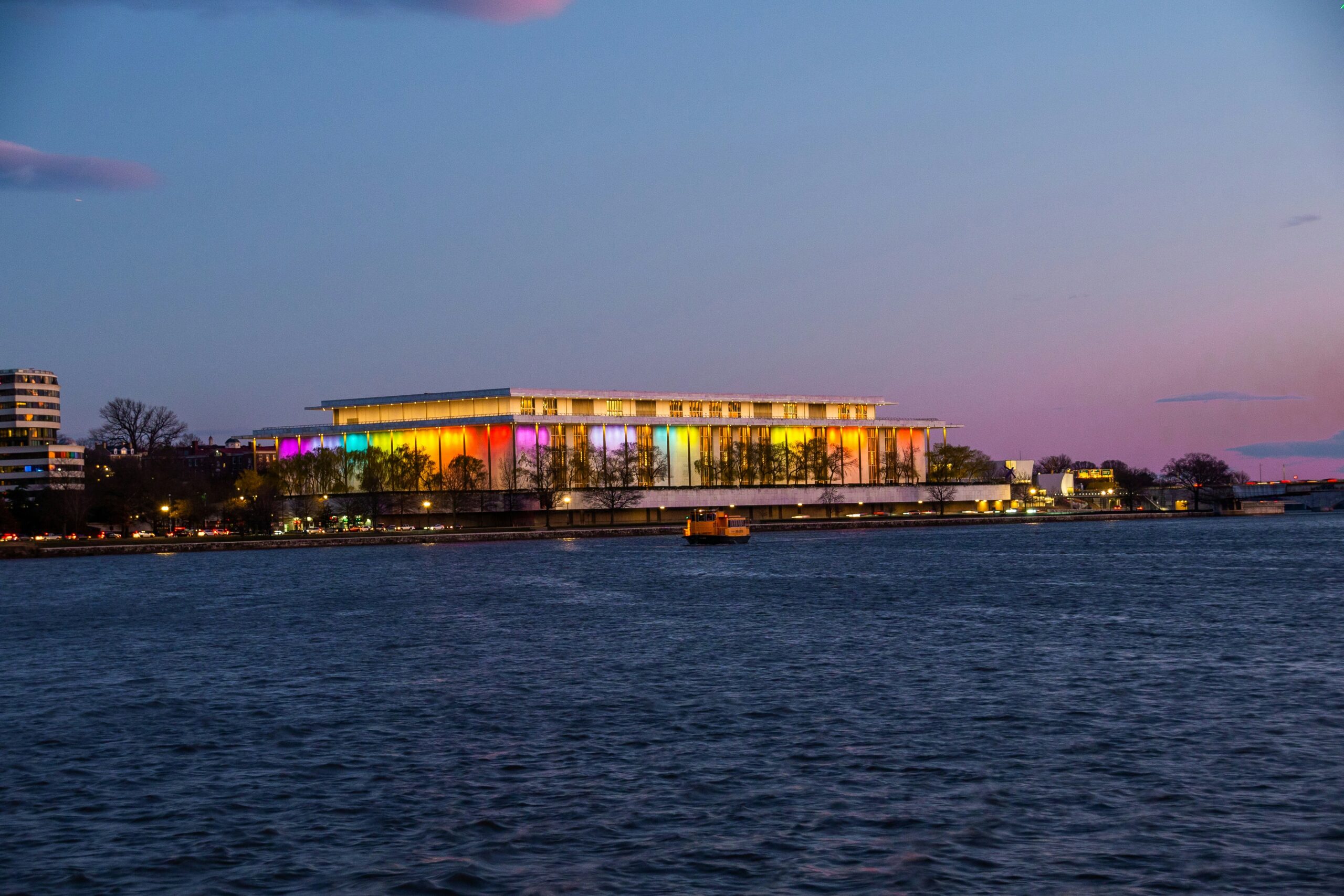
Originally commissioned as the “National Cultural Center,” the arts venue known for its celebration of American drama has been the star in its own drama since being singled out by President Trump for its conversion from a temple of the arts to an engine of liberal activism.
Read more Paramount’s Hollywood Exit Could Trigger an Avalanche in Los Angeles
“We don’t need woke at the Kennedy Center,” Trump said soon after taking office in 2025. “So I’ll be there until such time as it gets to be running right.” (RELATED: The Trump-Kennedy Center Naming Kerfuffle, Part 2)
Although Trump stated clearly that his mission was to revitalize the center, which had suffered from structural neglect and anemic ticket sales, the president’s takeover was met with the predictable howls of indignation from woke artists, as well as a wave of cancellations and boycotts, which only added further damage to its already-precarious financial situation. (RELATED: Spoils Must Be Taken, and With No Hesitation or Reservation)
This week the board voted to close the facility indefinitely, citing “dire” financial circumstances and the building’s structural problems, including a partial ceiling collapse.
This spurred a fresh wave of anguished cries from the Greek chorus of wokerati, rising to a fever pitch this week when Trump was photographed with a mock-up poster titled “Kennedy Center Demolished.” (RELATED: Studies in Pride, Envy, Pointlessness, and Death)
The Washington Post’s culture critic Philip Kennicott rose to the occasion by penning a front-page essay invoking no less than the victims of Hiroshima as a suitable corollary for the grief felt by the center’s supporters.
Once dedicated to the celebration of the greatness of Western culture … they have now become agents of radical anti-American political movements.
My friends, the crumbling Kennedy Center is a metaphor for the arts in America. And it should be demolished, along with many other arts institutions, including the National Book Award and the Pulitzer Prize.
It gives me no pleasure to write this. I don’t say “I love the arts” — as one might say of pickleball or pizza — rather, the arts are something I live for, and more importantly, the arts live for me. They have given me inspiration, meaning, and a way of seeing what is true and lasting. The philosopher Friedrich Nietzsche once said, “Without music, life would be a mistake.” To that I would add poetry, literature, painting, drama, and all of the other ways in which, in the words of Shakespeare’s Hamlet, art holds “the mirror up to nature” and gives “the very age and body of the time its form and pressure.” (RELATED: A Dome for Man)
The Kennedy Center’s story is the story of virtually every venerable arts institution. Once dedicated to the celebration of the greatness of Western culture — from Itzhak Perlman to B. B. King — they have now become agents of radical anti-American political movements.
The transformation did not happen overnight. A useful date is 2018, when the Center created the position of Vice President and Artistic Director of Social Impact and hired poet and activist Marc Bamuthi Joseph. Joseph announced that he intended to integrate his belief in “politically engaged” art more deeply into the Center’s “organizational values system.” A year later, as the Center opened its new REACH complex, he described the change more plainly: the Kennedy Center was making the transition from an institution that “shows art” to one that sees itself as an “agent for making culture itself.”
In the aftermath of George Floyd’s death, what had been called “social impact” became an explicit institutional mission. The Kennedy Center declared that it had a “unique and urgent responsibility to systemically foster anti-racism,” while Joseph described the Center as a mechanism for the national ambition to become “systemically anti-racist and structurally inclusive.”
Read more On Cappuccino and Standards
By 2022, the transformation was complete enough to dispense with euphemism. The Center’s annual report explained that its “Social Impact” programming would “leverage the arts for non-arts outcomes to advance justice and equity.” Artists in its Social Practice Residency were invited to propose “critical interventions within existing social systems” intended to produce “social change.”
Asked whether the arts should serve as “liberatory pedagogy,” Joseph stated, “I absolutely move in that vector.”
Thus the hallowed halls of the Kennedy Center became a venue for “Queer Youth” dance parties, indigenous groups dedicated to “decolonializing so-called America” and a residency for prison abolition activists, including a talk by one such activist in front of a large photograph of Che Guevara.
This is not an anomaly. The ultra-prestigious National Book Award, once dedicated to celebrating American literature’s highest achievements, announced its nominees this week. The list is little more than a catalogue of fashionable liberal causes: Gaza narratives, black identity politics, a memoir of “queer parenthood.”
Recall the similarly prestigious Pulitzer Prize, which in 2020 awarded its prize for commentary to Nikole Hannah-Jones for the introductory essay to the New York Times’ 1619 Project, an attempt to recast the American story as a grievance narrative by placing slavery at its center. The award came despite a highly public dispute over the project’s historical claims, including objections from prominent historians and a subsequent revision by the Times of Hannah-Jones’s claim.
Having some familiarity with the landscape of arts prizes, I can tell you the rot goes all the way down. Committees from nearly every state, local, and national award have abandoned their comparatively tedious duty as judges of merit for the thrilling prospect of becoming world-changing agents of justice, elevating the most zealous evangelists of their neo-religion, and righteously rejecting any work whose chief defect is ideological incorrectness.
You might be tempted to say, who cares? Or as a friend of mine said recently, “I’m not into all that artsy stuff.” The problem is, the artsy stuff is into you — and everyone else who lives in the American cultural landscape. Awards such as these, or Kennedy Center residencies, give an imprimatur that travels far beyond the rarefied world of arts and letters; they become what is taught in schools, celebrated by the media, and ultimately the “form and pressure of the time” in which we live.
Which brings us back to that crumbling building on the Potomac. Yes, it should be demolished, as both a practical and symbolic matter. But buildings can be rebuilt. The harder task is recovering the conviction that made such institutions worth having in the first place: that art need not serve a political program to justify itself; that such quaint notions as beauty and truth and excellence are not frivolous pursuits but among the things that make civilization worth preserving.
The Kennedy Center may indeed need new walls and ceilings. What the arts need is a new foundation.
READ MORE from Chris Jansen:
Welcome to the Far Right
What Addicts Don’t Need: The Kindness That Kills
The Soul of Man Under Socialism, Revisited
Chris Jansen is a translator, essayist and poet. His books include Hamlet Decoded, We Can Be Heroes: A Rehab Memoir, The Last Mayan, and The Lost Poems of Juan Ramón Jiménez. He lives in Athens, Georgia.
Read more From Charles Manson to Bruce Davis: California’s Troubled History of Crime and Punishment
About the Author