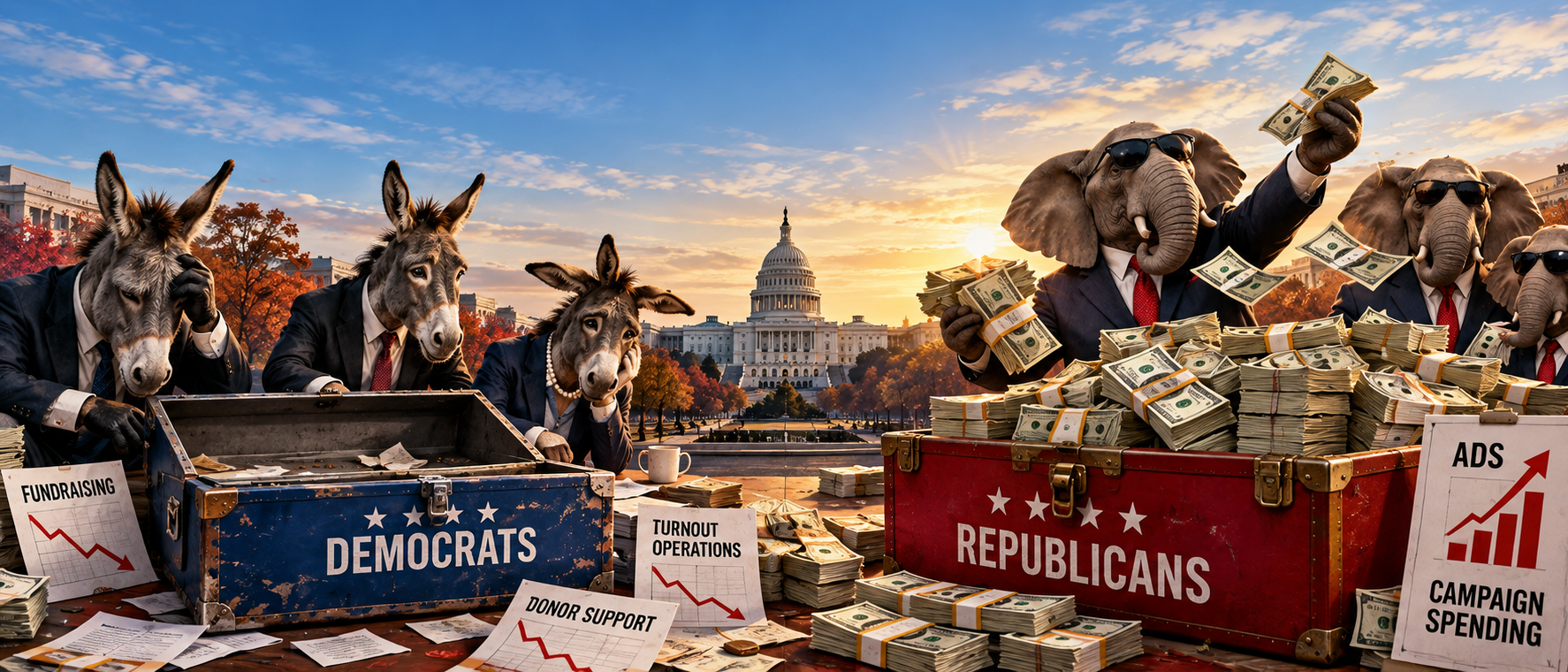
As the 2026 midterms rapidly approach, the consensus among the commentariat is that the Democrats will retake control of the House of Representatives and perhaps the Senate as well. This meeting of the “expert” minds is based primarily on the polls, despite their increasing tendency to underestimate GOP performance, and the fact that the president’s party usually loses seats in one or both houses of Congress in midterm elections. But there is another factor at play this year that most of the pundit class has overlooked. The Democrats are usually flush with cash in midterm cycles and they use much of it to fund turnout and ad campaigns. But this year many of their donors deserted them.
Read more Christa Pike’s Botched Execution Denies Justice to Her Victim’s Family
Nonetheless, the conventional wisdom to which the commentariat clings includes a lot of lazy thinking — not to mention outright hostility toward President Trump and his supporters.
This “donor strike” as the Wall Street Journal describes it, began due to deep dissatisfaction with the leadership at of the Democratic National Committee (DNC) after their catastrophic mismanagement of the money donated to the Kamala Harris presidential campaign. People such as George Soros, Reid Hoffman, and other high-profile donors have been loath to write the big checks Democrats have relied upon for years. The DNC isn’t the only victim of these disgruntled donors. The party committees and super PACs lag far behind their Republican counterparts across the board. This is not only diminishing their chances of winning some congressional races, it is hurting their gubernatorial campaigns, according to a Politico report.
In former and future presidential battlegrounds Florida, Texas, Ohio, Georgia, Wisconsin and Nevada, the gubernatorial advertising gap is yawning. For the remainder of the campaign, Republicans are on track to outspend Democrats on television about 6-to-1 in Florida, more than 3-to-1 in Texas, 2.5-to-1 in Georgia, more than 2-to-1 in Wisconsin, and only slightly more narrowly in Ohio and Nevada … The Democratic Governors Association, with finite resources and 36 statehouse races on the ballot this year, is not on the air in Florida or Texas a month before the election.
Inevitably, there is a considerable amount of whistling past the graveyard by the media. The New Republic advises its readers, “The real impact of Republicans’ cash advantage will only be clear when polls close on November 3. But until then, we have one clear indicator that money might not be everything in 2026: the generic ballot. And signs point to a potential tsunami for Democrats.” First of all, the generic ballot tells us absolutely nothing about the gubernatorial contests. It’s just a poll that purports to measure voter intentions in congressional races. Moreover, as Republican pollster Patrick Ruffini points out, the polls in the last four congressional elections have consistently overstated the Democrats actual election performance.
In the last few election cycles, we’ve seen a pattern of Democrats looking competitive in red state Senate contests during the summer only to fade by Election Day. I wanted to test if this was a consistent pattern, not just the selective memory of a Republican. 3,312 polls over the last four election cycles in the old FiveThirtyEight archive confirmed the pattern. In each of those four cycles, the Democratic candidate’s margin was overstated. The average polling error across all polls was D+3.7, and 73% of polls released overstated the Democrat relative to the election result.
Read more From Jerusalem to America: The Moral Case for Compromise
The Democrats certainly aren’t taking public polls as seriously as their lack of cash. They know that happy talk from publications such as the New Republic is worthless. The Washington Post reports that Ben Wikler, a former chair of the Wisconsin Democratic Party, is worried about the paucity of money to pay for ads: “Campaigns are running fewer ads. They’re splitting 30-second ads into 15-second chunks. They’re having to choose between defining themselves and defining their opposition,” said Wikler, detailing the difficult choices candidates must make. “At this point you’re just deciding where you want to lose by less.” Meanwhile, Republican money continues to pour into competitive Senate and House contests, Politico reports:
Republicans are poised to massively outspend Democrats on advertising: Since the start of August, they have placed $820 million in ad buys across the Senate map, compared to $556 million from Democrats, including future bookings through Election Day. That includes outspending Democrats in all but one of the nine most expensive Senate races … On the House side, the GOP has spent or booked $454 million across the map to $381 million for Democrats. That disparity grows even larger in the districts that were within 10 points at the presidential level in 2024.
The impact of the huge Republican cash advantage will go beyond advertising. The Democrats can usually rely on well-funded voter turnout operations that often make the difference in close elections. This year, however, the disgruntled Democrat donors have left these organizations in the lurch just as early voting gets started. AP reports, “America Votes, a coordinating hub for more than 400 progressive groups, has fallen ‘well below’ the level of funding it had during the 2022 midterms.” Consequently, organizations focused on engaging and mobilizing low-propensity voters have been forced to scale back staffing. This comes at a time when the Republicans have the funds and technology to get out its low-propensity voters.
None of this is meant to suggest that the Republicans don’t have real challenges to overcome in the next 29 days. Regardless of how accurate polls are, it will not be easy to neutralize the midterm curse that almost always bedevils the party in power. Nonetheless, the conventional wisdom to which the commentariat clings includes a lot of lazy thinking — not to mention outright hostility toward President Trump and his supporters. Moreover, this will be the first election in many years during which the Republicans have a clear cash advantage. This factor, combined with Trump’s uncanny ability to defy the predictions of the self-satisfied pundits, may portend a better November for the GOP than the “experts” forecast.
READ MORE from David Catron:
Ketanji Brown Jackson Throws a Fit As Supreme Court Backs SAVE Voter Verification
Read more The flydubai Terror Attack Tests Middle East Security and Diplomacy
Does the Press Understand the First Amendment?
From Truman to Trump: Why Election Polls Keep Getting It Wrong
About the Author