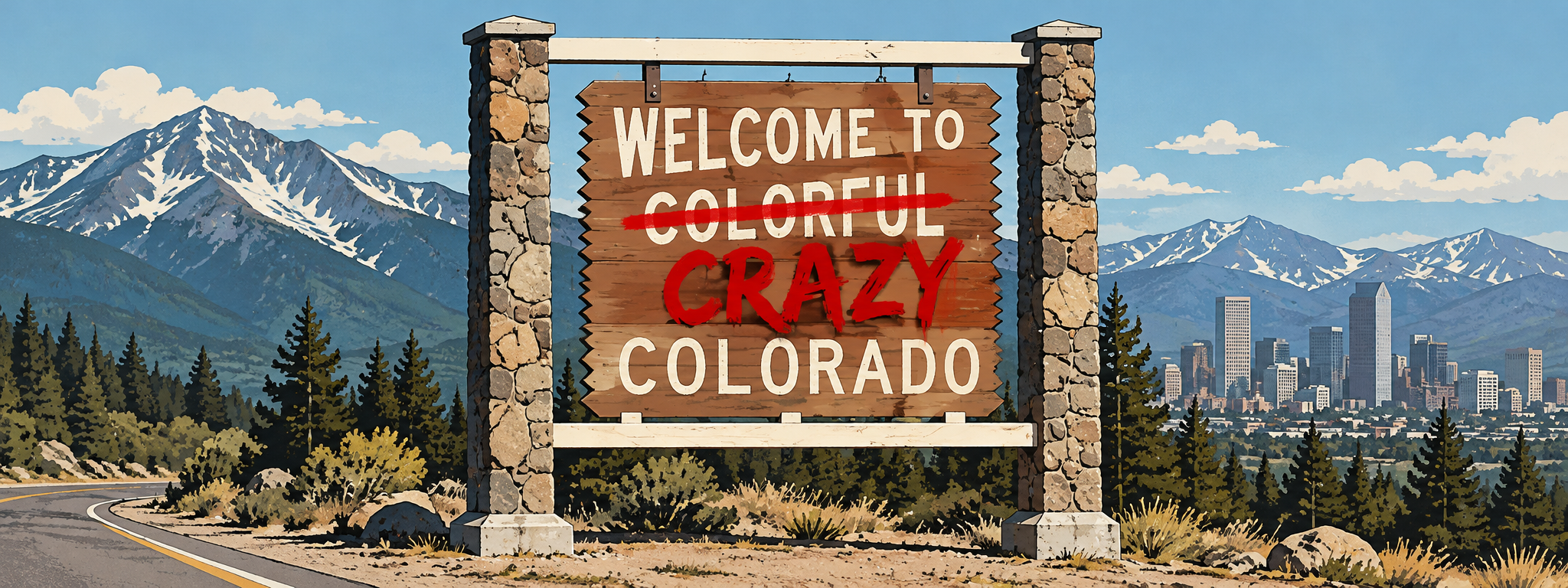
Heads up, California. That state in the crazy lane in your rearview mirror is closer than it appears.
Read more Real Men Don’t Vote Democrat
It’s Colorado.
The Golden State, to give it its due, has set the gold standard in wackiness. Maybe it’s the gorgeous scenery; the consistent, perfect weather; the coruscating paradise of sun, sand, surf, and unending, gorgeous youth that drew by the millions the vibrant and energetic, and weird, to the West Coast. Or maybe it’s just the fact that once you get there you stay there because you can’t get farther west beyond there — even after you discover there is no there there.
Whatever. It is the bellwether of many phenomena and trends, both good and bad. It has given us communes, hippies, flower power, Charles Manson, Jim Jones, the Symbionese Liberation Army, freeways, smog, skateboarding, crack cocaine, Valleyspeak, smoking bans, biker gang culture, psychedelic culture, organic food culture, street gangs, police helicopters, fast-food drive-thrus, and every trendy culinary fad to come down the pike.
And culturally, Colorado weird has not caught up to Cali wackiness.
It does have potential, however. The Centennial State, as is well known, is a weed haven. The state was the first to legalize recreational marijuana (along with Washington) in 2012, and the haze is so thick at the annual pot extravaganza called the Mile High 420 Festival that you’d think you were in Beijing. So many have heisted for their rec rooms mile marker 420 on Interstate 70 that the state changed the marker to 419.99, to prevent the constant theft. And of course, the Bong-a-Thon, “the nation’s longest running cannabis event” (since 1974), is convened every summer at a “clandestine location somewhere in Colorado.”
Less amusingly, it has also turned the name “Columbine” into a shorthand descriptor of mass school violence. The murder of 12 students and one teacher at Columbine High School, in 1999, rewrote the playbook on school shootings, both from a media standpoint and from a tactical-response standpoint. It was the first mass school shooting that invited 24/7 news coverage and became a macabre inspiration for copycat attacks; news crews invaded south-suburban Denver and saturated airwaves for days with nonstop, often-troubling coverage.
The incident also flushed out of service the “surround and wait” approach to active-shooter scenarios. Police afterward were more likely to enter and take on shooter(s) actively (with the conspicuous exception of Uvalde, Texas).
The Political Fallout
Politically, the weed is working its magic (along with an influx of Californians and a younger state demographic that skews left) as the state has turned from reliably red to now stubbornly blue, to the point that El Paso County (home to the Colorado Springs evangelistic-military complex) is moving purple. The state went for Barack Obama in 2008 and has remained in the Democrat column ever since. The governorship has been in Democrat hands since 2007; both senators are Dems, as are the attorney general and secretary of state, and both chambers of the state legislature.
And it doesn’t like Donald Trump. The state seems to suffer from elevated TDS, as it attempted to remove Trump’s name from the 2024 presidential ballot. The U.S. Supreme Court shot that down — only Congress can disqualify candidates from holding office.
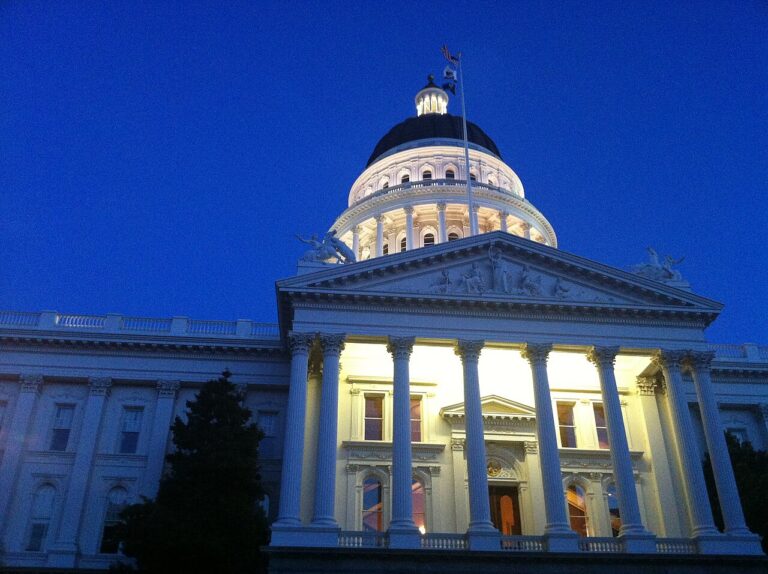
There was also an incident regarding the Trump portrait in the Colorado State Capitol, in which the president looks like, well, a puffer fish. The president complained — the painting “was purposefully distorted to a level that even I, perhaps, have never seen before” — and, after his administration provided a suitable replacement, Colorado swapped it out finally in 2025, but not without much pearl-clutching.
Colorado also became the metastasizing node in a carcinogenic immigration system perpetrated by the Biden administration. It was an incident in the Denver suburb of Aurora that captured the nation’s attention leading up to the 2024 election. Members of the Venezuelan gang Tren de Aragua were filmed terrorizing an Aurora apartment complex, which set off national alarm bells over the threat posed by illegal immigrants allowed into the country by Biden.
The Left ignored the issue at first, then downplayed it, then blew it off as a landlord problem, then excoriated conservative pols for plumping it into a scandal that wasn’t, then finally blamed Texas governor Greg Abbott for sending roughly 43,000 illegals, mostly Venezuelans, to sanctuary city Denver, as a protest of Biden administration immigration policy. Abbott’s point: there would be no problem had Biden not allowed 10 million illegals over the southern border, and Democrat pols in sanctuary cities should shoulder some of the cost incurred by this invasion on his Texas cities.
The LGBTQ State
“As far as LGBTQ rights are concerned, we are pushing the envelope,” Dafna Michaelson Jenet, a former Colorado state legislator, told the Wall Street Journal. “We are trying to make it the best place to live for someone who is LGBTQ.”
That they are definitely trying to do, but their persistent, crazed efforts to strip Christians of their religious liberties in favor of LGBTQ rights are finding consistent failure before the U.S. Supreme Court.
First there was Jack Phillips, of Masterpiece Cakeshop fame. Back in ancient times, pre-Obergefell (2012), Phillips refused for religious reasons to bake a cake for a same-sex union and was sued. He was left dangling as his case crawled through the judicial machinery, before final vindication by SCOTUS in 2018.
Even before that exonerating verdict, in 2017 he was sued again, this time for refusing to bake a cake celebrating a man’s alleged transition to a woman. Colorado state courts and state appeals courts all ruled against him and his principled religious stance, which put him again in judicial purgatory awaiting a resolution. That came finally in 2024, as the Colorado Supreme Court dismissed the case on procedural grounds, managing in the process to totally duck the question of artistic free speech and religious liberty.
In 2023, the same tribunal that lit the fire under Phillips, the Colorado Civil Rights Commission, ruled that a web designer, Lorie Smith, could not refuse to construct custom websites for homosexual couples. She, like Phillips, cited religious reasons. And her case, like Phillips’s same-sex case, made it to the U.S. Supreme Court, which ruled what everybody knew it would rule: that Colorado could not make somebody say something they didn’t want to say.
Speaking of making you say something you don’t want to say, Colorado put into law last year something called the Kelly Loving Act, which almost instantly provoked lawsuits alleging First Amendment violations. The law criminalizes “deadnaming” (i.e., using someone’s birth name when they don’t want you to) and using unpreferred pronouns of people claiming gender transition. One lawsuit claimed, “it is now a ‘discriminatory practice’ under Colorado law to refer to transgender-identifying individuals by their birth name (i.e., not their ‘chosen name’) or to use biological pronouns (i.e., not their preferred pronouns) in a place of public accommodation.”
The law has major ramifications in child-custody cases, as a parent who seeks to use common sense or biblical principles in dealing with troubled children — intentionally “deadnaming” or “misgendering” them — could be accused of applying coercive control and thus be penalized in custody battles.
Another ruling dealing with the transgender issue made it to the high bench last year and, as has become customary for Colorado civil rights law, was as unconstitutional. This Colorado law banned counselors from seeking to change a youth’s sexual orientation or gender identity.
Again, free speech, and what is termed “conversion therapy,” was upheld by the U.S. Supreme Court, this time by an 8–1 vote. Justice Neil Gorsuch,
Colorado may regard its policy as essential to public health and safety. Certainly, censorious governments throughout history have believed the same. But the First Amendment stands as a shield against any effort to enforce orthodoxy in thought or speech in this country. It reflects instead a judgment that every American possesses an inalienable right to think and speak freely, and a faith in the free marketplace of ideas as the best means for discovering truth.
Not yet slammed down but probably soon-to-be is another Colorado law dealing with religious freedom. The U.S. Supreme Court agreed to hear next month St. Mary Catholic Parish v. Roy, in which a Catholic pre-K program was denied state funds because it refused to enroll families that would not support Catholic teachings on sex and gender.
States that restrict religious entities from participating in state-funded programs have been losing these cases lately. Three times in the past 10 years, the high court has stipulated that a government cannot exclude religious parties from the benefits available to the general public simply because of their religious beliefs or exercise.
The twist in this case is that the Catholic preschools — 34 in the Denver area — are seeking an exemption from the state-imposed requirement that, to participate in the program, they enroll all comers, regardless of sexual orientation and gender identity. The archdiocese wants to deny parties that fail to support Catholic teachings on sex and gender.
The state said no and denied the funds. The schools sued; the case bumped through the judicial system and will now be heard by the Supremes.
The state’s problem is that it is not treating the Catholic schools like it is everybody else. The program allows schools to prefer other groups in enrollment, like kids with disabilities or to keep kids from a given family together.
Writes Michael A. Helfand at City Journal:
A final, broad “catch-all” preference allows, according to the testimony of the program’s director, providers to favor enrollment for a child based on “the child and/or family being part of a specific community.” This includes foster-care children, children of veterans, children of color, and members of the LGBTQ community. It even allows schools to operate exclusively for “gender-nonconforming children.”
Given this context, Colorado’s program is hard to defend. If a religious school may not prefer families who share its faith, why can other schools prefer students based on race or sexual orientation?
Although similar to previous cases, this case will provide the Supreme Court the opportunity to rule on extraneous conditions attached by states to funding programs. Colorado is attempting to deny religious schools participation in these generally available programs by making them comply with mandatory conditions attached to the programs, in this case “quality standards.”
The final example of Colorado’s assault on religion emanates from 2022 and is possibly the most egregious. A court in Colorado said a religious school could not fire a teacher of religion for transgressing the school’s religious tenets. Moreover, the court said who is or is not a minister should be decided not by the affected religious institution, nor by the courts, but by a jury in a civil trial.
The school, Faith Christian Academy, of the Denver suburb of Arvada, appealed the decision to the 10th Circuit Court of Appeals, which upheld the ruling. The U.S. Supreme Court denied certiorari.
This ruling calls into question the “ministerial exception,” which mandates that churches and church schools that promulgate church teachings have the right to choose their own leaders without government interference. Chief Justice John Roberts wrote in the 2012 benchmark Supreme Court case Hosanna-Tabor Evangelical Lutheran Church & Sch. v. EEOC, “The church must be free to choose who will guide it on its way.”
Climate Overreach
The most bizarre of the Colorado cases might be Suncor v. Boulder County, which the U.S. Supreme Court heard earlier in October.
Boulder thinks it should regulate climate policy for the rest of the country. In 2018, the county filed a lawsuit against big oil companies Suncor Energy and Exxon Mobil, claiming they increase the use of fossil fuels, which increases greenhouse gases, which furthers climate change, which harms the local environment.
Says University of Virginia law professor Saikrishna Prakash, speaking to Forbes: “If Boulder can attach liability to these two companies … it can attach liability to thousands of others as well. So essentially, Boulder claims that Colorado can reach around … the entirety of the United States, and to my mind, regulate production everywhere by attaching liability to it. Further, Boulder claims that Colorado can regulate worldwide production by attaching liability to it.”
Three dozen other cities and states have filed similar lawsuits and will be quick to move if Boulder County wins at the high court.
Ominously, Justice Samuel Alito has recused himself from deliberations because he and his wife own oil company stocks. A 4–4 tie at the Supreme Court would leave the lower court ruling to remain in place.
Read more Remembering Iron Mike Ditka
The case should be decided by next summer.
READ MORE from Tom Raabe:
Chandler Simpson’s One-Man Rebellion Against Baseball Analytics
The Hopeful Protestant Future
Supreme Court to Rule on Religious Preschool Case
About the Author