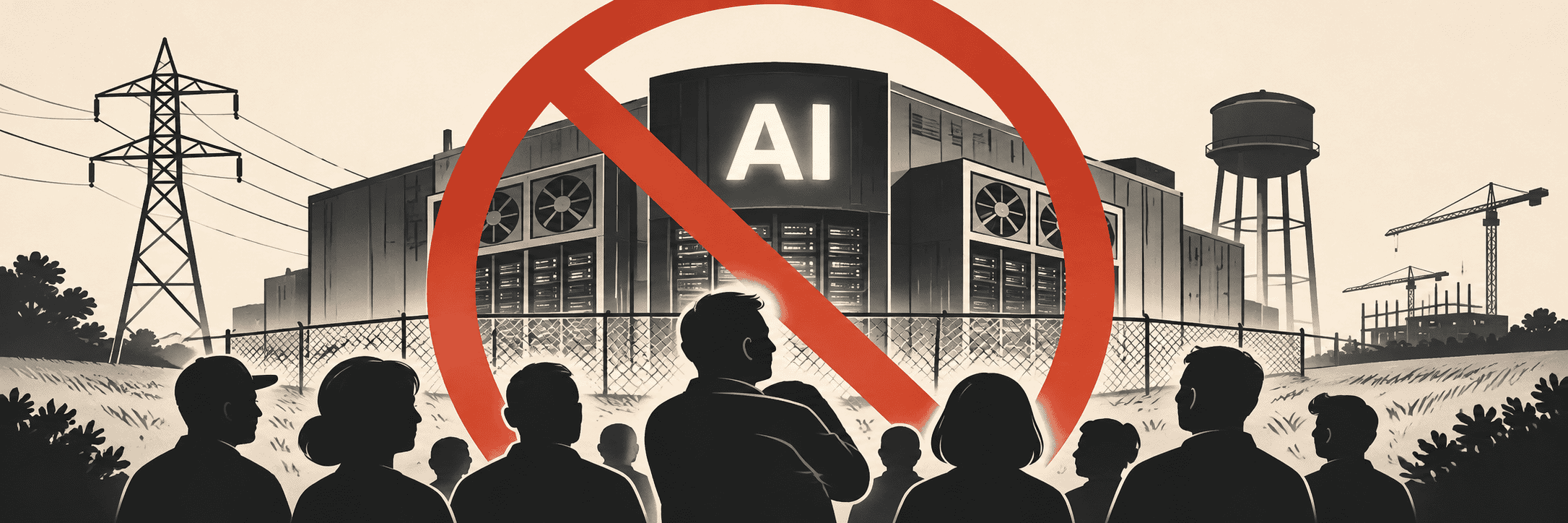
The revolution in artificial intelligence (AI) was supposed to take place in the “cloud.” It turns out, though, that the cloud occupies a lot of real estate, consumes prodigious amounts of electricity, requires vast liquidity (water and capital), and has neighbors who increasingly want it to go away.
Read more What Makes a 35-Point Difference in How Someone Votes?
The U.S. midterm elections injected this reality into national politics. Democrats swept into control of Congress and captured governorships long held by Republicans. But among the election’s most consequential developments for American industry was the transmutation of opposition to data centers from a local into a national political force. Candidates promised restrictions, moratoriums, and closer scrutiny of the enormous computing facilities on which the AI revolution depends. (The average data center occupies 100,000 square feet; the largest are more than 1,000,000.) (READ NEXT: From ‘All In’ to Tap the Brakes: Josh Shapiro Redefines Pennsylvania’s Tech Boom)
The industry may have to become more disciplined, more geographically diversified, more responsive to local communities, and more convincing about the returns on its extraordinary investments.
In Texas, where Republican Governor Greg Abbott was defeated by Democrat Gina Hinojosa, the issue loomed large in the campaign. Hinojosa promised to protect communities from the costs and consequences of data-center development. Such concerns were repeated in campaigns in Georgia, Ohio, and other states. Local referendums overwhelmingly favored restrictions on new facilities. (READ NEXT: The 5QT Presents: The Five Black Pills, Part 5 — What You Hate About AI Is Not Really About AI)
Wall Street Reacts
Wall Street responded. Shares of data-center operators, electrical utilities, and companies dependent on the AI construction boom plunged. Investors began asking if political opposition could interrupt one of the largest capital investment surges in American history.
Could an election, or a collection of local zoning battles, derail the technology widely predicted to transform the American economy? Was the new industrial revolution, predicted among other things to retire the national debt, to be met by fatal reaction? To understand that question, we must ask what a data center is.
When someone asks ChatGPT a question, the answer appears on a screen, often within seconds. It is tempting to imagine that the answer emerges from some disembodied intelligence residing in the cloud. In fact, of course, the operation takes place in a vast physical network of processors, memory systems, storage devices, communications equipment, and cooling machinery. The cloud is not a place. It names an arrangement for linking and supporting computers located somewhere else.
In my book, A Serious Chat with Artificial Intelligence, I describe data centers as the modern equivalents of steel mills or power plants. They are the industrial infrastructure of an economy increasingly dependent on computation. Where steel mills transformed iron ore into the material of industrial civilization, data centers transform electrical energy and digital information into computational services. A top-end graphics processing unit (GPU) can perform 20,000 trillion calculations per second. That devours electricity. (READ NEXT: Ground Broken on a Rust Belt Powerhouse: Shippingport’s Data Hub Rises in the Age of AI Anxiety)
The comparison is more than metaphorical. Like the industrial facilities of an earlier age, data centers require enormous, fixed investments, reliable energy supplies, transportation and communications infrastructure, specialized equipment, and access to skilled labor. Unlike steel mills, however, they produce something almost invisible to their end users. Given the opposition to data centers, often bordering on hysteria, it is not irrelevant to recall the famous description applied to the early Industrial Revolution England: “dark, satanic mills…”
Traditional data centers support banking, retail transactions, medical records, internet searches, streaming entertainment, and countless other services. AI adds another, especially demanding, layer. Training advanced AI models requires thousands or tens of thousands of specialized processors working together for days on enormous datasets. Once trained, these models require further “compute” every time users ask questions, generate images, analyze documents, or employ increasingly elaborate AI agents. The first activity is called “training”; the second, “inference.”
Training can often be scheduled around the availability of computing resources during “off hours.” Inference must respond to users, frequently in real time. As AI becomes integrated into ordinary economic activity, demand for inference may grow enormously even if the pace of training new models slows. The future of AI infrastructure, then, is not simply a matter of building ever-larger facilities to train ever-larger models. How efficiently can this technology serve millions, eventually billions, of users?
Already, the scale of investment is being called “unprecedented.” The International Energy Agency estimates that the largest technology companies will spend more than $700 billion on capital expenditures in 2026, much of it on data-center expansion — facilities containing hundreds of thousands of processors, drawing hundreds of megawatts of electricity, and requiring elaborate cooling systems. It is scarcely surprising that people living near proposed sites have begun asking questions:
Will the facility increase their electricity bills? Strain local water supplies? Lay new transmission lines across their property? Will generators, cooling equipment, and electrical infrastructure create persistent noise? And then, there are tax incentives. Communities may be asked to subsidize facilities that create substantial construction employment but relatively few permanent jobs once operating.
These concerns cannot all be dismissed as Not-in-My-Backyard-ism. Some are legitimate questions about costs, property rights, and who should pay for infrastructure. An elementary principle of market economics is that those who will profit from an investment should put up the money; data-center costs should not automatically be shifted to households and businesses. But another principle of market economics is that investment costs in the end are paid off by consumers who purchase the benefits
The issue becomes more complicated because electricity networks are shared systems. Investments may serve multiple customers, and their costs and benefits must be allocated through regulatory arrangements that are often difficult for ordinary consumers to understand.
Opposition has grown far beyond isolated neighborhood disputes. Data Center Watch reports that more than 45 projects representing nearly $68 billion in proposed investment were blocked or delayed by local opposition during the second quarter of 2026 alone. But 30 state legislatures introduced measures addressing such matters as facility locations, water and electricity use, and infrastructure costs.
Then Came November 3.
Thus, the election did not create the opposition; candidates advocated or exploited local disputes, injecting them into national politics. Newly elected officials may now find themselves under pressure to deliver the restrictions promised during their campaigns. (READ NEXT: Like It Or Not, Data Centers Are Part of the Midterms Now)
For investors, who dislike uncertainty, this political escalation arrives at a sensitive moment. Long before the election, financial analysts began questioning the unprecedented sums being committed to AI infrastructure. AI had manifold and multiplying applications, of course, but would those applications generate revenues and profits sufficient to justify the capital expenditures being proposed? Often, sensational earnings reports saw stock prices plunge because the conference calls with CEOs featured estimates of future borrowing. A technology may transform civilization while proving disappointing to investors who financed its early development at excessive valuations.
Railroads transformed 19th-century America, but many investors lost fortunes. Telecommunications transformed the late 20th century, but the fiber-optic construction boom left substantial excess capacity and bankrupt companies. The economic value of a technology and the profitability of particular investments are quite simply very different questions. (READ NEXT: Why Aren’t Our Modern-Day Robber Barons Giving Us Robber-Baron Benefits?)
Read more The 2028 Presidential Election Will Be the Last Stand to Prevent Permanent Leftist Rule
Will AI travel a similarly rocky road? Data-center construction increasingly involves debt financing, long-term leases, special-purpose entities, and contractual commitments extending years into the future. In October, S&P Global warned that the largest technology companies, the hyper-scalers, may have more AI-related financial liabilities than are readily apparent from their published accounts. It estimated that six major American companies could spend more than $7 trillion on AI-related capital expenditures between 2025 and 2030. Not all of that expenditure will be financed through bonds, and not all will necessarily materialize. But the scale creates exposure to interest rates, credit conditions, construction delays, and the possibility that anticipated demand will fall short.
Not to mention political interruption, which could have contradictory effects. It might undermine highly leveraged developers whose financing depends on completing projects rapidly. It might also restrain speculative overbuilding and give customers time to demonstrate that AI services can generate sufficient returns. What looks like a disaster to one investor may look like overdue financial discipline to another.
But would slowing American data-center construction abort the AI revolution or tame it to mere evolution? That is a much larger claim.
First, computing technology itself continues to advance. Improvements in processor design, specialized chips, model architecture, quantization, and other methods of reducing computational requirements can make AI systems less expensive to operate. Some capabilities that require enormous models can increasingly be delivered by smaller ones. Efficiency improvements, however, do not guarantee reduced total electricity consumption. Greater efficiency changes the amount of physical infrastructure required for any given computational task, but cheaper compute can stimulate more demand, a familiar phenomenon in economics known as the Jevons paradox.
Second, U.S. data centers need not all be located here. Countries with abundant electricity, favorable climates, available land, and governments eager to attract investment have powerful incentives to welcome digital infrastructure. Canada, the Nordic countries, and several Middle Eastern states are among the possible beneficiaries of a more restrictive American environment.
Moving computation abroad is not costless. Data sovereignty, cybersecurity, communications delays, political stability, and national-security restrictions all matter. Advanced AI training facilities also depend on access to specialized chips whose international distribution may be restricted on grounds of national security.
Still, capital has always moved in response to differences in costs and regulatory conditions (an aspect of “comparative advantage”). AI infrastructure is unlikely to be an exception. A more spectacular possibility has attracted attention from Elon Musk: data centers in space. In January 2026, to the Federal Communications Commission for authority to develop an orbital data-center system potentially involving as many as one million satellites.
The appeal is understandable. Solar energy is abundant in orbit, and some orbital configurations offer prolonged exposure to sunlight. Space-based computing might eventually avoid certain terrestrial land-use and electricity-grid constraints. But formidable engineering and economic problems remain. Launching computing equipment is expensive. Electronic components must survive radiation. Communications with Earth impose bandwidth and latency limitations. Above all, processors generate heat, which must be rejected through radiators rather than ordinary terrestrial cooling systems.
It appears to date that space-based data centers may become technically and economically practical for certain applications. They are not yet a demonstrated substitute for the enormous terrestrial infrastructure required by commercial AI.
The more immediate alternatives are less dramatic: building facilities in more welcoming jurisdictions, generating dedicated power, improving cooling technology, locating facilities near abundant energy supplies, and designing systems that perform more computation with fewer resources.
At this time, developers are negotiating arrangements that directly address the objections of nearby communities, including commitments to finance infrastructure, protect existing ratepayers, disclose water requirements, and compensate local governments for demonstrable costs. These are more than mere political concessions. They reveal the pressure to make the economic costs of production more transparent.
There remains, however, another and more insidious political danger. If governments respond to legitimate local concerns with sweeping prohibitions, it may abort mutually beneficial investments rather than ensure that developers bear their costs. If, conversely, government grants enormous subsidies, or shifts private costs onto unwilling ratepayers, it encourages investments whose apparent profitability may depend on political favoritism. The early history of railroads in America is an object lesson. Initially, railroads were charged with “monopoly” (as dramatized in Frank Norris’s 1901 novel, The Octopus: A Story of California). Subsequent research finally caught up with the monopoly scare (and growing anti-capitalism) to reveal that coercive monopolies had been achieved via political advantages.
The election of 2026 may mark a turning point in the political-economy of AI, but not necessarily the one imagined by those predicting the doom of the AI boom. The industry may have to become more disciplined, more geographically diversified, more responsive to local communities, and more convincing about the returns on its extraordinary investments.
Some companies doubtless will discover that the anticipated profits did not justify their expenditures. Some projects will be abandoned. Others will move to greener pastures. New technologies will alter the economics of computation in ways that cannot now be predicted. That is how industrial revolutions proceed: not as uninterrupted triumphal marches, but through invention, speculation, opposition, disappointment, adaptation, and renewed innovation.
The AI revolution is not an abstraction floating above the economy. It is part of the economy, subject to the same scarcity of resources, competing demands, financial constraints, and political pressures as every other industry.
The cloud has come down to earth. Whether AI continues to flourish will depend in part on how successfully its builders learn to live there.
READ MORE from Walter Donway:
The IRGC and Muslim Brotherhood: An Alliance America Can’t Ignore
The New AI Job-Displacement Target: Surgeons?
Socializing and Longevity: Does Online Count?
Walter Donway is the author of A Serious Chat with Artificial Intelligence (Romantic Revolution Books, 2026). His articles on AI and other issues have appeared in the Daily Economy.
Read more Five Quick Things: Items Which Might Become Significant, In Time
About the Author