Zeitgeist is a fascinating subject for study, conducive to a number of questions. Here are three. At what point does the culture change? When does the change become undeniable? Does it come from the top down or the reverse?
Read more The Ballot Is Not a Compliance Form
For players in the entertainment business, these are not abstract questions but crucial monetary ones that will determine the success or failure of their product. They may ignore the warning signs to maintain ideological purity, but they can’t escape the consequences. Then, the ultimate question becomes how badly will they get hit? One answer — badly, but not badly enough to make them reverse course, until they’re thrown out.
As I cited in a recent article here, director Christopher Nolan should have felt the increasing headwind against a woke version of The Odyssey two years ago, especially given the story he was telling. In Homer’s epic, King Aeolus, “the keeper of the winds,” gives Odysseus a bag full of winds to advance his journey home, cautioning him not to open it all at once. After 10 days, within sight of Ithaca, his crewmen open the bag and get the ship blown all the way back to Aeolus. (READ MORE: The Left Wanted the Culture War They’re Now Losing)
Director Nolan metaphorically opened the windbag and will soon also pay a heavy price. I cited many of his problems — a feminist translation, a moderately attractive black actress (Lupita Nyong’o) as Helen of Troy, a plain brown actress (Zendaya) as Athena, the goddess of wisdom, and an actress claiming to be an actor (Elliot Page) as one of Odysseus’ warrior sailors. All and any of these will repel a lot of moviegoers.
[T]here’s no end in sight to the two most simplistic and self-destructive devices in their control — gender-swapping and race-swapping.
Nolan might give the excuse of being part of the woke wave when he began developing the movie, though there was already a backdraft in 2022. But there can be no excuse for others moving forward, only contempt for the majority traditionalist audience. So there’s no end in sight to the two most simplistic and self-destructive devices in their control — gender-swapping and race-swapping.
Coming soon: a black Man-at-Arms (the usual go-to Idris Elba, previously a black Heimdall in the Thor movies) in He-Man and the Masters of the Universe, a black Snape in Harry Potter the TV series, a female Aslan (the Christ figure lion) in Greta Gerwig’s Narnia: The Magician’s Nephew, a black Wonder Man, and many more. The purveyors of such infantility can virtue signal about reverse racism all they want. People over 60, especially artists, like me in both cases, know how pathetic and counterproductive this is.
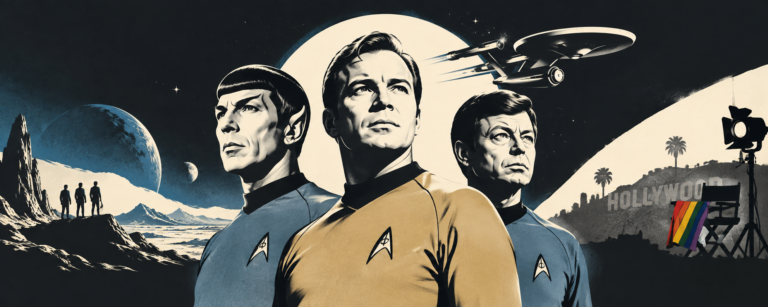
The first actress I ever had a crush on was Nichelle Nichols, Lieutenant Uhura in Star Trek. Watching her at her Enterprise com station every episode, totally efficient, and gorgeous, I never thought about her race, just her legs. In her 1994 autobiography, Nichols wrote about planning to quit Star Trek after Season One for more challenging roles, but was dissuaded by an early Trekkie, Dr. Martin Luther King Jr.
Read more Toward a Post-Iran Grand Strategy
“This is not a black role, and this is not a female role,” King told her. “You have the first non-stereotypical role on television, male or female. You have broken ground… For the first time, the world sees us as we should be seen, as equals, as intelligent people — as we should be.” But to many in present-day Hollywood, what the hell did Dr. King know? Other than some nonsense about the content of character trumping the color of skin.
And one of my first role models was Bill Cosby in I Spy. Cosby’s Alexander Scott was every bit as cool, tough, and witty as his partner, Kelly Robinson (Robert Culp). As a kid, I would have gladly been either one of them. Culp and Cosby made the early decision not to address race as a message in itself. “We are two guys who don’t know the difference between a colored man and a white man,” Culp said at the start of the series. And that message came through loud and clear beyond the influential series through the end of the 20th Century.
True, the late ‘60s and early ‘70s brought race back to the fore, boosted by the volatile times and, on-screen, the likes of Norman Lear. Archie Bunker in All in the Family was meant to be a buffoonish racist. Only he was unexpectedly humanized by the great Carroll O’Connor. And even Lear’s second most popular show, Sanford and Son, made everybody of all races laugh, thanks to the brilliance of Redd Fox.
The 1980s under Ronald Reagan resurrected the I Spy color-blind message to hit status. You had iconic favorites, not one of whom uttered a single word about race or racism: Lando Calrissian (Billy Dee Williams, The Empire Strikes Back), B. A. Baracus (Mr. T, The A-Team), Axel Foley (Eddie Murphy, Beverly Hills Cop), Ricardo Tubbs (Philip Michael Thomas, Miami Vice), Roger Murtaugh (Danny Glover, Lethal Weapon), and many others, all incidentally written by white men.
Then came Barack Obama. The overwhelmingly elected first black president could have been the last nail in the racism coffin. Instead, he unleashed it like Odysseus’s crew did Aeolus’s bag of winds. “The Cambridge police acted stupidly,” Obama said about the arrest of a black professor, forcing open his own front door. “There is a long history in this country of African-Americans and Latinos being stopped by law enforcement disproportionately.” With his endorsement, the racism rage swept through Hollywood, followed by the feminist takeover, then the straight white male exile from both sides of the camera.
The new players believed they’d rule forever, pouring woke crap down the audience’s throat. But the zeitgeist changed, both from the ground up — we, the people, reject them — and the top down — President Trump mocks them. Which is why they hate Trump and us. Because they know we’re going to swap them — for real screen artists.
Read more There Used to Be a Ballpark Here
READ MORE from Lou Aguilar:
The Laugh’s on Hollywood
The Left Wanted the Culture War They’re Now Losing
The Hollywoke Strain
About the Author