Thirty-one years ago a group of American marines and a sailor from Camp Hansen on Okinawa raped a local school girl. This was the culmination of a series of less severe incidents that represented a trend. It set off a political firestorm that reverberated as far as Tokyo and Washington. Recently, a similar situation has developed there with the alleged robbery and murder of an Okinawan woman by a U.S. Marine. Most readers may not even know where Okinawa is so I will provide some background.
Read more We Haven’t Fixed AI’s Left-Wing Bias (We’ve Just Stopped Talking About It)
Okinawa. It is the largest of the Ryukyu Islands which make up the southernmost prefecture (province) of Japan. The indigenous Okinawans are not ethnically Japanese. Rather, they are more closely related the the Chinese who dominated the prefecture originally. The are a deeply pacifistic people having been caught between Japanese and U.S. forces in a bloody battle when marines and soldiers overran the Island in 1945. They also feel like an often abused ethnic minority.
If we do not institutionalize trust, the next crisis is inevitable.
Okinawa has always had great strategic value, but it is particularly important today as it is part of the string of U.S. bases that surround the disputed South China Sea where American and Chinese navies frequently square off and would be a major logistics base in any conflict as it was during the Vietnam War. The issue of U.S. basing on Okinawa is a sensitive one in Japan and the horrific act by a U.S. serviceman opened old wounds.
The Marine Corps leadership on the Island is reacting the way bureaucracies always react in a crisis. They close the barn door after the proverbial horse gone loose. They have forbidden the use of alcohol, are conducting a stand down for “reflection,” and instituting a curfew, thus punishing the whole for the sins of a few; in this case, a single individual. Instead of shouldering the responsibility for lack of positive leadership they try to resort to bromides and hope that the whole thing will blow over.
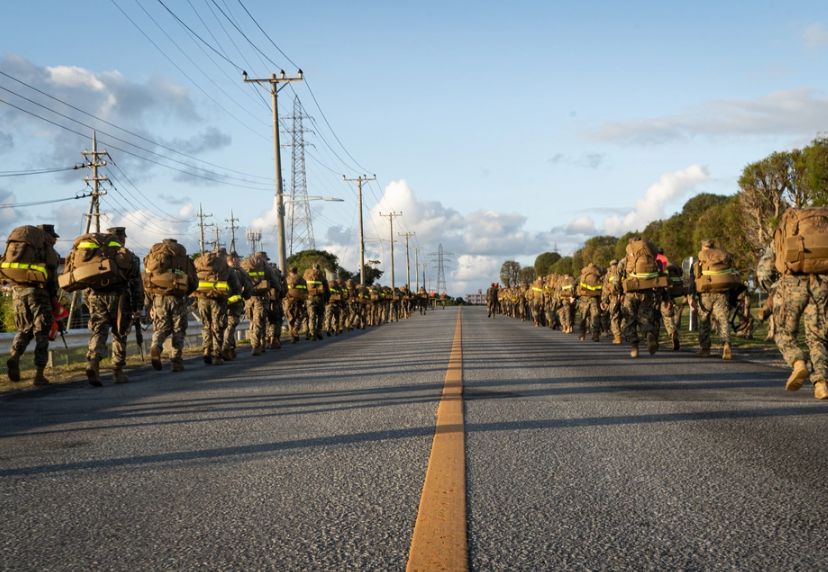
I’m concerned with this because I spent two years of my life trying to repair the damage done in the 1995 incident. In early 1996, I took over command of Camp Hansen. I actually had two hats. One was as commander of a combatant unit part of the Fleet Marine Corps (FMF) and the second was as camp commandant because I was the senior colonel on the 5,000 personnel installation. Thus, I reported to two generals and had two staffs working for me. However, both general officers made it clear that my primary duty was to repair the strained relations with the local population, especially our neighboring town of Kincho (Kin Village) where the young victim lived. I succeeded, and would offer some advice to the senior military leaders who will try to recover from the current mess.
The first thing I did upon assuming command was to to gather the troops in the base theater. This took three increments due to the size of the population My presentation was short and not sweet. “This talk is not directed at the group as a whole. I don’t practice mass punishment, but rather I am talking at those of you who might be considering mischief when you walk outside the gate on liberty. I have three big don’ts. I’ll put up with a certain amount of horseplay here on the reservation, but here is what you will not do out in town. You will not:
– Hurt, insult, or rob an Okinawan
– Drink and drive
– Abuse or insult women, Japanese or American. You will treat women with the respect that you would want to be shown to your mother or sister.
If you are accused of one or more of these, here is what is going happen. You, your squad leader, platoon commander, company commander, and battalion commander will come see me and we will all discuss how we failed to instill the discipline in you that is expected of a United States Marine, and I consider naval personnel on base to be marines as well. Trust me. It will be the most socially significant experience of your young life. Then, and only then, will I hand you over to your chain of command for whatever disciplinary action they deem appropriate. For the rest of you, take care of your buddies. If one of them seems to be losing control, get a taxi and bring him back to camp, We don’t leave marines on the battlefield, and I expect you to do the same here on Okinawa. I’ll will try to visit your workplaces and billets, but I hope none of you has to visit me in mine. That is all, you are dismissed.”
Read more America’s Dangerous Confusion About Right and Wrong
My father had come out for the change of command and he attended the first session. He later said, “I don’t know about them, but you scared the hell out of me.” For the two years of command, I only had to exercise the “big Ds” once and that was for a relatively minor DWI. I stressed to all the officers on the installation that I held myself personally accountable for the actions of all of our marines and sailors and that I in turn would hold them equally accountable for the conduct of their troops.
The next step was to improve the camp’s relations with Kincho which were essentially non-existent. I asked my interpreter to set up a courtesy call on the mayor. As expected, the initial meeting was frosty. However, I invited the mayor and town council to an American style cook out on base. They had a great time. In return, they invited us to their next karaoke party in town. That became a monthly event and did much to break the ice.
The mayor and I agreed to a series of joint community improvement projects such as picking up trash along the highway and on the beaches. When one of Okinawa’s frequent typhoons hit, we assisted in clearing the debris. In the event of a tsunami, we developed a joint plan for expediting the movement of the population through the camp and on to higher ground. We also did a number of joint sporting events. The purpose here was to build trust. If an incident did occur, the citizens would know that we had done our best to prevent it and would cooperate in mitigation. Fortunately, none occurred on my watch or that of my successor.
The majority of the camp’s residents were — and still are — units on a six month rotation deployment from the states (UDP). I made it a policy to greet each one with the same pitch on the three “big Ds” and I took the mayor with me to give a short welcoming speech through the interpreter where he called for them to be good neighbors. Some of the older colonels on the base general staff thought that I was coddling the locals and I pointedly reminded them that they were part of the problem. Over the course of two years things settled down and the Marine Corps leadership encouraged other camps and the Air Force and Navy installations on the island to adopt similar policies.
Unfortunately, institutional memory is fleeting in large organizations and history has repeated itself three decades later. I would urge the military leadership on Okinawa to adopt similar policies, not just as a reaction to the recent incident, but as as an ongoing institutional policy to prevent the next one. If we do not institutionalize trust, the next crisis is inevitable.
READ MORE from Gary Anderson:
Why the Iran War Has Been So Poorly Fought
The Military Decline Since Desert Storm Is Both Physical and Mental
Starting a War Is a Bad Bet
Gary Anderson retired from the Marine Corps in 2000. He served on Okinawa for seven years during his career.
Read more Columbus Goes to the White House
About the Author