Ideas Have Consequences is the title of a conservative classic published in 1948. In that best-selling book, Richard M. Weaver foresees the decline of the West due to a loss of faith in its governing ideals.
Read more The Spectacle Ep. 465: The Left and Right Are WRONG About Lindsay Clancy
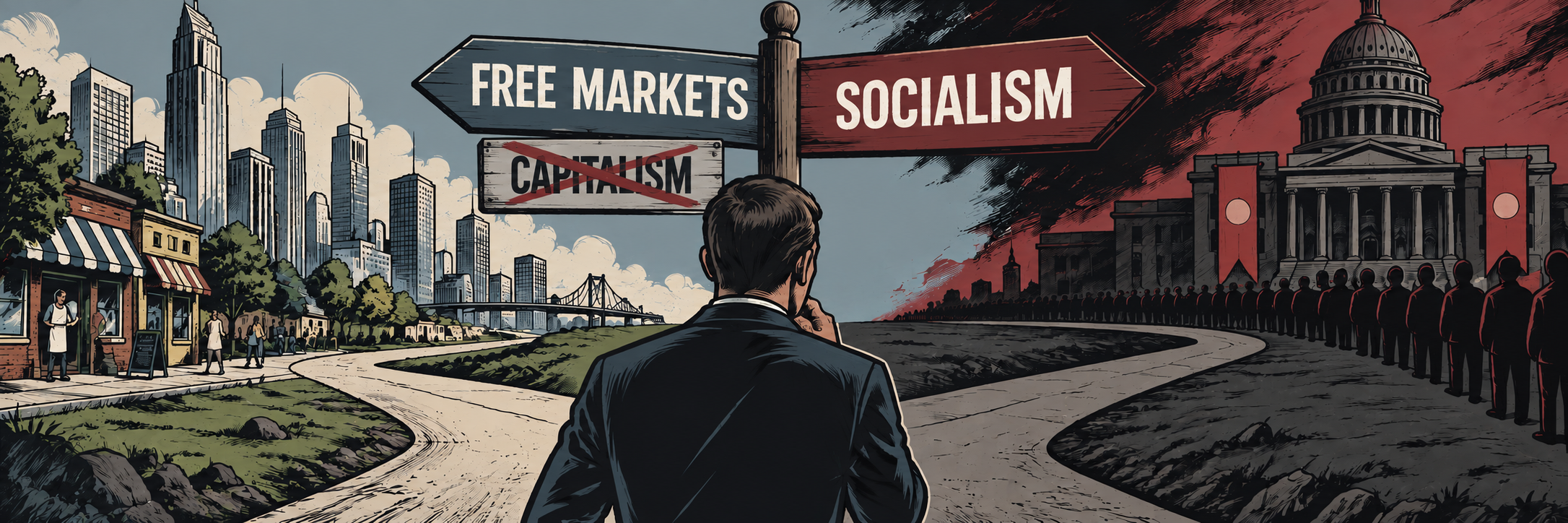
Something parallel is going on today in the current political debate about “socialism” versus “capitalism.” Today, however, a better title would be Words Have Consequences. Rather than being drawn into a “rigged” debate about the merits of “capitalism versus socialism,” conservatives should be reframing the issue as about a choice between “free markets” and “socialism.”
The term “capitalism” is not neutral. It implicitly posits that “capitalists” are running the show, whereas “socialism” is supposedly about benefiting “society” as a whole. Of course, nothing could be further from the truth: history has shown that “free markets” create the greatest opportunity for the greatest number, whereas “socialism” leads to ruin, both economically and spiritually. (RELATED: Why I Support Zohran)
Unlike “capitalism,” the term “free markets” emphasizes as its defining feature that people are free to make thousands of decentralized decisions for themselves…
Unfortunately, however, to the public, evocative words are often more persuasive than historical facts and figures. The word “capitalist” calls to mind the cartoon character of a rich, cigar-smoking oligarch, not the recent immigrant who is living the American Dream by starting their own landscaping or house cleaning business. No wonder then that the rising tide of “democratic socialists” in the Democrat party, aided by their allies in the legacy media, wish to try to frame the current debate as between “socialism,” which sounds good, and “capitalism,” which sounds bad. (RELATED: Everyone Hates Milton Friedman Again)
Every good trial lawyer knows, or should know, that how one phrases a question often determines how that question will be answered. Back when I was trying court cases, we carefully picked the terms that we used to describe issues in the case — and when the judge and the other side started using our terminology, we knew that we had won the case.
For example, years ago when I was defending a company in a toxic tort case, our jury research showed that about half of prospective jurors believed that any chemical with three letters for a name probably caused cancer (what!). We stopped referring to our client’s product by the three-letter abbreviation for its chemical name and instead called our product by its trade name. Freed from the overhang of prejudicial terminology, we won the case based on the science.
However, recently the far left has gotten good at coming up with scary terms that substitute for a fair and balanced discussion of the facts. For example, “Franken-foods” for those that contain genetically modified plants, or “forever chemicals” for per- and polyfluoroalkyl substances (PFAS), a class of over 14,000 different chemicals with different uses and properties — and no, they don’t really last “forever.”
Read more What We Must ‘Never Forget’ 25 Years After 9/11
Unlike “capitalism,” the term “free markets” emphasizes as its defining feature that people are free to make thousands of decentralized decisions for themselves rather than being governed by “experts” who purport to know what’s best for them. Ever since Adam Smith wrote The Wealth of Nations in 1776, wise people have known that the “invisible hand” of the market distills far more information than any human can consider and therefore is often wiser than any individual.
Admittedly, government by “experts” who purport to do what they think is best for the public is a superficially attractive idea, but it is deeply wrong for two separate reasons:
- centralized power can always be captured and perverted by special interests, a concept called “rent-seeking,” for which James M. Buchanan won the Nobel Prize in economics in 1986, and
- decentralized decision-making in markets is often “smarter” than the so-called experts, an idea for which Friedrich von Hayek won the Nobel Prize in economics in 1974.
For over two decades I taught these and other conservative thinkers to the few students at the Yale Law School who were interested in hearing the other side of the conventional liberal gruel that they were being force-fed by the media and in some of their other classes. As luck would have it — or maybe it was more than luck? — a bright young law student from Ohio named JD Vance took my course. Let’s hope he did the reading for that class.
Anyway, those of us who are interested in a fair debate on the merits should stop falling into the Left’s rhetorical trap of framing the issue as a struggle between “capitalism” and “socialism.” No, the debate is really about how much freedom we are allowed to retain; the real issue is whether we leave most economic decisions for people to make for themselves or turn everyone into a ward of a supposedly beneficent state that decides for all of us what kinds of cars we may drive and what we may buy at the government-run grocery store.
To be sure, sometimes markets should not be left totally unregulated. There are exceptional circumstances, called “market failures” in economic theory, in which unregulated free markets may not result in efficient allocation of goods and services. But such circumstances are relatively rare and do not imply that government “experts” should decide everything just because they think they are smarter than the general public— as they almost always do.
The debate today is really about the proper size and role of government and whether we should replace our still relatively free markets with even more government control. So going forward, let’s call a spade a spade: the debate is about “free markets” versus “socialism,” not “capitalism” versus “socialism.”
Read more Volkswagen’s Electric Suicide Pact
READ MORE from E. Donald Elliott:
Our Worst Problem? Our Antiquated Constitution
Goodbye, New York Times
Why Aren’t We Talking About Things That Matter Anymore?
About the Author