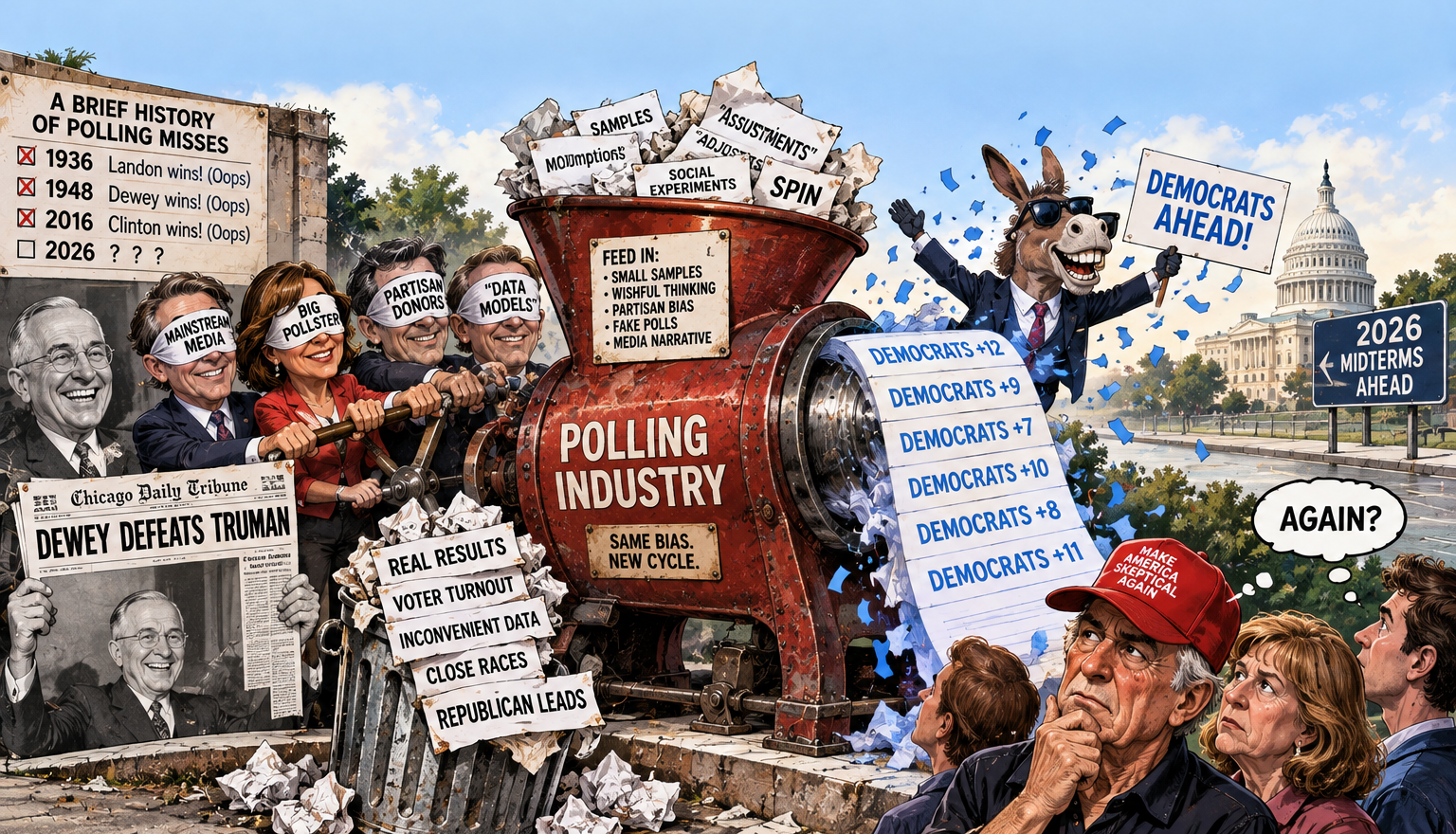
If one peruses the major polling aggregators, the Democrats appear to have the upper hand as the midterm elections approach. The RCP average, for example, contains precisely one survey — the Harvard CAPS / Harris Poll — that shows the Republicans with a generic ballot lead. This conforms to the conventional wisdom that the President’s party tends to lose congressional seats in the midterms, but conformity isn’t the purpose of public opinion polls. We got plenty of agreement among the 2016 presidential polls. Consequently, only one pollster called the race correctly. Since that election a lot of voters have been very suspicious of pollsters, and their track record more than justifies that skepticism.
Read more The Questions We Must Ask About Islam
So-called scientific polling was first introduced 90 years ago in a far different world. From 1916 to 1932, the only accurate predictions in presidential elections came from a publication called the Literary Digest, which mailed millions of mock ballots to potential voters. This hopelessly unscientific method enabled this magazine to correctly call five consecutive presidential elections. In 1936, however, the Digest predicted that Republican Alf Landon would defeat incumbent President Franklin D. Roosevelt. This was wildly wrong. Roosevelt won the popular vote 62 percent to 37 percent. During the same election George S. Gallup happened to release his first presidential survey, which correctly predicted Roosevelt’s victory.
Yet one question always rears its ugly head — why do all the “errors” appear to favor Democrats? The only conundrum is exactly how much.
This ushered in the era of statistical polling, which relied on the random selection of small but ostensibly representative samples of the population. Ironically, this “scientific” polling method had a shorter run of successes than did the Literary Digest before disaster struck. Having called the 1936, 1940 and 1944 presidential elections correctly, the most prominent pollsters (Gallup and Roper) predicted incumbent President Harry Truman’s defeat in the 1948 election by his Republican challenger Thomas Dewey. Truman won, of course, to their chagrin. On the night of November 4, Truman gleefully held up the Chicago Tribune with its headline declaring Dewey the winner.
Late on November 2, Truman went to sleep in Independence, Missouri, knowing he led by one million votes in early results but was expected to lose. Four hours later, he received a call … Truman was leading in the election and expected to win. Dewey conceded the next day, but the famous Tribune photograph was taken two days later, as the Truman family was in Saint Louis and returning to Washington. Life photographer W. Eugene Smith caught Truman in the moment after a staffer handed the President a copy of the Tribune early edition that had been found on a train earlier.
This was, of course, the most famous failure of “scientific polling” in history until Donald Trump defeated Hillary Clinton 68 years later in 2016. The press, which had nothing but contempt for Truman had been predicting his defeat since he received the Democratic nomination. The pollsters must have been influenced by that animus. According to the National Constitution Center, the Roper poll had stopped doing surveys in September and Gallup stopped in October when the race was at 45 percent for Dewey and 41 percent for Truman. When the dust finally settled, however, Truman easily defeated Dewey in the Electoral College, by a 303 to 189 margin. He also won 46 out of 48 states and the popular vote 49 to 45 percent.
Midterm elections are much more difficult to poll accurately, largely because it’s extremely difficult to predict who will turn out to vote. Far fewer people participate in congressional elections than in presidential elections. And, despite the proliferation of pollsters who have weighed in during the primaries, the number of accurate polls has decreased. The most obvious recent examples involved Democrat primaries in Michigan, where most polls indicated that Senate candidate Abdul El-Sayed enjoyed a double-digit lead over his opponent, and Wisconsin, where the polls showed gubernatorial candidate Francesca Hong far ahead of her opponent. El-Sayed won by a single percentage point and Ms. Hong lost her election.
Read more Madison Keys’ U.S. Open Collapse Offers a Lesson in Winning and Losing
These election results will likely increase public skepticism about the polls, particularly considering that at least one of the polling firms showing Francesca Hong with a 20 point lead has confessed to deliberately producing fraudulent numbers. Median Strategies, which also produced bogus polls showing Los Angeles Mayor Karen Bass with a 12-point lead over her primary opponent, suddenly shut down its operation and confessed to the Los Angeles Times that it produced the fabricated polls showing Hong and Bass with implausibly wide leads on their races as a “social experiment.” Median Strategies began posting on social media August 9th representing itself as the cure for the polling industry’s credibility crisis:
Polling has a credibility problem. Ours is the fix: no partisan clients, no campaign or party money, numbers that go wherever the data takes them even when it’s inconvenient. Trustworthy polling, rebuilt.
A few weeks later Median Strategies revealed the following to the Times.
Median Strategies was created as a short term social experiment to examine how purported polling information could enter and spread through the political information ecosystem without independent verification. We are not seeking publicity or attribution for the individuals involved and are declining interviews.
One can’t help but wonder how many other polling firms are conducting “social experiments.” This brings us to some useful research conducted by pollster Patrick Ruffini of Echelon Insights. He writes, “In the last few election cycles, we’ve seen a pattern of Democrats looking competitive in red state Senate contests during the summer only to fade by election day. I wanted to test if this was a consistent pattern.” He analyzed 3,312 polls over the last four election cycles in the old FiveThirtyEight archive and this is what he found: “The average polling error across all polls was D+3.7, and 73 percent of polls released overstated the Democrat relative to the election result. Again, that’s across more than 3,000 polls, so that’s hardly just statistical noise.”
Although Ruffini focuses on the Senate in his analysis, there can be little doubt that the same patterns manifest themselves in polls that purport to tell us how well House and gubernatorial candidates are faring in their various races. It’s important to remember, however, that even honest pollsters face enormous challenges. Yet one question always rears its ugly head — Why do all the “errors” appear to favor Democrats? The only conundrum is exactly how much.
Read more Ryan Reynolds Says the 1980s Were ‘Brutal.’ He Couldn’t Be More Wrong
The only real puzzle is just how much.
READ MORE from David Catron:
The Left Has a Working-Class Problem
The Marxist-Islamist Alliance Feeds On DSA Naïveté
Why Republicans May Defy Midterm History
About the Author