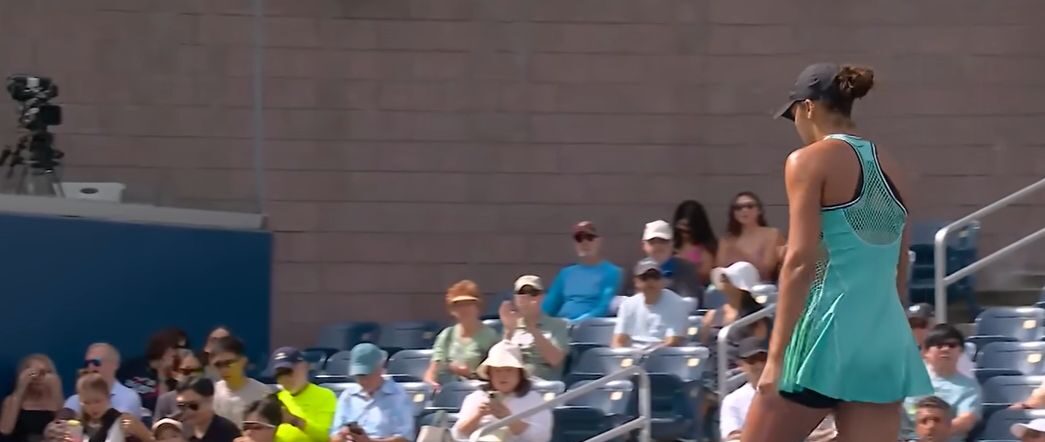
Win some, lose some: folk wisdom. Madison Keys puts it this way: “I think my level dropped, and she started to play better.”
Read more Ryan Reynolds Says the 1980s Were ‘Brutal.’ He Couldn’t Be More Wrong
Miss Keys was referring to a blown lead. She was 5-0 in her third round match against Zheng Qinwen, the stakes were a place in the second week of the U.S. Open, and the 31-year old American star from Illinois and Florida, now Mrs. Bjorn Fratangelo, had match point on her racquet. Then she started winning very few, and losing many more.
Kipling wants you to think about your response to life’s vicissitudes. Madie Keys worried about something more mechanical: “I couldn’t swing,” she said, “and it scared me.” She choked.
She lost here in the 2017 final to her good friend Sloan Stephens. Miss Keys won the Australian Open in 2025 and, of course, would dearly like to have a U.S. Open trophy; her opponent won Olympic gold (Paris, 2024) and is one of China’s best players since Li Na.
Madison Keys had come from behind in her previous match, with her fans cheering her on; this time they fell silent, while Miss Qinwen’s went loud.
This was at the Grandstand; on nearby Court 5 on the same afternoon, Dane Sweeny suffered through a meltdown of his own. The newcomer from Australia could not find the form that got him an upset win over Lorenzo Musetti. Against Luciano Darderi, he went down in three frustrating sets despite gutsy moments that he was unable to turn into momentum.
There is a reason for the Rudyard Kipling lines above the entrance at the All-England Lawn Tennis Club: “If you can meet with triumph and disaster/And treat those two imposters just the same…”; the poem’s theme is that humility and perseverance are two sides of the same quality of character. You do not let defeat define and depress you, nor do you let victory make you vain; you brush both aside and prepare for the next test.
It may be corny, but life, like the rounds in a tennis tournament, is a series of tests.
Which goes too for your erstwhile opponent, of course: Maddie can blame herself, as can Dane; but you may be sure neither fails to give credit: to Zheng’s ability to deploy her forehand after a weak first set; to Luciano’s stubborn determination to hit the last ball over the net, point after point.
No less corny: You can say you beat yourself; but you better figure out how they beat you.
Read more College Football’s Latest Chaos: NFL Players Are Coming Back
Madison Keys knows this, though she was speaking of more specific issues. Kipling wants you to think about your response to life’s vicissitudes. Madie Keys worried about something more mechanical: “I couldn’t swing,” she said, “and it scared me.” She choked.
She is scarcely alone. Fundamentals always need rehearsing and relearning. She will figure out what to do about the glitch in her swing. She could not make the ball go where she wanted: an irksome problem for sure, but not fatal. She will un-choke.
Last year another top player, Coco Gauff, got trapped by a kink in her serve, causing her to bleed points without making her opponent work for them. She got over that, and in the round of sixteen she will meet fellow American Iva Jovic, who won a thrilling test of endurance against Filipina star Alexandra Eala a few hours later, before a crowd at Arthur Ashe Stadium no less dense and loud as the ones at Grandstand and Court Five.
Same day, same place, Taylor Fritz, a contender for First American Man since 2003 to Win the U.S. Open, was leading two sets to zero, then lost three in a row.
It may be more difficult to reconcile yourself to the realities of competition when the loss is not the kind of collapse Madison Keys and Taylor Fritz experienced. When a contest is decided by just fractions of inches or seconds, one reaction, certainly a healthy one, is to say, “I was so close I know I’ll get it next time.” But you must beware of a nearby thought: “If I couldn’t when I was so close, I never will.”
Is there a middle way? There was a match late in the day at the Grandstand that was nail-biting close but not as wrenching emotionally as the one between Maddie and Zheng. Arthur Gea, a qualifier from France, beat wild card New Jerseyan Michael Zheng — NCAA champion twice and Columbia University graduate (psychology major) — in five sets. For all of the first four, it was hard to say who was the stronger player. Gea dictated points with mighty forehands; Zheng resisted with a better backhand. The two six-footers, near contemporaries at 21, 22, found opportunities and missed them, recovered from three-point deficits and hit through long deuce points, saved break points. placed zingers. Gea played with more pace and aggression, Zheng with more resilience and variety. Every time one looked to take charge, the other stepped up.
You better believe it, as my Banneker pal Gary likes to say, and he never sees a ball he won’t chase down and reach when you thought you had him. And Maddie Keys and England’s great poet really do think the same way. Sometimes it just doesn’t click, and the game falls apart. Other times it just keeps going, until something happens, just a small thing.
You keep it in perspective and you come back. And the show moves to the fourth round of the great tournament in New York’s most multi-lingual borough, where you do not need an interpreter to understand what its hard working people say: win or lose, you’ll make it.
Read more America Is at War With Iran, Whether We Call It a War or Not
READ MORE from Roger Kaplan:
Gritty Play on Court 17: Dane Sweeny Stuns Lorenzo Musetti at US Open
The Great American Open
From Washington to Montreal, Toronto, and Cincinnati: Tennis in an Age of Chaos
About the Author