After subjecting myself in the 1980s to grueling covered-dish-and-quilting gatherings, where women assembled in church basements to do womanly things and discuss matters I found spectacularly banal, 40 years have done little to change my opinion that granting women the right to vote did nothing to improve the American electorate.
Read more Florida’s Curriculum on Communism — Every State Should Follow Suit
Politically incorrect, certainly. I always have been. Harsh, perhaps. But after nearly half a century of observation, I believe it. And I’m a woman who, hopefully, applies logic, truth, and common sense to my opinions — three attributes that seem to be lacking among the pink-clad sorority sisters.
I’m sure that in 1920, when American women secured the constitutional right to vote, few could have imagined what female participation — or the political exploitation of women as a voting bloc — would eventually devolve into: dead fetuses, children socially transitioning at age six, and women defending a woman who, for whatever reason, killed her three babies while her husband was out procuring takeout. (RELATED: The Demonic Possession of Liberal Women)
Many were motivated by religious conviction, abolitionism, temperance, family responsibility, and the belief that women’s participation would elevate the moral character of public life. Sadly, modern society has molded women into something those who fought for their right to vote wouldn’t recognize.
Political judgment has become an emotional extension of female wiles rather than a civic responsibility grounded in knowledge and reason.
It’s difficult to imagine the suffragettes foresaw female political participation devolving into identity-driven voting, where “the right to choose” too often means choosing emotion over intellect, respect for the dignity of life, and the country’s betterment.
Thus, America now grapples with a constitutional amendment that has transformed gender into a political constituency whose influence appears to be undermining, rather than contributing to, the nation’s stability. More dangerously, political judgment has become an emotional extension of female wiles rather than a civic responsibility grounded in knowledge and reason.
In 1885, suffragist Carrie Chapman Catt directly confronted the objection that enfranchising women would add ignorant voters. Her response portrayed the American woman as “patriotic, broad-minded, intelligent.” That was then; this is now. (RELATED: Feminism: The ‘Shadow Church’ Replacing Christianity)
The current climate suggests that the suffragettes may have placed their faith in the wrong sex.
In the 2024 election, men favored Donald Trump by 12 points, while women favored Kamala Harris by seven — a 19-point gender divide that raises the impolite question of how much of Harris’s appeal to women was enhanced by the fact that she, too, came equipped with ovaries and a uterus.
Even more telling, 64 percent of women now say abortion should be legal in all or most cases, compared with 55 percent of men. This is the largest gender gap Pew has measured on the issue in roughly two decades. Also, , compared with 45 percent of men, believe the decision to abort should belong solely to the pregnant woman — meaning the father has no say in whether that particular child lives or dies.
A century after women argued that their maternal instincts qualified them to help steer the nation, a sizable percentage are using that hard-won political clout to defend the termination of motherhood before it even begins.
Read more Catholic Bishops Fight Trump’s Stricter Vetting of Migrant Child Sponsors
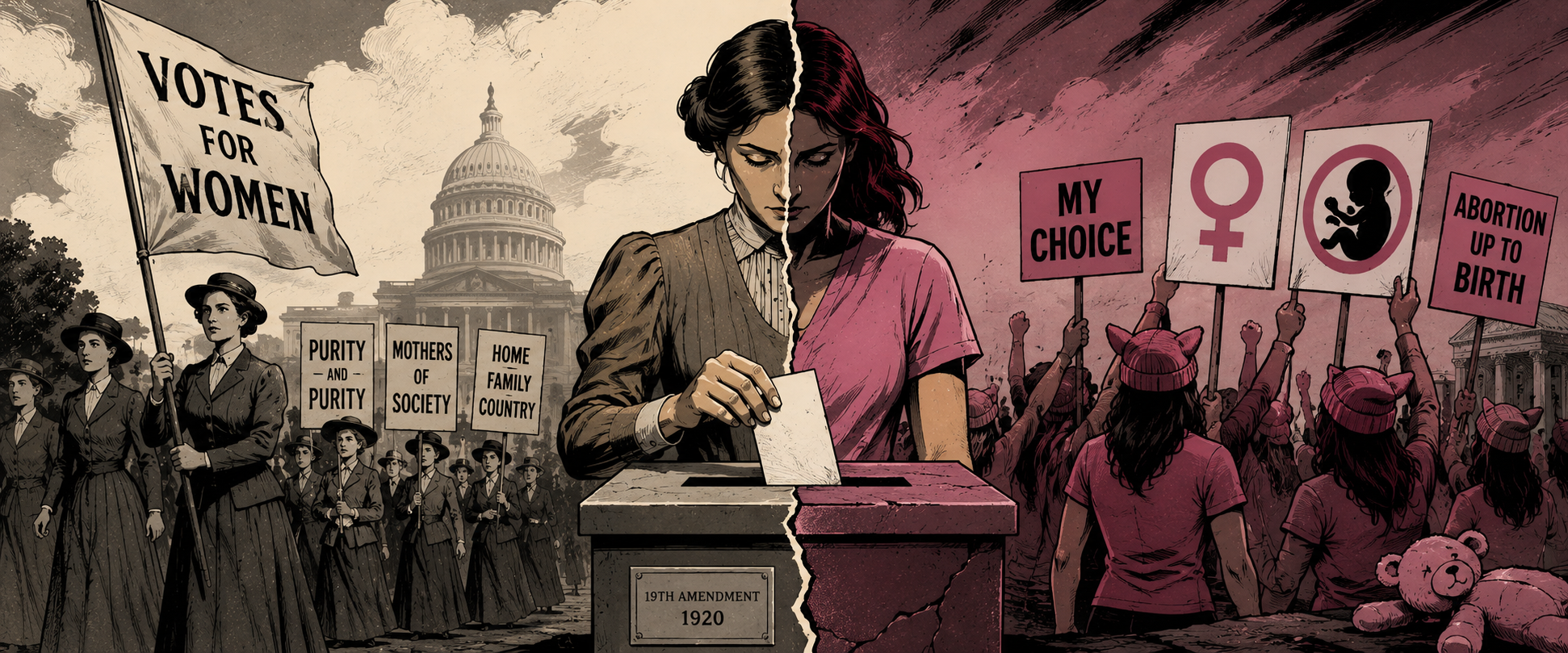
One hundred and six years ago, voting wasn’t about access to morning-after pills and dilation and curettage. A major suffrage argument was that women possessed distinctive “piety and purity” and, as the “mothers of society,” would use their votes to institute social reforms. Portraying the ladies that way brought hundreds of thousands of mainstream women into the movement.
A Library of Congress historian explains how motherhood and women’s presumed moral superiority were invoked to argue for suffrage. Women marched with their children, arguing that mothers needed political power to protect their children and their communities’ welfare. Now here we are: instead of carrying signs that read, “GIVE MOTHER THE VOTE — WE NEED IT,” women in pink T-shirts are protesting on behalf of a mother who has admitted to garroting her three children with resistance bands and whose defense attributes her actions to postpartum psychosis. (RELATED: When Women’s Liberation Disappoints)
Mom got the vote, and the nation that elevated the sacrosanct maternal spirit is now suffering for it. More than a century later, I’d likely stand with those who objected to women setting their dainty feet inside a voting booth.
The Library of Congress describes the Woman’s Christian Temperance Union as largely composed of women who held what were considered, at the time, moderate-to-conservative views. It also notes that Frances Willard argued that women, as nurturers of children and “moral guardians of the home,” should have greater influence over public policy. The idea was that to protect her home, children, and family, voting was a woman’s duty — “the heritage and future of the country.”
Female political activism now seeks to shape public opinion even in murder trials; many policies championed specifically in the name of women are antithetical to what those who fought for the right to vote could ever have imagined. (RELATED: Five Quick Things: Is the Lindsay Clancy Case a Windfall for the GOP?)
I can’t help but wonder what Susan B. Anthony and the other suffragists would think of a voting bloc that, because of politics, mocks the Christian widow of a murdered man while lionizing, defending, and making excuses for a mother who systematically took her children’s lives — and then, out of sexist emotion, blames her innocent husband. If that doesn’t exhibit a kind of collective female psychosis among the entire group of defenders, from the murderess to her apologists, nothing does.
The women who fought for suffrage could scarcely have imagined that, a century later, “the women’s vote” would be courted in part through left-wing policies that include promises to protect the right to abortion up to birth — or that abortion itself would be promoted as a fundamental component of women’s political equality while roughly 65 million unborn children, both male and female, are relegated to the ash heap.
The suffragists envisioned that women’s distinctive moral and maternal instincts would improve the electorate. They have not. In the 21st century, those instincts have not only disappeared; they have been politicized, redirected, and increasingly exploited. Women whose main objective when the right to vote was granted was to protect their families are now publicly decrying motherhood and gleefully placing their offspring on Molech’s altar.
And so, while no longer in the basement of a church, pretending to listen to other women discuss boring topics, I have decided that, given the evolution of women’s influence on the country’s direction, revisiting the 19th Amendment would not be a bad idea.
Like a gentleman on the Titanic who steps aside to give a woman and her child his place on the lifeboat, I would willingly relinquish my right to vote — as an informed female patriot — if doing so would ensure that the nation I love doesn’t sink beneath an unstable pack of hormonal quilters drilling holes in the hull.
Read more Five Quick Things: Citizens Against Virtually Everything
READ MORE:
Five Quick Things: Is the Lindsay Clancy Case a Windfall for the GOP?
The Demonic Possession of Liberal Women
Feminism, the Nose-Ring Theory, and Our Potential Extinction
About the Author