It’s official: Ukraine is out of Patriot missiles to defend against Russia’s intensifying air attacks, with less than one percent of its NATO-donated stocks left. Recent ballistic missile interception rates reflect its diminished defenses, as North Korea reinforces Putin for a final push to dismember Ukraine’s industrial base and complete the conquest of Donbas.
Read more The Spectator P.M. Ep. 242: Has Sorority RushTok Gone Too Far?
During the night of Monday, Aug. 17, all 23 Russian ballistic missiles launched on Kyiv got through to their targets. Interceptions were 50 percent or more when there was the necessary supply of Patriots with speed and accuracy to knock out Russian Iskanders, Zircons, and other missiles on their hypersonic terminal trajectories.
Ukraine’s other air defenses continue performing reliably. Eighty percent of Russian drones, increasingly consisting of jet-powered Geran-4s and a newly developed Baderols, were shot down by Ukraine’s domestically produced drone interceptors whose technology is now in worldwide demand.
Russian cruise missiles fared little better. Of 46 air-launched Kh-101s and sea-launched Kalibrs, 36 were intercepted, mostly by cheap and widely available air-to-air missiles fired from recently delivered F-16s being flown almost exclusively for defensive operations. (RELATED: Drones Are Not Enough)
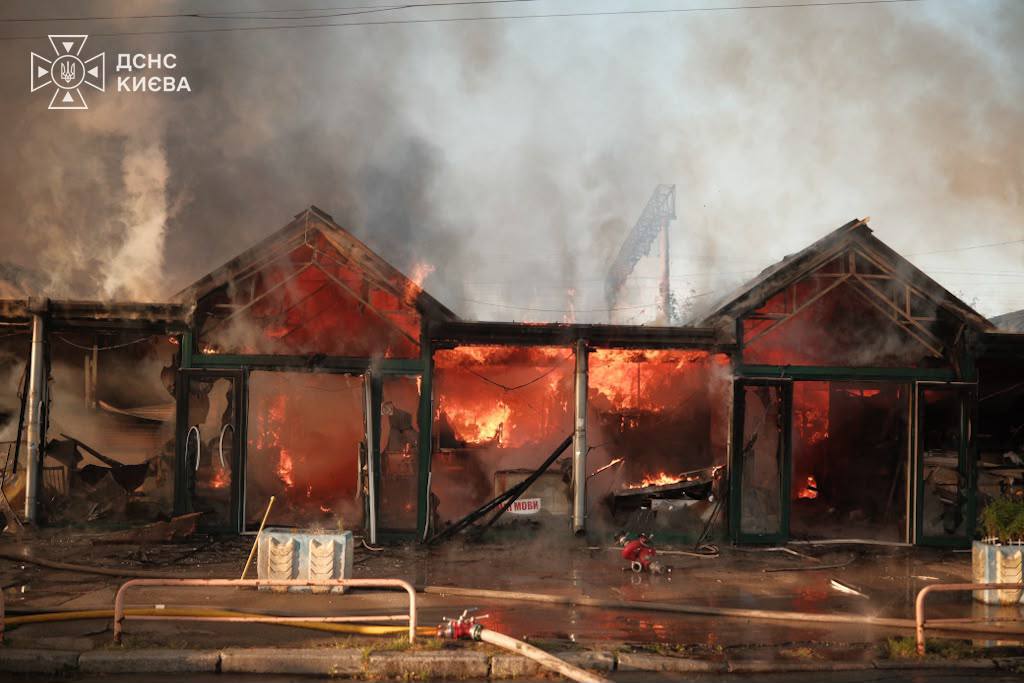
But Russia’s ballistic missiles reached their targets, mainly consisting of industrial and warehousing facilities related to Ukraine’s drone and Flamingo cruise missile production, which are the current focus of Moscow’s strikes. One major storage complex hit by a vertically diving projectile caught on phone cameras let off a huge explosion and a massive orange and black smoke cloud over the capital.
U.S. supplies are too overstretched by the war on Iran to spare any for Ukraine, which is asking for 300 interceptor missiles.
“We need missiles for Patriots. That’s something that only our partners can provide,” President Volodymyr Zelenskyy nervously pleaded following last week’s strikes. U.S. supplies are too overstretched by the war on Iran to spare any for Ukraine, which is asking for 300 interceptor missiles. To fill the potentially fatal missile gap, President Donald Trump gave a green light last month to grant Ukraine U.S. licenses to produce its own Patriots. (RELATED: Peace in Ukraine? What Nazi Germany Can Teach Us About Defeating Putin’s Russia)
But Raytheon and Lockheed Martin are blocking the transfer of their ABM technology. A recent article in the Atlantic magazine cites business reasons. The prospect that Ukraine could apply similar efficiency to air defense munitions, as it has to other Western systems copied and often enhanced by its defense startups, “appears to unsettle U.S. contractors whose profit margins depend on controlling supply,” according to the magazine.
There may be more pressing reasons. The PAC-3 Ka-Band radar guidance component for Patriots’ instant acquisition is highly sensitive advanced technology that the U.S. restricts from even close allies. Entrusting it to a government noted for corruption, targeted by Russian espionage, and riven by internal feuds that recently led to the sacking of popular defense minister Mikhailo Fedorov is a risk.
Ukrainian military analyst Dmitry Snegirev says that the U.S. is considering NATO production of PAC-3 interceptors in Germany, due to the “risk of Russian strikes on manufacturing facilities in Ukraine.”
“Even with licensing, production in Ukraine itself may never materialize,” Snegirev says.
Germany could become a steady source of Ukrainian interceptors through the recently unveiled FEYJA program for joint development of ABM systems with some European countries. French president Emmanuel Macron has promised to provide a new French system in cooperation with Italy sometime next year. Neighboring Poland has pledged to contribute Patriot missiles from its own arsenals but only managed to deliver five so far, possibly wary of growing Russian air activity along its own border.
Read more Mark Carney’s Smuggler’s Blues
It seems unlikely that Ukraine’s air defenses can be resupplied with sufficient volume and haste to shield the embattled country from the Russian offensive that’s set to intensify in the coming weeks.
Ukraine estimates Russia’s ballistic missile stock at about 700. Russian military industry currently produces about 80 per month, and North Korea is now contributing its missiles for Putin’s “special military operation,” which not only magnifies the threat to Ukraine’s industrial, energy, and economic infrastructure but may soon be used as decisive tactical battlefield weapons.
Ukraine’s shortage of Patriots already allows Russia’s high-performance Su-35 fighters to operate within previously denied airspace to conduct precision strikes and closer air support for ground forces moving on the Donetsk “fortress belt,” the bastions of Kramatorsk and Sloviansk.
According to Ukrainian intelligence reports, North Korea, which contributed decisively to Russia’s expulsion of Ukrainian forces from Kursk last year, has delivered KN-30 ballistic missiles whose two-and-a-half-ton warheads have five times the explosive payload of the standard Russian Iskander-M and a range of 1,000 kms. They have arrived over recent days on 10 separate flights carrying six launchers and 90 North Korean military personnel for their operation and maintenance. About 150 shorter-range KN-23s and KN-24s have been in theater since July and were recently launched against Kyiv and the southern city of Zaporizhzhia, according to Ukraine’s Defense Intelligence chief, General Vadym Skibitsky.
Military analysts believe that KN-30s, whose heavier payload and longer range make them less accurate, may be intended for smashing Ukrainian bunker and trench networks around Kramatorsk and Sloviansk. Russian troops are already reported to be fighting in the suburbs of Sloviansk and moving on Kramatorsk from heights to the city’s east and through the neighboring town of Druzhkivka from the south.
North Korea is also reported to be contributing 18,000 troops for Russia’s offensive. Putin is expected to ask for 50,000 in an upcoming meeting with his North Korean counterpart Kim Jong Un. Intelligence reports indicate that North Korean units sent to Ukraine include some 400 Russian-trained drone operators. (RELATED: North Korea Is in the Fight)
Ukrainian intelligence officials say that Putin plans to mobilize 300,000 additional men following fixed elections next month in which he is promoting decorated war veterans to the Duma to strengthen support for the war.
Zelenskyy says that he is refocusing Ukraine’s still highly effective offensive air power to target Russian ballistic missile launch sites, announcing that a Russian Iskander erector launcher was destroyed on Aug. 22. His drones and cruise missiles have scored much success in crippling Russia’s oil industry, with consistent waves of attacks on energy networks and refineries. But given the difficulties that the U.S. has encountered in efforts to eliminate Iran’s mobile launchers with months of airstrikes using the world’s most sophisticated surveillance drones and combat aircraft, prospects for Ukraine achieving better results seem delusional.
Zelenskyy is proposing negotiations with Russia through which both sides might agree to curtail attacks on certain targets. “We can stop hitting their fuel if they stop hitting our agriculture,” he said, indicating a growing concern over recent Russian targeting of Ukraine’s grain production and food distribution.
Fighting does appear to have died down in the Black Sea following a recent brutal battle of the ports. Russia retaliated for Ukrainian drone swarms against Crimea with a missile onslaught on Odesa’s harbors, to which Ukraine responded with a devastating attack on Russia’s naval base and main oil terminal of Novorossiysk.
But Foreign Minister Lavrov insists that there can be no negotiation without the surrender of Donetsk. If Patriots cannot be rushed to Ukraine, Zelenskyy might be urged to reconsider accepting Russia’s terms before Putin turns Kramatorsk into another Stalingrad and degrades Ukraine’s industries to the point that they are no longer capable of securing what would be a dangerous and unsteady future peace.
Read more Trump’s Nixon Playbook: Squeeze Iran, Dare China to Blink
READ MORE from Martin Arostegui:
Cuba’s Hidden Proxy Network: The War Against America
CIA Files Raise New Questions About Smartmatic and Venezuela’s Elections
Spain: Pedro Sánchez Declares Border War on His Own Country
Image licensed under Creative Commons Attribution 4.0 International.
About the Author