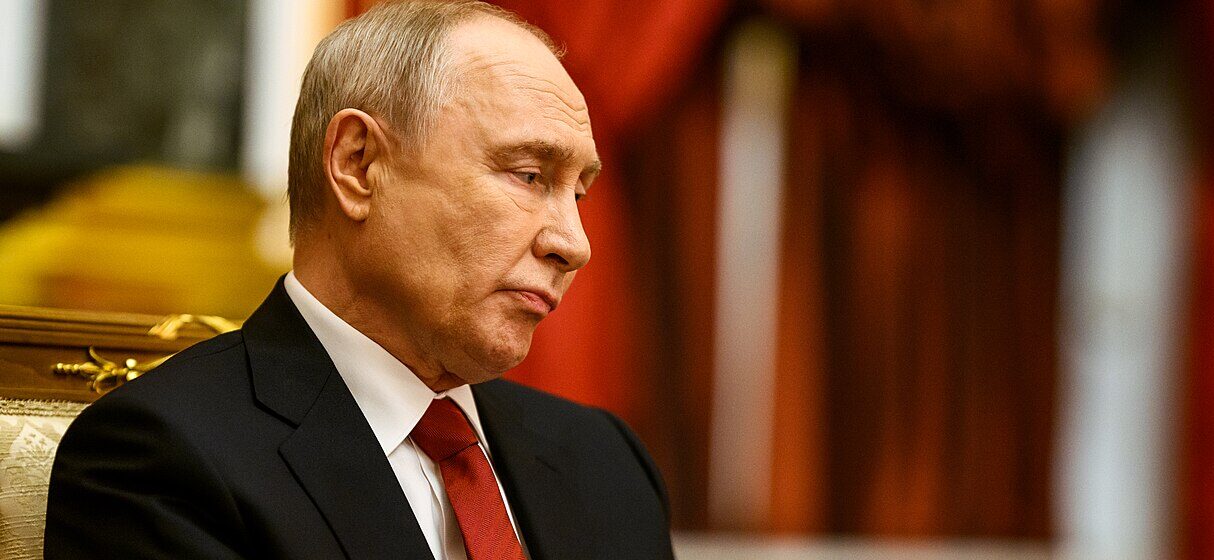
U.S. Special Envoy Steve Witkoff and Jared Kushner meet with Russian President Vladimir Putin in the Red Drawing Room at the Kremlin in Moscow, Russia, Saturday, September 5, 2026, to continue dialogue to end the Russia-Ukraine War. (Official White House Photo by Daniel Torok)
Vlad the Impaler Putin seems to have finally agreed to U.S. brokered peace negotiations with Ukraine as his forces get pushed back from the fortress belt strongholds of Kramatorsk and Sloviansk, whose capture has been his main objective. While President Donald Trump’s offer to purchase Russian diesel, provide sanctions relief, and other financial incentives is clearly enticing Vlad the Impaler to the negotiating table, battlefield reverses exposing the vulnerabilities of his overstretched army and Ukraine’s ongoing capacity to strike back are also weighing on his moves.
Read more A Time for Choosing: Reagan’s Warning for Republicans and Democrats in 2026
“Any bilateral negotiation should focus on security guarantees for both Russia and Ukraine in a final form rather than on suspension of hostilities,” said Putin, sounding almost like a Neocon last week as he expressed willingness to negotiate without the usual maximalist surrender demands and shrill nationalist rhetoric. (RELATED: Waging Peace in a 2026 World Rhyming With 1956)
In a brutal war where an entire country is being decimated and thousands killed daily, even small gestures and changes in tone carry significance.
He halted airstrikes on Ukraine during his day of meetings with Trump’s special envoy Steve Witkoff, who obtained the release of a 74-year-old American imprisoned in Russia while Melania Trump secured a local ceasefire in the besieged Ukrainian town of Oleshky to evacuate starving civilians. The Russians even agreed to clear their landmines.
Drone and missile attacks on Ukrainian cities resumed the following day, but the brief respite at least indicated that Putin is taking negotiations seriously. In a brutal war where an entire country is being decimated and thousands killed daily, even small gestures and changes in tone carry significance.
News from the front has not been good for Putin recently. Russia’s grinding pincer movement on Donetsk’s fortified industrial belt could be coming apart. His army has sustained a major defeat in Lyman on its northern approach to Sloviansk following a series of Ukrainian counterattacks in which newly developed ground combat robots were air-dropped by drones on the Russian rear to cut off its salient towards the city’s outskirts.
Kremlin spokesmen have tried to wrest importance from the resulting rout, saying that the Lyman front is “stabilizing.” But Russia has lost some 200 square kms., which will be hard to recover, neutralizing its immediate threat to Sloviansk.
The setback may have come as something of a shock to Putin, whose southern pincer on Kramatorsk also shows signs of dissolving. There are persistent reports of growing urban fighting in Kostiantynivka, the southernmost point of the fortress belt triangle which his overconfident generals assured him was under Russian control back in July.
In the confused drone-saturated Kill Zone of the front lines where Russian and Ukrainian positions often overlap, it’s difficult to tell whether recently intensified fighting is due to counterattacks or if parts of Kostiantynivka remained under Ukrainian control even as Putin’s top brass told him that the city was secured.
“While Russian forces try to push onwards towards Druzhkivka (the next town before Kramatorsk) Ukrainian troops remain entrenched in the city center of Kostiantynivka and even some eastern outskirts, making it difficult for Russia to deploy its drone teams in the city,” according to the Kyiv Independent’s chief battlefield correspondent, Francis Farrell.
A similar situation could be developing southwest of Kramatorsk in Dobropillia, where the Russians are trying a back door to the fortress belt for an enveloping maneuver aimed at cutting off supply routes from western Ukraine. Russian military sources reported last week that the town had fallen. Russian units captured some villages to its north. But Ukrainian defense spokesmen insist that the city remains firmly under Ukrainian control and is being reinforced by the crack Azov Brigade.
Read more Obama’s Legacy: A Stronger Iran and a Weaker Welfare System
“Videos have emerged of Russian soldiers raising flags in the city though they are often quickly eliminated and do not indicate any certainty of territorial control,” reports Farrell.
“Russia’s approaches to Kramatorsk and Sloviansk are effectively blocked,” according to former CIA chief, General David Petraeus, who was recently in Ukraine visiting frontline areas. Putin may be forced to accept that his stated deadline for taking Kramatorsk by the end of the year was a delusion. (RELATED: Putin Goes for Broke — and the CIA Goes to Moscow)
In the sprawling industrial urban complex which had a combined population of a quarter million before the war, his forces face endless and brutal house-to-house fighting which would likely extend well into 2028, raising casualty tolls that could prove unsustainable. Ukraine’s kamikaze robot mini-tanks armed with machine guns, grenade launchers, and embedded explosives detonated by remote control would roll onto Russian troops moving through underground passages, tunnels, and pipelines used by Spetsnaz teams in previous take-downs of Ukrainian cities.
“It would be Stalingrad,” says Petraeus, referring to the brutal months-long WW2 urban battle that cost two million Russian and German lives. Russia has suffered some 45,000 casualties in the past month, its highest toll of the war so far, which cannot be replaced at the army’s current monthly recruitment rate of 30,000.
Ukrainian intelligence officials predicted that Putin was planning a mass mobilization of 300,000 men in October, but no such order had been announced by month’s end. Forced inductions are reported to be taking place secretly to minimize public reactions in Moscow and other main cities where press gangs would now have to operate amidst populations already suffering from increased Ukrainian cruise missile and drone strikes. If Putin chooses to go low-key about filling his army’s depleting ranks, it could yet be another indication that he is becoming increasingly aware of his limitations. Putin’s paranoia has grown to the point where he has built 16 air defense towers to protect his main residence in Valdai from drone attacks.
We predicted in this column a year ago that if Ukraine could mount a dynamic defense of Donetsk combining ingenious uses of drone systems with special warfare capabilities demonstrated with repeated success throughout the war, Russia could be pressured into accepting demarcation lines “further east from where Putin envisions.” (RELATED: On the Frontlines of the War That Will Change Europe)
While the U.S.-drafted nine-point peace plan contains bitter pills for Zelenskyy to swallow, including recognition of Russian sovereignty over 20 percent to 25 percent of Ukrainian territory and dropping aspirations to join NATO, it highlights the creation of a “demilitarized zone” in Donetsk under international guarantees, an issue over which “the two sides remain mountains apart,” according to Vice President JD Vance.
Russia’s 24/7 ballistic-missile and jet-powered drone strikes extending to all of Ukraine’s dozen provinces as its air defenses are depleted allow no hope for any outcome approaching the expulsion of Russia from eastern Ukraine, which Zelenskyy has stubbornly held out on. Residents of the capital, Kyiv, are virtually living in bomb shelters as power-generating facilities are systematically taken out across the country, leaving over half a million Ukrainians without electricity as a freezing winter sets in.
If NATO cannot sufficiently replenish Ukraine’s patriot missiles, it must provide any assistance required to keep Donetsk’s besieged citadels from Russian capture. Seizure of the key industrial and communications hubs at the westernmost point of the Donbas region provides the ideal staging area for future moves on the rest of Ukraine. If Putin has dropped such intentions, he should readily agree to U.S. terms in view of the growing pressures on his army. And if Zelenskyy really wants the war to end — which some of his critics say he doesn’t so as to keep his martial powers — he should agree to turning the fortress cities tenaciously held by his crack brigades into an internationally supervised buffer zone. It may be the best security guarantee that Ukraine can get.
Read more LutherLand: The Martin Luther Theme Park You Never Knew You Needed
READ MORE from Martin Arostegui:
Reagan’s SDI Vision Is Today Affordable
Europe’s Hard Left at Its Most Dangerous
Iran’s Sleeper Cells Come Awake
About the Author