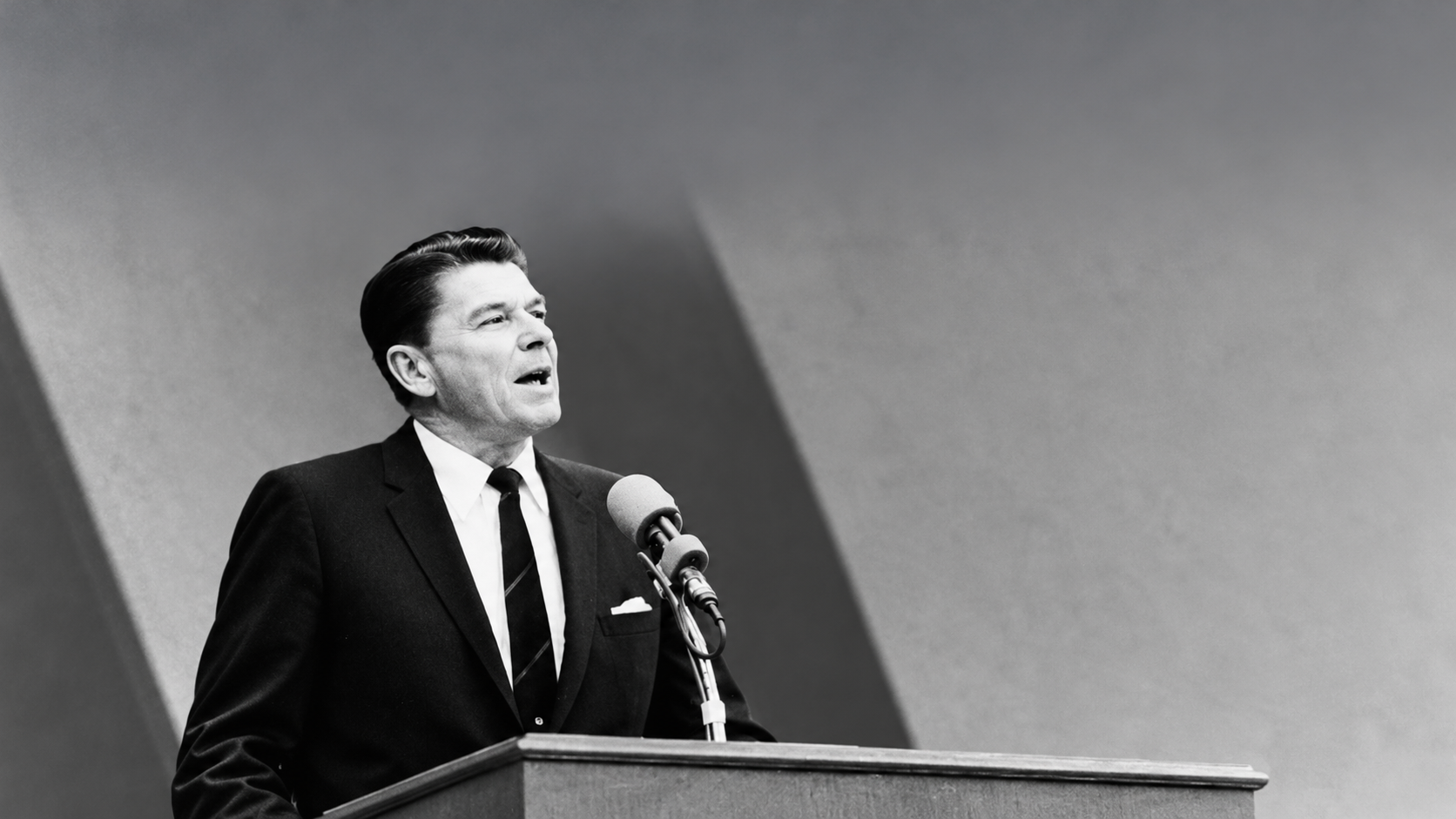
It was 62 years ago, Oct. 27, 1964, that Ronald Reagan delivered a speech designed to help salvage Republican Senator Barry Goldwater’s sinking presidential campaign. It did not accomplish that goal, but what has become known as the “A Time for Choosing” speech catapulted Reagan to national fame.
Read more Obama’s Legacy: A Stronger Iran and a Weaker Welfare System
It was indeed a turning point for the nation and for the Republican Party’s conservative wing, which was fighting an ideological battle against the then-dominant moderate or “Rockefeller” wing of the party. It took until the presidential election of 1980 for Reagan and conservatives to prevail.
President Trump will continue to be a dominant force, but the extent of his influence on the 2028 elections will be determined by results of the 2026 midterms.
Today both the Republican and Democrat parties are facing a new “time for choosing.” The choices they make will define not only their parties, but the future of America’s free enterprise system, and, in fact, the future of capitalism itself.
The Democrat Party is embroiled in what famed political consultant James Carville has termed a “schism.” His comments came following the primary election victories of three so-called Democratic Socialist congressional candidates in New York City. The trio was endorsed by New York’s communist Mayor Zohran Mamdani along with other far-Left notables, including Congresswoman Alexandria Ocasio-Cortez and the socialist/oligarch Vermont Senator Bernie Sanders. (RELATED: Paris Is Burning. Is Washington Next?)
The Democratic Socialist movement has taken strong root in the nation’s most left-wing cities, including the mayoral victories of Katie Wilson in Seattle and Janeese Lewis George in Washington, D.C. In Maine, Democrats nominated a socialist adorned with a Nazi tattoo on his chest for the U.S. Senate. When that proved to be too much even for the Left, they nominated a new candidate — who, it turned out, fathered two children with his second cousin. (RELATED: After We Laugh, We Must Treat DSA Program As Deadly Serious)
All this left Carville sputtering: “If it’s such a powerful, sweeping movement that’s got momentum everywhere, then go ahead and be at the head of it. Don’t use the Democratic Party to advance it.” (RELATED: Carville’s Presidential History Lesson)
That advice went unheeded.
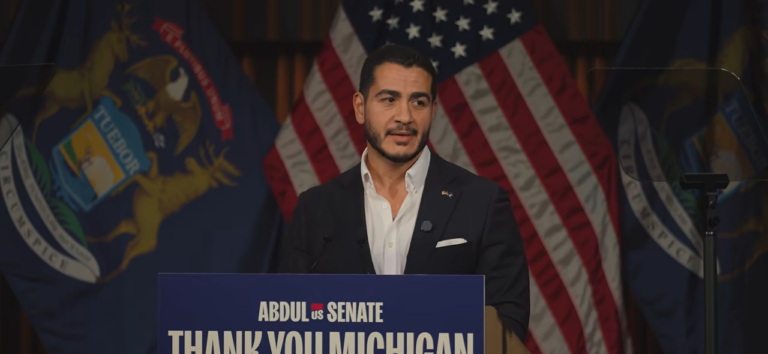
Democratic socialists broke out from their heavily blue city enclaves to nominate extremist Abdul El-Sayed for a U.S. Senate seat in Michigan. El-Sayed has a bromance with the radical podcaster Hasan Piker, a Hamas-loving antisemite who once said America deserved the terrorist attacks of Sep. 11, 2001. (RELATED: Abdul El-Sayed: A Muslim Brotherhood Puppet and a Grave National Security Threat)
In the state primaries that followed, democratic socialists had mixed results, in several instances nominating congressional candidates in heavily Republican districts where their candidates have little chance of winning the general election.
Republicans are facing considerable headwinds. The party that holds the White House historically fares poorly in midterm elections. Mix in an unpopular war in Iran along with affordability struggles at the kitchen table and a blue wave becomes more likely.
But thanks to the DSA, the Democratic Party may still snatch defeat from the jaws of victory. Trump and Republican congressional candidates nationwide are painting Democrats in swing districts with the socialist brush, framing the election as communists vs. common sense.
Sensing the danger, House Minority Leader Hakeem Jeffries has sought to distance himself and his conference from the far Left. Jeffries told The Hill: “I don’t support the DSA agenda, as has been articulated by the DSA itself.” That was a nuanced statement designed to fend off Republican election attacks but still leaving room for him to manage what threatens to be a conference riddled with internal dissent. (RELATED: The DSA Comes for the Democrat Old Guard)
This battle between traditional Democrats and the party’s ascendant socialist wing will spill over into the 2028 presidential election cycle, which will begin the day after the midterms. The party will need to choose between a relatively moderate standard bearer who can appeal to the swing voter (no such candidate is on the horizon) or double down on a DSA agenda-embracing nominee, which would essentially cede the election to the GOP and imperil its congressional candidates.
Read more LutherLand: The Martin Luther Theme Park You Never Knew You Needed
The Republican Party is also facing a “time for choosing,” although the divide is far less deep and easier to bridge. There is no doubt that President Donald Trump is the most dominant figure in the party. His businesslike approach to governing, coupled with populist rhetoric, appeals to and motivates what has been broadly termed the MAGA movement.
Populism is a governing strategy, not an ideology.
But there are important policy differences between MAGA populists and Reagan-style conservatives. Populism is a governing strategy, not an ideology. That does not make it bad, but for a political party to remain cohesive it must have an underlying ideological base. The Democratic Party has suffered a schism because it no longer has such a unifying ideological underpinning. (RELATED: Winning the Election Shouldn’t Be This Hard for Republicans)
It is safe to say that most voters who consider themselves to be “MAGA” also consider themselves to be conservatives. They are, however, more willing to stray from conservative principles in the name of pragmatism than are Reagan conservative devotees.
The Right is blessed with a robust network of “think tanks” and policy organizations that give the GOP the ideological base the Democratic Party lacks. There is friction within the ranks. The venerable Heritage Foundation has tilted incrementally toward the populist position, opening the door for organizations such as Advancing American Freedom where traditional conservatives have found a home.
That is not to say that any of this is necessarily bad. Unlike the Left, which requires rigid adherence to its policy objectives (ask Democratic Senator John Fetterman), conservatives tend to think for themselves, resulting in robust policy debates that ultimately make the movement, and by extension the Republican Party, stronger. (RELATED: The Democratic Party Leaves John Fetterman)
This tension has also manifested itself in primary election battles such as that which saw the stalwart conservative Congressman Thomas Massie lose his primary re-election bid after pushing purity past the point of voter acceptance. Where that line lies can sometimes be difficult to ascertain. (RELATED: Grifters, Activism, and Thomas Massie)
After the 2026 mid-term elections, where that line lies will become the big debate within the Republican Party. Vice President JD Vance, heir to the Trump populist mantle, is the early favorite for the 2028 Republican presidential nomination. Already, U.S. Senators Ted Cruz and Rand Paul are making noise about running. Cruz hails from the traditional conservative wing of the party; Paul has exhibited a libertarian bent. A robust primary election debate could be in the offing.
President Trump will continue to be a dominant force, but the extent of his influence on the 2028 elections will be determined by results of the 2026 midterms. If Republicans gain or suffer minimal losses, Trump will continue to be kingmaker. A blue wave, however, would render him a lame duck.
Regardless of the outcome, Reagan-style conservatism will remain the party’s ideological base. But, after November, the GOP will have a “time for choosing” as to how far into populism it wishes to stray.
The Republican “time for choosing” is far less stark than that which confronts Democrats. It is, however, no less consequential.
READ MORE from Lowman S. Henry:
From Blue to Purple: GOP Makes Significant Voter Registration Gains in Pennsylvania
Kamala Harris: The New Coke
Forget the Polls: Here Are the Numbers That Matter
Lowman S. Henry is Chairman & CEO of the Lincoln Institute and host of the weekly American Radio Journal and Lincoln Radio Journal. His e-mail address is [email protected].
Read more How Soviet Propaganda Found a New Home in ‘Human Rights’ Organizations
About the Author