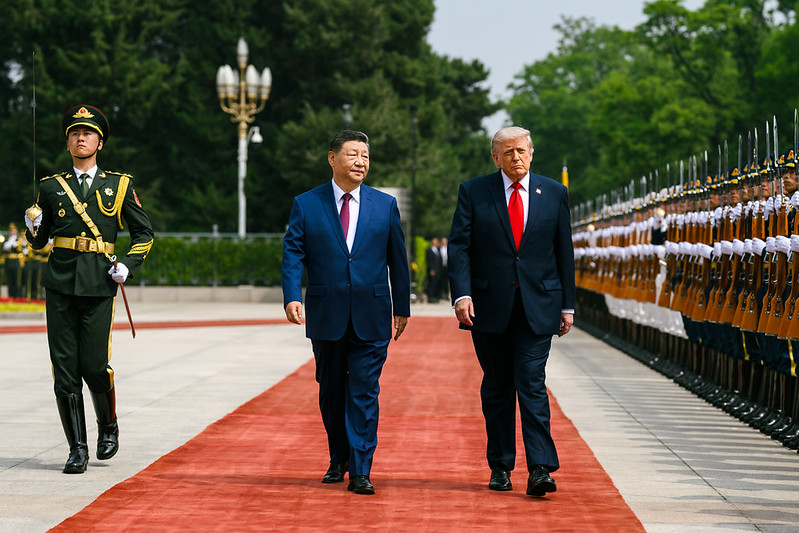
In one month, Chinese President Xi Jinping will be in Washington for a summit meeting with President Trump. On Monday, the Trump administration announced tough new economic sanctions — an “economic D-Day” — against Iran and countries that do business with Iran, including China, which is the major purchaser of Iranian oil.
Read more Lindsay Clancy and America’s Death Culture
China’s Foreign Ministry has publicly opposed new sanctions, calling instead for the “relevant parties to take responsible measures and solve the issues through diplomatic and political means.” The New York Times headlined a story on this issue, “Why China Thinks It Can Resist Trump’s Economic Threats,” while Foreign Policy magazine writes that Trump needs China’s help to effectively sanction Iran. CNN warns that Trump’s new economic sanctions could risk upending the approaching summit meeting with Xi. (RELATED: Trump’s Iran Gamble: ‘Economic D-Day’ and the Strait of Hormuz)
Treasury Secretary Scott Bessent has urged China to “get with the program” of putting economic pressure on Iran to end the war. Bessent on Monday said the new sanctions target Iran’s “five most vital” financial lifelines, and characterized them as “economic asphyxiation of [the Iranian]regime.” The potential secondary targets of U.S. sanctions include Chinese banks and oil refineries, and any entities and individuals in China that help Iran evade sanctions. Tariffs are another possible option. There is also speculation that the U.S. could attempt to persuade its allies in the region to impose a land blockade to complement the sea blockade that is already in place near the Strait of Hormuz.
A successful summit with Xi is less important than bringing the conflict with Iran to an end.
Trump clearly wants the upcoming summit meeting with Xi to help stabilize the geopolitical rivalry among the world’s two superpowers. There may be voices within the administration advising Trump to avoid harsh secondary sanctions against China to ensure a “positive outcome” to the summit. The president should resist such advice and instead follow through with geoeconomic warfare designed to bring Iran to its economic knees. A successful summit with Xi is less important than bringing the conflict with Iran to an end. We have already crippled Iran militarily; now is the time to cripple it economically.
Arguably, ramping up our geoeconomic warfare against Iran a few weeks before the summit meeting with Xi will help end the Iran war and stabilize relations with China. Here, Trump is following President Richard Nixon’s example in May 1972, when Nixon ordered the mining of Haiphong Harbor and the bombing of Hanoi in the lead-up to a summit meeting with Soviet leader Leonid Brezhnev.
Read more Economic D-Day
Nixon wanted to end U.S. participation in the Vietnam War by drawing down American forces there while helping South Vietnamese forces improve their capacity to defend their country — it was called “Vietnamization.” North Vietnamese forces had launched an invasion of the South on Mar. 30, 1972, and the situation looked bleak for our South Vietnamese ally. Haiphong Harbor was where Soviet ships helped supply North Vietnamese forces, and the scheduled summit in Moscow with Soviet leader Leonid Brezhnev was scheduled to begin on May 22. Nixon’s critics (and some within the administration) warned that the mining of Haiphong and bombing of Hanoi would result in the Soviets canceling the summit or at best undermining Nixon’s overall policy of détente.
In his memoirs, Nixon explained his decision to mine Haiphong Harbor and bomb Hanoi: “I believed that it was essential that we take decisive action to cripple the North Vietnamese invasion by interdicting the supplies of fuel and military equipment the enemy needed for its push into South Vietnam.” He faced the issue of how the Soviets would react by writing Brezhnev a letter wherein he reiterated his dedication to détente and explained that U.S. actions in mining Haiphong and bombing Hanoi would not divert him from improving overall U.S.-Soviet relations.
The military actions ordered by Nixon worked to halt the North Vietnamese advance. The summit in Moscow went ahead as scheduled and was generally considered a success. As the Navy Times later noted, “The mining action, along with the bombing campaigns … was a key reason that North Vietnam agreed to negotiate a peace deal in Paris.” And Nixon’s successful triangular diplomacy with the USSR and China continued.
Nixon’s actions were statesmanship of the highest order. Instead of worrying about Soviet reactions, Nixon pursued U.S. interests by taking decisive action that increased U.S. credibility even with our key adversary. And he conducted skillful quiet diplomacy with the Soviets to temper their negative reaction. Trump is doing likewise by imposing harsh and crippling economic sanctions against Iran and secondary sanctions against China and other countries that trade with Iran. The rulers in Beijing will understand (as Soviet leaders learned about Nixon) that this president will do whatever is necessary to put America first.
Read more Iryna Zarutska, Lindsay Clancy, and the Politics of Who Gets Mourned
READ MORE from Francis P. Sempa:
Trump is Combining Geoeconomic and Kinetic Warfare Against Iran
Communism, McCarthyism, and the New Red Scare
JFK, the Berlin Wall, and a Cold War Failure
About the Author