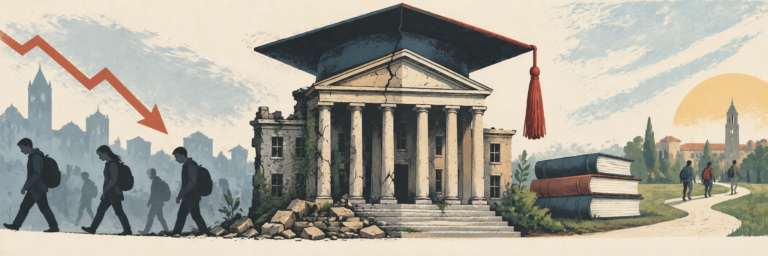
My alma mater is the latest college to lower the bar of academic excellence by piloting a “pass or no credit” policy for incoming freshmen this fall, the purpose of which is to “acclimate” new students “to the demands of college” and “allow intrinsic motivations to guide” their “personally meaningful academic journey.” The University of Michigan thus joins other august institutions of higher learning such as the Massachusetts Institute of Technology and the California Institute of Technology in attempting to address the alarming mental health crisis on campus by alleaviating the pressure of earning high grades.
Read more Everyone Hates Milton Friedman Again
Although I’m unfamiliar with the empirical evidence suggesting that such a program will actually work, I can rely on anecdotal evidence to surmise that it may backfire—at least for a certain type of student like myself.
Perhaps the new policy at Michigan will alleviate the stress of adapting to college life. But in my case, I needed the stress of those B’s to change my habits.
When my parents drove me to Ann Arbor in the late 1980s, I hadn’t a clue about what courses I should take, let alone what I should do with my life. That led to a 12-credit load my first semester with no STEM courses and the freedom to stagger back to the dorm at 2 a.m. every Friday and Saturday night. Fraternities were still “wet” and bouncers weren’t checking IDs too closely. I generally kept up with the reading and writing, but my “slacker” lifestyle was not without consequences. I earned two B’s, one B+ and an A- that first semester.
Not bad, but definitely not good enough, and no one had to tell me that. Most of my tuition was covered by scholarships with my parents paying the rest. Even though the overall cost of higher ed. was a fraction of what it is today, I had worked hard in high school and I knew the value of money.
Things changed drastically when I returned to campus the following January. I adopted simple steps to discipline myself and practice better study habits without sacrificing my social life. I forced myself to take 8 a.m. classes so as to avoid sleeping until noon, sought help with my dismal writing skills, and found healthier ways to engage with friends on weekends. The efforts paid off. Four A’s and one A- on my transcript in classes that were significantly harder than those in the first semester.
It all came down to drive and self-mastery, two things I never would have sought or gained if it weren’t for my first-semester report card. If I had earned four “Passes” (and I certainly would have), I am absolutely sure I would have put no more effort into the second semester than I had the first.
I admit that my story was quite boring in comparison with a few hallmates that year.
Less than four weeks into the semester, Alejandro got hauled away in handcuffs for peddling cocaine out of his room. After being put on academic probation, my high-school valedictorian, Jason, packed his bag and boarded a bus for the Upper Peninsula to shack up with a girl he met at a party. Mark, one of the brightest guys I ever met, literally failed every class and enlisted in the Air Force.
All these men taught me an important lesson: It is entirely possible to be a “straight-A” student and flunk out of college. When I say “straight-A,” I mean high school. Mark, Jason — even Alejandro — belonged at the University of Michigan. They earned it. Their high-school GPA’s and ACT scores were higher than mine. Their presence on campus in September was no mistake of the Admissions Office, and their dismissal/suspension by the Academic Dean in December was their mistake and their mistake alone. Just like today, most students at the University of Michigan in the 1980s were used to straight-A’s in high school, and that was before grade inflation. Getting a few B’s was a wake-up call. Working harder might not guarantee you better marks, but at least you knew you had no chance of getting them unless you actually worked harder.
More importantly, you knew exactly where you stood at the end of the first semester. “Passes,” it seems, give you little indication whatsoever. You might be in the low-B range, but you might be in the upper-A range. And in 1988, there was a huge difference between the two.
I can’t speak for women, but men were fiercely competitive in the 1980s. If you got a B in calculus, you lost to the guy down the hall who got a B+. For all their imperfections, grades were a fair indicator of performance and ability. If you got a bunch of B’s one semester, it was probably because you hadn’t put in the effort. But if you did put in the effort semester after semester and kept earning B’s, you were essentially a “B-student.” In most — though not all — cases, a string of C’s and C+’s was a pretty sure sign you just weren’t capable of anything higher.
Read more Scott McKay’s The Necessary Men — Episode 4: Landfall
My hope is that college men today are just as desperate for a challenge as they were 40 years ago. If they are anything like me, they yearn to feel the difference between life as a straight-A student and life as straight-B student. I could nurse a wicked hangover until late Tuesday evening and still maintain B’s. I knew I was a slacker even though I wasn’t failing. In the second semester, I discovered it wasn’t hard to earn A’s and that it involved more than just studying harder. It was a matter of getting up at six, going for a jog, eating a good breakfast, and putting on something other than sweatpants and a T-shirt for class.
I can’t speak for the average male student at the U. of M. today, but my “academic journey” would have been entirely different if it weren’t for my lackluster — albeit “passing” — performance in the first semester — a performance only B’s could indicate.
MLive reports that nearly 75 percent of grades assigned at the U. of M. in 2022 were in the A-range: a rise of 18 percentage points over a decade. Grade inflation is real, and it affects every aspect of college life.
Mind you, the grades you earned in the 1980s often depended on the classes you took. There were “easier” courses and “softer” profs. In my day, all of us took Astronomy since, for some strange reason, it was an easy A. Only the brave took Biochemistry because you invariably earned a B. But you would never even think of embarrassing yourself by earning a B in Astronomy, just as you were determined to work your butt off to be the first to earn an A in Biochemistry.
It’s not that a Pass/Fail system is without its merits. When used judiciously, it can make students aspire to the same level of achievement a grade-point system does. Ralston College, where I currently teach, utilizes a Pass/Fail system, but we set the bar high. Very high. So high that ranks of “Pass With Distinction” and “Pass With Highest Distinction” are extremely rare and (dare I say) relative.
Relative to what? To the performance of one’s peers. It’s conceivable that an entire cohort perform at the level of “Pass With Distinction” when compared with another cohort but receive diplomas that say “Pass” simply because no one distinguished himself or herself from the pack in that particular year.
Harsh? Not really, since the goal is simple: perform at an A-level and earn a “Pass” or perform at a B-level or below and run the risk of “Fail.” “With Distinction” is just icing on the cake, and using it sparingly is the perfect recipe for grade deflation.
My point is that even if grades have lost their meaning, effort, performance, and ability have not. That’s what grades are meant to reflect, be it in a point system, be it in a Pass/Fail system.
Perhaps the new policy at Michigan will alleviate the stress of adapting to college life. But in my case, I needed the stress of those B’s to change my habits. I needed them to help me “acclimate to the demands of college” and “allow intrinsic motivations to guide” my acadmic journey — “intrinsic” because I knew I had a lot to change within myself to start earning A’s.
If I were starting at the U. of M. this fall, I’m afraid it wouldn’t make much difference whether I was nursing a hangover until Tuesday or getting out of bed for a 6 a.m. jog. I would still be earning a string of “Passes” while worsening whatever mental-health problems I brought to campus in the first place.
Daniel B. Gallagher teaches philosohpy and literature at Ralston College in Savannah.
Read more Trump is Combining Geoeconomic and Kinetic Warfare Against Iran
About the Author