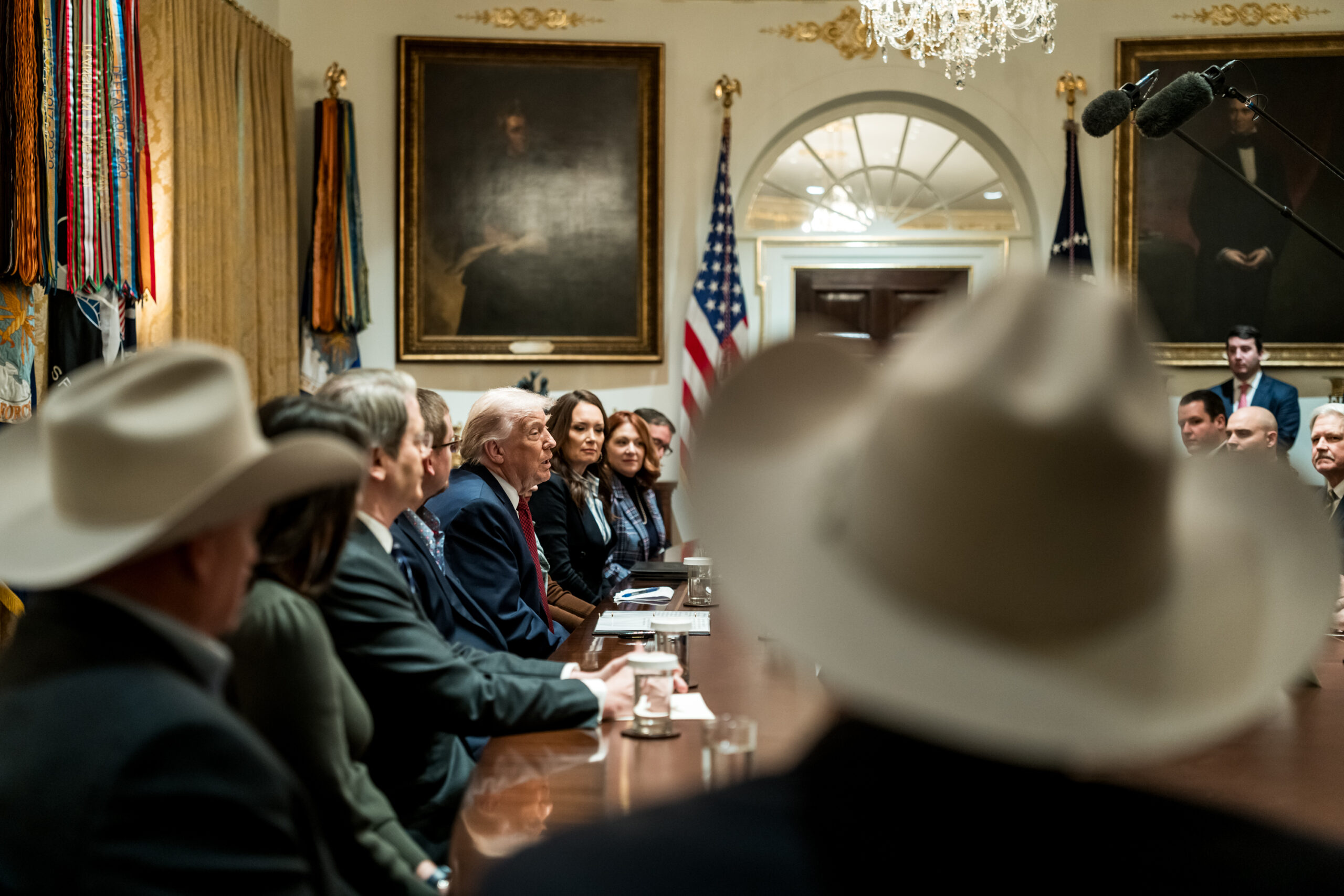
President Donald Trump participates in a roundtable discussion alongside Secretary of the Treasury Scott Bessent, Secretary of Agriculture Brooke Rollins, NEC Chair Kevin Hassett, after announcing a $12 billion aid plan for farmers in the Cabinet Room of the White House, Monday, December 8, 2025. (Official White House Photo by Abe McNatt)
War, Clausewitz explained, is the continuation of politics by violent means. But violence is only one tool in a nation’s war arsenal. Other tools include economics, cyber warfare, diplomacy, information warfare (what used to be called propaganda, psychological warfare, and disinformation), espionage, counterintelligence, and subversion. Americans are an impatient people, but impatience in war can lead to the loss of political and popular support — which is essential for democracies to achieve victory.
Read more Five Quick Things: Is the Lindsay Clancy Case a Windfall for the GOP?
In the past, American foreign policy has been affected by unsuccessful wars. The stalemate of the Korean War caused President Harry Truman not to seek reelection in 1952. Similarly, the failure to achieve victory in Vietnam led to President Lyndon Johnson’s exit from the Democratic Party primaries in 1968. Our ultimate defeat in Southeast Asia also led to the “Vietnam Syndrome,” which imposed psychological and political restrictions on America’s use of force in international relations.
Geoeconomic warfare demands patience. Trump and Bessent are talking about siege economic warfare that can over time collapse Iran’s economy and possibly collapse the regime.
Ironically, it was a very successful war against Iraq in 1991 that has contributed to America’s impatience about achieving victory and Americans’ expectations that wars can be won with fewer and fewer casualties. In the first Gulf War, the United States accomplished its military and political objectives in 42 days of fighting, including a 100-hour ground campaign, and relatively light combat casualties. Our victory in the Gulf War raised expectations among Americans that wars can be won quickly and at low human cost. We went to war in Afghanistan and again in Iraq in 2002 and 2003 with the expectation that we could achieve swift victories with light casualties, but it didn’t turn out that way. Instead, the Bush 43 administration transformed early battlefield victories into a crusade for global democracy that dragged on for many years with steadily rising casualties. To some extent, we are living through a period of time dominated by what could be called the “Afghan-Iraq Wars Syndrome.”
In Afghanistan, early military success produced a hubris that began a “global war on terror” and our ultimate political defeat there. In Iraq in 2003, Bush’s premature boast of “mission accomplished” was followed by an insurgency that produced more violence and political chaos in that country and led to diminishing support for the war back home. These “endless wars,” to borrow President Trump’s phrase, sapped American confidence and will to such an extent that the phrase “exit strategy” has become a necessary component in every U.S. military action.
To be sure, there were valuable lessons learned from our mistakes in Afghanistan and Iraq, just as there had been valuable lessons learned from our defeat in Vietnam. In some sense, our defeat in Vietnam cast a shadow over America’s 21st century wars. “No more Vietnams” was a rallying cry for those who opposed U.S. military intervention anywhere in the world.
Read more The ‘Black Insurgent’ and Americanization of Polish Society
But the first Gulf War has also cast its shadow over America’s 21st century wars, including the current war against Iran. The results of first Gulf War left the impression that U.S. technology, including its precision weapons, was going to make our wars more efficient, cleaner, and less costly. That is what we expected when we waged wars in Afghanistan and Iraq in the 21st century.
It is also what we expected — or were told to expect — in the current war against Iran. And, indeed, our initial attacks on Iran’s nuclear facilities in 2025 lasted just twelve days and cost very few American casualties, while the renewed military conflict with Iran that began this February is only six months’ old and our casualties remain relatively light. Yet, already Americans are getting impatient about what has been to date a remarkably successful military campaign against Iran, while the anti-Trump media and even some of Trump’s supporters call the war a “quagmire.”
The kinetic part of the war against Iran has inflicted devastation on that country’s infrastructure and military capability, but the U.S. desired political outcome has not yet been achieved. Rather than renew large-scale kinetic military operations, the Trump administration is waging geoeconomic warfare and has vowed to ramp up that effort. The U.S. Navy is already blockading the Strait of Hormuz, causing real and painful economic damage to Iran. The Iranian economy has contracted by nearly three percent and inflation is estimated at more than 60 percent. The president has warned Iran that they face “unprecedented” economic pressure — an “economic D-Day.” Treasury Secretary Scott Bessent said that the U.S. is “going to apply measures like have never been seen in the history of the economic isolation of a country.” Bessent is expected to outline those measures on Monday.
Geoeconomic warfare demands patience. Trump and Bessent are talking about siege economic warfare that can over time collapse Iran’s economy and possibly collapse the regime, but anyone who has studied warfare knows that sieges take time. Achieving a favorable political outcome to this war will require patience by the American people.
Read more Fauci’s Former Advisor Admits Involvement in COVID Grant Scheme
READ MORE from Francis P. Sempa:
Communism, McCarthyism, and the New Red Scare
JFK, the Berlin Wall, and a Cold War Failure
The Hitler-Trump Comparisons Are Back, Courtesy of the National Interest
About the Author