Every year, on Aug. 1, Poles commemorate “W” Hour at 5 P.M., the start of the Warsaw Uprising in 1944. The Polish insurgents waged a heroic struggle against Nazi occupiers and their allies for over two months, famously trudging through the city’s sewer system after their lines of communication were cut, while Soviet forces observed the attrition from across the Vistula. It is arguably the defining moment of modern Polish history.
Read more Fauci’s Former Advisor Admits Involvement in COVID Grant Scheme
History, of course, can be requisitioned for various purposes. With each passing year, as Polish society wades more deeply into the era of late-stage liberalism, debate over August Agboola Browne (various spellings of his name are used), the “Black Insurgent,” grows more intense. Browne was a Nigerian jazz musician who immigrated to Britain and found his way to Poland in the 1920s. He worked in various jazz clubs in Warsaw, married two Polish women, and fathered four children.
Browne has entered modern historical consciousness due to his reported activities during the 1944 Uprising. In 1949, seeking state benefits, Browne completed a survey in which he stated he fought in the Uprising in the Śródmieście district of the city under the code name “Ali.” Historians of the Uprising discovered this evidence in 2010, and Poles have largely accepted Browne’s testimony and celebrated this historical curiosity.
The NGO apparatus familiar in the West is metastasizing in Poland.
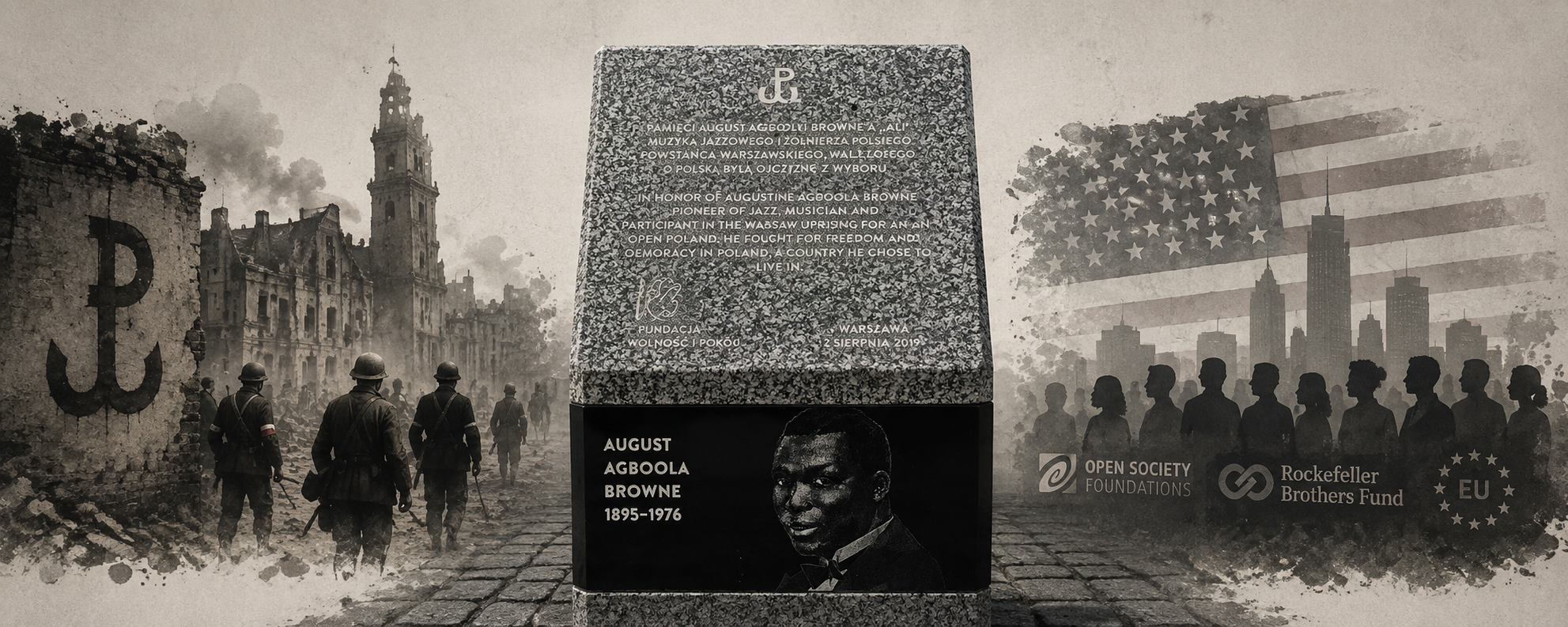
In 2019, the NGO Freedom and Peace Foundation (Fundacja Wolność i Pokój) organized and funded a stone memorial to Browne in central Warsaw. The NGO receives EU and other institutional funding but reportedly purchased the memorial with private donations. On Aug. 2, 2019, Warsaw Mayor Rafał Trzaskowski, who possesses impeccable Open Society credentials and subsequently lost the Polish presidential contests in 2020 and 2025, unveiled the memorial. The Browne saga has become an indispensable founding myth of a liberal, multicultural Poland.
In a 2017 letter to the director of the Warsaw Uprising Museum, the Freedom and Peace Foundation asserts, “In the context of current events, but also in accordance with historical truth, we intend to commemorate the figure of August Agbola O’Brown, the only black Warsaw insurgent, and to approach the authorities of the Capital City of Warsaw about installing in a public space an appropriate commemorative plaque dedicated to this black Pole … The aim of the idea is to preserve in social memory the figure of the black Insurgent-Pole.” A chapter in the 2021 Decolonizing Colonial Heritage, published by Routledge and funded by the University of Hull, includes a chapter called “Decolonizing Warsaw: The multiple afterlives of ‘Ali.’”
As a seminal moment in Polish history, the Uprising has been thoroughly studied and documented. Poles still benefit from the perspectives of the very last cadre of living insurgents. The idea that an African insurgent would escape this extensive historical analysis is doubtful. Last year, an additional document from 1965 surfaced in British state archives. In it, Browne, who had returned to Britain in 1958 and again sought state compensation, claimed to have been imprisoned in the Treblinka extermination camp from May 1940 to October 1944, before being transferred to smaller concentration camps and then gaining Soviet liberation in April 1945. This timeline would have precluded his participation in the Uprising and would have been impossible, as Treblinka opened in 1942.
Thus, prolongation of the Browne narrative requires accepting the 1949 Polish survey at face value, while categorically dismissing the 1965 British application and general lack of historical evidence. The available sources more plausibly suggest Browne was an adventurer and profiteer, rather than the post-national hero the Warsaw professional-managerial class craves.
Many are still prepared to make this mental leap. Nigerians living in Poland first publicly commemorated Browne at an event in 2022, with members of Poland’s Ministry of Foreign Affairs present. This month, the Embassy of Poland in Nigeria announced, “On 1st August 2026, Embassy of Poland in Abuja joined Nigerian Diaspora and Polish representatives to commemorate August Agboola ‘Ali’ Browne, Nigerian citizen who joined Warsaw Uprising in 1944 to fight occupation and terror of Nazi Germans in Poland during World War II.” Nigerian groups have repeatedly thanked the Freedom and Peace Foundation for promoting this historical anecdote, though doubts about its veracity mount.
Read more The Problem With Flock
It is part of a wider trend. The NGO apparatus familiar in the West is metastasizing in Poland. For example, the newly registered Black Justice Poland Foundation counts among its objectives “supporting the process of settling in Poland.” Its website describes “a Black-led foundation advancing the rights, dignity, and wellbeing of Black, African, and Afro-descendant communities in Poland.” The organization’s documented funders include the Rockefeller Brothers Fund and FemFund (The Feminist Fund in Poland), which in turn receives money from sources like the Open Society Foundations. (RELATED: ‘Africa Days’ in Eastern Poland)
A 2025 exhibit at Warsaw’s State Ethnographic Museum entitled “Whitewashing” (Wybielanie) aimed to reject Poland’s “colonial innocence” and examine how Poles in Africa “reproduced the colonial gaze.” Such a “colonial gaze” would only have been possible during the two interwar decades of the 20th century, and it would have been limited to some eccentric dreamers; nonetheless, like Browne, the “colonial gaze” is an indispensable element of the founding myth concocted in American activist circles.
Western Europe has already been contending with this imported cultural phenomenon. In his 2014 book The Suicide of France, recently translated into English, Éric Zemmour writes, “America, through its films, TV series, books, banks, NGOs, and even the extraterritoriality of its laws — in short, everything that was referred to as its ‘soft power’ — had constantly influenced (some said contaminated or polluted) the minds of old Europe.” He laments that “the French tradition was bound to be reworked, redrawn, and rewoven on the fabric imported from America.” (RELATED: The West Is a Superior Civilization (And I Don’t Care If That Offends You))
In his 2025 book Vandalising Ireland, Dr. Eoin Lenihan writes that Ireland “is importing a radical race idea from an American context and trying to force it into an Irish context where it simply doesn’t work.” Free-thinking Icelanders roll their eyes at the idea of “white privilege” in their secluded island nation. Germans have grappled with the effects of American military occupation and cultural diffusion for eight decades. (RELATED: The Extinction of Icelanders)
Yet, the betrayal of Tehran/Yalta and four-plus decades of communism are supposed to offer this silver (or is it gold?) lining: late to the rat race of liberalism and poorer than its Western European neighbors, Poland does not have the equivalent of Rosengård, Seine-Saint-Denis, or Tower Hamlets in its cities. For seemingly no good reason, and certainly not with the consensus of the Polish people, this is changing.
“So, what will happen now to [Browne’s] monument and commemorative plaques?” asks Kacper Kita, an analyst at the Warsaw Institute, in a recent piece. If Western Europe offers any indication, they will only grow in official importance.
READ MORE from Michael O’Shea:
‘Africa Days’ in Eastern Poland
Towards the ‘Triumph of Free Trade’
The Extinction of Icelanders
Michael O’Shea is an American-Polish writer and translator. He is a former visiting fellow at the Danube Institute in Budapest.
Read more TDS Victims
About the Author