If I were to watch one of those award shows, as often as not I would be required to listen to the winners of an Oscar or a Tony lecture me about something, usually a moral value that they embrace, and that they believe society has overlooked. But they, the fabulously quaffed, with special award in-hand, proceed to give the world the benefit of their important insights and reflections on morality, justice, and law. We’re told with scolding emphasis by the annointed ones that ours is “stolen land.” We have paid the mortgage every month for years and yet I am told that my Connecticut split level is not really mine. I’m living on stolen land … yes, stolen!
Read more Conservatives Should Begin Eating Woke Culture for Breakfast
In Connecticut, the Algonquian-speaking tribes shared linguistic and cultural connections and engaged in trade and commerce, but there were constant battles over land. There were issues of hegemony where Pequots battled with the Narragansett tribes for control in the southeastern part of our state near or beyond the current border with Rhode Island. Other boundaries were in dispute, resulting in armed bloody conflicts. While there may have been land occupation “rules” among the various tribes, the more powerful tribes succeeded. The Pequots pursued their goal of hegemony in their area while Narragansetts and Mohegans resisted. Occupation of land as of “right” was backed by the ability to defend that right.
Even where it was not armed conflict over boundaries, it would not be uncommon for the Pequots to demand a tribute from the Narragansetts. Or perhaps it is the Mohegans demanding tribute of the Pequots. The “tribute” of course is in the nature of protection money to avoid a bloody conquest. Again, it is clear that rules governing the rightful occupation of land were less effectual than the might of one tribe who aspired to expand its reach and authority.
Over centuries we substituted law for the cudgel — deeds and recorded titles, statutes of limitation, adverse possession, due process, and constitutional protection of property.
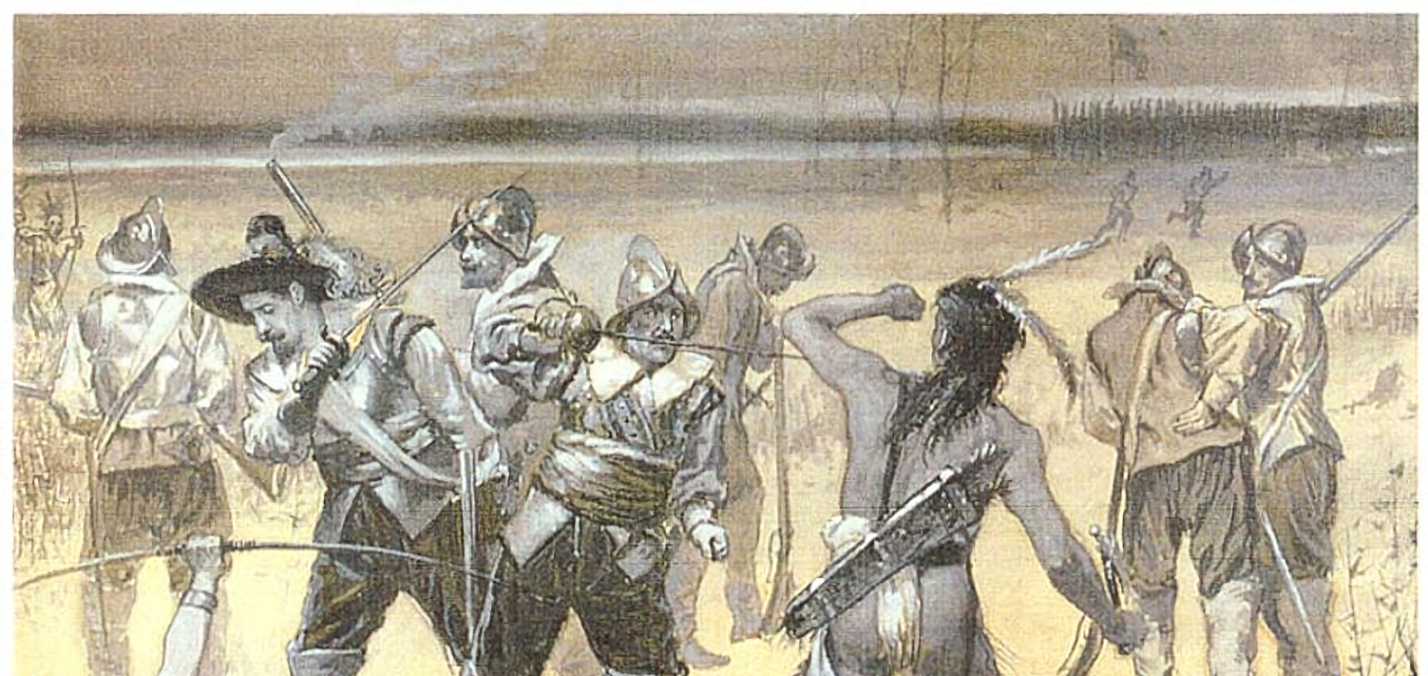
The issue of land title becomes even more muddled with the beginning of the Pequot War in the mid-17th century. The Pequots were engaged in trade with the English but abandoned that arrangement and commenced a commercial relationship with the Dutch. The Connecticut Colony declared a war on the Pequots. What followed over the next 10 years was a combination of alliances which involved Mohegans and Narragansetts joining with their English allies against the Pequots. Regrettably the Pequots were ultimately annihilated and those that survived were enslaved by the British and the Mohegans.
How many such transfers of land have occurred in North America, indeed, throughout the world across many centuries one struggles to imagine. How many layers of history should we peel back to identify the true “owner” of land? In 1066 the Normans led by William the Conquer invaded England and … they conquered. No one has ever made the argument on behalf of Anglo-Saxons that the Normans should give it all back!
I’m reminded of a story concerning the famous trial lawyer of the late 19th century and early 20th century, Clarence Darrow. A person charged with an armed robbery sought him out as his attorney and Darrow agreed to represent him upon the payment of a retainer of $700 dollars. The defendant reported that he didn’t have the money but said, “I can get it” in a few days. Darrow responded that he would have to decline the case because he couldn’t accept a fee paid with money that was stolen “so recently.”
There is in Darrow’s ironic and cryptic response a kernel of truth to which we must admit. The passage of time is important. Systems of law that were not connected at their inception have independently recognized the principle which we often express simply as “the statute of limitations” and the statutes relating to adverse possession. The Justinian codes and the English common law are perfect examples.
The reasoning supporting these rules of repose reflects the common understanding that as time passes memories fade, historical records are lost or obscured and as importantly, the sensitivity to a perceived injustice is muted. The concept of adverse possession is founded upon a simple principle: One who sleeps on his rights loses them. In our daily lives it seems we are more accepting of the fellow who has been a man of wealth for many decades even if we suspect a shady past, while the conniving scammer apprehended red handed is “perp-walked” for television cameras as we all applaud the due process of law.
Read more The Iran War: Trump Must Choose Between Victory and Defeat
In the opening scenes of Kubrick’s 2001, A Space Odyssey one of the apes realizes that holding a bone as a cudgel increases his power so that he and his mates are able to capture the waterhole from the occupiers who denied them access. The more powerful dominated over the less powerful until the less powerful changed that balance of power by picking up a bone. No one would seriously argue that the scene is meant to demonstrate some nuanced moral code. No, indeed, it artfully describes in its simplest terms, power affirming possession.
But I want to go back to the lecturing hairdo: How much (or how little) thinking has been done prior to commencement of this lecture about property rights one can only imagine. I suppose I feel as Darrow did about the fee that was to be paid to him. Even if one admits arguendo, that land was stolen it was so long ago and that really matters. However, there’s something even more compelling in my mind than the question of the passage of time affirming that which is perceived as a wrongful taking. The first question has to be: Was the shift in property rights a wrongdoing in the first instance?
So, what happened in North America? A new “tribe” appeared in a society that had always been dominated by one or another of the Algonquians. This new European tribe was different in so many ways. They were different in skin color; they were not as dark. They spoke in a language not familiar to the Algonquians. But most importantly, they had things that were unimaginable to any of these Native Americans; they had fine metals, firearms, and gunpowder to name just a few. And they possessed skills and abilities that the current occupants of the continent did not.
There is ample evidence of peaceful coexistence among some of the Connecticut tribes and this new tribe, however battles between settlers and the various tribes are reported and there is ample evidence of inhumanity as history unfolds, particularly in connection with the Pequot War. It is shocking to the modern mind but probably less so to those contemporaries. There is always a problem with distortion when one exports morality from one century to several centuries past. That is not to say that the wholesale slaughter of indigenous peoples in Connecticut (and in Massachusetts, New York and Pennsylvania) is acceptable to every 18th century European American. The slaughter of one group of people by another is not to be seen as acceptable in any period of history. However, it is also true that where one perceives his life to be imperiled one sees little that he does in his defense of life as excessive. The conflicts of the European tribe and the other tribes were within that pattern of conflicts that predated the appearance of the new tribe. If in the end, the mightier prevailed victory doesn’t convert what went before as virtue, but it was and still is an immutable reality.
There’s another large problem with this idea of stolen land. Let’s go back to those carefully quaffed lecturers one more time. They never tell us which of the tribes should be the recipient of the land that they insist should be returned. Should Stonington Connecticut be returned to the Pequots or to the Mohegans? And what of those Narragansetts; maybe they’d like to try their hand at the casino business. Throughout the state, tribal occupation of land shifted over time from one tribe to another until, finally, the most able to exert the force necessary prevailed. To the talking hairdo there is little merit in this outcome where the group prevailing is European. Little concern for land titles is evident when one Native American tribe conquers another, but when the prevailing tribe is light skinned and European, the land becomes “stolen.”
The only difference that is important, it seems, is the one based on race and culture. Somehow, that racist notion is repackaged into a virtue and used to lecture the rest of us. The real ire here is because their value judgement isn’t based upon anything virtuous at all. To put it more bluntly, it is the kind of thing that Martin Luther King Jr. gave his life to wipe out.
In the end, a Connecticut property owner may not feel good about finding some remote historical origin for his property rights in the hand of a bone-wielding ape. Perhaps that is where possession began. But it is not where property rights ended. Over centuries we substituted law for the cudgel — deeds and recorded titles, statutes of limitation, adverse possession, due process, and constitutional protection of property. The legitimacy of my title does not depend upon proving that no injustice occurred somewhere in the centuries before I acquired it. It rests upon a legal order that long ago decided that ownership must eventually become settled, or ownership can have no meaning at all.
READ MORE:
The DEI Business Case Is Falling Apart
James Burnham Meets the Woke Editor
Dem Dilemma: Far-Left Can’t Tolerate Winning Language
Peter E Ricciardi was born in 1944 in Conn where he practiced real estate law for more than 50 years.
Read more The Demonic Possession of Liberal Women
About the Author