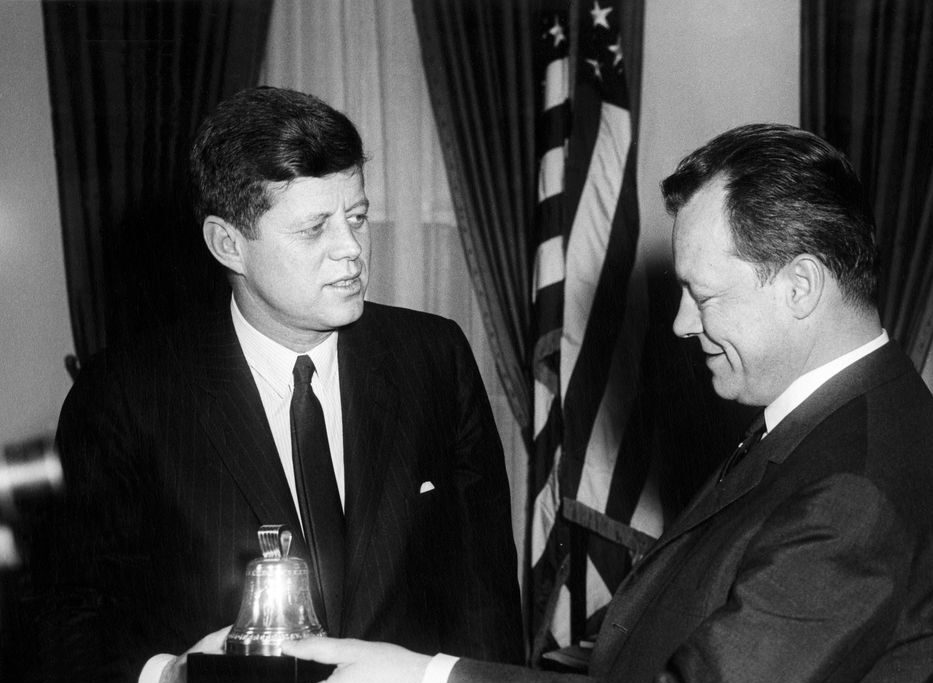
August 13, 1961, was another date that will live in infamy. That day, East German forces began constructing the Berlin Wall, erecting a physical barrier between the Soviet empire in Europe and the free world. The American president, John F. Kennedy, viewed it as a fait accompli that he was powerless to stop without risking a military confrontation with the Soviet Union. It was not Kennedy’s finest hour. His inaction over Berlin merely reinforced the increasingly accepted view that Kennedy was out of his depth as president. He had earlier botched the Bay of Pigs invasion, and at the Vienna Summit with Soviet leader Nikita Khrushchev he had exhibited naivete and inexperience.
Read more Thanksgiving Saved Again — Francesca Hong Lost
The Soviets considered Kennedy a “lightweight, a product of American privilege who lacked the experience required for leadership.”
The best book on the Berlin crisis of 1961 is Frederick Kempe’s Berlin 1861: Kennedy, Khrushchev and the Most Dangerous Place on Earth (2011). During the 1960 presidential election, Kempe writes, the Soviets wanted Kennedy to defeat then-Vice President Richard Nixon. The Soviets considered Kennedy a “lightweight, a product of American privilege who lacked the experience required for leadership.” They were not alone in that view. Konrad Adenauer, West Germany’s Chancellor, thought that Kennedy had a “dangerously flawed character and insufficient backbone.” Dean Acheson, who served as Secretary of State in the Truman administration, referred to JFK as an inexperienced “gifted young amateur.” President Eisenhower worried about Kennedy’s youth and inexperience. (RELATED: Conservatives and the Myth of JFK)
At Vienna, two months before the Berlin crisis, Khrushchev told his interpreter that Kennedy was “very inexperienced, even immature.” Kempe notes that when American officials saw the transcripts of the exchanges between the two leaders at Vienna, they were shocked that Kennedy had implied that the division of Europe was “acceptable and permanent,” despite the fact that the Potsdam Agreement had guaranteed unrestricted movement in all of Berlin, and that the Soviets’ previous effort to blockade Berlin in 1948-49 had ended with a reaffirmation of that agreement after the success of the Berlin airlift.
The motive for erecting the Berlin Wall, Kempe noted, was to stem the flow of East Germans who had been fleeing this outpost of the Soviet-communist empire since 1945. The survival of the Soviets’ satellite empire was at stake. There had been uprisings within the empire in the 1950s — East Germany in 1953, and Poland and Hungary in 1956. The erection of the Berlin Wall — which would eventually reach 96 miles in length — led to the construction of fortifications along a 4,350-mile border designed to prevent citizens of the satellite nations from fleeing communist rule. It was the physical manifestation of what Winston Churchill famously called the “iron curtain” in his memorable speech at Westminster College in Fulton, Missouri in 1946.
Read more The Electoral Integrity Issue Isn’t Israel — It’s Islam
Kennedy, too, understood that the erection of the Berlin Wall was designed to deter and defeat any internal rebellion within the empire in Eastern-Central Europe. Kempe notes that Kennedy in early August told Walt Rostow that “Khrushchev is losing East Germany. He cannot let that happen. If East Germany goes, so will Poland and all of Eastern Europe.” Kennedy even suggested that Khrushchev might build a wall.
But instead of asserting U.S. rights under the Potsdam Agreement — as Truman had done during the Berlin blockade — Kennedy did nothing. Kennedy believed, Kempe writes, that the wall would lead to an easing of tensions. It did no such thing. In fact, Kempe writes, Kennedy’s lack of a response emboldened Khrushchev to decide a few months later to send Soviet combat troops and nuclear missiles to Cuba, igniting the Cuban Missile Crisis in October 1962.
Kempe believes that the long-term effect of Kennedy’s inaction during the August 1961 Berlin crisis was to halt the unraveling of Soviet control over East Germany and the other enslaved nations of East-Central Europe. Perhaps, Kempe speculates, the Soviet empire would have fallen nearly 30 years before it actually did. (RELATED: Reagan, Gorbachev, and The Brink of War That Changed the World)
Historians love to recall JFK’s speech at the Brandenburg Gate on June 26, 1963, where he proclaimed “Ich bin ein Berliner,” but that speech should fade into oblivion when juxtaposed against President Ronald Reagan’s speech at the same location on June 12, 1987, when he told Soviet leader Mikhail Gorbachev to “open this gate” and “tear down this wall.” Kennedy’s inaction in August 1961 may have lengthened the Cold War. Reagan’s action during his two terms as president ended the Cold War.
Read more Circling Like Vultures: California Leads New Attack on Facebook
READ MORE from Francis P. Sempa:
The Hitler-Trump Comparisons Are Back, Courtesy of the National Interest
El Cid’s Ghost Haunts Spain’s Migrant Crisis
China’s Unrestricted Warfare: The CCP’s Blueprint for Victory Without Fighting
About the Author