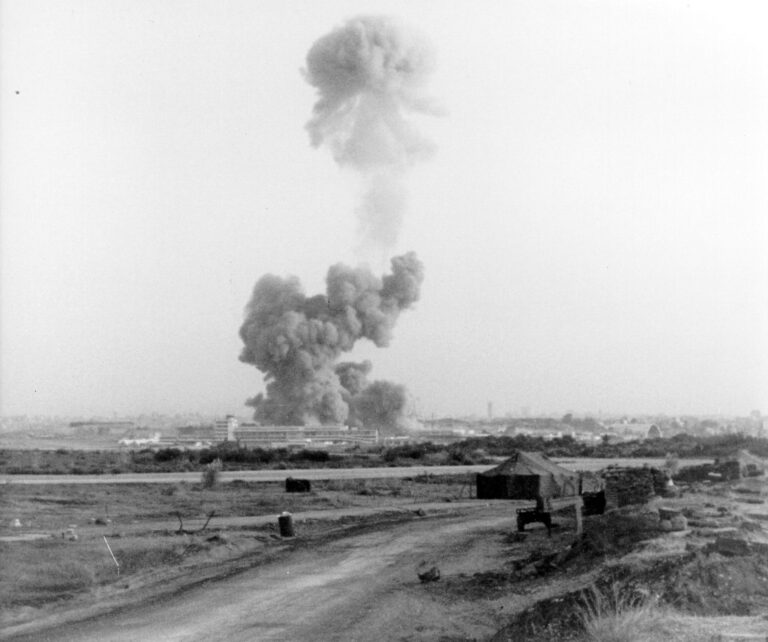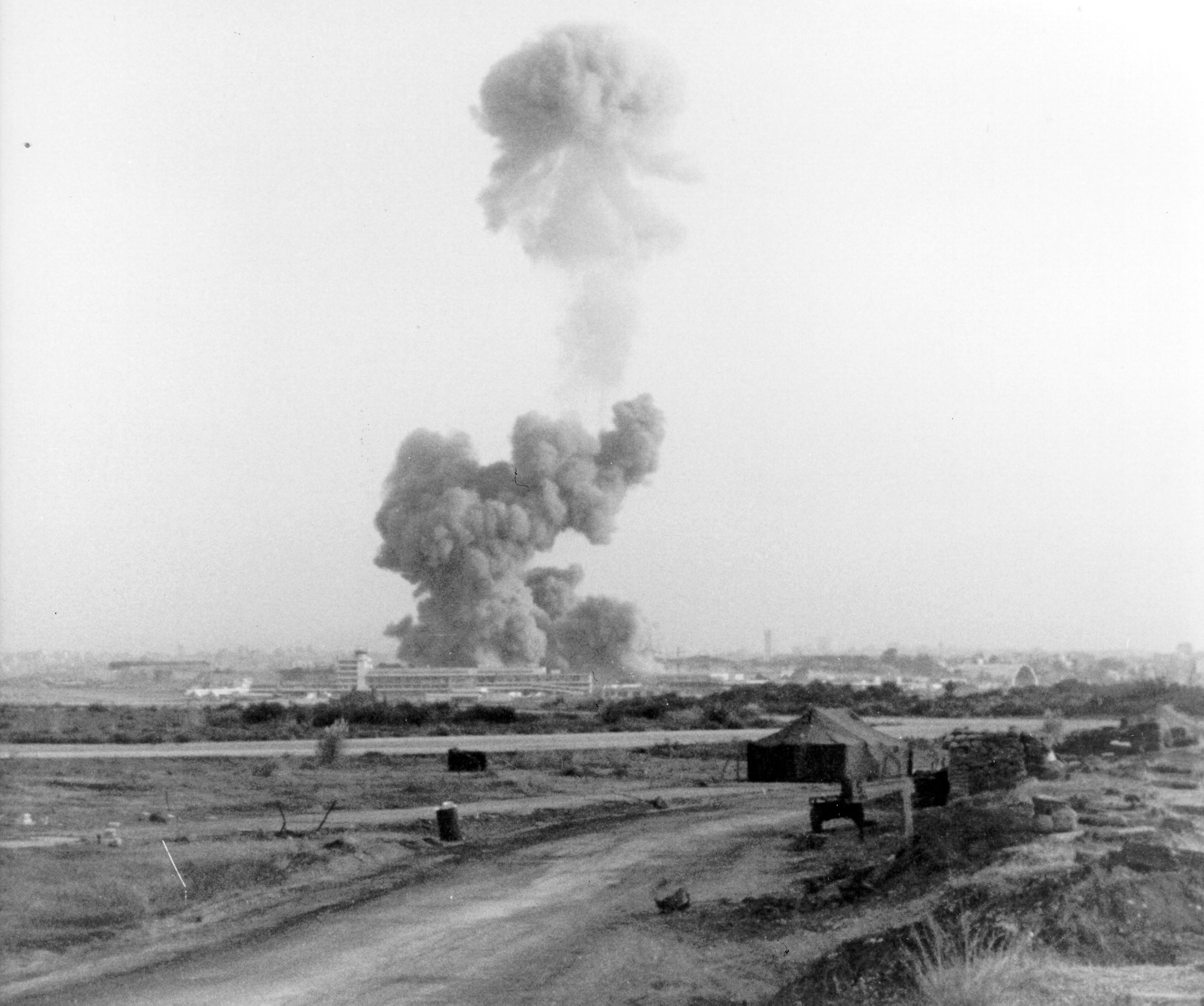
The explosion of the Marine Corps building in Beirut, Lebanon, created a large cloud of smoke that was visible from miles away.
On Oct. 23, 1983, shortly after 6:00 a.m. local time, a hijacked Mercedes stake-bed truck carrying approximately 6 tons of TNT-equivalent explosives smashed through a series of inadequate barriers and sentry posts and detonated at the building near the Beirut airport serving as the main barracks for peacekeepers from the first battalion of the 8th Marine Regiment. The four-story building collapsed on its occupants. Two hundred and forty-one American servicemen died: 220 Marines, 18 sailors, and three soldiers.
Read more Election Smorgasbord: Wedgewood’s Fake Polls, Flanagan’s Minnesota Flop, and Midterm Unrest
Not quite 10 minutes later, a second truck bomb struck some four miles away at the building housing a contingent of French paratroopers, also present as peacekeepers deployed to help bring an end to the Lebanese Civil War. This time, 58 French soldiers died in the blast.
For many days afterward, rescuers struggled valiantly to search for survivors trapped in the rubble, which proved to be largely a forlorn effort. The U.S. and French governments promised that they would honor their dead by staying the course and completing the mission and, briefly, their respective contingents were reinforced. But soon, and quietly, the withdrawal began. The U.S. would continue for a while to maintain a “rapid response force” situated on landing ships offshore, and the French conducted airstrikes.
Most dramatically, the battleship New Jersey arrived and bombarded “terrorist associated targets” in Lebanon and Syria, pounding the Bekaa Valley with hundreds of 2700 pound 16-inch shells. Eventually, the New Jersey would also be withdrawn, along with the rapid responders, to no very great long-term effect.
During the period following the bombing, the U.S. intelligence community generated significant evidence that the Iranian Revolutionary Guard Corps (IRGC) had been behind the bombings. Retaliatory strikes against Iranian targets were debated vociferously, but quietly, within the Reagan administration, but in the end no such action was taken.
The best form of remembrance … reminding ourselves that the war with Iran didn’t begin this past February 28th with the decapitation strikes on Iran’s fanatical leadership
My purpose today, however, isn’t to rehash the decisions made 40 years ago. It isn’t to re-examine the security failures that contributed to the tragedy. Nor is it to simply salute the memory of those who died on that awful morning, although, now more than ever, such a salute is well-merited. I hope that on the anniversary date itself, the Department of War will set aside time for a proper commemoration, perhaps a ceremonial reading of names by the Secretary of War. It would be appropriate if flags were lowered to half-staff in remembrance.
The best form of remembrance, however, would be something that much of the country seems determined to avoid, namely reminding ourselves that the war with Iran didn’t begin this past February 28th with the decapitation strikes on Iran’s fanatical leadership. It began in 1979 when radical Islamist fanatics seized control of a hitherto friendly and westernized Iran and turned it into a cesspool of tyranny at home and terrorism abroad. (RELATED: Ten Thoughts on Operation Epic Fury and Its Aftermath)
We might also remind ourselves of subsequent monstrosities attributable, in whole or in part, to the Iranian regime. In 1988, the U.S. frigate Samuel B. Roberts was badly damaged after striking an Iranian sea mine while on a mission to ensure right of navigation activities, specifically the escort of several tankers through the Strait of Hormuz and the Persian Gulf — something that, in retrospect, sounds very familiar.
And on Oct. 12, 2000, another anniversary just passed, a fast attack boat filled with high explosives — again, a now familiar tactic — struck the USS Cole in Yemen’s main harbor, inflicting massive damage and killing 17 U.S. sailors. Responsibility for the attack was conveniently associated with al Qaeda, but once again strong evidence pointed back to the IRGC.
Then, of course, there is the matter of 9/11. In the aftermath of the devastating World Trade Center attacks, the IRGC went to considerable lengths to efface its obvious connections to al Qaeda, and it remains unclear just what, if any, direct knowledge or inspiration can be attributed to Iran. But, unmistakably, in the years prior to 9/11 — and in spite of any purported Sunni-Shia tensions — Iran had supported al Qaeda with training and funding.
The foregoing is just a sampling drawn from the history of 47 years of Iran’s war against the West, and very particularly against the U.S. They’ve made no secret of this. Anyone who pays even the slightest attention to decades of explicit messaging from Tehran knows that the Iranian regime has been implacable in its determination to destroy both “the little Satan,” Israel, and “the great Satan,” that is, the U.S.
Read more Judge Gives Thumbs Up to Noncitizen Voting
Moreover, one can see the fingerprints of the IRGC all over the demonstrations and subversive acts that convulsed our cities and campuses in the aftermath of the Oct. 7 pogrom perpetrated by Hamas. While others — notably the Chinese-affiliated Singham network — contributed to the turmoil, Iran has clearly played an important role. (RELATED: Broadly Speaking, the Iran War Is About China)
Now, however, after suffering decades of attacks and, critically, after having reached the brink of a nuclear-armed Iran — that is, an aggressively hostile regime as untouchable as North Korea — we’re now being asked to forget all of this. I live in Virginia, subjected to relentless Democrat messaging as we approach the mid-term elections. In his re-election ads, Senator Mark Warner tells us he will “end the Iran war.” (RELATED: The Democrats’ Epic Fury Over Iran Strikes)
I leave it to others to parse just exactly how he plans to do this, but the fact remains that Warner and his fellow Democrats are now all about ending the war. There is just one obvious problem. As the Beirut bombings of 1983 should forcibly remind us, this war began a very long time ago. When we unleashed our bunker-busting bombs on Iranian nuclear sites in June of 2025 and joined Israel in smashing Iranian air defenses, or when we decapitated the theocratic dictatorship on Feb. 28 of this past year, we weren’t starting a war. (RELATED: Iran Can’t Bomb American Cities. Yet.)
I repeat — we were not starting this war. Quite the opposite. For the very first time in 47 years, we were fighting back, finally defending ourselves against a regime grown accustomed to having its own way. Instead of the pusillanimity of the Obama/Biden years, we now were waging war against our sworn enemy.
Democrats like Senator Warner insist that this is a “war of choice,” one of the most misused phrases in the lexicon of American foreign policy. Perhaps there have been past “wars of choice,” but the current war with Iran is one that Iran has chosen, not simply one time, but over and over again. If we simply walk away, as Senator Warner and his fellow Democrats seem to want, the result will not be peace, but a defeat that will outlast the current administration and its successors for years to come. (RELATED: The IRGC’s Midterm Endorsement Creates a Problem for Democrats)
Right now, the pressure of our naval blockade and our economic sanctions has the IRGC-controlled regime on the ropes. Our air and naval campaign has deprived the IRGC of its ability to conduct more than harassing actions and, in conjunction with Israel, we’ve humbled beyond recognition Iran’s Hezbollah and Hamas proxies. But if we walk away, all of this will have been for naught. (RELATED: Shipping Law at Hormuz: the US–Iran War and Rights of Passage)
Worse, a renewed and emboldened Iran, confident once again that it can endlessly leverage its proximity to the Straight of Hormuz, will rebuild its now-shattered nuclear weapons program. When that day comes, when Iran reaches the cusp of having such weapons, with the U.S. having sidelined itself, then it will fall to the Israelis to eliminate this existential threat.
Lacking our conventional bunker-busting capabilities, confronted by what will undoubtedly be a dramatically enhanced array of underground nuclear facilities, Israel will face a stark choice — use its own nuclear weapons to end the threat or accept the end to its own existence. We’ve avoided this horror story, not by wagging our finger in Jerusalem’s face and saying, “no, no, no,” but by stepping up and insisting that we will ensure that Iran will never have nuclear weapons.
And yet many Americans will vote for Senator Warner and his Democrat ilk because they can’t bear the thought of $4.56 per gallon gas prices. Or they will cast their votes for the Democratic Socialists of America because Trump makes mean tweets. One doesn’t have to like Trump or even be completely satisfied with his conduct of the current war to understand that nothing good will come from simply walking away.
Today, we mark the anniversary of the Beirut bombing. By all means, take the time to remember and reflect, to honor those who died so horrifically. But please, in your moment of reflection, remember that they were the casualties of a war we’re still fighting, a war we never wanted, a war not of choice but a war inflicted upon us. I would like to think that the dead from that day would appreciate the fact that, all these years later, we’re finally fighting back.
One might say it’s about time.
READ MORE from James H. McGee:
Learning to Read and the Crisis of Male Demoralization
The Stakes Are Too High to Sit Out the Midterms in Virginia (and Elsewhere)
Dale Rex: The ‘Incredible’ Hero of Horseshoe Woods
James H. McGee is a retired nuclear security and counter-terrorism professional. His most recent novel, The Zebras from Minsk, was featured among National Review’s favorite books in 2025. His next novel, The Cathedral of Sorrows, will directly focus on the plight of Africa’s Christians. You can find The Zebras from Minsk and his previous thriller, Letter of Reprisal, in paperback and Kindle editions at Amazon. The Cathedral of Sorrows will appear at Christmas time.
Read more Feeling Minnesota
About the Author