Welcome back to the world of Mike Holman.
If this is your first stop, here’s what you need to know: Mike Holman is the independent journalist, podcaster, and inveterate maker-of-enemies at the center of Scott McKay’s bitingly satirical thriller series — four novels (so far) chronicling one man’s habit of ending up in the middle of the very stories the rest of the media is too scared, too compromised, or too incurious to tell. Catch up on the whole series, read past episodes, and find links to every book at “The Mike Holman Novels at The American Spectator” and soon, see the video-novel version of this and the previous books at MikeHolman.com.
Read more The Spectator P.M. Ep. 238: You Probably Have (or Will Have) an AI Addiction
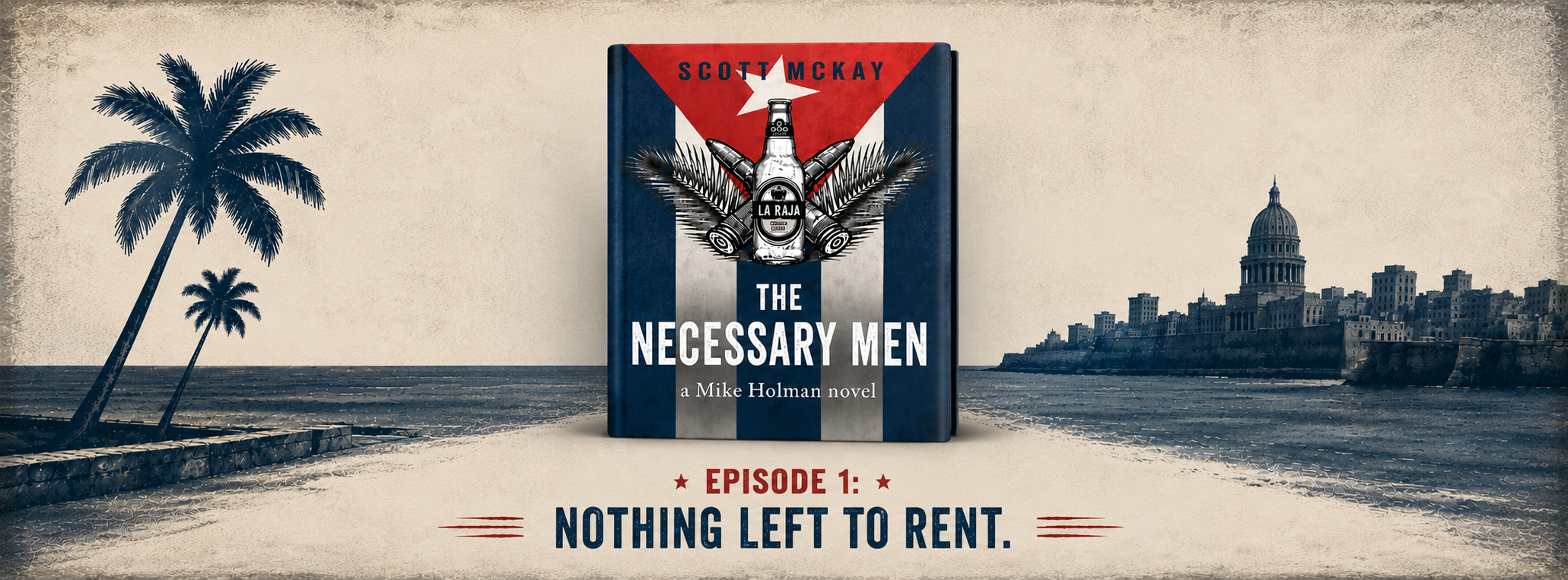
Starting this week, we’re serializing the fourth Mike Holman novel, The Necessary Men, right here at The American Spectator — new episodes dropping every Wednesday and Saturday. The full book goes on sale September 26th at Amazon and the new MikeHolman.com site, and you can pre-order a signed copy right now.
Where we left off: the last time we saw Colonel Cabrillo, he’d just lost a war — and his commission in the Venezuelan Army — in the jungles of Guyana. Mike, meanwhile, is riding about as high as a retired journalist can ride, having just helped blow up half of corporate Hollywood in a string of hostile takeovers that reordered American media and culture in real time.
Neither of them is done making history. This time, the target is Cuba.
Here’s the Prologue and Chapters One and Two of The Necessary Men.
Prologue
Havana, Cuba – February 11, 2026
“Cienfuegos,” said Cabrillo.
“Cienfuegos?” came the response. “This is madness. No. The answer must be no. Not on these terms.”
Manuel Lopez Alejandro Cabrillo, retired colonel in the Fuerzas Armadas Revolucionarias – the Revolutionary Armed Forces of the Republic of Cuba – sighed and rolled his eyes before taking a sip from the water glass in front of him.
He’d been listening for an hour to Manolo Candela, the president of the country, as he made demands of Cabrillo’s current employers. Cabrillo rejected none; the demands were absurd, ridiculous and largely petty.
Candela was very clearly to be the last president the Republic of Cuba – or at least this iteration of it – would have.
And Cabrillo’s current employers knew it. They had sent him here to negotiate with this fussy, professorial bureaucrat who had nevertheless schemed and brutalized his way to the top of Cuba’s communist government largely because both sides were desperate, and both sides knew the clock would soon run out.
And getting the best possible deal while there was still sand in the hourglass was what both sides needed.
For Candela, it was obvious: Cabrillo’s current employers were a lifeline. Not for the country, of course; there would be no positive solution for the people of Cuba. The government couldn’t keep the power on, food rations were getting tighter, the economy – including the tourist economy which Cuba had recently been banking on – was in utter collapse. There were riots in the streets often, which Candela was putting down with greater and greater brutality. The prisons were filling with dissidents while emptying of hardened criminals, and Cabrillo knew that was a sign of the end stage of a regime losing its legitimacy.
What Cuba did offer, though, was worthwhile to Cabrillo’s current employers.
Manuel Cabrillo hadn’t so much retired from his job in the FAR as acknowledged that it had gone away. He’d been stationed in Venezuela and installed in the Ejército Bolivariano, the Venezuelan army, as a field commander, as had thousands of other Cuban military and intelligence officers during the Madeira regime there. Cabrillo had led troops in battle, including in Madeira’s ill-fated war against Venezuela’s neighbor Guyana; he’d been captured on a destroyed runway in a little town called Mahdia, a few miles from Liberty Point, the city in the jungle built by the American capitalist Pierce Polk.
It wasn’t even Polk’s American mercenaries who’d captured him. That was the humiliating part. He’d been captured by Guyanese militiamen while surveying repairs to the runway. It was no particular salvation to his ego that Earl Roberts, the head of that militia, had later been elected president of Guyana.
Cabrillo’s capture had set his life off in a direction he hadn’t planned but wasn’t surprised by. He’d amassed a small fortune while in the employ of the Madeira regime, including a little freight company which did a brisk business moving cocaine from Colombia through the port of Maracaibo to Merida, Mexico on its way to the United States. It was a perquisite of his position in the Venezuelan army that his shipments were not to be checked at the border.
When the Madeira regime fell, and especially when his wife left him and cleared out the bank accounts on her way to… somewhere, Cabrillo lost everything.
But not everything. He still had contacts from the freight company. And the Colombians and Mexicans both recognized that Manuel Lopez Alejandro Cabrillo was a man of talent and drive, a man who merely needed opportunities and resources and he could achieve substantial things.
So he hired on as a security consultant for a consortium of cartels. And that soon led to a role in something like governmental relations. With certain governments.
One of which was Manolo Candela’s government, which still regarded Manuel Cabrillo as a hero.
Over the past three years, Cabrillo had connected the cartels with Candela’s regime as never before. It wouldn’t be out of place to say that Cuba had become something of a narco-state, though what was being negotiated was a grand escalation of that status.
Cuba was perfect for the cartels. Far better as a jumping-off point for shipments into the United States than Mexico, as it turned out; the reinstalled Trumbull administration had all but shut down the southern border and made drug shipments considerably harder and less profitable.
But Cuba was just 90 miles away from the southern tip of Florida. And Florida had miles and miles of coastline, much of it swampland and other uninhabited areas. And the cartels had become very, very sophisticated in the waterborne transportation of product to the American market.
In particular was the invention of the coffins.
They were submersible boats, crewed by three or four men, into which as much as ten tons of cocaine could be packed. The cartels built them in jungle shipyards throughout the Caribbean, at a price of between two and four million dollars. Often the coffins would make one, maybe two, runs and be scuttled; to the naked eye this would seem to be an exorbitant expense.
Until you calculated that ten tons of cocaine translated into as much as a hundred million dollars in revenue, and at that sum the cost of the coffins began to seem quite low.
What Cabrillo’s bosses wanted him to procure from Candela was the old Soviet submarine supply and repair facility at Cienfuegos, not far from Cabrillo’s family’s beachfront property there, so that the cartels could consolidate their boat production in a hardened facility and create an assembly line for the coffins.
They would overwhelm Trumbull’s Department of Homeland Security with vessels and fill the streets of the United States with white powder, serving two purposes – fattening the wallets of Cabrillo’s employers, and weakening the monster to the north before it could deliver the long-anticipated blows both to Cuba and the cartels everyone knew would come.
Trumbull had been back in office for almost a year and a half, and Cuba still stood against him. It was a surprise, but one that Cabrillo’s employers knew was also an opportunity with a short window.
Candela knew that, too. Which is why he was demanding not a straight fee to the government in exchange for a lease of the Cienfuegos facility but a cut of the revenue from each load delivered to Florida from Cuba, and a larger cut from the deliveries made from the coffins.
“I cannot convince my employers to make you their partner, jefe,” Cabrillo told Candela after the president had finished his fit of performative indignation. “That was not my charge. I was told to negotiate a number, a rate of regularly scheduled payments or a one-time fee, and to secure the use of the facility. I have listened to your list of requests and have not said no. Now is the time, jefe, for you to not say no.”
“Yes, but you do not understand,” said Candela. “Cienfuegos is not for sale.”
Cabrillo merely looked at the president.
“It is not for sale, Manuel,” Candela said again.
Cabrillo sighed once more.
“Jefe,” he said, “we are not buying Cienfuegos, and you are not selling it. You are renting out a hole the Russians dug forty years ago to hide things from the Americans. It is a hole full of cobwebs now. Useless. No submarine has entered that facility since you and I were little boys. If not this arrangement, what use will you make of it?”
“The Chinese will…”
“Jefe!” Cabrillo cut in, a derisive rebuke. “If the Chinese wanted Cienfuegos they would have bought it from you already. They do not. We do. Now, what I have put in front of you is a far more advantageous arrangement than you will get anywhere else. You can sell the rest of Cuba to the Chinese… if you haven’t already. But this, you will say yes to. And on the terms you have been presented. I have come bearing more than enough gifts for both the revolution… and the revolutionaries. After all, as the saying goes, La codicia rompe el saco.”
“You deride the revolution,” said Candela, in a tone Cabrillo read as defeat. “And you call yourself a communist.”
“I’m a committed communist, jefe,” Cabrillo retorted, “but even I know communism doesn’t work. So do your Chinese friends.”
Candela snorted, but Cabrillo could see that he had won.
“You need something new,” he said. “My employers are that something. And because they want this to work, I have brought you one last thing.”
“Yes?” Candela asked. “What would that be?”
Cabrillo rose from his chair and knocked on the door of the study. The large black man standing outside opened the door, nodded at Cabrillo, and motioned to another man down the hall.
And a few moments later came the girl. Cabrillo guessed she was 17. He hoped she was 17, at least. He didn’t know where she was from. Southern Europe, perhaps, or maybe the Caucasus. He could see in her pale, Slavic – maybe it was Slavic – face the desperation, or maybe it was resignation, of someone who could see, even at a tender age, that her life was not her own and would never be again.
She wouldn’t look at him as she walked past him into the room, her dress so tight it revealed everything, unsteady in the spike heels either from the sedatives she’d been given or the fear – Candela had a reputation, after all. Cabrillo judged that was for the best. He didn’t want her eyes to meet his. He did plan on sleeping that night, after all.
“Does it meet with your approval?” he asked Candela.
“Qué chica!” said the president. “You may have your Russian hole, Cabrillo. Send your men with papers. And leave us!”
Cabrillo did, exiting the villa from a side door and making for the car taking him to the hotel. It was dusk, and he could see the meager lights flickering on in the capital city across the bay.
Chapter One
Jupiter, Florida – February 19, 2026
“Hey,” she said.
And she gave me one of her looks.
I knew that look. I’d known her for a bit less than two years, and I’d been married to her for a bit more than one, but I was beginning to believe that I had mastered all of PJ’s looks.
I was hoping that wasn’t true. I couldn’t get enough of her looks. I was desperate to see more of them. And I savored each one.
This look was her I-have-something-important-to-say look. And that was fine, except as I turned to look at the clock, it said 5:45 a.m. And that wasn’t really the best time for a PJ look, least of all this one.
“Hey,” I said back happily, because I was far too deeply in love with my wife to wake up to her with anything other than a smile.
“I’ve been thinking, and I want to say this before the day starts, and things happen, and it just vanishes. OK?”
“I guess,” I said. “It’s not really dawn yet, though, and I really do want to get some sleep before that little monster in the next room makes it impossible.”
“That little monster has the same name you do,” she said.
“Yes, but he’s very loud when he decides to make himself known.”
“What I was going to say,” she said, “is that I was listening to this podcast yesterday, and I’ve been thinking about it ever since. So with women, we do, like, nonstop validation of each other. And that’s actually true. Take my friend Mary Beth. The other day she broke up with that guy Tyler…”
“They broke up? He seems like a cool guy.”
“I know. It’s stupid that she broke up with him. And yet when she told me about it, all I could say was ‘he’s not the one for you, honey. You can do better.’ I don’t even know why I said it. I don’t actually believe it. But it’s like the podcast said, female relationships are mostly about making each other feel better and not so much about making each other be better.”
“I’m going to remind you that the sun has not yet come up,” I said, “and later this morning I will be available for each and every existential discussion that might strike your fancy.”
“No, OK? I have something I’m getting to.”
I smiled weakly at her. It was a ploy of mine. But she caught me trying to roll over away from her and pulled me back.
“What I’m getting at is that on the podcast they were saying that women do a great job of validating each other, maybe too great a job of it, but we do a terrible job of validating the men in our lives.”
“We don’t have that problem,” I said.
“Are you sure? Because I can’t remember the last time I said I was proud of you.”
“I’ve never felt like you weren’t proud of me,” I said.
“But I don’t say it.”
“Instead you smile at me. All the time. And honestly, if that’s all I ever got from you for the rest of my life, it would be more than enough.”
“You came up with that before sunrise?” she said, shocked.
“Uh huh,” I said. “Can I go back to sleep now?”
“I’m not sure,” said PJ. “I kinda think I have other plans for you right now.”
“Oh,” I said. “Well, OK. But then can I go back to sleep?”
She did let me go back to sleep. Eventually. But PJ was awake, and she was determined to make that count. When I finally woke up an hour later, I could hear the music, and I knew she was doing the spinning thing again.
She’d turned one of the spare bedrooms into her Peloton studio. She insisted on having two of them side-by-side facing this giant-screen TV on one wall that she plugged into the bikes – setting up the illusion that you’d be riding in the Alps, or on the streets of Tokyo, or around the Australian outback. We had a subscription to some service that would stream those landscapes to the bike, and PJ was addicted.
And she’d gone old-school in her spinning studio with the stereo system. Big woofers built into the walls, treble coming from the ceilings, Bieber or Taylor Swift blasting out across the house. It only cost us like seven grand to set that stereo system up. A bargain. Totally. And I’m not complaining at all.
PJ’s spinning soundtrack never seemed to wake up Little Mike. Other things would, but PJ’s awful music didn’t bother him. So she was perfectly fine pushing those pedals and pretending to be biking around the Kalahari or along the canals of Amsterdam.
When I’d suggested that rather than her virtual landscape tours, we might consider actually traveling, PJ wasn’t impressed.
“No thanks,” she said. “I’m good. I have a three-month-old and three dogs. Y’know, responsibilities.”
“But we have resources. Melissa says again and again that she’s happy to house-sit, and between your mom and my mom…”
“Nope,” said PJ. “I’m good.”
And she just smiled.
It struck me that my wife had found a groove. Morning Peloton madness, making breakfast, working some genealogical project for one of her friends in the neighborhood, making lunch, running errands with Little Mike on her hip or walking the dogs with the baby in a stroller, pickleball at the club, making dinner, entertaining a few of our friends in the neighborhood…
She was happy. Content. PJ wanted nothing more out of life than our little paradise in Admiral’s Cove in Jupiter, Florida, and she resisted anything changing. Fiercely.
I couldn’t blame her. I was pretty happy as well.
But unlike PJ, I was starting to get restless.
My life had changed completely over the space of three years. I’d been a pretty successful independent journalist with a website that brought in a lot of traffic but didn’t make me rich, until I’d finally relented and let my old college roommate Pierce Polk hire me to write his autobiography. Then came his hiring our company to handle his PR. And once I’d done that, I really wasn’t independent anymore; I was in the orbit of one of the five or six richest men in the world.
Which was a life I hadn’t wanted.
But honestly, if I was a sellout, what I could say was that I’d certainly not suffered for it.
My company, Holman Media, had grown exponentially even without me actively running it anymore. I’d turned my podcast over to our website editor Colby Igboizwe, who’d held my audience and then some; I would do guest appearances with Colby all the time, but I was out of that day-to-day grind. I still wrote a weekly column at the site, but it was nothing like the daily work I’d done before. But with the capital we’d raised through taking over Pierce’s PR, and the fat profit my autobiography of one of the world’s greatest capitalists – Pierce had no less than six Fortune 500 companies that he owned more or less lock, stock and barrel – had brought in made me my first million.
I’d made many more than that over the last couple of years.
And that morning I had to talk about it.
It was a podcast interview with a kid named Terry Hadenroth, a YouTuber who’d become a big deal in the aftermath of the revolution in mass media we’d managed to engineer over the past year. Hadenroth’s folks were both in show business – his mom was a costume designer, and his dad had a bunch of executive producer credits, but not of any giant hit movies – and he’d gained a bunch of notoriety for doing reviews that had lots of inside scoop about what had gone on in the making of the movies and TV shows he was reviewing.
PJ blew into the bedroom after her Peloton ride – she said it was down St. Charles Avenue in New Orleans and then into the French Quarter, and she wasn’t all that happy when I noted that there’s a chunk of New Orleans between St. Charles Avenue and the French Quarter and asked her if she got to see that part – and told me I’d better get cleaned up or I’d be late for the interview.
That was another thing PJ liked doing. Melissa was my assistant. PJ did some of her job for free. I think it was her way of ruling our household.
I didn’t mind. She did a good job of it. And she generally stayed out of my home office, which I know was a sacrifice for her because she absolutely loved the couch in there. It was one of those giant overstuffed leather couches like you get at Restoration Hardware, but it wasn’t from Restoration Hardware. It was from some company in England, and she had it in the house Pierce had rented for her in London when I was in Belmarsh Prison, and she was keeping vigil for me.
That’s a whole other story, obviously.
Anyway, my office was my office. So much so that PJ bought me a vacuum cleaner just for the office, stashed it in a closet, and told me it was my responsibility to keep the place clean.
So if she was a domestic monarch, she was at least beneficent about it. In particular, PJ was becoming a heck of a good cook. And I had Little Mike sitting on the island counter in the kitchen making googly eyes at me while I was annihilating the Belgian waffle PJ made, when…
“You probably ought to let me put him in his crib,” she said. “He’s going to start crawling around and fall off.”
“Dearest PJ,” I said, “you can leave off with the helicopter mommying. My man here is going to exercise very good judgment and stay right where he is. Besides, my breakfast is fascinating. Isn’t that right, Little Mike?”
Little Mike just gave me a cute laugh. So, having put down the final bite of that waffle, I stood up and grabbed the kid and held him up to my face.
“How’s it goin’, little buddy?” I said.
Then I got my answer.
“Umm, PJ?” I said.
“What?”
“He’s, uhhh, leaking. And I have that interview…”
“Here,” she said, laughing. “Give him to me.”
And she went in one direction and I, very happily, went in the other.
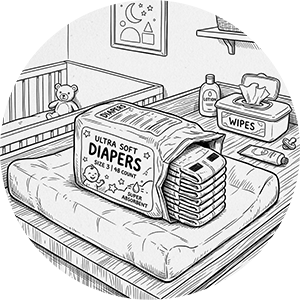
Be like the Holmans and ensure your nursery is always stocked and organized with these ultra-soft diapers. A perfect essential for every baby’s daily routine!
Hadenroth was a good sport about my demand. I’d big-boyed him pretty severely, saying that my schedule would only allow for a 90-minute block from 8:00-9:30 a.m. my time, which forced him to be up and ready at five in the morning L.A. time with his people. Grant Paxton, who ran Surge Vision Entertainment under the Blockbusters umbrella – Blockbusters was the streaming-based media conglomerate we had built, which had upended and reordered most of American media culture – had begged me to be nice to the kid, and I’d promised I would. He yelled at me for jacking Hadenroth around, though he was laughing when he did it.
I was hoping Hadenroth would just cancel.
I was lying through my teeth about being swamped. That afternoon I was playing golf at the Admiral’s Cove Golf Club with Stan Lynch, the 56-year-old retired hedge fund titan who was a board member of the Polk Global Freedom Initiative, of which I was the president. It wasn’t one of those golf-course business meetings. It was a beer-golf session that would finish up in the men’s grill with one or two too many of those Myers Rum-and-orange-juice-with-a-dash-of-the-bitters cocktails Stan swore by, and then I’d catch a ride back to the house on a golf cart from one of the kids working at the bag shack so PJ wouldn’t yell at me for driving home.
But Hadenroth didn’t know that.
“Hey,” he said, “I’d do this interview any time, any place. Seriously, it’s an honor. You’re… well, you’re a legend.”
“Oh? Damn.”
“You’re to podcasting what Limbaugh was to radio, Mike.” He spent another couple of minutes in that vein before getting to it.
“You do realize you’re mostly hated out here in Southern California,” he said.
“Mostly, yeah. Adam Carolla is a fan, though.”
“What’s your response to the people who say that you’ve wrecked the film industry and cut it loose from its home in Hollywood?”
“Gosh, I’ve never heard that complaint before,” I snarked. “What I’d say is that we didn’t kill it — it was dead when we got there. There are actually more film projects going on in SoCal this year than there were last year. They’re smaller, because technology has advanced to where you don’t need $200 million and three years to get an epic look. More projects, better quality, more democratized. Anybody with a good idea can find an audience now.”
“The Westerns are back,” said Terry, “but they’re starring Gary Cooper and John Wayne, and those guys have been dead for half a century. AI John Wayne seems like he’s displacing actors who’ve actually been practicing their craft.”
“Oh, I know,” I said. “I saw your interview with Mark Ruffalo. But I don’t know what he’s complaining about. Who would cast Mark Ruffalo in a Western? Come on.”
“I think he might take issue with that,” said Hadenroth.
“Well, it’s not like he’d say anything about me that he hasn’t already said.”
Hadenroth laughed. “Fair enough,” he said.
“Look,” I continued, “AI John Wayne doesn’t go on a podcast and say something stupid that costs the studio $200 million in lost box office like Alan Ritchson does every time he gets cast in something. Surge Vision had John Candy play Ignatius J. Reilly in A Confederacy of Dunces — a role Candy always wanted — and his family loved it, audiences loved it, thirty million streams in a month on a five-million-dollar production. For somebody who’s very sick of overpaid lunatics from Jane Fonda to Rachel Zegler to Lupita Nyong’o pretending that anybody cares what they think just because they can pretend to be somebody else in front of a camera, this is a much better world.”
“I knew it was a good idea to have you on,” said Hadenroth.
The interview went on, and then toward the end he hit me with a question I wasn’t prepared for.
“It seems like you’ve climbed this mountain,” he said. “So is this it for you? Or do you have something else up your sleeve?”
“I, ummm, well…”
“Don’t tell me I’ve stumped the great Mike Holman.”
I just shrugged.
I had nothing to say, and it pissed me off.
Three years earlier, if anybody had told me I’d be where I was, I wouldn’t have believed it. Spent two decades grinding it out in independent media and then took off like a rocket. I was getting a lifetime achievement award in an interview with a 22-year-old with a million subscribers on YouTube, and he called me a legend.
This was in an interview I thought was going to be hostile.
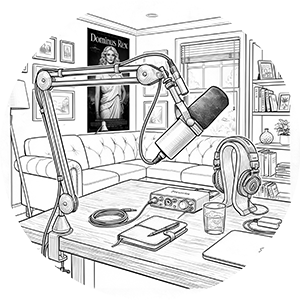
Mike’s home-office and podcast studio
And I was… bored?
I wouldn’t let myself admit that. To even think it utterly reeked of ingratitude.
After all, I’d gone from broke and single, to being on the front lines of that war between Venezuela and Guyana, as Pierce and his Sentinel Security private army fought off the communists to protect his jungle Shangri-La, to married, and then to prison in Britain for the crime of doing a podcast interview the Stormer government didn’t like, and then to revolutionary media mogul status. Who could take a ride like that and not think it was nirvana?
I loved my life.
But I also hadn’t written a book since Pierce’s autobiography. And my current, allegedly, creative project – a screenplay for a very unflattering biopic of Barry Omobba, the former president who all but wrecked the country on a host of fronts – was just languishing.
I was too comfortable to summon up the indignation it took to finish it. Much less to put the folks at Belmarsh Entertainment, one of the two Blockbusters film studios, to work crafting the AI imagery that would back it. Finding an actor willing to play Omobba in a movie trashing his legacy was, I was told, nothing short of impossible. So the whole thing would be an AI production.
Those were becoming commonplace. But I didn’t know what I was doing trying to be an AI filmmaker. I didn’t even know what I was doing trying to write a movie screenplay. And I didn’t want the Omobba thing to be a book; there had been a million books about the guy.
So I was without a project. I was almost semi-retired. And at 54, that was crazy.
The last time Stan and I had played the Admiral’s Cove course, we’d both gotten so lit up that neither of us could finish the round. It was a lot of fun, but we were embarrassed about it. The guys at the club had a good laugh at our expense over that adventure, and both of the wives had given us the scowl of disapproval. So we were adamant that there would be no drinking this time.
And instead of getting wasted, I was unloading my existential angst and ennui on Stan. Who had a problem of his own – namely, that his game had deserted him in absolutely comic fashion.
“Then let’s do something else,” he said. “When we got PGFI started, we talked about doing something big with education. What if we put a plan together to create a whole ecosystem for microschools, learning pods and homeschoolers?”
“We should,” I said. “You know anything about that stuff?”
“I do not,” he said, as he shanked his approach on 14 and looked askance at his nine-iron. “This stick is an absolute piece of shit.”
“Oh, yeah,” I said. “Definitely the club and not the guy holding it.”
“Fuck you,” he laughed. “Why don’t we gather up the team and start brainstorming? We’re loaded with cash right now, there’s momentum, and we’re already built. At this point we can basically apply a hedge fund model to pretty much any project, and we can throw ten or even eleven figures into it.”
“That’s the benefit of having Pierce at your back,” I said, as I drained my one birdie putt of the afternoon and savored the jealous look Stan gave me.
“Look,” said Stan, “you and I are two guys who’ve got the world by the balls. The one thing we aren’t allowed to do is not be grateful for it. You’ve got a little kid and the second-best wife in the world, everybody loves you…”
“Well, not everybody.”
“Everybody whose opinion you give a shit about.”
I shrugged. He wasn’t wrong.
“We can just take our time and find that next mountain to climb, and then we’ll do it right and climb the motherfucker,” he said. “Meantime, when is that John Rich movie about the bootleggers and the early days of NASCAR coming out? I can’t wait to watch that.”
“Two weeks, I think,” I said. “They ran into some problems with rights at the last minute. The lawyers are working through it.”
“Oh,” said Stan. “I forgot. You want to meet Diego Maceo?”
“La Bala?” I asked. La Bala was Maceo’s nickname. “The Hall of Fame pitcher?”
“Yeah. He’s having a big VIP charity thing at his brewery in Hialeah and Trina got us an invite. She knows Esmerelda, who’s Diego’s wife. If you and PJ want to go, it’s Saturday night.”
“Sure, why not?” I said. “I have no idea what PJ’s gonna say. She’s such a homebody it’s crazy right now, but I imagine I can drag her out for a night on the town.”
“Cool. Let’s do it. Ahhh, Goddammit!”
He’d just put his tee shot on 16 into the drink. I almost asked him if his driver was as defective as his nine iron, but I figured that would be rude.
And anyway, I didn’t get the chance, because my phone rang just then and it was Pierce.
Read more How Hamas Hijacks the Aid Pipeline
Who was calling to solve my problem for me.
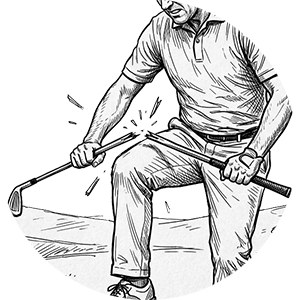
Stan’s golf game disintegrated just as Pierce called to change… everything.
Chapter Two
Jupiter, Florida, February 25, 2026
“Where are you and who are you with right now?” Pierce had said when he called.
And I told him we were on 16 at the club just as Stan hooked his three-wood into the trees.
“This is freakin’ hopeless today!” he said.
“Is it a money game?” Pierce asked me. “This is kinda important.”
“No, not at all,” I said. “In fact… hey, Stan, you want to call it a day? This is Pierce and he says it’s got some meat on it.”
“Best news all stinkin’ day,” said Stan, who was cooling off and recovering his promise to Trina that he’d stop cursing – a promise which didn’t fare overly well when his golf game went to seed like it had that day.
So we hopped in the cart and rode back to the clubhouse, Stan driving and me making small talk with Pierce, and then I got the guy on duty at the men’s grill to hook us up with one of the private rooms while Stan got us a pitcher of Yuengling and a couple of glasses.
“Least I can do after that pitiful performance today,” he said, kicking the door shut with his foot as I laid the phone down on the table and put it on speaker.
“OK,” said Pierce. “Are we ready?”
“Yeah,” I said. “Go ahead. It’s just you, me and Stan.”
“Right. Last night and this morning I had Burro down here. We did a dinner with Earl Roberts and George Abaka from Suriname, and then he left out after breakfast to hit Caracas, Bogota and Panama City.”
Mario Burro was the American Secretary of State. Earl Roberts was the president of Guyana, which was where Liberty Point was. George Abaka was the president of next-door Suriname.
“OK,” I said. “I take it he said something to you at breakfast, right?”
“He did indeed. And I’m gonna caution that this is my interpretation, because I got the strong sense that he was leading me in a certain direction without saying all the words. All right?”
“Just tell us the interpretation and then we’ll pick it apart,” said Stan, who was good at that game.
“OK, the long and short of it is I got the impression that he wants us to do a… green revolution, or a friendly invasion or something like that, in Cuba.”
“Well, that’s not much of an ask,” I snarked.
“OK, why do you have that impression, Pierce?” asked Stan.
“What he said was this – they’ve got a very full plate on foreign policy right now. They’re trying to manage the transition back to something workable in Venezuela, Colombia is a mess, so is Mexico, you still have Russia and Ukraine, China and Taiwan is still a crisis in the making… but the one thing they think has to get done is Cuba. And he thinks the domestic opposition in Cuba would be… the word he used was debilitating. Even despite the unlimited support of the Cuban exiles in Miami.”
“Two questions,” I said. “First, why is Cuba so important now, and second, why is he asking you to do something about Cuba? They could send the Marines in and finish that regime off pretty quickly.”
“First answer is pretty short: because the regime in Cuba is going down in a matter of weeks or months, and the question becomes what does it collapse into? Right now, the likely result is that it becomes a Chinese colony or a narco-state or both. It pretty much already is a narco-state.”
The DEA had just made a massive drug bust in Key Largo, where they’d run up on some Colombians who were loading 10 tons of cocaine on a semi truck from three pickup trucks in a gas station parking lot, and in the press conference after the bust, the lead agent said they were pretty sure this was another example of a submersible craft depositing a mass load of product somewhere out of the way and then the distribution network getting to work putting it on the roads. He said there was so much cocaine coming from South America and passing through Cuba that the cartels were now warehousing it in cities across America.
And he caused more than a little bit of a stir when he noted the cartels had really profited by having four years to build out their human network inside the United States thanks to the open border during the Joe Deadhorse administration.
“We’re shutting it down along the border with Mexico now,” he said, “but it’s so advanced coming by air and sea from Cuba that we’d practically have to set up roadblocks all over South Florida to even make a dent in what they’re doing.”
“But the second answer,” Pierce said, “is that there just isn’t the political bandwidth.”
“Why not?” I asked.
“Well, it sounds like they don’t have a choice but to go into Iran. They’re trying to stop them from getting nukes, and the Iranians have basically given them the finger. And once they’re in it with Iran, that’s gonna be all they do until it’s over. They have to keep a hand free to deal with whatever Russia or China will throw at them.”
“So, neocon shit,” said Stan.
“It is all connected, though,” I said. “I mean, PJ got shot saving Trumbull’s life in Guyana, and the guy who fired that bullet was an Iranian the Venezuelans brought with them.”
Stan shrugged.
“The other problem, like I said,” said Pierce, “is domestic politics.”
“Yeah,” said Stan, “because people don’t like neocon shit.”
“I’m gonna push back on that a little,” Pierce said, “because my complaint about the Bushies who had to start all those foreign adventures was that they started them in stupid places. Afghanistan should have been six weeks of bombing everything that moved until the Northern Alliance took the place over and then we’re out. Iraq was… I don’t know what that was.
“But think of this: where would we be if, at some point in the ‘90s, after the Cold War ended, we’d have gone in and run the Castros out of Cuba? What if they’d had freedom and market democracy for the last three decades?”
“I doubt seriously you’d have had to fight a war against Cubans and Venezuelans a couple of years ago,” I said.
“Exactly. Cuba’s been more than a thorn in America’s side; they’ve been an active exporter of radical revolution all over the Western hemisphere for better than 60 years, including in America, and honestly it hasn’t even stopped with not having the Soviets behind them, or more recently, Venezuela bankrolling them. They’re still at it even while they’re dead broke.”
“So you’re saying the neocons should have hit Cuba instead of Iraq.” That was Stan.
“Wouldn’t you agree?” said Pierce.
I was watching Stan, fascinated at the discussion.
“I’d rather hit nobody,” said Stan. “But if you’re saying pick one, sure. Cuba.”
“And here’s what that failure gets us. Burro said, and obviously this is a big deal for him, because his people all came from Cuba, that they’ve got a list of a whole host of political and media figures in this country who have documented ties with the Cuban regime. It’s not even a secret list or anything.”
“Oh, no,” I said. “It’s the usual suspects.”
“Your pal Gramsci-Ramos is one of the more obvious ones,” said Pierce.
I groaned and rolled my eyes.
One of the more uncomfortable moments I’d had after we’d engineered a massive stock-market coup and run hostile takeovers of all of the big media companies during Blockbusters’ big run was having to testify on what we’d done at the House Oversight Committee. The ranking Democrat on that committee was a crazy lady named Dolores Gramsci-Ramos, who represented part of Brooklyn. Gramsci-Ramos had run for president in 2020, raising an absolute shit-ton of money from “small donations” through the Democrats’ online fundraising platform, which did what looked like an intentionally horrible job of credit card security and financial reporting. She’d raised almost $300 million in strange denominations: $5.17, $8.91, $11.35 and so on. The theory, though nobody bothered to prove it, was that those numbers could be best attributable to foreign currency exchanges – a clear sign that her money was coming from overseas.
Gramsci-Ramos didn’t get the nomination. She did get further than anybody expected her to. And she was far and away the most radical leftist of the 20 candidates running that year.
And when she ran, she got out of Congress. Another wacko leftist, Naomi Yanko-Munsch, won her seat.
Then Gramsci-Ramos divorced her husband – everybody thought that guy was gay in the first place – moved to the congressional district next door, which was partly in Brooklyn and partly in Queens, and won it in 2022.
The rumor had been, and it really wasn’t a rumor anymore, that Gramsci-Ramos and Yanko-Munsch were together. They shared a house in DC as “roommates,” and the legacy media treated that as very sensible and laudatory, but when the two of them started wearing rainbow pins on their lapels and insisting on pushing the entire pride agenda from top to bottom, nobody was buying “roommates” anymore.
Anyway, Gramsci-Ramos was livid over the fact that we’d basically cornered the film and TV market under the Blockbusters umbrella, and as I was testifying at that committee she absolutely lit into me about an independent docudrama which had appeared on our platform, produced by a bunch of Cubans in Miami, that trashed Fidel Castro and his brother Raul and focused on all the money they’d stolen from Americans and Cuban exiles. The figure was something like $9 billion in 1961 dollars, which was $325 billion or so in today’s money, and it was clear the Candela regime, which was the Castro regime, really, would never be able to pay that back.
“These are lies,” she thundered at me. “You barged in and took over all these companies so that you could tell lies about the Castro brothers. You call that freedom of speech?”
“Well,” I said, “I do call it freedom of speech that people can access a film someone made and circulated on the Blockbusters platform and that they had the ability to produce it? Yes, that’s freedom.”
“But you promoted it.”
“OK, the platform has an algorithm which presents content to people based on the interests they input and the ratings they give to similar content. So I guess you could say we promoted it based on what we saw as the likelihood certain audiences would find it enjoyable or informative, sure. And it did get a 92 percent audience score at Rotten Tomatoes, so I think we did OK.”
“Again, Mr. Holman, the film was full of lies.”
“I’d say that’s more your opinion than established fact, and you’d be better off having that debate with the people who had their stuff stolen from them by the communists.”
Ohhh, she did not like that. She went absolutely ballistic, calling me every name in the book, and when the gavel came down, it was Yanko-Munsch, after what felt like one of those tag-team World Wrestling Federation handoffs, who was screaming at me. And it wasn’t even her time yet. They ended up recessing the hearing for an hour to calm things down.
And it was shocking how much support the Hyphens – everybody called them that – were getting for shilling for Cuba. So Burro telling Pierce he had a list of people who were Cuban assets wasn’t surprising at all.
“How does a shitty little country like Cuba have political influence here?” asked Stan.
“All kinds of reasons,” said Pierce. “But don’t you dare doubt that they do. Hell, the mayor of Los Angeles was in the Venceremos brigades when she was a college kid. She’s explicitly a Cuban asset, and she runs the second biggest city in the country.”
“Well, yeah, but that was college,” said Stan. “She’s not still an asset.”
“You don’t stop being a Cuban asset, Stan,” I said. “That’s like being in the Mafia.”
“Exactly right,” said Pierce.
Stan shrugged.
“OK, next steps,” Pierce was saying. “I’m gonna circle back with a plan for pushing the dirty commies out of power in Cuba, and then assuming you guys are up for this, we’ll start working on putting PGFI on this project. What say y’all?”
“Show me the plan,” I said, “but yeah. I like it.”
“Wait a minute,” said Stan. “What are we doing here? This is gonna be some Christopher Walken Dogs of War type thing?”
“Explicitly no,” said Pierce. “Ideally we’d do this without firing a shot.”
“How?” said Stan, incredulous.
“It might be as simple as just rolling up in there with food, power generation, bags of Quikrete and some agricultural equipment,” said Pierce. “Just go in and buy up the local jefes and make them let us take over town after town, and then the regime doesn’t even fall so much as it becomes irrelevant and just melts away.”
“Yeah, OK,” said Stan, clearly not buying that.
“I’m not gonna ask you to sign off yet,” said Pierce. “Let me get you something concrete so you can see more than just a vision statement. I know you’re an operations guy. But in the meantime, if it was doable to turn over the communist dictatorship of Cuba without starting a war, would you be in favor of it?”
Stan looked at me and then at the phone.
“Yeah. Sure, OK. I guess so.”

Stan’s post-golf Yuengling fix.
A couple of days later, PJ’s brother Hank stopped into town. He’d flown to Palm Beach from Austin, where he lived, and he said the next morning he was flying down to Liberty Point to see Pierce and the Sentinel Telecommunications guys.
Hank had a company that made apps. He’d started out working for his father, The Great Peter Chang, at Chang Pan-Pacific – which was a big import-export company out of San Francisco his dad had built. Hank had ejected at the perfect time; his dad had severely lost his way, and then he lost his company and his wife.
Not to mention his daughter. PJ was… estranged from The Great Peter Chang, which tends to happen when your father is involved in a plot to assassinate a presidential candidate you, as a Secret Service agent, are assigned to protect.
Yeah. It was bad.
They didn’t get Donny Trumbull, but the lunatic who managed to get just next to the stage of that basketball arena in Terre Haute and shoot him in the chest before turning the gun on “theyself” – yep, one of those – almost did. And PJ was running the Secret Service detail protecting Trumbull. They sabotaged her operation and expected her to cower while her dad used his stroke with the Deadhorse administration and particularly Pamela Farris, the vice president whose career in politics he’d bankrolled while he was banging her off and on, to bail PJ’s career out.
This did not go well with PJ, and she blew the whistle on the plot. She did it on my podcast; that’s how we met. And then Pierce, who saw the podcast and loved it, invited her to chill out down at Liberty Point, which she did, and loved it. And when I got down there just in time for the Venezuelans to invade the place, I found out that she loved me, too.
Anyway, The Great Peter Chang wasn’t done with evil things. He had something to do with Deadhorse’s people putting the Stormer government in the UK up to throwing my ass in jail for doing a podcast, and then he ended up fronting a Chinese media company which was trying to buy into the American entertainment sector that we were able to block as part of our Blockbusters victory. But The Great Peter Chang was a fish out of water going from import-export, a business he knew, to media, and he lost his financial backers a very large amount of money.
PJ and Hank stayed close. PJ stayed cordial with Kevin, the oldest brother who was trying to reconstitute his dad’s business. The other brother, George, was a submarine captain somewhere in the Atlantic; we never got to see him much.
And Mary, PJ’s mom, was separated from Peter. Probably forever. The only question was whether Mary was going to fully pull the ripcord and divorce him. She hadn’t decided. What she had decided was that she was relocating to Miami from San Francisco. Mary did international trade law; she’d caught on with a big firm downtown that had made her a senior partner. She was doing very, very well. And half the time she was in Liberty Point, because Pierce – and the Exchange of the Americas he’d built down there – was her biggest client.
Not to mention that Hal Gibson, the ex-Marine hero who was running Pierce’s security force in Liberty Point and handling all kinds of other projects for him, was Mary’s new squeeze.
I liked Mary. A lot. She showed up at the house when she could. Mary was very, very fond of Little Mike. She wasn’t unique in that regard.
Kevin was still in the Bay Area. Hank was in Austin. Peter was now in Hong Kong, trying to work some deals with his old Chinese friends and rebuild his empire. And PJ was with me.
But Hank was probably the most interesting of the Changs, and it takes a lot for me to say that given my bias toward PJ.
Hank made apps, as I said. He’d made two that were turning him very rapidly into a big-money tech bro. And in both cases, it had been his ability to work in Pierce’s orbit that catapulted him to success.
The first app was called RKtech. It was a construction app, which allowed you to design a house using an AI interface that had oodles of templates and guidelines. Which was cool enough, but through the app you could also do things like file construction permits and do other paperwork items you’ve got to do if you’re building or remodeling a house. What was also cool about RKtech was that if you dropped an address or a pin into the app, it could give you site data from the lot and help design the floor plan based on the topography, the view, where the water and sewer connections were and so on, and it would pop out AI-generated images of the inside and outside of a building you’d design with it.
Hank sold that app to Pierce, and Sentinel Construction started using it to expedite projects, and before you knew it, they were revolutionizing the construction and homebuilding industry.
Then Hank hooked up with some people who were building the mother of all AI filmmaking apps, an engine called CASTR, which, in its first iteration, would let you pick a movie, then pick actors from drop-down menus to play the characters, and it would stream the recast movie an hour later. Brad Pitt and Angelina Jolie in Casablanca? No problem. At Blockbusters we jumped on that app, had them build it out into a full-on post-production suite such that it could now make feature-length movies from a screenplay, with a few steps in between, and CASTR was the tech backbone of our media revolution.
Hank was going to be the richest one of us, except for Pierce. And he said his next project was probably the most consequential one yet.
“What is it?” I asked him as we tucked into the feast PJ had put together – a roasted chicken with new potatoes and grilled vegetables with a garlic sauce.
“We’re calling it Conduit. It’s a crypto-communications app that reopens free speech. Big freaking deal.”
“What, like Telegram?” PJ asked.
“Nnnnot really,” said Hank. “This is several levels above that.”
“Oh,” said PJ.
She was in the Secret Service, which meant she actually had some experience and technical knowledge of this stuff, but nope. Not her thing anymore.
Hank just smiled and winked at me. He knew his sister. Before I could blink, the two of them were talking about his sex life and friends back home in Frisco, and I was the third wheel.
Which was fine.
Then dinner was over, PJ kissed her brother as I cleared the table and insisted on doing the dishes, and she took the dogs for their nightly mile-and-a-half walk while Hank and I retired to the deck by the pool. I had half a case of Diego’s La Bala beer iced down in a cooler, so I brought that out there, and Hank and I relaxed by the water.
“Go on, tell me,” I said.
“So you don’t need the internet to use this app. It works on bare cellular signal — even a weak 2G signal. Governments know how to block apps. They can’t turn off their own cell towers.”
“Interesting,” I said.
“Second: the traffic is invisible,” said Hank. “To anyone monitoring a network, it looks like ordinary cellular traffic. There’s nothing to flag, nothing to identify as the app. It’s a ghost. We almost called it Ghost, but there’s a web design platform out there that already has that name.”
“Right,” I said. “So that’s…”
“Wait,” said Hank. “Third: no phone number to sign up. Telegram still ties you to a phone number. This gives you a randomly generated ID. Nothing links the account to a person.”
“OK, that’s a big deal,” I said.
“And fourth: nothing lives on a server. This is all decentralized. There’s no central system to raid or subpoena.”
“OK, but while technically this sounds like the end-all and be-all of online freedom, they’re just gonna say it’s for pedos and terrorists and arms dealers and cartel thugs. What’s the response?”
“We’ve handled all that. Three things are built in that weed out the scumbags about as best as can be done.”
“All right,” I said. “Give it to me.”
“So first, we set up a vouching system for access,” said Hank. “You can’t just download Conduit. You need an existing verified user to bring you in. Every account has a chain of accountability without revealing actual identities. If someone in your chain does something criminal, the whole branch gets flagged and shut down. It’s not foolproof, but it filters out opportunistic bad actors who can’t get a referral, because who wants to lose their account and then have to beg a friend to get back in?”
“OK, but that could hurt your growth, though.”
“Not that worried about it. We think we’ll deter most of the bad actors with that protocol. But we’re also doing hash-matching…”
“Hash-what?”
“Basically, the app can fingerprint known illegal content – CSAM databases, known terrorist material, that kind of thing – without actually reading or storing anything. The content stays encrypted end-to-end but known bad material still gets flagged.”
“That’s over my head, but I guess it sounds good,” I said.
“OK, and here’s why I’m flying down to Liberty Point in the morning. Because we’re making this thing in concert with the Sentinel Telecoms guys. It’s going to be their app. And because they co-developed the infrastructure, there’s a quiet security layer that monitors behavioral patterns without reading content.”
“So Pierce is Big Brother here,” I said.
“It’s going to be his app. He isn’t Big Brother unless you ask him to be. And his effort is that he’s throwing people off the app who do illegal shit.”
“Whose idea was this thing, Hank?”
“Mine. I pitched it to Pierce a few months ago. And honestly, it was your ordeal in the UK that inspired it. All over Europe they’re censoring people. Putting them in jail for Facebook posts. It’s such bullshit. We wanted to even the score, and you know how passionate Pierce is about this stuff. So this thing is just about ready to turn on, and when it turns on we’re going to set it loose in Germany first, then in Western Europe, then in China…”
“I know another place they need it,” I said.
“Oh, yeah. Definitely Cuba. By the way, this beer – this is Diego Maceo’s stuff? It’s pretty good.”
“Yeah. It’s not bad. Reminds me of Dos Equis a little, but it’s more of a full-bodied taste.”
“Anyway,” said Hank, “I don’t know that this app is a massive moneymaker. This is more of a world-changer. All the worst shitholes, they control the internet and stifle speech. We want to give the regular guy a middle finger they can use, whether it’s against the mullahs, the Davos assholes, some commie commissar, whatever.”
“I like it,” I said. “I don’t know if Pierce told you, but he’s got some sort of plan he’s putting together to try to change Cuba over. We’re going to see somebody next week about this operation; he didn’t say who.”
“Dude,” Hank said, and smiled before taking a big pull from his bottle of La Bala.
Refresh with the classic look and bubbly feel of Diego Maceo’s own La Bala Cerveza.
Hank left for Liberty Point the next morning. While he was in the air, I assumed Pierce called.
“Hey,” he said, “we need to put you and Stan, and I guess Trent, and whoever else you think you should bring, on a plane somewhere. Probably be three or four days, say, Wednesday to Sunday of next week.”
“And where is this somewhere?” I asked.
“Singapore,” said Pierce, as though he was talking about Charlotte or Birmingham.
“Why in the hell are we going to Singapore, Pierce?”
“All will be made known in time. Besides, you’re gonna be flying on a Gulfstream 800. If you were going to freakin’ Antarctica, you ought to be pumped to ride on that thing.”
He wasn’t wrong, but on the other hand Pierce was asking me to collect my people and fly them almost as far away as it was possible to fly them. I thought that was a little on the obnoxious side.
“And if I say fuck that, let’s meet whoever we’re going to meet somewhere else, then what?”
“Just go with it, Mike. I promise this will be worth the ride.”
I didn’t see how, but I also realized that if Pierce wanted us to go to Singapore, it was because Pierce was operating on a far higher level than I was, at least with respect to this Cuba operation. And if he said it would be worth the ride to Singapore, he was probably right.
So I told PJ.
“Hey, honey,” I said, “Pierce wants me to get on his Gulfstream 800 jet and fly to Singapore next week. Wanna come?
She smiled.
“Nope. I’m good.”
And she kissed me.
She didn’t even ask what on earth would make that destination necessary. She trusted that there was a reason I was going, and that was it.
And Stan and Trent and Melissa were like kids at a playground over the idea that we got to fly to Singapore on Pierce’s new jet.
“This is going to answer my question, I’ll bet,” said Trent.
“What’s that?” I asked him.
“How do we get in? My guess is Pierce has got us a Chinaman.”
“Trent!” said Melissa. “You can’t say Chinaman!”
“I can’t? Why not? It sounds way cooler than Chinese.”
“You’re supposed to say Asian.”
“Asian? Guy could be an Uzbek or Bengali or a Mongolian. What good is that?”
“OK,” I said, breaking up the debate over 21st-century semantics. “Pierce gave me the ‘all will be made known’ treatment when I asked, but yeah – I’m assuming we’re going there to see somebody who can get us into Cuba under some sort of friendly cover.”
“Wonder who it is,” said Stan. “There aren’t that many people with the wherewithal to pull off a thing like this, much less be Chinese and willing to work with Pierce.”
“Why meet in Singapore, anyway?” asked Trent. “Why not Hawaii?”
I shrugged.
“Because the guy is in Singapore, and you go to him,” said Stan. “That’s why.”
“Even if you’re Pierce?” asked Melissa.
“It’s not…” said Trent, with a suspicious look.
“Oh, no,” said Stan. “No way.”
“Not who?” That was me.
“Well, Simon Lim is in Singapore,” said Stan. “He would be big enough for this. But that guy is…”
“I’d be terrified to get on a plane to see that dude,” said Trent.
“Why?” I asked. “Who is Simon Lim?”
“He’s an oligarch’s oligarch. Grew up literally in the Politburo in Beijing. His dad was one of Mao’s inner circle. Simon came up in ChiCom politics and then he ended up flipping over to the business side. Electronics, energy, shipping. He built a substantial empire, a lot of it shady. At one point several years ago he ran afoul of the leadership and they put him through their six-month re-education thing, where you come out refreshed and you publicly proclaim yourself cured of all wrongthink. He did that and then he ultimately ended up in Singapore, where he owns like half the city.”
“That would make him richer than Pierce,” I said.
“Oh, no,” said Trent. “But I’d say this guy is a lot more powerful than Pierce is.”
“It doesn’t matter,” said Stan. “Lim is not our guy.”
“What makes you think he’s not?”
“Because. That cat is way, way too embedded at the top. They have him doing stuff that… you’d have to have the absolute complete trust of the regime to be anywhere near it.”
“Like what?”
“Like he’s the guy who runs the shadow fleet of those oil tankers which ship sanctioned oil to China,” said Trent. “They’re getting hundreds of millions of barrels of oil at deep discounts from places like Iran. There is no way a guy like that would help us pull Cuba out of communism.”
But on Wednesday, aboard the Gulfstream over the Atlantic, Pierce sent us a packet of information about the trip and prominently in that packet was proof that Stan and Trent were wrong.
Read more New Executive Order Announces New Federal Vaccine Guidelines
Simon Lim was our guy. And that was not what I wanted to find out.
Pierce’s Gulfstream 800 soars above the Atlantic on its way to Singapore.
Coming Saturday, August 15: Episode 2 of Scott McKay’s The Necessary Men.
About the Author